




TL;DR
- Both Netcore and clevertap help brands drive customer engagement, but they are built for different stages of growth.
- Netcore offers a unified platform with native email, SMS, WhatsApp, RCS, push, web personalization, AI recommendations, and predictive analytics, making it the best mobile app engagement platform.
- Netcore’s proprietary email infrastructure delivers 95%+ inbox placement, while AI-powered capabilities help brands improve conversions, retention, and customer lifetime value.
- If your goal is basic engagement, clevertap may suffice. If you’re looking to build an AI-driven, omnichannel customer engagement strategy, Netcore is the more future-ready choice.
For mobile-first brands, the customer engagement decision often comes down to two platforms: Netcore and clevertap. Both promise omnichannel orchestration. Both claim AI-driven personalization. Both pitch themselves as the engine behind your next phase of growth.
But under the hood, these platforms are architected for fundamentally different outcomes. clevertap was built as a mobile engagement and retention platform. Netcore was built as as a unified agentic marketing platform, designed to handle the depth, scalability, and channel ownership that enterprise brands need.
In 2025 and 2026, an increasing number of brands have moved from clevertap to Netcore: Photobook, Axis Securities, Plum, Paxel, 7-Eleven, Hungry Hub, Sekolah.mu, and CashEnable, among them. Each migration tells a story about the gap between what clevertap promises and what it delivers at scale.
This guide examines both platforms across architecture, capabilities, support quality, and real-world results, to help you decide which platform is right for your business in 2026.
Why This Comparison Matters
For brands evaluating clevertap, the experience often starts strong. Push notifications work. Basic segmentation gets you live quickly. The platform looks comprehensive on paper.
But over time, growing brands hit recurring friction:
- Poor conversions on non-push channels despite multiple consultation attempts.
- Code-heavy templates for push notifications slow execution.
- No-code nudges and walkthroughs are unavailable, forcing engineering dependency.
- Lower delivery rates on app push notifications with delays on critical messages.
- No AI recommendations, on-site personalization, or in-channel recommendations.
- No advanced triggers like merchandising triggers required for ecommerce.
- Predictive segmentation that underdelivers on actual campaign results.
- 4 additional vendors required for Email, SMS, RCS, and WhatsApp.
- No QBRs or monthly connects, with poor onboarding leading to data discrepancies.
- No ROI consultation to optimize platform usage.
These aren’t isolated complaints; they’re systemic gaps that compound over time, eroding marketing velocity and ROI.
Here’s how Netcore addresses each of them.
Netcore Strengths
Netcore’s edge over clevertap comes from architectural choices: proprietary email infrastructure, native AI recommendations across channels, deeper enterprise support, and a genuinely unified stack that eliminates vendor fragmentation. Here’s where Netcore genuinely pulls ahead:
1. Unified Full-Stack Platform
clevertap requires brands to manage 4 additional vendors beyond their core platform for Email, SMS, RCS, and WhatsApp. This creates contract complexity, data fragmentation, attribution gaps, and operational overhead.
Netcore’s Marketing Cloud delivers everything in one platform:
- Channels: Email, Web, App, SMS, RCS, Voice, WhatsApp, Social Media.
- Engagement Layer: Customer Engagement, Personalization, Product Experience, Search.
- Foundation: Unified Customer View + Analytics & AI + Services & Consultancy.
One contract. One support team. One source of truth. No vendor sprawl.
2. Email 2.0 with 95%+ Inbox Placement
clevertap relies on third-party integrations for email and cannot help with transactional emails or AMP emails in journeys. For brands where email is a revenue channel, this is a structural limitation.
Netcore owns its email infrastructure, delivering 18B+ emails per month with proactive delivery consultancy ensuring 95%+ inbox placement. The platform supports up to 30,000 TPS speed (vs clevertap’s dependency on third-party providers).
3. AI-Powered Product Discovery
clevertap cannot go beyond extremely dynamic personalization over email and basic web personalization. This leaves significant gaps in the customer journey.
Netcore delivers hyper-personalization across the entire product discovery flow:
- Enterprise site search relevance and personalization
- AI product recommendations on Home Page, PDP, PLP
- Personalized browse experiences
- Product Information Management integration
- No 0 search results (predictive search prevents dead-ends)
- Personalized boutique experiences
- Recommendations drawer for contextual upsell
- Personalized WhatsApp messages with dynamic product cards
- Understanding product performance with built-in analytics.
This is the difference between sending personalized messages and creating personalized journeys.
4. No-Code Nudges & Walkthroughs
clevertap lacks no-code nudges and walkthroughs, forcing engineering dependency for in-app personalization. Templates for push notifications remain code-heavy, slowing execution velocity.
Netcore enables marketers to:
- Build user-specific in-app experiences that convert intent
- Identify and create hyper-contextual moments within critical user paths
- Personalize app experiences by rolling out segment-specific features
- Optimize app experiences through rapid no-code A/B testing
- Build infinite segments based on behavioral data and actions
- Understand the impact of every nudge on core user metrics automatically.
6. Actionable Insights Dashboards
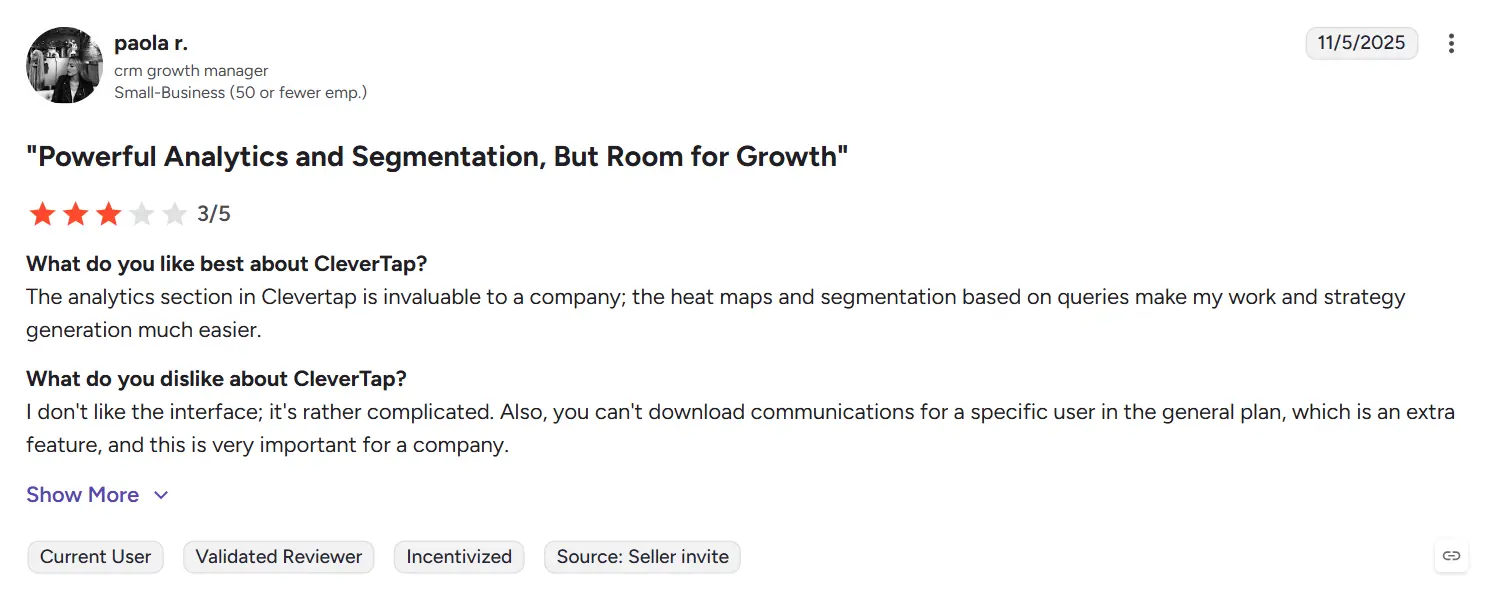
clevertap’s dashboards offer statistics but lack insights. There’s no churn prediction. There’s no AI that explains why metrics moved. Customers consistently report: “Lack of data and gap in analytics. Poor analytics capabilities.”
Netcore’s AI-powered analytics:
- Predicts customer churn with confidence-scored segments (overall, fairly likely, least likely)
- Identifies the “why” behind metric movements (e.g., “Web campaign with ID 88 dropped its contribution by 100%”)
- Tracks goals with attribution to specific user behavior
- Ties metrics back to user behavior for investigation.
7. User Path Analytics
clevertap’s Content Flows are difficult to read and action on, and only work before or after an event, not both combined. The donut-style visualization makes it hard to interpret user journey patterns.
Netcore’s User Path Analytics:
- Simple node-to-node Sankey representation for easy interpretation
- Look at user path before AND after an event combined
- Track drop-off points across complex flows
- Convert path insights directly into actionable segments
8. Advanced Segmentation Customizability
clevertap’s segmentation is limited to “users who did/did not do” you can’t easily modify segments after testing. Customers say: “Unable to edit segments. The filters need consistency in parameters.”
Netcore enables:
- Multiple engagement and attributes as parameters in AND/OR conditions
- Easy segment modification post-testing
- Drill down into individual contacts engaged
- Segment engagement information (critical missing in clevertap)
- User counts at every stage of the journey
9. Verified Higher Gartner Ratings
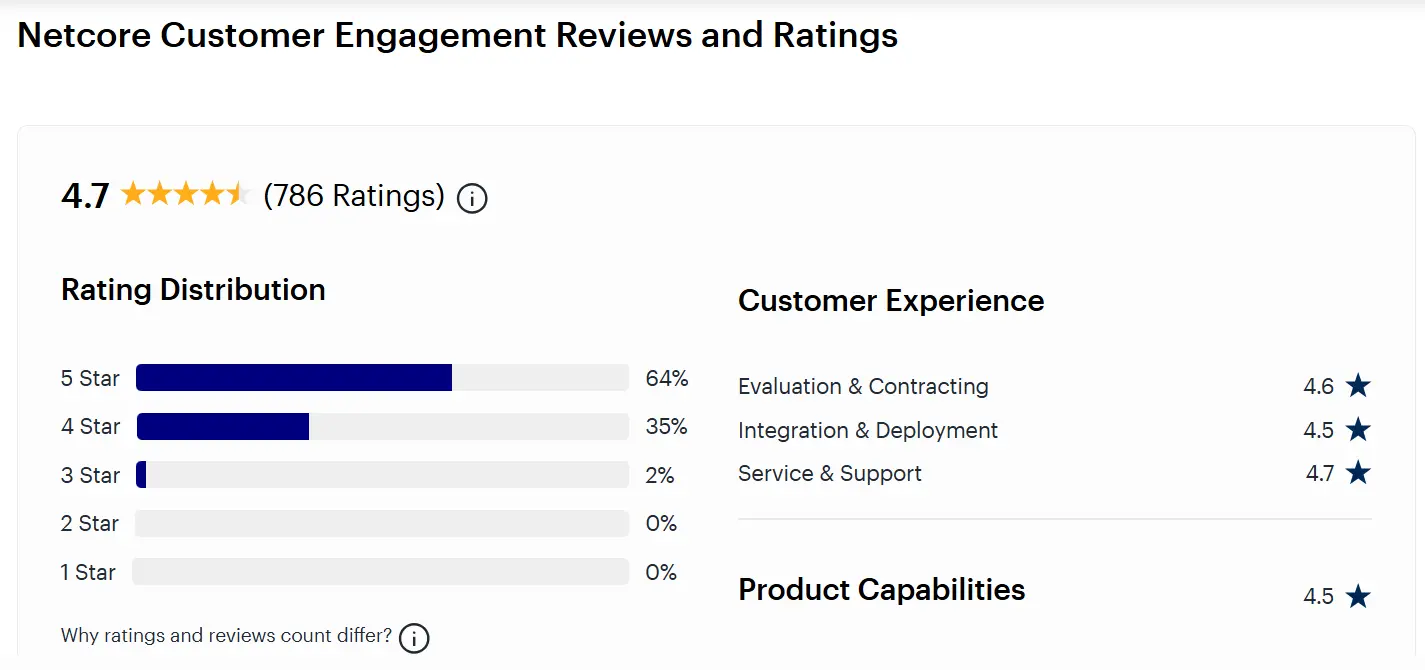
Across 786 verified Gartner reviews for Netcore vs 136 for clevertap, Netcore consistently rates higher.
10. Enterprise-Grade Support
clevertap’s customer base skews mid-market: 67 reviews from $50M-1B companies, 13 from $1B-10B, and only 1 from $10B+. Customer reviews flag “need more improvement in service and case studies” and “customer support can use some work.”
Netcore’s customer mix proves enterprise readiness: 93 reviews from $50M-1B, 26 from $1B-10B, and 20 from $10B+ companies, genuinely catering to scalability with KPI-based Customer Success Managers and quarterly business reviews.
Netcore’s Support Model:
- KPI-based consulting (not reactive ticket resolution)
- Dedicated CSM + Data Scientist per enterprise account
- QBRs (Quarterly Business Reviews) and monthly connects
- Proactive ROI consultation (clevertap: not offered)
- 25+ years of marketing expertise embedded in service
Netcore Limitations
Netcore has genuine strengths, but it also has real gaps that buyers in this comparison need to go in with eyes open about.
Where Netcore falls short:
1. Best for Brands Ready to Use the Full Stack
Netcore is designed as a unified platform across engagement, personalization, product discovery, search, and analytics. If your team plans to use Netcore only for a single channel (e.g., just app push or just email), you’ll be paying for more platform than you’ll use. Brands that maximize ROI on Netcore are those committed to consolidating multiple point solutions into one platform.
2. Ideal for Outcome-Driven Teams, Not Setup-and-Forget Operations
Netcore is built for brands that want continuous optimization tied to business KPIs. If your operating model is “set up campaigns once and let them run,” you may not extract full value from Netcore’s AI agents, predictive segmentation, and behavioral path analytics. The platform rewards active engagement with insights.
3. Requires Data Readiness for Maximum Value
Netcore’s AI and personalization capabilities scale with the quality and depth of your customer data. Teams migrating from basic event-tracking setups (like many on clevertap) may need 4–6 weeks of upfront instrumentation work to define event taxonomy properly. Netcore helps with this, but it’s not automatic.
4. Marketing Cloud Focus, Not CRM Replacement
Netcore is a customer experience and growth platform, not a CRM. If you’re evaluating Netcore as a Salesforce, HubSpot, or Zoho CRM replacement, the positioning won’t fit. Netcore integrates with your CRM but doesn’t replace it.
clevertap Strengths
clevertap has genuine areas of capability that work well for specific use cases:
1. Mobile-First Engagement
clevertap positions itself as a mobile-first platform, and its core push notification capabilities work reliably for basic use cases. For brands whose engagement strategy revolves entirely around app push notifications without deeper omnichannel needs, clevertap covers the basics.
2. Quick Time-to-First-Campaign
clevertap’s onboarding allows mobile teams to ship basic push notification campaigns relatively quickly. For lean teams that just need a tool to send notifications, the initial setup is manageable.
3. Established Mobile App Analytics
clevertap offers solid mobile app analytics for tracking user behavior, basic funnel analysis, and core engagement metrics. Teams focused primarily on understanding app user behavior find value in the analytics layer.
4. Rule and Content Personalization (Basic Use Cases)
clevertap supports rule-based content personalization and dynamic product messaging for straightforward use cases. For brands with simple personalization needs (especially in email and basic web contexts), the capabilities are sufficient.
clevertap Limitations
Based on verified Gartner reviews, customer testimonials, and direct migration stories from brands like Photobook, Axis Securities, Plum, Paxel, 7-Eleven, Hungry Hub, Sekolah.mu, and CashEnable:
1. Vendor Fragmentation (4+ Additional Vendors Required)
clevertap brands consistently report needing 4 additional vendors for Email, SMS, RCS, and WhatsApp—creating contract complexity, data silos, attribution gaps, and inflated operational costs.
2. Code-Heavy Templates for Push Notifications
Push notification templates require code-heavy configuration, slowing campaign execution and creating dependency on technical resources. This contradicts the no-code marketer-first positioning expected from modern engagement platforms.
3. No No-Code Nudges or Walkthroughs
Critical in-app personalization capabilities like contextual nudges and feature walkthroughs require engineering resources—not marketer-controlled. This is a significant gap for product-led growth and adoption strategies.
4. Lower Push Delivery + Delayed Critical Notifications
Multiple customers report lower app push notification delivery rates and delays on time-sensitive notifications. For transactional, deals, or urgency-based communication, this directly impacts conversion.
5. Missing AI Recommendations & On-Site Personalization
clevertap cannot deliver:
- AI product recommendations across Home Page, PDP, PLP
- Enterprise site search relevance and personalization
- Personalized browse experiences
- Understanding product performance
- Personalized WhatsApp messages with dynamic product cards
- PIM integration
This is a fundamental gap for e-commerce, retail, and D2C brands.
6. Missing Advanced Triggers (Merchandising, Behavioral)
Advanced triggers like merchandising triggers, dynamic catalog updates, and complex behavioral cascades are unavailable—limiting campaign sophistication for e-commerce brands.
7. Email Gaps: No Native Support, No Transactional, No AMP
clevertap email capabilities require third-party integration, cannot help with transactional emails, and cannot include AMP emails in journeys. For brands where email drives revenue, this forces additional vendor management.
8. Segmentation Limitations
clevertap’s segmentation suffers from:
- No Segment engagement information displayed
- No User Count at the segment level
- No drill-down into individual contacts engaged
- Inability to cross-check sanctity of data/engagement
- Limited segment creation flexibility (only “did/did not do” filters)
- Cannot edit segments easily after creation
- Inconsistent filter parameters
Customer quote: “Unable to edit segments, the filters need consistency in parameters.”
9. Dashboard & Analytics Gaps
Multiple customers report:
- “Dashboards – modularity in marketing level data tracking dashboards is missing.”
- “Segment Upload, Campaign Analysis and Dashboards get failed and you have to repeat the same tasks again.”
- “Analytics for marketing campaigns is all over the place. Campaign List and the detail numbers do not tend to match a lot of times.”
- “Lack of data and gap in analytics. Poor analytics capabilities.”
- “Reporting is tough.”
10. Content Flows Are Difficult to Interpret
clevertap’s Content Flows visualization is difficult to read and action on, and only supports analysis before OR after an event, not both combined. This limits behavioral journey understanding.
11. No Churn Prediction in Dashboards
clevertap only offers default and custom-built dashboards. There’s no native ability to predict churn, which is table-stakes for retention-focused engagement platforms.
12. Insights Without “Why”
clevertap dashboards provide statistics but no insights into why metrics moved. It’s difficult to tie metrics back to user behavior, requiring manual investigation across systems.
13. Poor Support Quality & No QBRs
Customer feedback consistently flags support issues:
- “Great tech, but has its bugs and delays in support.”
- “Need more improvement in service and case studies.”
- “Customer support can use some work.”
- No QBRs or monthly connects conducted
- Poor onboarding leading to event integration discrepancies
- No ROI consultation to optimize platform usage.
14. Limited Enterprise Scalability
clevertap’s customer base skews mid-market (67 reviews from $50M-1B, only 1 from $10B+). For brands scaling to true enterprise volumes, clevertap’s track record is limited compared to Netcore (20 reviews from $10B+ companies).
15. Poor Predictive Segmentation Outcomes
Despite marketing predictive segmentation as a capability, brands consistently report poor campaign results on segments powered by clevertap’s predictions. The promise outpaces delivery.
Netcore vs clevertap Features: A Head-to-Head Comparison
| Capability | Netcore | clevertap |
|---|---|---|
| Unified Platform | All native in one platform | Requires 4 additional vendors |
| Email Infrastructure | Proprietary, 95% inbox placement | Third-party dependency |
| Transactional Emails | Native support | Not available |
| AMP Emails in Journeys | Native | Not available |
| AI Product Recommendations | Home Page, PDP, PLP | Not available |
| Enterprise Site Search | Native + personalization | Not available |
| No-Code Nudges & Walkthroughs | Marketer-driven | Code-required |
| In-App Personalization | Real-time behavioral | Limited |
| Push Notification Templates | No-code | Code-heavy |
| Push Delivery Boost | 45% via Smart Push (4 stages) | Standard delivery (lower rates) |
| APN Delivery Consultancy | KPI-based dedicated team | Not available |
| Segment Editing | Easy post-creation | Limited |
| Churn Prediction | Built-in with confidence scores | Not available |
| Predictive Segmentation Quality | Proven enterprise outcomes | Reportedly underperforms |
| Personalized WhatsApp | Native with dynamic content | Not available |
| Advanced Merchandising Triggers | Available | Not available |
| QBRs & Monthly Connects | Standard for enterprise | Not conducted |
| ROI Consultation | Proactive | Not offered |
| Gartner Overall Rating | 4.6 (173 reviews) | 4.0 (136 reviews) |
Use Case Scenarios: Which Platform for Which Business?
Choose Netcore if:
- You want a unified full-stack platform that eliminates the need for 4+ separate vendors across Email, SMS, RCS, and WhatsApp.
- Email is a meaningful revenue channel and 95%+ inbox placement, AMP emails, and transactional support directly impact your bottom line.
- You’re scaling beyond basic push notifications and need AI recommendations, on-site personalization, search relevance, and behavioral triggers.
- You need marketer autonomy with no-code nudges, walkthroughs, and template-driven push notifications (not code-heavy configuration).
- App push notification delivery is critical and you can’t afford lower delivery rates or delays on important notifications.
- You want analytics that explain “why,” not just dashboards with statistics, including churn prediction with confidence-scored segments.
- You’re an enterprise brand ($1B+ revenue) requiring proven scalability and dedicated KPI-based support with QBRs.
- You want a true partnership with proactive ROI consultation, dedicated CSM + Data Scientist, and quarterly business reviews.
Brands who migrated from clevertap to Netcore:
- Photobook: Moved from clevertap to Netcore for deeper personalization
- Axis Securities: Migrated for unified engagement across channels
- Plum: Switched to better mobile engagement and analytics depth
- Paxel: Choose Netcore for scalable APN delivery
- 7-Eleven: Migrated for enterprise-grade omnichannel orchestration
- Hungry Hub: Moved for unified email + push + WhatsApp execution
- Sekolah.mu: Switched for AI-powered personalization
- CashEnable: Choose Netcore for enterprise scalability.
Choose clevertap if:
- Your engagement strategy is exclusively mobile push and you don’t need deep omnichannel capabilities.
- You’re a mid-market brand with simple personalization needs and are comfortable managing multiple vendors for non-push channels.
- Your team has engineering resources to handle code-heavy push templates and manual nudge configurations.
- You don’t require advanced AI capabilities like product recommendations, search personalization, or churn prediction.
- Email isn’t a primary revenue channel and you’re comfortable using a third-party ESP separately.
Your business is in the early stages of data maturity and basic analytics dashboards meet your reporting needs.
Why Choose Netcore Over clevertap?
- More mature Agentic AI: 6 live AI agents (Insight, Content, Decisioning, Segment, Scheduler, Shopping) vs. limited live AI capabilities.
- Advanced no-code personalization: Launch in-app nudges with journeys, targeting, priority management, custom HTML, and PX-in-Journeys.
- Built for ecommerce: AI-powered site search, PIM, Shopping Agent, merchandising, and product recommendations in one platform.
- 24 pre-built propensity models: Predict purchase, churn, repurchase, uninstall, clicks, opens, and more.
- Unified platform: Email, Push, WhatsApp, AI Search, and Recommendations, reducing the need for multiple vendors.
- Strategic partnership: Dedicated onboarding, regular business reviews, and ROI consultation to maximize platform success.
Total Cost of Ownership (TCO)
While licensing costs are an important consideration, the true cost of ownership extends far beyond the platform subscription. Evaluate the following factors before making your decision:
- Platform consolidation: A unified platform can reduce the need for multiple third-party tools for email, WhatsApp, personalization, AI search, and product recommendations.
- Implementation & onboarding: Consider deployment timelines, onboarding quality, and the resources required to get the platform up and running.
- Integrations: Check whether additional vendors or custom integrations are needed to support your marketing channels and ecommerce stack.
- Operational efficiency: No-code capabilities and AI-powered automation can reduce dependency on engineering teams and speed up campaign execution.
- Customer success & ROI: Ongoing strategic support, business reviews, and optimization guidance can significantly improve platform adoption and maximize ROI over time.
When comparing platforms, consider both the upfront investment and the long-term operational costs. A platform that consolidates capabilities and provides continuous strategic support often delivers a lower total cost of ownership and higher business value.
Why Netcore Is Best for Mobile App Engagement
Netcore empowers marketers to launch and optimize in-app experiences without developer dependency through its no-code in-app nudge engine. With a Nudge Gallery, journey orchestration, advanced targeting, priority management, custom HTML, and PX-in-Journeys, teams can quickly deliver personalized mobile experiences, iterate faster, and improve engagement without waiting on development cycles.
Migrate to Netcore
Looking to simplify your MarTech stack without disrupting customer engagement? Netcore makes migration seamless with zero-dark-period implementation, dedicated migration specialists, and managed services that help you go live in weeks, not months. Consolidate Email, SMS, RCS, WhatsApp, App Push, AMP, AI-powered personalization, product recommendations, and search into one unified platform. Backed by agentic AI, advanced analytics, SKU-level revenue attribution, and enterprise-grade deliverability, Netcore helps you reduce operational complexity while driving measurable business outcomes from day one.
Final Take
Both Netcore and clevertap are established customer engagement platforms, but the right choice depends on your growth ambitions.
Choose Netcore if you want a unified omnichannel stack, owned email infrastructure, AI-powered personalization, predictive intelligence, and enterprise-grade support that directly impacts revenue and retention. Choose clevertap if your engagement strategy remains primarily focused on mobile push notifications and basic lifecycle automation.
The real question isn’t which platform has more channels or dashboards; it’s which platform can help you execute faster, personalize deeper, and scale without adding more vendors, tools, and complexity. Looking for a platform built for outcomes, not just engagement? Talk to us.