




In this buyer’s guide, we’ll break down Netcore vs MoEngage across capabilities, AI innovation, analytics, pricing, and overall business impact to help you make an informed decision. Whether you’re optimizing retention, exploring agentic marketing, or looking for stronger ROI accountability, this guide will help you assess which platform is the right fit for 2026 and beyond.
Why This Comparison Matters
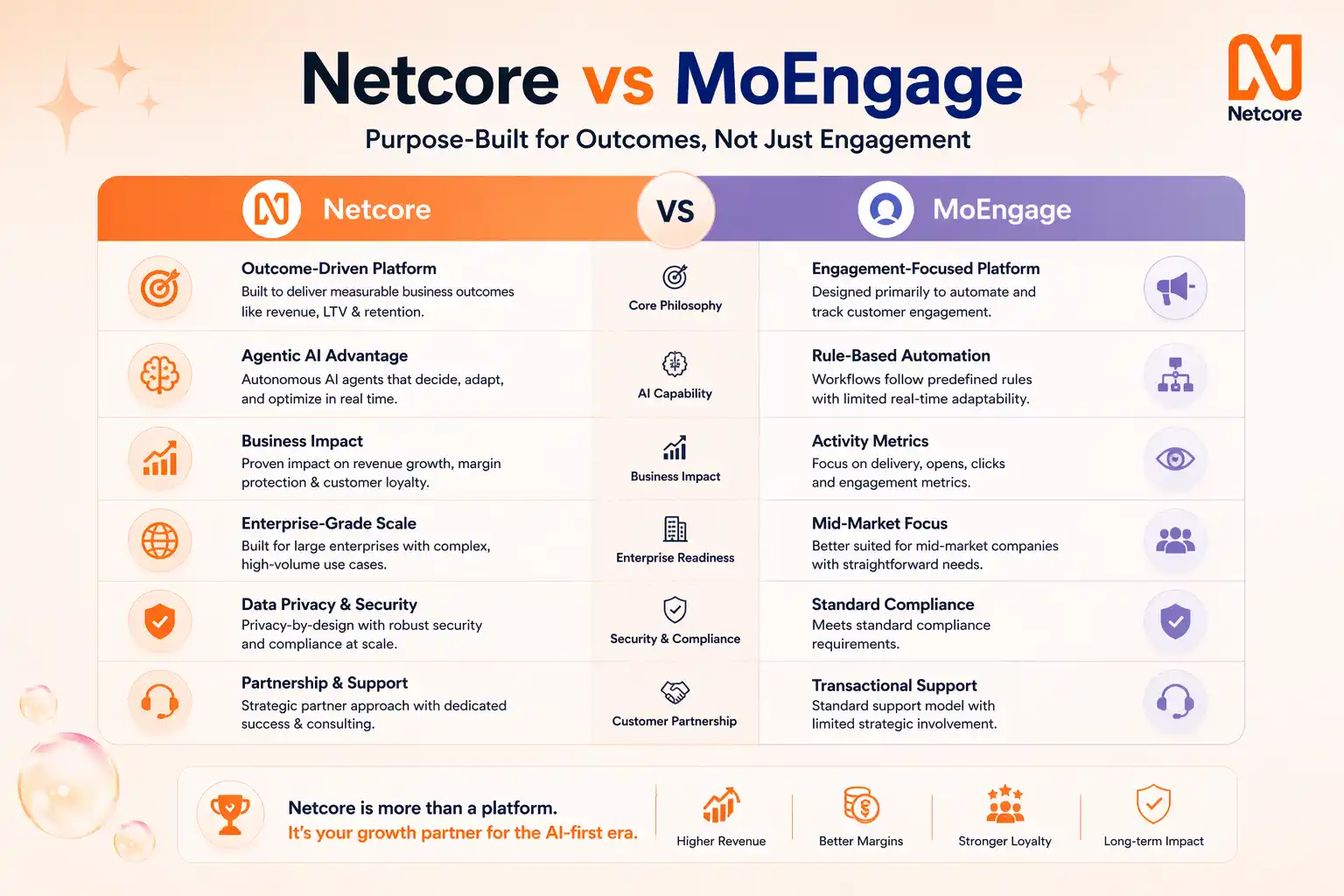
Netcore and MoEngage are two of the most seriously evaluated customer engagement platforms across APAC, the Middle East, and emerging markets, and they target the same buyers. But they are architecturally different platforms built around different philosophies of what “great marketing” means.
Here’s why this decision deserves more than a feature checklist comparison:
Choosing a customer engagement platform isn’t a 6-month commitment. It’s an 18–36 month one once you factor in data migration, team training, integration work, and the campaigns already built on top of it. Getting it wrong doesn’t just waste budget, it locks you into the wrong foundation at the exact moment the market is shifting toward agentic, AI-first marketing.
Both Netcore and MoEngage are credible. Both have documented customer wins. Both have real limitations that vendors won’t lead with in demos. And the buyers who regret their decision are almost always the ones who optimised for “which has more features” rather than “which is built for what we need over the next three years.”
That’s what this guide answers, directly and honestly.
A Quick Comparison Table
| Dimension | Netcore | MoEngage |
|---|---|---|
| Primary Positioning | Full-stack AI engagement + agentic marketing with omnichannel reach | Insights-driven omnichannel engagement |
| Core Strength | Email deliverability + AI personalization + Inbox Commerce | Analytics depth + predictive AI + journey orchestration |
| Best Fit | Mid-market to enterprise | Growth-stage to enterprise |
| AI Capabilities | Agentic marketing platform; affinity + propensity models; STO | Merlin AI + Sherpa AI; predictive content, send-time, segmentation |
| Email Infrastructure | Proprietary ESP; 95%+ inbox placement | Third-party reliant; strong but not owned |
| Inbox Commerce | Native interactive AMP emails with cart, booking, forms | Not available natively |
| Pricing Model | Volume/usage-based; outcome-based pricing available | MAU-based; from ~$999/month |
| Ease of Use | Moderate; intuitive but can feel complex at scale | Moderate; powerful but steeper learning curve |
| Customer Support | Mixed, strong account management, some support delays | Generally strong; varies by plan tier |
| Gartner Peer Insights (Email) | 4.7 (100 reviews) | 4.7 (9 reviews) |
| G2 Overall | 4.5 / 5 | 4.5 / 5 |
Netcore Strengths
Netcore’s edge comes from three things most platforms can’t easily replicate, a proprietary email sending infrastructure, AI that’s woven into the agentic marketing platform rather than bolted on, and a genuinely differentiated Inbox Commerce capability.
Here’s where Netcore genuinely pulls ahead:
- Best in class agentic marketing stack.
Netcore offers a comprehensive agentic AI layer purpose-built for autonomous marketing. Its specialized agents work together across strategy, decisioning, and execution, including Insights Agent for campaign intelligence, Audience Agent for auto-refreshing micro-segments, Scheduler Agent for send-time and channel optimization, Content Agent for generating channel-ready creatives, Decisioning Agent for real-time next-best-action orchestration, and Shopping Agent for conversational product discovery. Tying it all together, Co-Marketer helps orchestrate strategy and execution across agents, bringing autonomous, outcome-driven marketing into one coordinated system. - Netcore’s Inbox Commerce with 95%+ inbox placement. Unlike most platforms that rely on third-party email service providers, Netcore owns its sending infrastructure. This means inbox placement, sender reputation, and deliverability are within Netcore’s direct control, not dependent on a vendor they resell. For high-volume senders, Netcore’s proprietary ESP and AI-driven sending optimisation ensures inbox placement of over 95%. That’s a material difference if email is a primary revenue channel.
- Differentiated mobile-first engagement capabilities
Netcore offers unique mobile-first features like Nudges, a differentiated capability beyond standard in-app pop-ups or triggers common across platforms. For brands focused on mobile engagement, these capabilities make Netcore a particularly strong choice for driving contextual interactions, conversions, and retention within the app experience. - AI-powered product discovery
Netcore combines intelligent product discovery with AI-powered product recommendations to influence customer decisions in the moment, helping users discover relevant products, reducing friction in the journey, and driving higher conversions through contextual, behavior-led engagement. - Outcome-based pricing. Netcore has introduced outcome-based pricing for clients, which ties costs to measurable business results rather than just platform usage. This is a significant trust signal, and a meaningful shift from the “pay for access, figure out ROI yourself” model most platforms still operate on.
- KPI-driven customer success. Verified Gartner reviewers describe Netcore’s team as “an extension of our own,” helping both on strategy and day-to-day execution. Every client is paired with a Customer Success Manager and Data Scientist working toward defined business outcomes, not just resolving support tickets.
Netcore Limitations
Netcore has genuine strengths, but it also has real gaps that buyers in this comparison need to go in with eyes open about.
Where Netcore falls short:
- Best for brands seeking a unified platform, not multi-vendor stacks
Netcore is designed as an integrated ecosystem, bringing together CRM, CDP, messaging infrastructure, product discovery, and agentic marketing in one platform. If your strategy is intentionally built around stitching together multiple point solutions, Netcore’s unified approach may be more comprehensive than what you need. - Ideal for outcome-driven teams, not brands seeking a basic messaging tool
If you’re simply looking for a standalone tool to send emails, WhatsApp messages, or run isolated campaigns, Netcore may be more platform than required. It is built for brands looking to drive business KPIs through intelligence-led customer engagement, not just execute campaigns. - Works best when foundational data readiness is in place
Netcore delivers the most value when customer events and behavioral data are well defined. Teams early in their data maturity journey may need to invest upfront in instrumentation and data structuring to accelerate adoption and maximize outcomes. - Best suited for teams ready to evolve beyond traditional martech.
Netcore is an agentic marketing platform, not a traditional rules-based martech system. For brands preparing for where marketing is headed in the next few years, however, those AI capabilities become a long-term advantage.
MoEngage Strengths
MoEngage is an insights-first platform that earns its reputation through analytics depth, a mature predictive AI layer, and strong usability for teams that want to run sophisticated omnichannel engagement without a long technical runway.
Here’s where MoEngage genuinely excels:
- Analytics and insights architecture. MoEngage was built around the belief that better data leads to better campaigns. Its funnel analysis, event tracking, cohort reporting, and real-time segment updates are consistently praised across G2 and Gartner as among the most practical and reliable in the market.
- Merlin AI and Sherpa AI. MoEngage’s predictive AI layer covers send-time optimisation, best-channel prediction, content testing, and multivariate experiments. MoEngage uses predictive modelling to tailor communication based on customer intent and likelihood to convert, making its AI genuinely integrated rather than an add-on dashboard.
- Real-time segmentation. MoEngage’s segments update dynamically based on live user behaviour. This means campaigns always target the right people based on what they’re doing now, not what they did in last week’s batch job. For time-sensitive retention plays, this is a practical advantage.
- Cross-channel breadth. MoEngage supports email, SMS, WhatsApp, push notifications, in-app messaging, and web push.
- Journey orchestration at scale. MoEngage’s visual journey builder handles complex, multi-condition lifecycle flows without requiring developer involvement at each step.
- Scalability for large customer bases. MoEngage is particularly well-suited to businesses managing millions of active users across e-commerce, fintech, travel, and media, where segmentation complexity and campaign volume are both high.
MoEngage Limitations
MoEngage is powerful, but it requires investment in learning, setup, and budget. Teams that underestimate any of those three tend to underutilise it.
Where MoEngage has room to improve:
- Steep learning curve for advanced features. Multiple G2 reviewers specifically flag that navigating MoEngage’s more sophisticated capabilities requires structured training. Non-technical teams or lean marketing operations functions may find the ramp-up slower than expected.
- Cost escalates quickly. The entry point of ~$999/month for 10k MAUs sounds accessible, but mid-scale teams running 100k+ MAUs with advanced AI features active are looking at $5,000–$10,000+/month. Add-ons and the enterprise tier unlock draw consistent criticism for unpredictable total cost of ownership.
- No Inbox Commerce equivalent. MoEngage has no equivalent to Netcore’s interactive email capability. For e-commerce brands looking to reduce checkout friction within the email channel itself, this is a genuine gap.
- Complex use cases expose gaps. Some users report friction when engagement workflows become highly non-standard or involve complex multi-condition branching logic. For businesses with intricate, edge-case-heavy customer journeys, this is worth testing in a proof of concept before committing.
- Reporting customisation limits. While MoEngage’s analytics depth is strong for standard use cases, building fully custom dashboards or non-standard attribution models requires workarounds that some teams find frustrating.
Netcore vs MoEngage Features: A Head-to-Head Comparison
Both platforms cover the core feature set. The gap shows up at the edges, in email infrastructure ownership, interactive commerce, and the depth of the AI personalisation layer.
| Feature | Netcore | MoEngage |
|---|---|---|
| Email Infrastructure | Proprietary ESP; 95%+ inbox placement | Third-party; strong but not owned |
| Inbox Commerce | Native interactive emails (cart, forms, bookings) | Not available |
| AI Layer | Agentic marketing platform; affinity + propensity models | Merlin AI + Sherpa AI; predictive content + STO |
| Segmentation Depth | Profile-level with AI-personalization: behavior, affinity, propensity, discount sensitivity | Real-time behavioral; AI-suggested segments |
| Journey Builder | Visual; unified across channels | Visual; strong; some complexity at scale |
| Analytics | Solid; some limitations vs MoEngage | Deep; funnel, cohort, attribution |
| Push Notifications | Web + app; Push Amplification feature | Strong mobile-native; automation-focused |
| Native; unified channel management | Bundled in MAU pricing | |
| RCS | Supported | Limited |
| SMS | Available | Available |
| In-App Messaging | Available; no-code nudges with triggers and push | Strong; real-time in-app triggers and push notifications |
| Web Personalization | Available; AI-driven | Available |
| Agentic Marketing | Insight Agent, Audience Agent, Co-marketer, Decisioning Agent | In development |
| Pricing Model | Volume/usage-based; outcome-based option | MAU-based; $999/month entry |
Check what the direct comparison between Netcore and MoEngage looks like on G2 as rated by real businesses.
| Category | MoEngage | Netcore |
|---|---|---|
| Meets Requirements | 8.8 | 8.7 |
| Ease of Use | 9.0 | 8.9 |
| Ease of Setup | 8.8 | 8.7 |
| Ease of Admin | 8.8 | 9.0 |
| Quality of Support | 9.0 | 9.0 |
| Business Partnership | 9.2 | 9.1 |
| Product Direction (% Positive) | 9.6 | 9.5 |
Use Case Scenarios: Which Platform for Which Business?
The right platform depends on your primary growth lever, your team’s technical capacity, and whether email or mobile is your most critical engagement channel.
Choose Netcore if:
- You want a unified platform, not a patchwork of point solutions for engagement, CDP, messaging, and personalization.
- You’re looking for a platform focused on business outcomes, not just campaign execution, with strong support for driving retention, conversions, and ROI.
- You need hyper-personalization to the segment of one, using real-time behavioral intelligence and AI-driven decisioning.
- You want best-in-class agentic marketing capabilities, including AI agents for insights, segmentation, decisioning, content, channel optimization, and even guided product discovery, all orchestrated through a co-marketer layer.
- You’re investing in a future-ready martech stack and want to move beyond traditional automation toward autonomous, outcome-driven marketing.
Check out how Netcore has helped various leading brands across industries and regions scale their revenue and achieve KPIs in Success Stories. Trusted by 6,500+ brands across 40 countries.
Choose MoEngage if:
- Analytics and data-led decision-making are your competitive edge. MoEngage’s insights-first architecture and deep funnel, cohort, and attribution reporting give product and growth teams more to work with. If your team runs regular data reviews to optimise engagement strategy, MoEngage’s reporting layer will be used more fully.
- Predictive AI across channels is your primary use case. MoEngage’s Merlin AI and Sherpa AI are mature and deeply integrated than most competitors in this space. If send-time optimisation, best-channel prediction, and AI-powered content recommendations are capabilities your team will actively use, MoEngage delivers a stronger out-of-the-box experience.
- Mobile is your primary engagement surface. MoEngage has strong mobile-native roots and handles push notification automation, in-app messaging, and mobile journey orchestration particularly well.
- You have the team and budget to extract full value. MoEngage rewards teams that invest in setup, learning, and campaign architecture. If you have a capable marketing operations function and are prepared for a structured ramp-up, the depth pays off.
Final Take
Both Netcore and MoEngage are strong enterprise platforms;, the right choice depends on your priorities. Choose Netcore if email revenue, owned infrastructure, Inbox Commerce, and agentic marketing align with your future roadmap. Choose MoEngage if analytics depth is your primary need. The real question isn’t which platform has more features, but which is built for where your marketing organization is headed. Looking for a platform built for outcomes, not just execution? Talk to us.