




TL;DR
The top marketing automation platforms in 2026 focus on stack consolidation and agentic AI in marketing. Expect to prioritize total cost of ownership, omnichannel unified control, and autonomous workflows that tie directly to revenue. Platforms like Netcore, HubSpot, Klaviyo, ActiveCampaign, Brevo, and Salesforce lead the charge of AI-powered marketing automation.
Marketing automation is no longer just about scheduling emails or building drip campaigns; it’s about orchestrating intelligent, real-time customer journeys across channels. In 2026, the shift toward AI-powered and agentic platforms means marketers don’t just execute campaigns; they deploy systems that learn, adapt, and optimize on their own.
From predictive segmentation and next-best-action recommendations to autonomous journey orchestration, today’s platforms are built to drive measurable revenue, not just engagement. In this article, we break down the top 13 marketing automation platforms in 2026, covering their key features, strengths, and ideal use cases.
How to Identify the Best Marketing Automation Platform for Your Needs
To identify the best marketing automation platform, evaluate its ability to consolidate your martech stack, provide omnichannel control, and deliver autonomous AI decisions. Focus heavily on the total cost of ownership and direct ROI attribution rather than isolated workflow features.
Your marketing stack is likely suffering from bloat. When you use one tool for email, another for SMS, and a third for analytics, you create data silos. This fragmentation prevents you from delivering true personalization at scale.
Workflow automation and seamless integrations are critical for connecting disparate SaaS tools and avoiding these data silos. However, integration alone does not solve the underlying issue. You need a platform that naturally absorbs the workload of multiple tools.
When evaluating a platform for 2026, you should look through the lens of business outcomes. Ask yourself how quickly the platform can prove its value. Examine the core tension: does this software add another layer of complexity, or does it give you unified control over your customer journey?
Industry standards suggest grading platforms on three critical dimensions:
- Omnichannel Seamlessness: Customers do not see channels; they see your brand. Your platform must orchestrate email, SMS, WhatsApp, and in-app messages from a single dashboard.
- Agentic AI Capabilities: Basic “if/then” rules are outdated. You want an autonomous system that predicts customer behavior and optimizes send times and content variations in real time.
- Accountability to ROI: The platform must connect campaign execution directly to revenue generation, giving CFOs the exact proof they demand.
Top 13 Marketing Automation Platforms: The Complete 2026 List
To build this list, we evaluated platforms on one thing: can they actually drive revenue in an AI-first world?
In 2026, marketing automation is no longer about workflows, it’s about autonomous decisioning systems. The best platforms don’t just execute journeys; they predict intent, trigger next-best actions, and continuously optimize outcomes.
Platforms 1–4: Best for Enterprise Stack Consolidation
These platforms solve martech sprawl at its root, by combining data, intelligence, and execution into a single system.
1. HubSpot
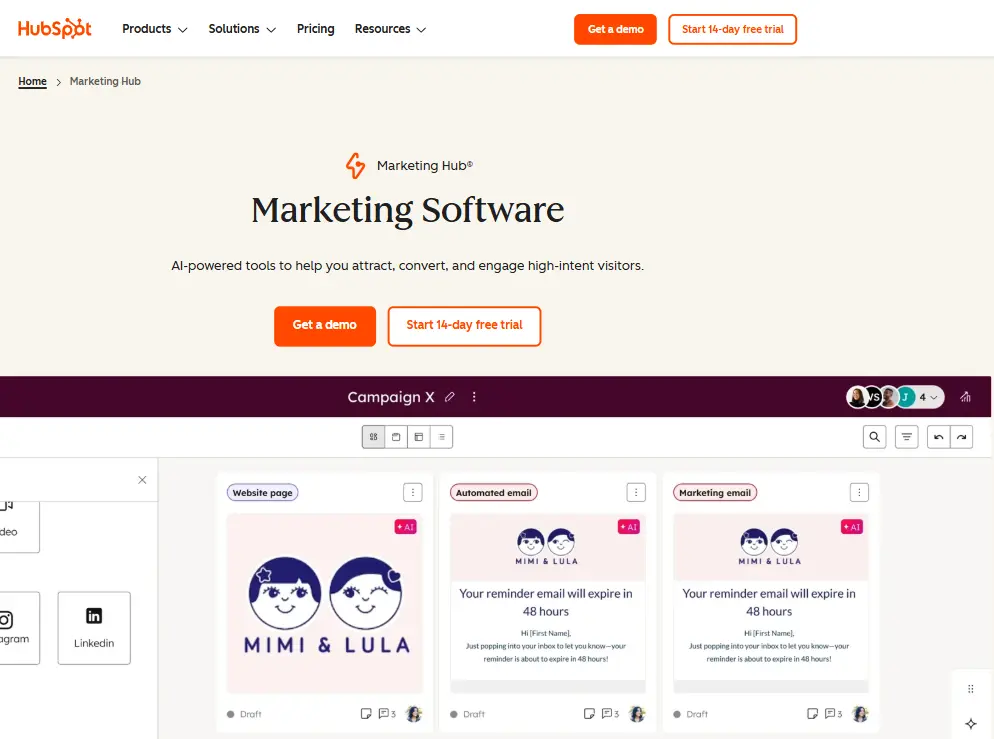
HubSpot continues to dominate as the all-in-one GTM platform, now enhanced with AI copilots across marketing, sales, and service.
Pros:
- Unified CRM + marketing + content + sales ecosystem
- Strong AI assistants for content, reporting, and forecasting
- Massive integration marketplace
Cons:
- Costs scale steeply with data volume and usage
- Advanced AI and reporting locked behind premium tiers
Verdict for ROI: HubSpot delivers strong ROI only when used as a full-stack system. Partial adoption leads to tool overlap and rising costs.
2. Netcore
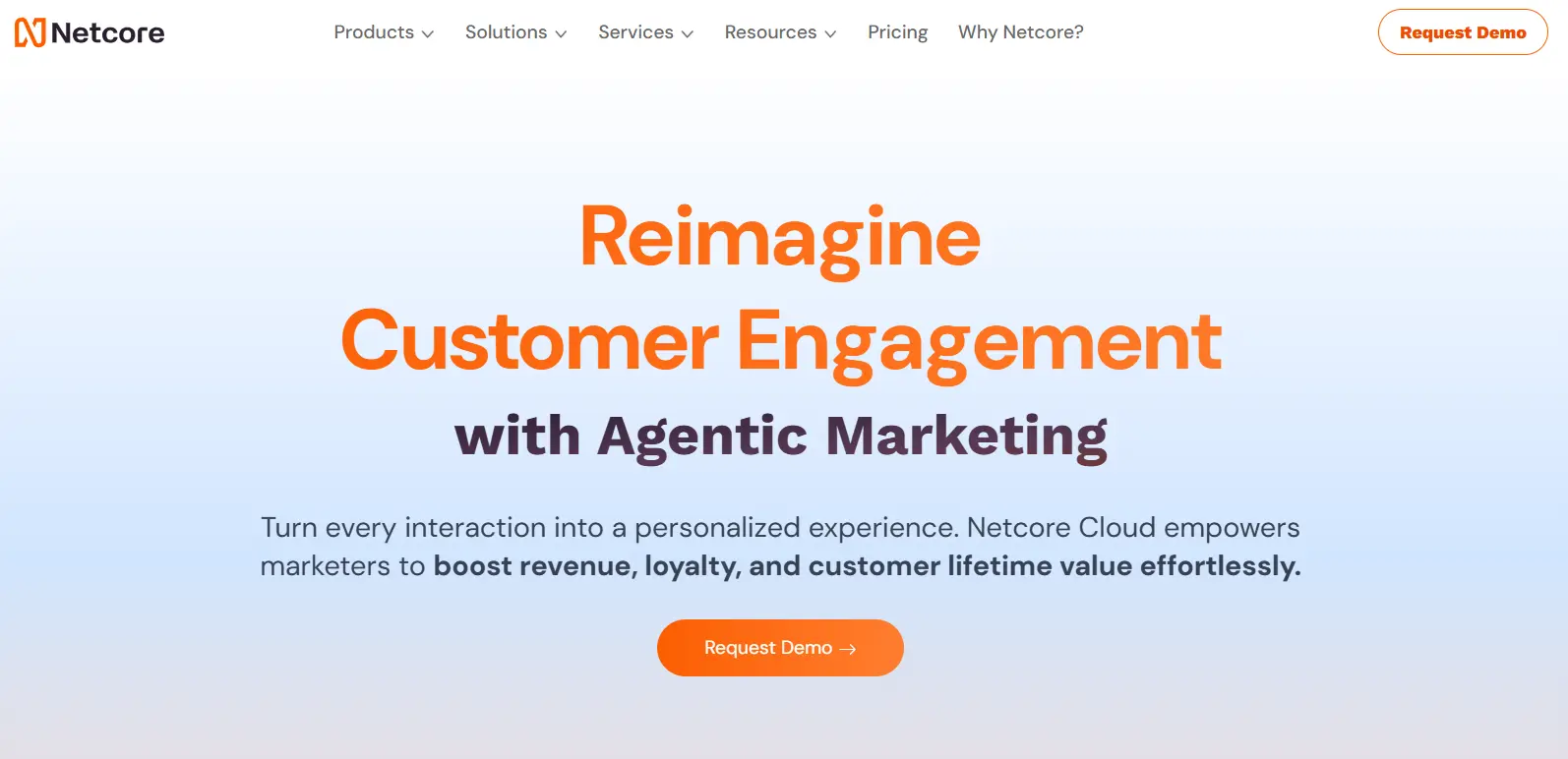
Netcore has evolved from Email platform to complete marketing automation suite, where AI agents don’t just assist, they run lifecycle marketing autonomously.
Pros:
- Native CDP with real-time identity resolution
- Agentic AI for next-best action, churn prediction, and journey orchestration
- Deep omnichannel execution (Email, SMS, WhatsApp, Push, RCS)
Cons:
- Requires structured onboarding to unlock full capability
- Overkill for teams looking for basic campaign automation
Verdict for ROI:
Netcore stands out by directly tying AI decisions to revenue outcomes, reducing manual effort while increasing conversion efficiency and lowering tool sprawl.
3. ActiveCampaign
ActiveCampaign bridges the gap between traditional automation and AI-assisted orchestration, making advanced journeys accessible.
Pros:
- Intuitive automation builder with AI-assisted recommendations
- Strong personalization and dynamic content
- Large library of pre-built workflows
Cons:
- CRM lacks depth for enterprise-grade use
- AI capabilities are assistive, not fully autonomous
Verdict for ROI:
Best suited for teams transitioning from basic automation to behavior-driven lifecycle marketing without heavy technical investment.
4. Omnisend
Omnisend remains a leader for ecommerce, now enhanced with AI-driven product recommendations and lifecycle triggers.
Pros:
- Tight ecommerce integrations (Shopify, WooCommerce, etc.)
- Pre-built, revenue-focused workflows (cart, browse, post-purchase)
- AI-powered campaign optimization
Cons:
- Limited flexibility outside ecommerce use cases
- Not built for complex B2B journeys
Verdict for ROI: Omnisend drives fast, measurable revenue lifts for ecommerce brands by automating high-intent moments.
Platforms 5–8: Best for B2C Omnichannel & Personalization
These platforms excel at turning behavioral data into hyper-personalized, cross-channel engagement at scale.
5. Customer.io
Customer.io leads with its event-driven, developer-first architecture, now enhanced with real-time personalization capabilities.
Pros:
- Highly flexible event-triggered messaging
- Strong API and data pipeline integrations
- Granular control over user-level interactions
Cons:
- Requires engineering support for setup
- Less intuitive for non-technical marketers
Verdict for ROI: Ideal for PLG and app-first businesses where product behavior directly drives communication.
6. Brevo
Brevo positions itself as a cost-efficient omnichannel suite, now incorporating lightweight AI for campaign optimization.
Pros:
- Pricing based on usage, not contacts
- Solid transactional messaging infrastructure
- Multi-channel (Email, SMS, WhatsApp) in one platform
Cons:
- Limited depth in AI and predictive analytics
- Basic segmentation compared to advanced platforms
Verdict for ROI:
A strong choice for teams seeking affordable, reliable multichannel execution without complex AI needs.
7. GetResponse
GetResponse has leaned into AI-powered campaign creation and conversion funnels, especially for creators and SMBs.
Pros:
- Built-in webinar and funnel tools
- AI-generated emails and landing pages
- End-to-end campaign management
Cons:
- UI still reflects legacy complexity
- Limited enterprise scalability
Verdict for ROI:
High ROI for SMBs looking to convert quickly using integrated funnels and content automation.
8. Ortto
Ortto combines customer data, journey orchestration, and analytics into a single visual platform.
Pros:
- Visual journey builder with real-time data overlays
- Strong CDP-lite capabilities
- Integrated analytics for funnel performance
Cons:
- Advanced data usage requires technical familiarity
- Support quality varies
Verdict for ROI:
Ortto helps teams identify and fix funnel inefficiencies faster, improving conversion rates through clarity.
Platforms 9–13: Best for B2B, Niche, and Emerging AI Use Cases
These platforms specialize in specific growth motions, from outbound sales to lean automation.
9. Apollo.io
Apollo has evolved into a sales intelligence + outbound automation engine powered by intent data.
Pros:
- Massive B2B contact database
- AI-assisted sequencing and outreach
- Strong intent and enrichment signals
Cons:
- Not built for lifecycle or B2C marketing
- Requires compliance diligence
Verdict for ROI:
Apollo drives pipeline generation at scale, especially for outbound-heavy GTM teams.
10. Drip
Drip focuses on ecommerce lifecycle marketing with deep revenue attribution and personalization.
Pros:
- Strong behavioral segmentation
- Clear revenue attribution per campaign
- Dynamic product recommendations
Cons:
- Limited outside ecommerce
- SMS capabilities vary by region
Verdict for ROI:
Drip excels at connecting campaigns directly to revenue, making performance transparent.
11. Keap
Keap targets small businesses with a sales + marketing automation hybrid, now with AI-assisted workflows.
Pros:
- CRM + invoicing + scheduling in one platform
- Easy automation setup for non-marketers
- Guided onboarding
Cons:
- Limited flexibility for advanced use cases
- Legacy UX elements
Verdict for ROI:
Best for service businesses prioritizing operational efficiency over advanced marketing complexity.
12. Constant Contact
Constant Contact remains a simplicity-first platform, now with basic automation and AI-assisted content tools.
Pros:
- Extremely beginner-friendly
- Event and campaign management tools
- Reliable email delivery
Cons:
- Minimal AI and automation depth
- Limited segmentation
Verdict for ROI:
Works for businesses needing consistent communication without complexity.
13. MailerLite
MailerLite offers a lean, fast, and affordable automation platform, now with light AI enhancements.
Pros:
- Clean UI and fast setup
- Affordable pricing
- Built-in landing page and email tools
Cons:
- Limited integrations
- Basic analytics and automation depth
Verdict for ROI:
Perfect for startups optimizing for low cost and simplicity while maintaining solid execution.
Future Trends
The most critical shift in 2026 is the move from basic automation to intelligence over execution. You no longer build rigid flowcharts where “if a user clicks X, send Y.”
Agentic AI systems now monitor real-time user behavior and make autonomous decisions. They predict the optimal channel, the perfect time of day, and the most compelling message variant without manual human intervention.
This technology closes the gap between the personalization consumers demand and what marketing teams can practically deliver. You transition from an executor of campaigns to an orchestrator of strategy. The software handles the micro-decisions, leaving you to focus on the high-level business logic and revenue mapping.
Making Your Final Choice for 2026
You face a crowded market filled with overlapping feature sets. To cut through the noise, you must build an objective scorecard.
Rank your contenders based on their ability to act as a single platform with unified control. Ask them to prove their omnichannel seamlessness. Demand case studies showing true personalization at scale. Most importantly, ensure the vendor speaks the language of ROI and accountability.
If a platform cannot clearly demonstrate how it replaces your disconnected tools and drives measurable revenue impact, discard it from your shortlist. Your 2026 budget is too valuable to waste on software that only executes basic tasks.