




TL;DR
- Netcore and Salesforce Marketing Cloud are enterprise-grade customer engagement platforms, but they differ significantly in ecommerce capabilities, AI-powered personalization, platform architecture, and total cost of ownership.
- Netcore offers a unified platform with AI-powered search, product recommendations, omnichannel engagement, real-time personalization, and built-in analytics, reducing the need for multiple products and integrations.
- Salesforce Marketing Cloud delivers powerful customer engagement and CRM capabilities, particularly for organizations already invested in the Salesforce ecosystem.
- When comparing both platforms, evaluate AI maturity, personalization, ecommerce functionality, implementation complexity, scalability, and long-term operational costs, not just licensing.
- This buyer’s guide compares Netcore and Salesforce Marketing Cloud across key capabilities to help you choose the platform that best aligns with your customer engagement and growth objectives in 2026.
Salesforce Marketing Cloud (SFMC) was built for a different era of marketing, one where relational databases, SQL-driven segmentation, and batch-driven journeys were the gold standard. For years, it delivered exactly what enterprises needed: a robust system of record extended into marketing execution.
But marketing in 2026 demands something fundamentally different. Real-time behavioral orchestration. Event-native segmentation. Autonomous optimization. Cross-channel execution without add-on complexity. The question is no longer about platform preference; it’s whether your architecture supports your growth velocity.
This guide compares Salesforce Marketing Cloud and Netcore across architecture, capabilities, total cost of ownership, and real-world customer results. We’ve pulled from enterprise customer migrations, verified analyst reviews, and detailed feature-level comparisons to help you decide whether your current platform is a foundation for growth or a constraint on it.
Why This Comparison Matters
For most enterprises today, the cost of staying with SFMC isn’t on the license line item. It’s hidden in:
- 30–40% of marketing bandwidth is lost to SQL queries and data preparation
- 1-hour refresh cycles that miss peak intent windows
- 70–80% of execution is still manual despite Einstein AI investment
- 40–60% inflated TCO beyond license through add-ons, SI fees, and headcount
- 6–12 month implementation timelines that delay ROI by quarters
- 15–25% first-session conversion erosion due to batch-driven activation
Salesforce CRM remains a powerful system of record. But relational marketing clouds struggle to operate at the speed today’s customers expect. The question isn’t whether you should leave SFMC, it’s whether the architecture costs are sustainable for your next phase of growth.
A Quick Comparison
| Dimension | Netcore | Salesforce Marketing Cloud + Agentforce |
|---|---|---|
| Primary Positioning | Full-stack agentic marketing platform combining engagement, analytics, product discovery, and AI agents | Enterprise marketing automation platform integrated with CRM and AI-powered agents |
| Core Strength | Agentic execution, omnichannel engagement, product experience, and product discovery | CRM-centric customer journeys, enterprise workflow automation, and Salesforce ecosystem integration |
| Best Fit | Mid-market to enterprise brands focused on growth, retention, and personalization | Large enterprises deeply invested in the Salesforce ecosystem |
| AI Capabilities | Audience Agent, Insight Agent, Decisioning Agent, Shopping Agent, Content Agent, Co-Marketer | Agentforce agents for CRM workflows, sales, service, and marketing assistance |
| Agentic Execution | Autonomous insight-to-action workflows with campaign activation built in | Primarily assistive AI; complex workflows often require configuration and approvals |
| Customer Data Architecture | Event-native architecture with real-time ingestion and activation | CRM-centric architecture relying on Data Cloud and multiple Salesforce products |
| Analytics & Insights | Native analytics, anomaly detection, funnel analysis, cohort intelligence, and Insight Agent recommendations | Strong reporting and dashboards but often requires multiple Salesforce modules for deeper analysis |
| Email Infrastructure | Owned ESP with high deliverability, AMP Email, STO, and Inbox Commerce | Enterprise-grade email infrastructure but lacks native AMP-powered commerce experiences |
| Inbox Commerce | Native AMP emails with forms, surveys, product discovery, and checkout actions | Not available natively |
| Product Discovery | Native AI search, merchandising, recommendations, and Shopping Agent | Requires third-party commerce search and recommendation solutions |
| Web & App Personalization | Real-time personalization, nudges, walkthroughs, feature experimentation, and contextual engagement | Requires additional Salesforce products and implementation effort |
| Channels Supported | Email, SMS, WhatsApp, RCS, Push, In-App, Web Personalization | Email, MobilePush, SMS, Advertising, Web, and CRM-driven channels |
| Implementation Time | JS integration in ~30 minutes; campaigns live in days | Typically weeks to months depending on stack complexity |
| Ease of Use | Marketer-friendly with minimal dependency on developers | Powerful but requires specialist resources and Salesforce expertise |
| Pricing Model | Flexible usage-based pricing with outcome-based engagement options | Premium enterprise pricing with multiple add-on costs across the Salesforce ecosystem |
| Customer Success Model | Dedicated CSMs with KPI-driven consulting and growth ownership | Enterprise support model with success plans based on contract tier |
| Key Differentiator | Unified stack combining AI agents, engagement, analytics, personalization, and product discovery | Deep CRM integration and enterprise ecosystem breadth |
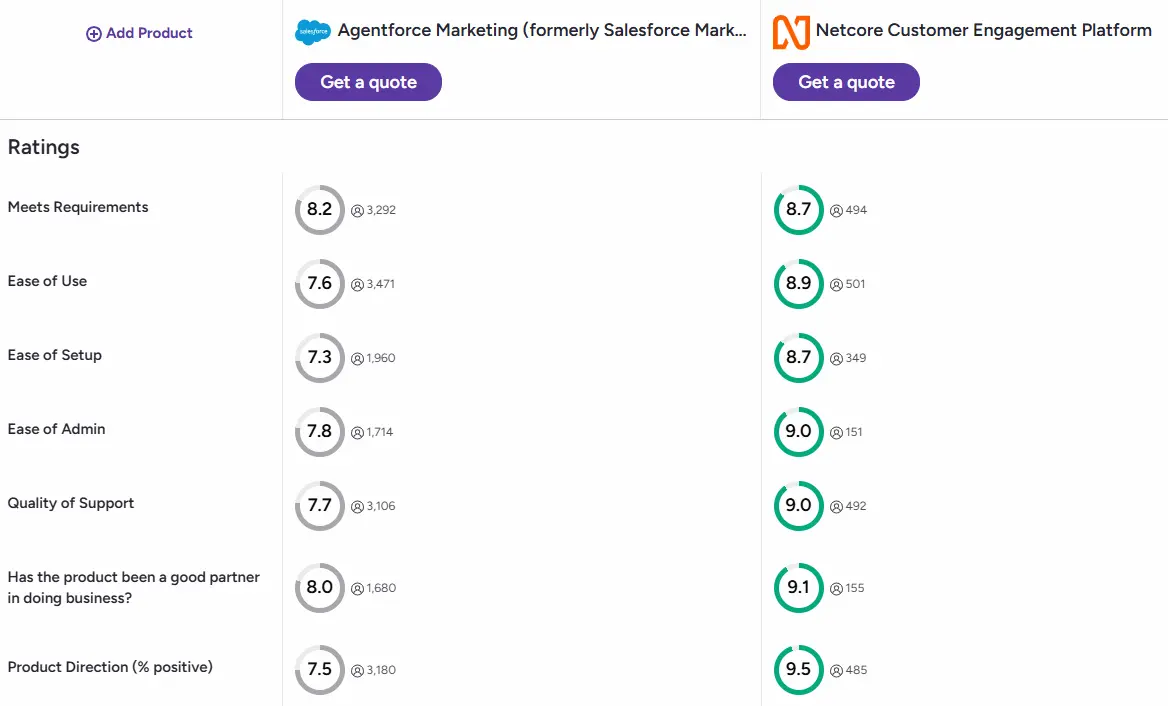
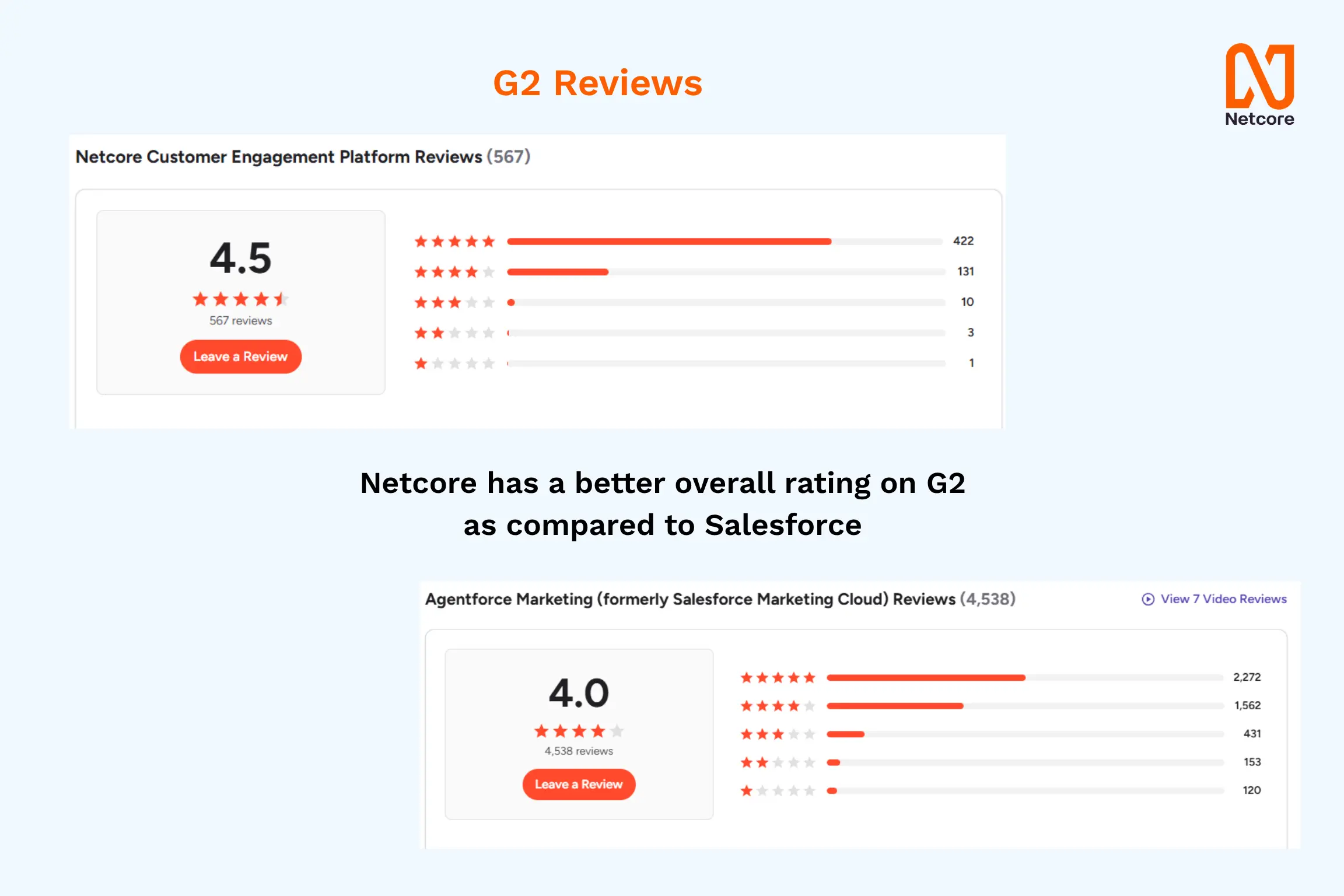
Check what the direct comparison between Netcore and Salesforce looks like on G2 as rated by real businesses.
Netcore Strengths
Netcore’s advantage isn’t about feature parity; it comes from a fundamentally different agentic marketing architecture. It is event-native (not relational), real-time (not batch-driven), agentic (not assistive), and outcome-aligned (not volume-priced).
Here’s where it pulls ahead:
1. Event-Native Architecture (No SQL Dependency)
SFMC relies on SQL-heavy data models, slowing segmentation and execution.
Netcore uses a unified event-native model, capturing real-time behavior across web, app, campaigns, and backend events, no SQL, no joins.
Impact:
- 30% faster campaign builds
- 70% less SQL dependency
- Faster team ramp-up
2. Real-Time Activation
SFMC’s batch refresh delays engagement.
Netcore activates journeys within seconds, capturing user intent instantly.
Impact:
- 2–5x higher drop-off recovery
- 15–25% higher first-session conversions
3. Agentic Marketing Architecture
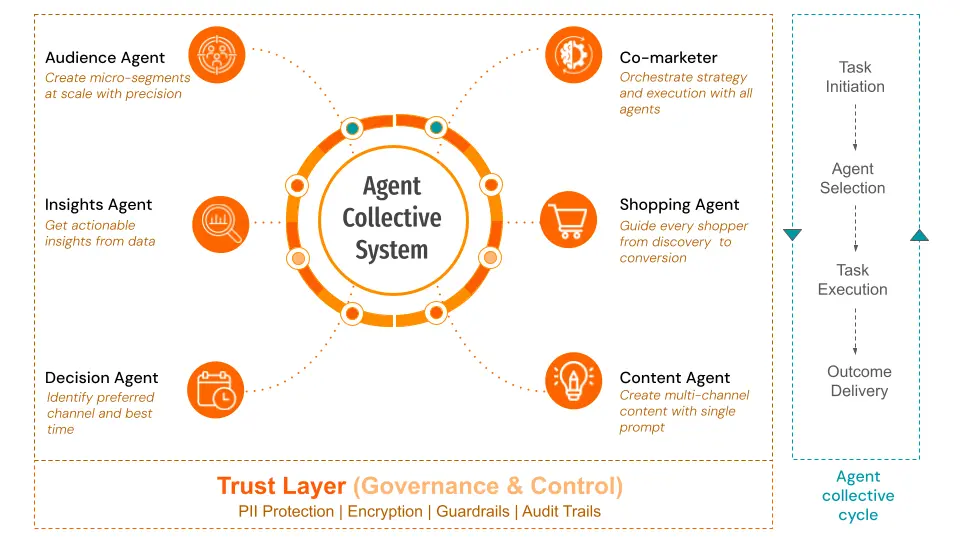
SFMC’s AI suggests & humans execute.
Netcore’s multi-agent system (Segment, Scheduler, Content, Insights, Co-Marketer) detects, decides, and acts autonomously.
Impact:
- 3x ROI lift
- 25x faster campaign velocity
- 100x micro-segmentation
4. Unified Native Stack
SFMC requires multiple tools for channels, analytics, and execution.
Netcore offers built-in omnichannel + analytics + AI in one platform.
Impact:
- 40–50% faster optimization
- 40–50% lower total cost of ownership
5. Faster Time-to-Value
SFMC implementations take months.
Netcore enables go-live in 30–45 days with ROI in 8–12 weeks.
6. Mobile-First Execution
SFMC treats mobile as an add-on.
Netcore is mobile-native, with real-time triggers and unified orchestration.
Impact:
- 15–25% higher first-session conversions
- 2–5x better recovery rates
7. Outcome-Based Pricing
SFMC pricing scales with usage.
Netcore aligns pricing with performance and outcomes, not volume.
8. Netcore-Only Capabilities
- Native Web Push, RCS, AMP Email
- Built-in behavioral analytics
- No-code advanced messaging
- Real-time in-app nudges
- KPI-driven customer success model
Netcore Limitations
Netcore has genuine strengths, but it also has real gaps that buyers in this comparison need to go in with eyes open about.
Where Netcore falls short:
1. Best for Brands Seeking Unified Marketing Execution, Not CRM Replacement
Netcore is a marketing automation and engagement platform, not a CRM. If you’re considering Netcore as a Salesforce CRM replacement, you’ll be disappointed. The strategic positioning is clear: Netcore complements Salesforce CRM (with a bi-directional connector) and replaces SFMC for marketing execution. Some early prospects expected CRM functionality and faced expectation mismatches.
2. Ideal for Outcome-Driven Teams Ready to Move Beyond Workflow-Based Marketing
Netcore is built for brands ready to embrace autonomous, intelligence-led engagement. If your team is comfortable building extensive workflows in Journey Builder and your operating model depends on SQL specialists, the paradigm shift may feel uncomfortable. Netcore’s agentic platform requires teams willing to let AI execute, not just suggest.
3. Works Best When Foundational Data Readiness Is in Place
Netcore delivers maximum value when customer events and behavioral data are well-defined. Teams transitioning from SFMC’s relational structure may need 4–6 weeks of upfront instrumentation to define event taxonomy and structure behavioral signals properly. Netcore helps with this, but it’s not automatic.
4. Best Suited for Teams Reducing Agency and SI Dependency
Netcore is designed to reduce reliance on external agencies and System Integrators for marketing execution. If your operating model is built around heavy agency relationships managing your SFMC journeys, you’ll need to reconsider how internal teams take ownership of execution. The platform’s marketer-first design assumes you want autonomy, not outsourcing.
5. Best for Brands Willing to Consolidate the Stack
Netcore’s unified approach is most valuable for brands tired of multi-vendor sprawl. If your strategy intentionally maintains 10+ point solutions across CDP, ESP, push platforms, and analytics tools, Netcore’s consolidation philosophy may feel restrictive. The value compounds when you commit to a unified stack, not when you treat Netcore as one more vendor.
Salesforce Marketing Cloud Strengths
SFMC remains a credible enterprise platform with specific strengths:
1. Deep Integration with Salesforce CRM
SFMC’s native integration with the Salesforce ecosystem (Sales Cloud, Service Cloud, Commerce Cloud) is unmatched. For enterprises with mature Salesforce deployments and complex CRM workflows, this integration depth is genuinely valuable.
2. Established Enterprise Validation
Salesforce has decades of enterprise credibility. Risk-averse organizations with rigorous procurement processes find comfort in Salesforce’s market position, analyst recognition, and large customer base.
3. Robust Journey Builder for Mature Workflows
For teams with established Journey Builder workflows in production, SFMC delivers reliable execution. Brands with significant investment in Journey Builder architecture, custom AMPscript, and Marketing Cloud Personalization may find migration costs prohibitive.
4. Einstein AI for Recommendations
Einstein provides AI-powered recommendations across send-time optimization, content selection, and engagement scoring. While it remains assistive (not autonomous), Einstein adds value for teams with the bandwidth to act on its insights manually.
5. Comprehensive Multi-Cloud Capabilities
For enterprises requiring deep coordination across Sales, Service, Commerce, and Marketing within one ecosystem, SFMC’s tight integration with the broader Salesforce platform offers operational consistency.
Salesforce Marketing Cloud Limitations
Based on Gartner Peer Insights, G2 reviews, and direct enterprise customer migrations:
1. The Relational Trap (Data Extensions & SQL Dependency)
SFMC’s relational model requires data extensions, primary key mapping, and manual joins across studios. The result: 30–40% of marketing bandwidth lost to SQL and data prep. Segmentation depends on technical resources. Campaign build time elongates. New marketers need months to ramp.
Impact: Growth velocity tied to SQL bandwidth.
2. Batch-Driven Intent Decay
1-hour refresh cycles. CRM-first ingestion. Post-session journey triggers. Welcome emails triggered after abandonment. KYC nudges delayed. The 60-minute refresh lag reduces first-session recovery dramatically.
Impact: First-session drop-offs unrecovered. Intent cools before activation. CAC efficiency declines.
3. Assistive AI With Manual Execution
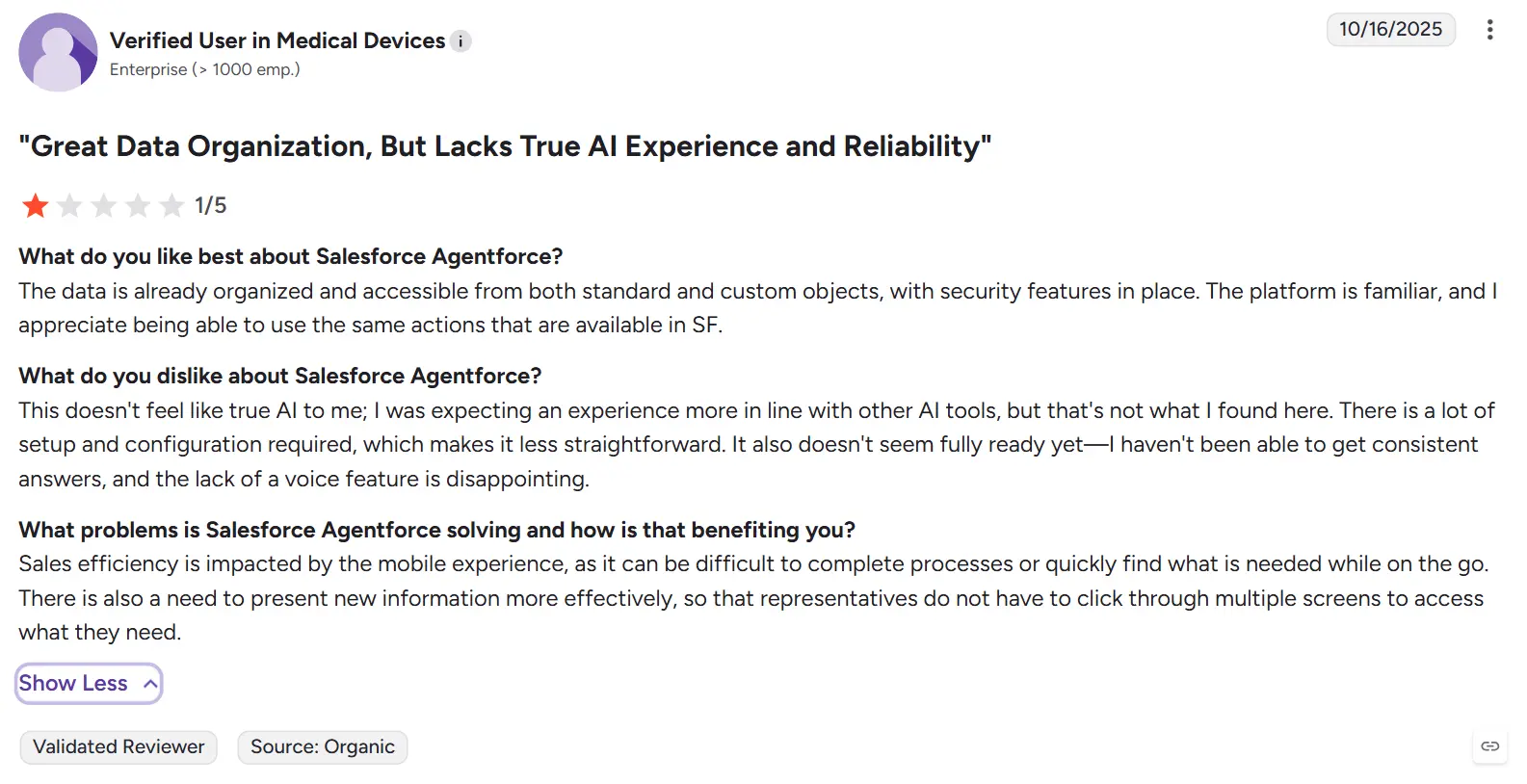
Einstein recommends; humans execute. Channel selection stays manual. Path optimization remains reactive. Campaign logic stays workflow-heavy. Despite AI investment, 70–80% of execution remains manual.
Impact: 80% of time building workflows. AI ROI diluted. Experimentation constrained.
4. Add-On Economics & Stack Fragmentation
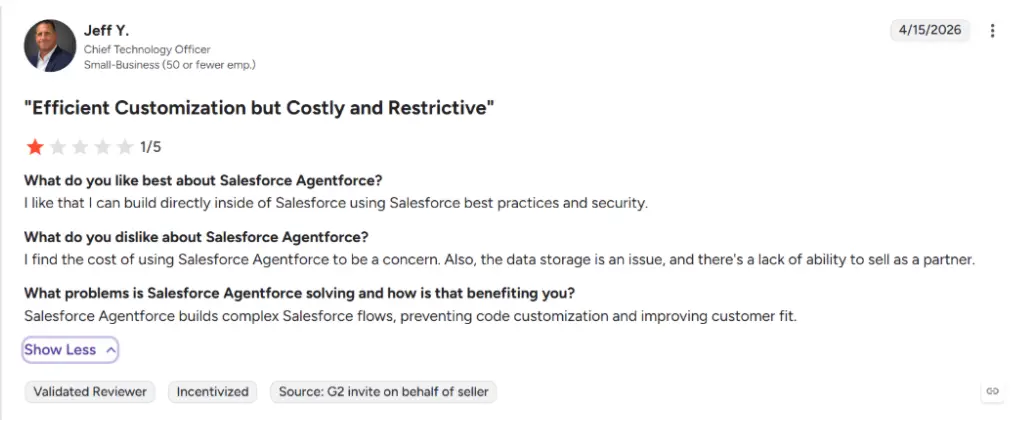
WhatsApp is an add-on. RCS is an add-on. Advanced analytics is external. SQL headcount is required. SI retainers compound monthly. The true cost of SFMC runs 40–60% above license.
Impact: ROI obscured by ecosystem cost. Innovation budget consumed by infrastructure.
5. Implementation Gravity (6–12 Month Rollouts)
SFMC implementations are notorious. 6–12 month rollouts. External SIs required. Stabilization cycles. Minimal ROI in year one. Velocity pauses during migration. Competitive momentum is lost.
Impact: Technology becomes the project—not the enabler.
6. The App Execution Gap
Mobile is an add-on, not the core engine. SDK events process post-sync, not in-session. Push, in-app, and analytics fragment across layers. Mobile journeys remain workflow-heavy and manual.
Impact: A 30–60 min sync lag costs 25% of first-session conversions. 70–80% experimentation ceiling. 20–30% drop-off monetization loss. Mobile ROI diluted by architecture.
7. Pricing Inflation at Renewal
Add-on pricing expansion causes TCO growth at renewal cycles. Multiple enterprise customers report renewal shock as feature additions, data growth, and add-on dependencies compound year-over-year. CFOs increasingly flag renewal risk as a budget concern.
8. Agency Dependency for Advanced Journeys
Enterprise SFMC deployments often rely on external agencies for advanced journey configuration, AMPscript development, and complex segmentation. This creates slower experimentation cycles and layered costs beyond platform pricing.
Netcore vs SFMC: A Head-to-Head Comparison
| Capability | Netcore | Salesforce Marketing Cloud |
|---|---|---|
| Data Architecture | Event-native architecture designed for marketer-owned execution and real-time activation | Relational data model with heavy reliance on SQL queries and data extensions |
| AI Execution Model | Autonomous multi-agent system for segmentation, insights, decisioning, content, and optimization | Einstein AI provides recommendations and predictions; execution remains largely manual |
| Implementation Timeline | Typically 30–45 days with minimal dependency on external consultants | Typically 6–12 months with significant system integrator involvement |
| Mobile Architecture | Mobile-native core platform built for app engagement and lifecycle marketing | Mobile functionality delivered through separate modules and add-ons |
| In-App Engagement | Real-time behavioral nudges, walkthroughs, surveys, and contextual user experiences | Workflow-driven engagement triggered after data synchronization |
| Channel Stack | Native Email, Push, In-App, WhatsApp, RCS, SMS, and Web Personalization | Modular ecosystem with additional products and add-ons for certain channels |
| Email Infrastructure | Proprietary ESP with AMP Email, Inbox Commerce, and advanced deliverability controls | Native enterprise ESP without AMP Email support |
| Analytics | Embedded behavioral analytics, funnels, cohorts, user path analysis, and anomaly detection | Advanced analytics often require external BI tools or additional Salesforce products |
| WhatsApp Capabilities | Native support for carousel templates, interactive journeys, and in-app engagement | Available through add-ons with comparatively limited template capabilities |
| AI Agency Involvement | In-house AI and GenAI expertise with direct implementation support | Advanced AI use cases frequently require agency or consulting partner involvement |
| Pricing Model | Outcome-linked pricing with a blend of fixed and performance-based components | Volume-based pricing with multiple premium add-ons and expansion costs |
| CRM Lock-In Risk | CRM-agnostic platform with open data architecture and flexible integrations | Strong dependency on the broader Salesforce ecosystem |
| Customer Success | Dedicated Customer Success Manager plus Data Scientist aligned to business KPIs | Tiered support model; dedicated success resources typically reserved for enterprise plans |
| Total Cost of Ownership | Typically 40–50% lower than Salesforce Marketing Cloud | Often 40–60% higher than initial licensing costs after add-ons, services, and implementation |
Use Case Scenarios: Which Platform for Which Business?
Choose Netcore if:
- You’re tired of SQL bottlenecks and want marketers to own segmentation without technical mediation.
- You need real-time activation to capture first-session intent. A 30–60 minute lag is unacceptable for your business model.
- You want autonomous AI execution with an agentic marketing platform, not just AI recommendations that humans manually act on.
- You’re facing implementation fatigue and need to go live in 30–45 days, not 6–12 months.
- You want predictable pricing aligned with outcomes rather than surprise renewals with add-on inflation.
- You’re ready to consolidate your stack and eliminate multi-vendor sprawl across messaging, analytics, and CDP.
- Mobile is critical to your revenue model, and you can’t afford SFMC’s post-sync mobile architecture.
- You want a true partnership with skin in the game, not a vendor that profits regardless of your outcomes.
Real proof from enterprise SFMC customers who migrated to Netcore:
- Enterprise Fintech (PayU, ClearTax): After replacing SFMC with Netcore they achieved 24% revenue lift in 90 days. 24% uplift in tax filings during the critical 48-hour deadline window. 50% acceleration in lead growth for B2B financial products.
- Mobility Platform (Buser): Full switch from Salesforce to Netcore’s AI-powered Mobile Suite. 71% lift in marketing ROI. 40–50% reduction in MarTech spending. 11% reduction in app uninstalls via real-time “Resurrection” journeys.
“The two things that made us choose Netcore were cost and autonomy. We’ve already seen an ROI lift of 71% since the switch.”
— Luiza Guimaraes, Senior Marketing Manager, Buser
Choose Salesforce Marketing Cloud if:
- Deep Salesforce CRM integration is non-negotiable, and your team has years of investment in Sales Cloud, Service Cloud, and Commerce Cloud.
- You have mature Journey Builder workflows with significant AMPscript investment, and migration costs outweigh the benefits.
- You have dedicated SQL specialists and engineering resources comfortable maintaining data extensions and complex segmentation queries.
- You prefer Salesforce’s analyst recognition and market position over emerging platforms, regardless of architectural differences.
- Your team accepts 6–12 month implementation timelines and has a budget for external SIs as part of the standard operating model.
- You operate primarily in batch-driven marketing models where real-time activation isn’t a competitive necessity.
- Mobile-first execution isn’t critical to your revenue model.
Why Choose Netcore Over Salesforce Marketing Cloud?
- Built for ecommerce from the ground up: Netcore combines AI-powered site search, product discovery, merchandising, and real-time product recommendations in one platform, while Salesforce often relies on additional products or Commerce Cloud for similar capabilities.
- Unified on-site and in-app personalization: Deliver personalized web experiences, pop-ups, nudges, in-app messaging, push notifications, and product recommendations without purchasing separate personalization solutions.
- Real-time customer engagement: Netcore activates journeys instantly using live behavioral events, enabling in-session personalization across web, app, email, and messaging channels.
- Native omnichannel capabilities: Orchestrate Email, SMS, WhatsApp, RCS, Push Notifications, and In-App Messaging from a single platform, reducing dependence on third-party integrations.
- Purpose-built for product-led growth: Netcore unifies search, merchandising, recommendations, personalization, and customer engagement, making it easier to optimize the complete shopping journey from product discovery to conversion.
- Built-in experimentation: Test campaigns, journeys, content, and personalization strategies with native A/B and multivariate testing to continuously improve customer engagement and conversion performance.
Why Netcore Is the Best Customer Data Platform?
Netcore goes beyond traditional Customer Data Platforms by combining real-time customer data, AI-powered intelligence, and omnichannel activation in a single platform. It unifies customer interactions across web, app, email, SMS, WhatsApp, Push, and RCS to create a 360° customer view. With real-time identity resolution, behavioral segmentation, predictive insights, and built-in journey orchestration, marketers can instantly turn customer data into personalized experiences. Unlike standalone CDPs that require separate activation tools, Netcore enables brands to collect, analyze, and activate customer data from one platform, driving faster decisions, higher engagement, and measurable revenue growth.
Total Cost of Ownership (TCO)
While Salesforce Marketing Cloud is a powerful enterprise platform, many advanced ecommerce capabilities such as on-site personalization, AI-powered search, merchandising, and product discovery often require additional Salesforce products or integrations. Netcore consolidates customer engagement, personalization, AI search, product recommendations, and omnichannel messaging into a single platform, reducing licensing, integration, and operational complexity. With faster implementation, managed migration, and a unified user experience, Netcore helps brands lower their total cost of ownership while accelerating time-to-value and maximizing marketing ROI.
Migrate to Netcore
Modernize your customer engagement stack with a zero-disruption migration to Netcore. Our dedicated migration experts handle data migration, journey recreation, integrations, and platform onboarding to ensure a smooth transition with minimal business impact. By consolidating AI-powered personalization, product recommendations, site search, Email, SMS, WhatsApp, RCS, Push, and In-App Messaging into one unified platform, Netcore helps reduce platform complexity, eliminate unnecessary integrations, accelerate campaign execution, and deliver measurable business outcomes from day one.
Final Take
Both Netcore and Salesforce Marketing Cloud are capable enterprise platforms, but the right choice depends on where your marketing organization is headed.
Choose Salesforce Marketing Cloud if you’re deeply invested in the Salesforce ecosystem, have dedicated technical resources managing SQL-driven workflows, and prioritize continuity over change.
Choose Netcore if you’re looking for real-time execution, agentic AI, faster time-to-value, lower operational complexity, and a platform designed to optimize outcomes autonomously, not just automate workflows.
The real question isn’t which platform has more features. It’s whether you want a marketing engine built for the last decade’s workflows or the next decade’s speed, autonomy, and growth.
Looking for a platform built for outcomes, not just execution? Talk to us.