




TL;DR
Manual, rules-based personalization is dead, costing enterprise brands massive revenue due to martech sprawl and disconnected data. True 1:1 engagement requires an autonomous, AI-driven intelligence layer, like Netcore’s unified platform, that instantly orchestrates customer data across channels to deliver measurable ROI and undeniable conversion uplift.
You are drowning in disconnected martech tools while your CFO demands definitive proof of marketing ROI. Despite investing heavily in customer engagement platforms, your team is still stuck building manual, “if/then” triggered emails instead of delivering true ecommerce personalization. The era of rules-based marketing is over; survival now requires an autonomous, AI-driven intelligence layer that orchestrates customer journeys and delivers undeniable revenue impact.
What is Marketing Personalization?
True marketing personalization uses unified customer data and AI to deliver the exact right message, on the right channel, at the perfect moment. It moves beyond basic demographic segmentation or manual “if/then” rules, functioning as an autonomous intelligence layer that drives measurable revenue and deepens customer loyalty.
For years, the industry accepted a severely watered-down definition of personalized marketing. Marketers were taught that inserting a first name into an email subject line or building a rigid segment of “women aged 25-34 in New York” constituted a tailored experience.
That definition is officially dead.
As noted by Emarsys, personalized marketing requires using unified customer data to tailor experiences to individual preferences and behaviors. But collecting that data is only step one. The critical failure point for most enterprise brands is execution.
When your team relies on manual campaigns, you are placing an artificial ceiling on your revenue. You cannot manually build enough rules to accommodate the infinite variations of modern consumer behavior. At Netcore, we recognize that true personalization is not a messaging tactic; it is an intelligence layer.
It requires a system that learns, adapts, and acts without human intervention. When a user browses your site, adds a product to their cart, and leaves, an autonomous system doesn’t wait for a marketer to schedule a batch-and-blast email. It acts in milliseconds.
For the full picture on this topic, read our case study on growth with ecommerce personalization.
Current Marketing Personalization Challenges
Martech sprawl is the enemy of revenue. When your email platform doesn’t talk to your mobile app, and your website analytics live in a completely different dashboard, you create disjointed, frustrating experiences for your buyers.
You cannot orchestrate a seamless 1:1 journey if your data is fractured. As highlighted by StackAdapt, utilizing browsing history and past purchases is foundational for moving beyond basic demographics into true digital personalization. But how do you utilize that history if it’s locked in a silo?
The solution is a unified Customer Data Platform (CDP) functioning as the heartbeat of your engagement strategy.
At Netcore, we solve this by reorganising the stack. We bring data, decisioning, and delivery into one unified Agentic marketing platform. This eliminates the latency between when a customer takes an action and when your brand responds.
So what does this mean for your results? A unified data layer means you stop paying for overlapping software licenses. More importantly, it ensures your predictive models are trained on complete customer profiles, leading to highly accurate AI-powered product recommendations that drive direct conversion uplift.
How do you Deliver Seamless Omnichannel Execution Across Every Touchpoint?
Omnichannel is table stakes. Your buyers do not see channels; they see a single brand. But if your marketing architecture operates in silos, your customers feel the friction immediately.
Imagine a typical e-commerce flow.
First, a user is browsing on the website and searching for products. Second, they trigger a sticky bar on the website, add products to their cart, and exit the website.
In a siloed setup, that user might receive a generic promotional email three days later. In an architected omnichannel environment, the response is immediate and coordinated.
Third, an exit offer pop-up triggers on the website. If they still abandon, the platform autonomously launches a coordinated sequence: an abandonment email followed perfectly by a Push or SMS notification if the email goes unopened. When that subscriber finally purchases, the system instantly upgrades their profile from subscriber to customer, altering all future messaging.
This is what seamlessness looks like. The channel is irrelevant; the journey is everything.
So what does this mean for your results? By orchestrating channels to work together rather than in isolation, you capture lost revenue at the exact moment of highest intent. Cross-channel coordination prevents message fatigue, reduces your unsubscribe rates, and accelerates time-to-value.Go deeper on this by reading our guide on omnichannel marketing guide.
Future of Marketing Personalization
The most significant shift happening in martech right now is the transition from execution to intelligence. Marketers are exhausted. You cannot manually build enough “if/then” journeys to satisfy the modern consumer.
Enter Agentic Marketing, as it combines personalization and behavioral marketing.
Agentic AI systems do not wait for you to draw a workflow on a digital whiteboard. They analyze real-time data, predict the next best action, and execute it autonomously. They decide which channel a specific user prefers, what time they are most likely to open a message, and exactly which products will trigger a purchase.
At Netcore, our AI engine is built to carry the cognitive load. We deliver your results, not just your messages.
So what does this mean for your results? Agentic systems free your marketing leaders to focus on high-level strategy and creative direction. By letting the AI handle the micro-decisions of send times and channel selection, you see massive improvements in campaign performance without adding headcount.
Key Aspects of Personalized Marketing
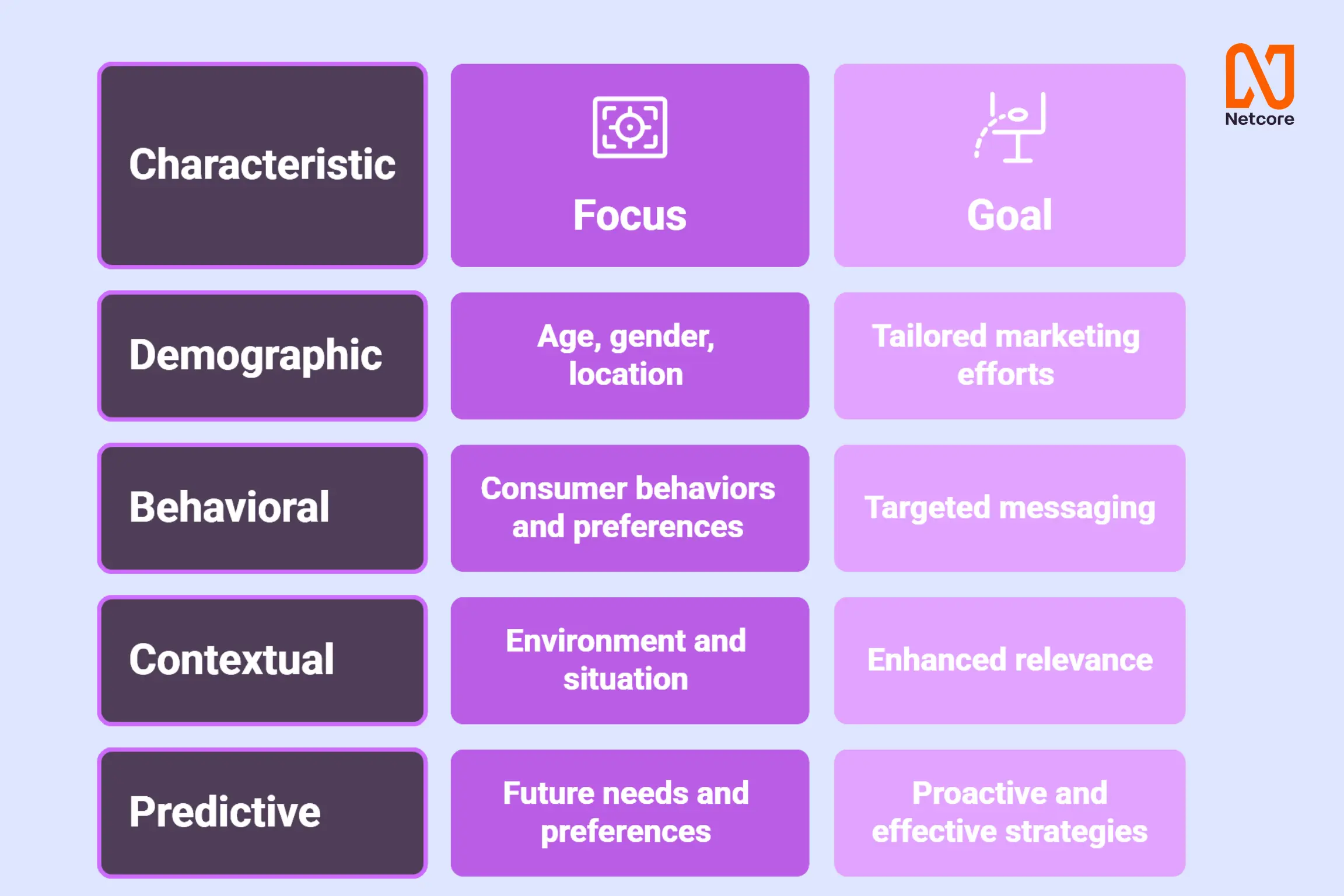
To architect a profitable personalization engine, you must understand the four distinct layers of campaign intelligence. You cannot rely on just one; they must work in tandem.
- Demographic Personalization
The baseline. Tailoring content based on age, location, gender, and language. Useful for broad categorization, but completely insufficient for driving high-intent e-commerce conversions on its own.
- Behavioral Personalization
Triggering experiences based on exact user actions. This includes cart abandonment flows, browser behavior emails, and sticky web bars that react to mouse movements, indicating exit intent.
- Contextual Personalization
Adapting the message based on the user’s current environment. Changing product recommendations based on live weather data, local store inventory, or the specific device the user is holding.
- Predictive Personalization
The pinnacle of agentic intelligence. Forecasting what a customer will want before they know it. Using machine learning to trigger replenishment campaigns based on both frequent and irregular buying patterns.
So what does this mean for your results? Mastering all four layers ensures you aren’t leaving money on the table. Predictive campaigns alone can drive up to a 15% increase in repeat purchase rates by catching the customer right before they run out of a consumable product.
What are Real-world Personalization Marketing Examples?
Theory does not impress the C-suite. Concrete use cases do. Here is how leading enterprise brands use Netcore to turn raw data into highly converting touchpoints.
1. Search Intelligence and Dynamic Recommendations
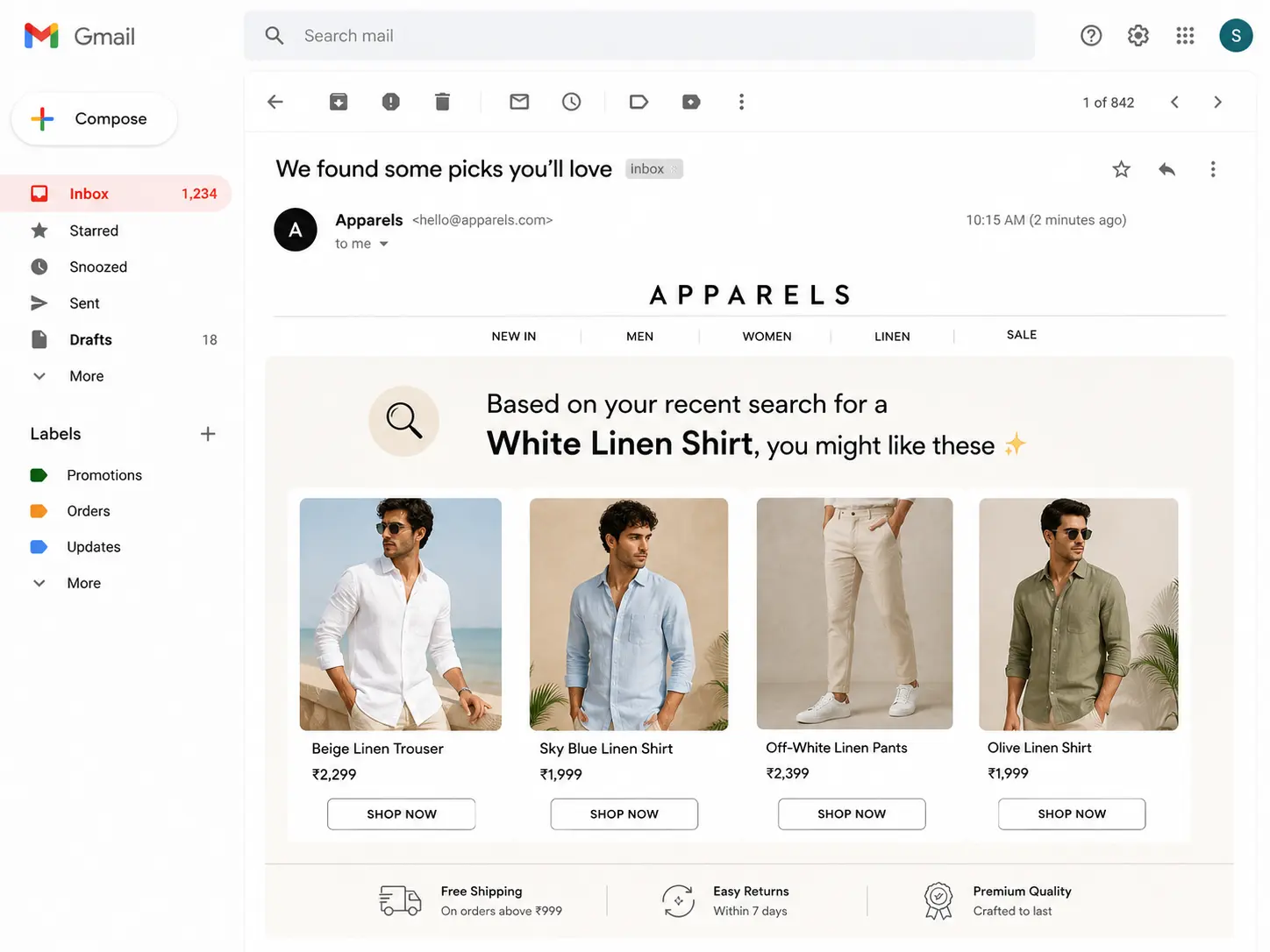
Generic product grids kill conversions. When a user searches your site, the engine must adapt instantly. If a user receives a browser behavior email that says, “Based on your recent search for a White Linen Shirt, you might like these,” you are capturing high-intent interest. If the price drops later, an autonomous trigger sends: “Good news! The price of the White Linen Shirt has dropped.”
2. Predictive Replenishment Campaigns
For consumable goods, timing is everything. Our AI tracks frequent and irregular buying patterns. If a customer typically buys moisturizer every 45 days, the system autonomously triggers a cross-sell recommendation on day 40: “Customers who bought this moisturizer also bought our new shower gels. Subscribe and save on your favorite products!”
3. Milestone-Driven Loyalty Triggers
Retention is cheaper than acquisition. Integrating personalization into your loyalty program guarantees relevance. When a user hits a milestone of 10 transactions, they don’t just get a generic thank you. They receive tailored VIP communications: “You’ve made 10 purchases! Share your milestone with friends.” or “As a Gold member, enjoy free shipping on all orders.”
So what does this mean for your results? These are not hypothetical concepts; they are revenue-generating realities. By implementing search intelligence and dynamic loyalty triggers, our clients routinely see significant increases in items per order and massive drops in zero-result search queries.
Marketing Personalization Strategies
You must architect your experiences to respect the modern consumer’s attention span. We adapt the traditional sales framework into a digital personalization blueprint for building marketing personalization strategies:
- 3 Seconds to Capture Attention: Your app or website’s hero banner or the email subject line must dynamically adapt to the user’s last known data point. If they are an active shopper, show them their recently viewed items instantly. No generic welcomes.
- 3 Minutes to Build Trust: Provide immediate value through seamless UX. Use dynamic content blocks to highlight localized shipping policies or display user-generated reviews specifically for the product categories they browse.
- 3 Touchpoints to Drive Action: Do not rely on a single channel. Orchestrate a coordinated sequence, an in-app message/a nudge, an email, and a timely push notification that gently guides the user toward conversion without overwhelming them.
So what does this mean for your results? Applying this structured framework ensures your marketing personalization is disciplined. It prevents you from annoying customers with excessive messaging, thereby protecting your brand equity while optimizing your conversion funnels.
How do you Overcome the Privacy Paradox in a Cookieless World?
Personalization at scale requires data, but consumers are increasingly fiercely protective of their privacy. This is the modern marketing paradox: buyers demand 1:1 relevance, but they will not tolerate invasive tracking.
With third-party cookies depreciating, enterprise brands must pivot aggressively to zero- and first-party data strategies. You must earn the right to personalize.
This is done through transparent value exchanges. When you prompt a user with, “Set your preferences to receive product recommendations tailored just for you,” you are engaging them in a mutually beneficial contract. You are offering a better, faster shopping experience in exchange for their explicitly granted data.
A unified platform makes this seamless. Because the CDP centralizes consent management alongside behavioral data, you ensure that every personalized touchpoint is fully compliant with global privacy regulations.
So what does this mean for your results? Transitioning to first-party data removes your reliance on rented audiences. You build an owned asset of highly engaged subscribers, insulating your revenue streams from the whims of browser updates and algorithm changes.
Final Take
The shift from manual campaign execution to autonomous personalization is no longer optional; it is the only way to predictably scale e-commerce revenue. If you continue relying on fragmented data silos and rules-based triggers, your team will remain trapped in operational busywork while competitors capture your market share. We tear down these data silos by introducing an agentic intelligence layer that makes real-time decisions on your behalf. By focusing entirely on outcomes rather than just message delivery, you regain absolute control over your customer journeys. It is time to transition your strategy from basic segmentation to predictive, autonomous orchestration.
Ready to build your autonomous revenue engine? Talk to us.