




The way customers move has changed. The way we optimize hasn’t.
Today’s customer doesn’t follow a script. They open an email on their commute, ignore a push notification, respond to an SMS three days later, and convert through an in-app message they almost didn’t see. The journey is non-linear, multi-channel, and deeply personal.
Yet most marketing optimization strategies are still built around a fundamentally different assumption: that journeys can be improved one step at a time.
They can’t. And the gap between how customers actually behave and how we optimize for them is quietly costing conversions every day.
The Real Problem Isn’t Your Messages. It’s How You’re Testing Them.
Most teams are running A/B tests. Subject lines, send times, channel selection—variable by variable, campaign by campaign. And while these tests produce data, they rarely produce clarity.
Here’s why: a message doesn’t convert in isolation. It converts as part of a sequence—shaped by what came before it, how long the user waited, and which channel delivered it. Testing individual elements tells you what performs best in a vacuum. It tells you almost nothing about what drives outcomes in the real world.
The result is a familiar frustration: teams that are constantly optimizing, but never quite sure which combination of decisions is actually responsible for results.
Three structural gaps drive this problem:
Cross-channel blind spots. Traditional A/B tests evaluate steps. They don’t evaluate systems. You can learn that Email A outperforms Email B—but you can’t learn whether Email → SMS outperforms Push → Email → SMS, at different timing intervals, with different creative pairings.
Combinatorial complexity. The moment you move beyond single-variable testing, the number of permutations becomes unmanageable. Multi-step, multi-channel journey testing at scale simply can’t be done manually without sacrificing either speed or rigor.
Reactive analysis. Without continuous path-level measurement, optimization becomes an after-the-fact exercise—something you do when a campaign underperforms, not a system that prevents underperformance in the first place.
The gap isn’t in your creative or your channels. It’s in your ability to test and learn at the journey level.
Introducing Journey Path Optimizer

Journey Path Optimizer is a new AI-powered capability built directly into your journey builder—designed to identify, test, and automatically scale your highest-converting multi-channel journey paths.
It shifts the unit of optimization from the individual message to the complete journey. And it does so continuously, without manual intervention.
How It Works
Step 1: Define Multiple Journey Paths
Within a single campaign, you can now build and run multiple journey variations simultaneously. Vary the channel mix, the sequence of touchpoints, the timing between steps, and the message or creative at each stage. Every variation runs concurrently—ensuring statistically valid comparisons across real user behavior, not hypothetical projections.
Step 2: Continuous Behavioral Analysis
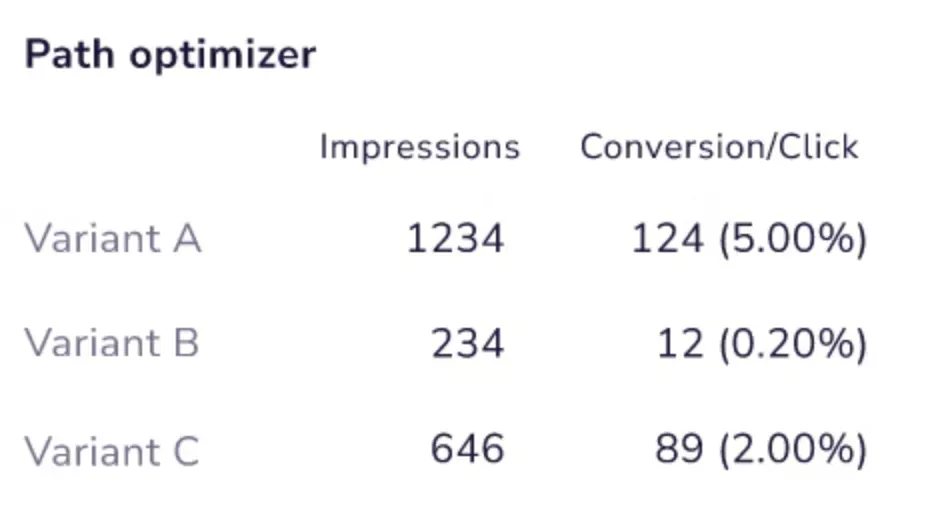
As users move through their journeys, Journey Path Optimizer tracks performance at the path level—not just the step level. Impressions, click-through rates, and conversions are measured against your defined goals, and the system continuously evaluates which complete journey structure is driving the strongest outcomes.
This is a fundamentally different lens. You’re no longer asking “which email performed best?” You’re asking “which sequence of decisions, across which channels, at which cadence, produces the highest conversion rate?”—and getting a live answer.
Step 3: Automatic Traffic Allocation
As confidence in path-level performance builds, the system dynamically shifts traffic toward higher-performing journeys in real time. Underperforming paths don’t get paused manually—they simply receive less traffic as the algorithm optimizes allocation. High-performing paths scale automatically.
The outcome: your campaigns continuously improve without requiring manual reconfiguration, campaign duplication, or reactive analysis.
What Changes for Your Team
For marketing leaders: Journey Path Optimizer delivers the conversion lift that incremental optimizations have never been able to provide. By optimizing the journey as a system rather than a set of disconnected steps, you unlock compounding improvements in campaign ROI—with far less operational overhead.
For marketing practitioners: It eliminates the manual work of comparing journey variants across exports and spreadsheets, and replaces reactive optimization with a continuous, automated system. You design the experiments; the platform runs them and acts on the results.
Built-In Visibility at Every Stage
Automation without transparency isn’t optimization—it’s a black box. Journey Path Optimizer is designed to keep your team informed and in control throughout.
Available now:
- Real-time user impressions across all active paths
- Conversion and click-through tracking against defined goals
- Path-level performance summaries within the optimizer node
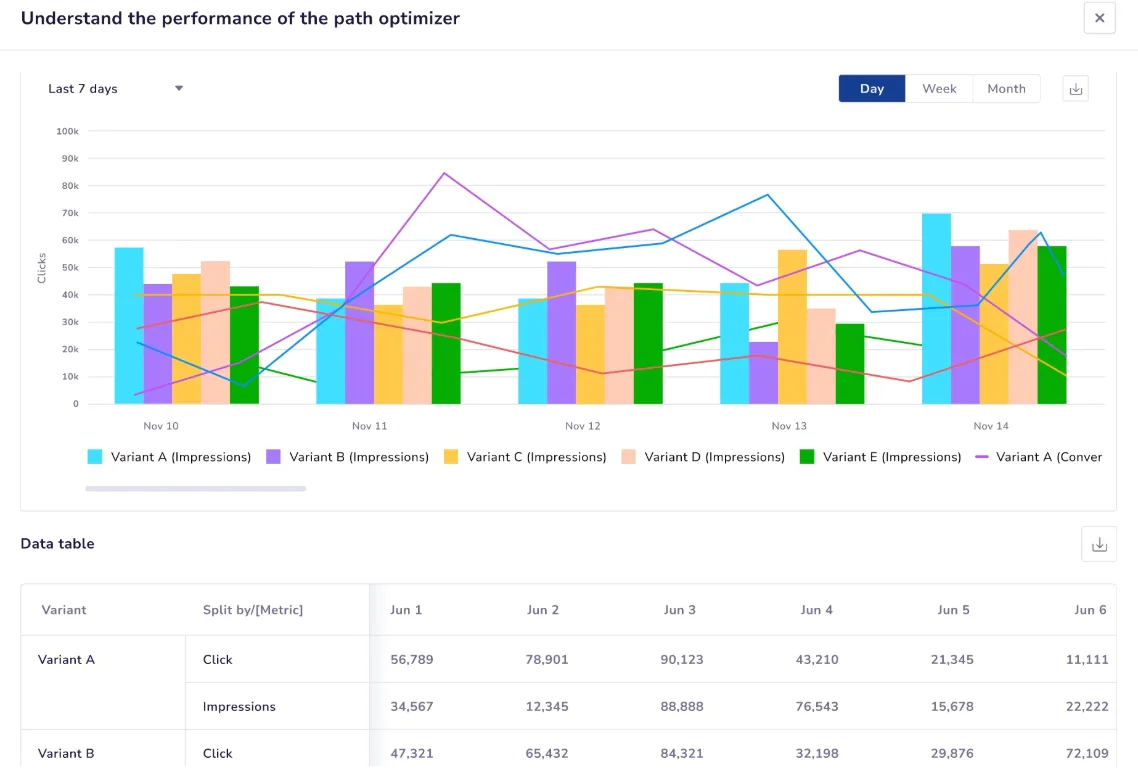
Coming soon:
- Day-wise journey path analysis for granular trend visibility
- Visual performance graphs embedded directly within journeys
- Comprehensive CSV export of optimizer data
- Advanced analytics for deeper exploration across campaigns
The Standard for What Optimization Should Be
The era of single-variable testing had its moment. It helped teams move faster than intuition alone. But customer journeys have outgrown it.
The teams that will win the next phase of marketing aren’t the ones with the best individual messages—they’re the ones with the best systems for discovering which journeys work and scaling them automatically.
Journey Path Optimizer is that system.
It’s available now. Log in to your journey builder to get started.