




If you’ve ever worked with a high-expectation consumer brand, you know the reality: massive seasonal spikes, emotionally charged purchases, and zero tolerance for delay. There’s no room for “we’ll analyze this tomorrow.”
Now layer in the complexity of gifting.
In most ecommerce categories, a delayed campaign means a missed revenue opportunity. In gifting, it can mean a missed birthday, an anniversary, a once-a-year moment that doesn’t come back. Timing isn’t just a performance metric; it’s the emotion itself. The surprise. The “I remembered.” The “I’m sorry.” The “I love you.” When your value proposition is tied to real-world deadlines, marketing decisions cannot lag behind data.
That was the inflection point for a leading D2C gifting platform.
They realized that dashboards and generic AI prompts weren’t enough. When campaigns needed to be optimized at 3:15 PM for a 3:30 PM push, insight had to translate into action instantly. So they moved from a standalone generic AI chatbot to an insights-driven AI agent powered by Netcore, one that didn’t just analyze campaign data, but operationalized it in real time.
The Problem
Most high-growth consumer brands don’t have a data shortage. They have a signal shortage. This brand was sitting on tons of campaign history data, segments, time windows, and creative variations. But the insights they desperately needed were buried in the noise:
- Each stage of the campaign performed differently – Click-through rate (CTR) and conversion rate changed from one stage to another.
- CTR spikes – Engagement (CTR) went up and down at different times of the day, but deeper segment-level patterns were missed.
- Unaddressed behavioral patterns – Conversion rate and drop-off trends weren’t fully analyzed by generic chatbots.
When you’re running “always-on” campaigns alongside high-stakes seasonal peaks (Valentine’s Day, Mother’s Day, Holiday), the cost of delayed learning is brutal. If you learn on Tuesday what you needed to know on Monday, you’ve already paid for it.
So the marketing team made a clear shift, moving beyond generic AI co-pilots to a campaign-native intelligence layer. This new approach was built to analyze customer engagement patterns, identify high-intent segments most likely to engage and convert, and activate marketing data in a way that aligns with how marketers actually think and ask questions.
Enter Insights Agent
They used Netcore’s Insights Agent, an AI tool that turned campaign data into instant, clear decisions. No SQL. No messy dashboards. No manual analysis.
For this gifting team, the magic was in the fact that the system was providing faster time to richer insights. It helped them answer questions in the exact context that marketing data lives in:
- “What worked last year in a particular time period and why?”
- “Which CTA placement actually moved the needle on engagement?”
- “If I have to send at 11 AM today, what do I need to know before I hit ‘go’?”
They weren’t looking for a report. They were looking for direction, fast!
Breakthrough 1: Building a “Best-in-Class” Timing Habit
Most brands follow the same playbook. Industry benchmarks consistently point to the 9–11 AM window as the safest bet for engagement. Tuesday mornings. Midweek sends. Local-time optimization. It’s validated by studies. Reinforced by platforms. Automated through STO. This brand did the same.
On the surface, the data agreed. Mid-morning drove solid open rates. The dashboards looked healthy. Timing felt “optimized.”
But the Insights Agent didn’t stop at opens. When it analyzed performance by revenue, not just engagement, a clearer picture emerged. The 9–11 AM spike was real, but it was driven by opens, not revenue. Users opening at 10 AM were habitual openers, consistent, but average in order value. The real revenue concentration was happening elsewhere. A narrower late-afternoon window, with lower inbox competition, consistently delivered higher conversion rates and stronger AOV from repeat buyers. This pattern wasn’t visible in aggregate reporting; it only surfaced when performance was segmented by buyer value, device behavior, and purchase frequency.
This insight reshaped how the team approached timing. The 9–11 AM window became the control group, a benchmark for engagement. The late-afternoon slot became the profit lever, optimized for conversions and revenue. High-impact campaigns were scheduled deliberately in this window, and tests were built around it. Timing was no longer treated as a background automation setting, but as a strategic variable directly tied to revenue, not just engagement.
The lesson wasn’t that benchmarks are wrong. It was that optimizing for “best open time” can quietly cap growth. The compounding returns came from shifting the question from
“When do people open?” to “When do our most valuable customers buy?”
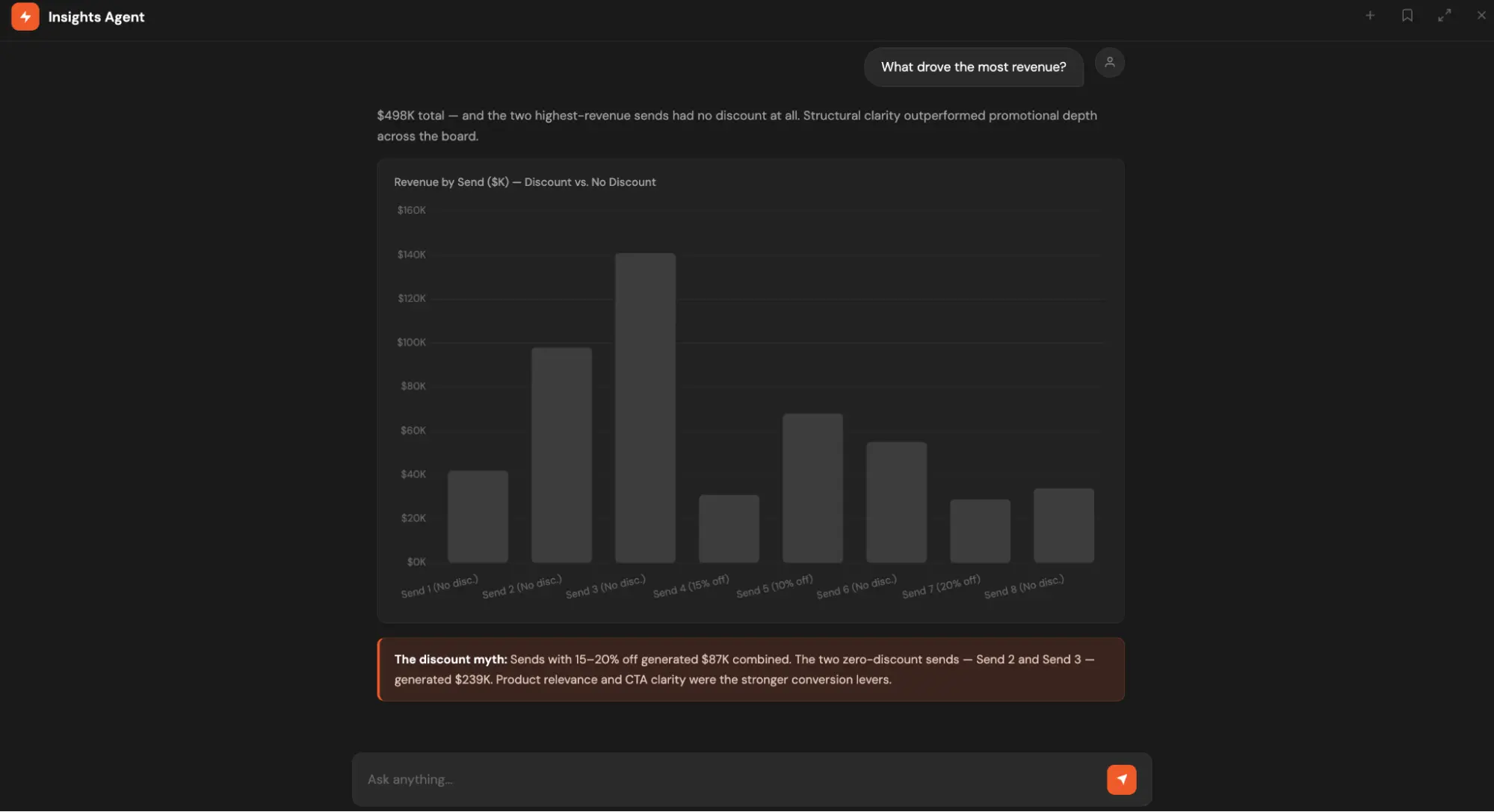
Pictographic representation of the Insight’s Agent in action.
Breakthrough 2: The Valentine’s Day Win (Hiding in Plain Sight)
For years, the brand approached Valentine’s Day with confidence. The campaign had structure, emotional storytelling, and a clear progression from early inspiration to last-minute urgency.
But when performance was reviewed, the analysis was always broad. Valentine’s Day was treated as one consolidated effort, revenue up or down, engagement strong or weak. Wins were attributed to “seasonal demand,” and underperformance was chalked up to timing or fatigue. The campaign functioned as a single narrative, and the nuance inside it was largely ignored.
The Insights Agent changed that.
Instead of evaluating Valentine’s Day as one large campaign, it broke down every send structurally, analyzing CTA hierarchy, footer interactions, click distribution, and downstream purchase behavior. It isolated performance variables instead of judging the campaign as a whole. And that’s where a surprising pattern emerged.
One of the historically highest-performing sends did not win because it had the strongest discount or the most emotive subject line. It wasn’t louder. It wasn’t more urgent. It wasn’t more creatively ambitious.
It simply included two clear footer CTAs: “Gifts for Her” and “Gifts for Him.”
At first glance, that detail felt minor. But when the agent mapped click behavior and conversion paths, the impact became clear. Emails that gave customers an immediate way to self-identify the recipient consistently reduced browsing friction. Customers clicked faster. They explored deeper. They converted sooner. Average order value trended higher in those sessions.
In contrast, emails that relied solely on broad collection CTAs such as “Shop Valentine’s Collection” required shoppers to do the mental sorting themselves. They had to decide who they were shopping for, filter options, and navigate category structures before feeling momentum. That extra cognitive step, small but measurable, translated into lower engagement depth and longer conversion lag.
The insight wasn’t about creativity. It was about cognitive load.
By giving customers a simple, recipient-led decision point, the brand removed ambiguity. It allowed shoppers to declare intent in one click. Once intent was declared, everything downstream became sharper, recommendations aligned more accurately, product grids felt more relevant, and the purchase journey tightened.
The Results: Real Lift, Not Vanity Lift
- Open rates: Jumped by 52%
- Click-through rates (CTR): Rose by 300%
The change wasn’t cosmetic. It materially altered customer behavior, and crucially, the growth came from learning faster, not just sending more emails.
Breakthrough 3: Real-Time Marketing (The Sunday Sports Drop)
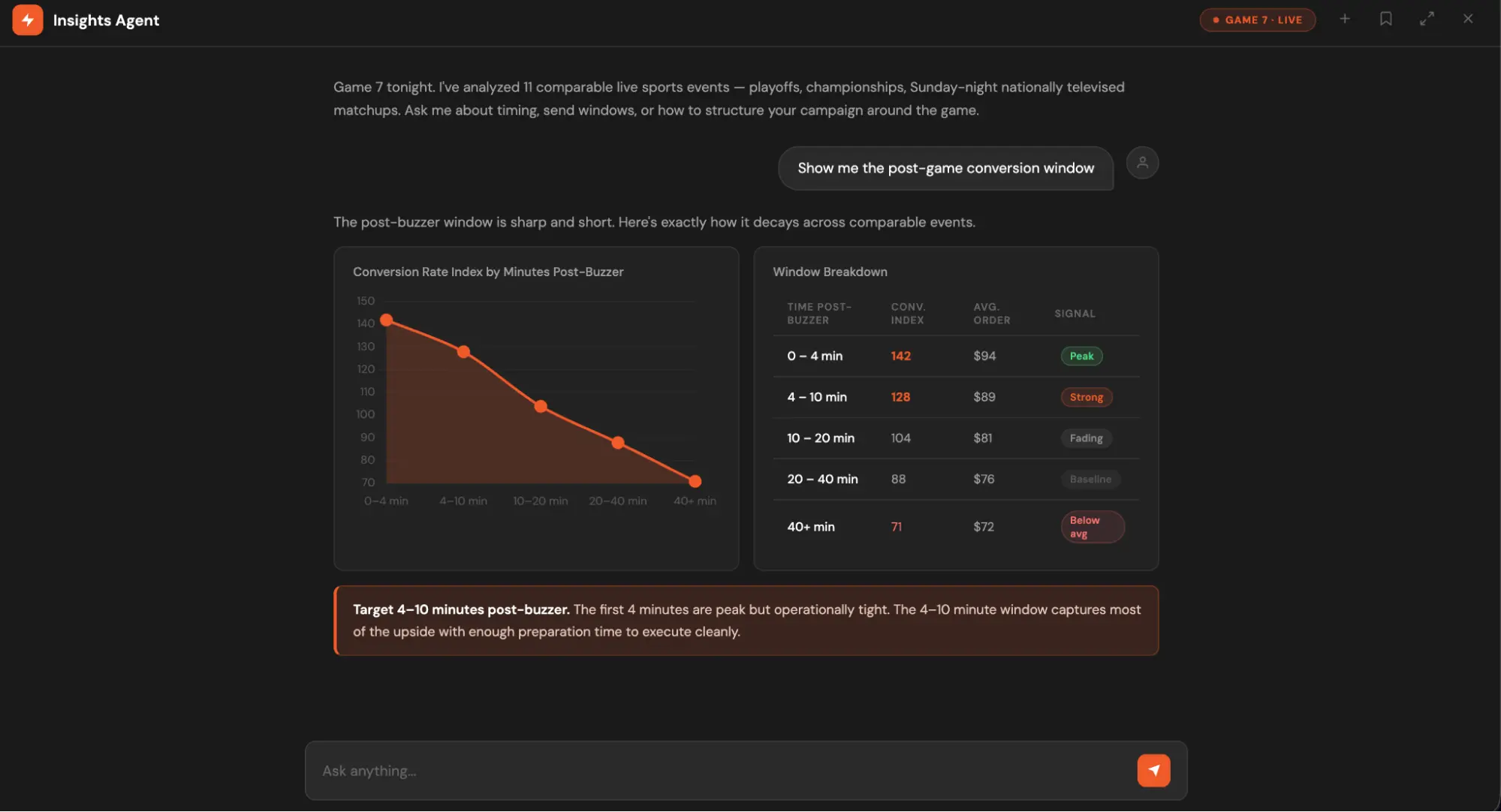
Insights Agent became the team’s real-time copilot during a high-stakes cultural moment.
It was Game 7 of the NBA Finals, a Sunday night with massive national attention. The brand had a limited-time bundle ready, creatively aligned to championship energy and designed to capitalize on peak engagement. But the timing risk was significant.
Send too early, and the audience is still fully immersed in the broadcast.
Send during peak gameplay, and attention is fragmented.
Send too late, and the emotional momentum fades into post-game commentary.
The window wasn’t broad. It was narrow and behavior-dependent.
The team used the Insights Agent to analyze historical performance across comparable high-intensity sports moments, playoff games, nationally televised matchups, and prior Sunday-night traffic spikes. Instead of defaulting to a fixed send time, the agent identified micro patterns within live-event timelines: engagement lift during halftime browsing, subtle mobile activity spikes late in the fourth quarter, and a sharp but short-lived conversion window immediately after the final buzzer.
Based on those patterns, the team structured its execution intentionally. They deployed a light teaser during halftime to seed awareness without demanding action. The primary drop went live within minutes of the final whistle, while emotional intensity was still high and second-screen behavior was peaking.
It was about aligning with behavioral momentum in real time. The campaign landed inside the moment instead of adjacent to it, and that precision materially improved engagement and conversion performance.
The Takeaway: Stop Doing Post-Campaign Archaeology
Let’s be blunt: Generic chat interfaces can help you think. Insights Agent helps you decide. This team didn’t switch tools because one AI was inherently “smarter.” They switched because one tool is built entirely around the performance of the campaigns, patterns in engagement, timings, and more!
By the end of the cycle, the brand validated something massive: Insights Agent isn’t a reporting layer. It is a tool that makes you a 10X MARKETER.
It allowed them to stop treating insights as a reactive, “post-campaign” chore, and start treating them like a live instrument panel to drive faster loops, smarter bets, and a whole lot less guesswork.
Check out Insights Agent today!