




Picture this. You’re two weeks into a campaign. One variant of your cart abandonment journey is clearly working — your WhatsApp branch is pulling a 9.4% conversion rate against the Email branch sitting at 3.1%. Every marketer on your team can see it. And yet, you’re still sending half your users down the Email path because the testing window isn’t technically over.
That’s not a hypothetical scenario. That’s how most A/B testing in customer journeys works. You set a split, you wait, you call a winner manually, you republish.
Trial and error, manual effort, siloed A/B tests – that’s a lot of steps. Somewhere in that waiting window, real users went through the losing variant. Those conversions are gone. They don’t come back when you update the journey.
Journey Path Optimizer, powered by Netcore Decision Agent, is built to end that cycle. It’s an AI-powered node you drop into your journey canvas that automatically routes users to the best-performing branch — in real time, while the journey is live.
Four ways static A/B testing is quietly costing you conversions
The marketers who get the most value from Journey Path Optimizer usually come to it after feeling each of these problems personally. If any of them sounds familiar, you’re already in the right place.
- Traffic waste: A standard A/B test holds traffic evenly for the entire test window — often 2 to 4 weeks. If one variant starts outperforming the other in week one, you can see it. You still send half your users to the loser until the test ends. Those conversions are permanently lost.
- Decision lag: By the time you have enough statistical confidence to declare a winner and update the journey, campaign conditions may have already shifted. A competitor ran a flash sale. It’s now peak season. The product offer changed. A static test can’t adapt to any of this — and neither can you, until the test is “done.”
- Manual overhead: Someone has to monitor the test. Someone has to call the winner. Someone has to update the journey, re-publish it, and document the change. None of that is campaign work — it’s operational debt sitting on top of actual campaign work, every single time you want to run an experiment.
- Sequential testing bottleneck: Want to know whether WhatsApp beats Email and whether a 2-hour delay beats a 12-hour delay and whether a coupon beats urgency copy? That’s three separate experiments. Months of sequential testing to answer questions that should take days.
| “The only way to know if WhatsApp beats Email for your recharge reminder isn’t intuition — it’s evidence. The problem is that evidence takes time you don’t have.” |
Meet Journey Path Optimizer: Move from A/B tests to automated experiments in real-time
When you add a Path Optimizer node to your journey and publish, the journey starts distributing users evenly across all your variant branches. Week one looks like a normal A/B test. Then things get interesting.

Here’s how it works:
- Users are initially distributed evenly across multiple paths in a journey.
- Journey Path Optimizer evaluates each path based on conversion goals set by the marketer.
- As data comes in, it identifies the best-performing path—and dynamically routes future users to it.
- This process never stops. Journey Path Optimizer continues testing and reallocating in real time to maximize ROI.
What makes Journey Path Optimizer stand out are its key features:
- AI-Powered Optimization: Continuously identifies the highest-converting journey paths and automatically reallocates traffic.
- Multi-Dimensional Testing: Run up to 5 variants, with multiple optimizer nodes across a single journey.
- Fully Automated Operation: Marketers choose conversion goals and distribution modes, Journey Path Optimizer handles the rest.
- Real-Time Monitoring: Track user distribution, conversions, and performance insights instantly.
- Effortless Scalability: Easily test combinations of content, channels, and timing across user segments, minimal dev overhead required.
- Adaptability to Change: Whether it’s a seasonal spike or a shift in user behavior, Journey Path Optimizer adjusts on the fly.
| With Journey Path Optimizer, experimentation becomes a living part of your customer engagement strategy, constantly evolving, always optimizing. |
A static test commits to an allocation and holds it until you manually intervene. Our Path Optimizer treats allocation as a variable — one it keeps adjusting based on what’s actually happening in your journey, in real time, for the entire life of the campaign.
How teams across industries use Journey Path Optimizer
The obvious answer isn’t always right. That’s the whole point.
The most common mistake brands make when they first use Journey Path Optimizer is assuming they already know which variant will win. Sometimes they’re right. But more often than not, the data surprises them — and the surprise is where the real value is.
Here’s how teams across different industries are putting it to work. These reflect the kinds of experiments actively running on 23+ live journeys as of early 2026.
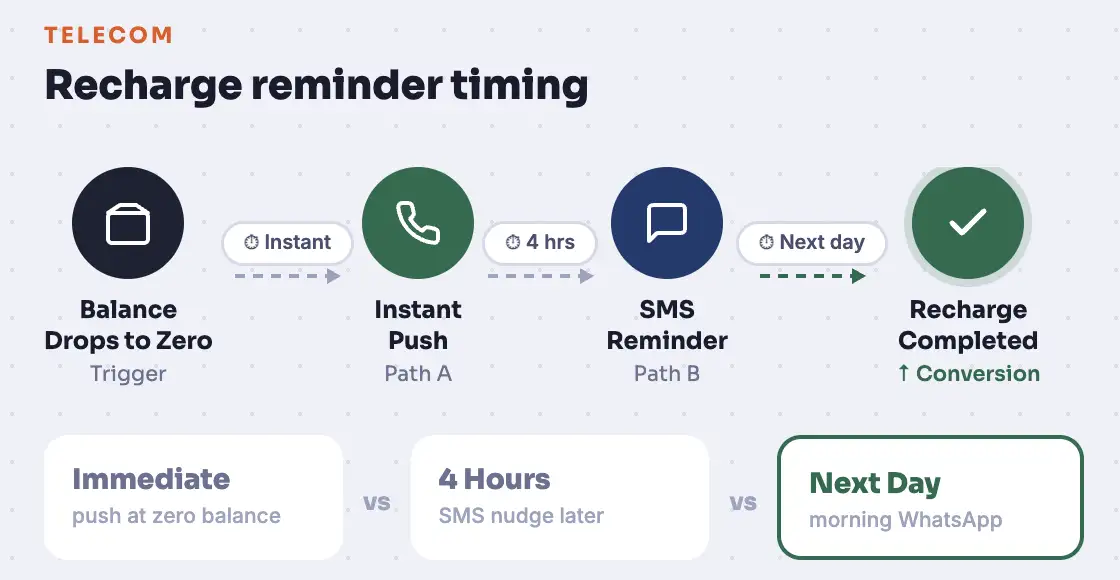
1. The Timing Test — Telecom: Finding the “Golden Hour” for Recharge Reminders
A prepaid subscriber’s balance just hit zero. You have one shot at a recharge prompt — but when you send it matters as much as what you say.
Set up three paths triggered the moment a user’s balance drops: an immediate push notification, one sent four hours later, and one the next morning. Each path carries the same offer. The only variable is timing.
Journey Path Optimizer monitors which delay produces the most completed recharges and begins routing users toward that window automatically. If your data shows that users who receive the nudge four hours later convert at nearly double the rate of the immediate send, the system shifts traffic — no analyst required, no re-publish needed. You stop interrupting users who aren’t ready and stop missing users who are.
2. The Budget Saver — BFSI: Cutting Cost-Per-Conversion on Loan Reminders
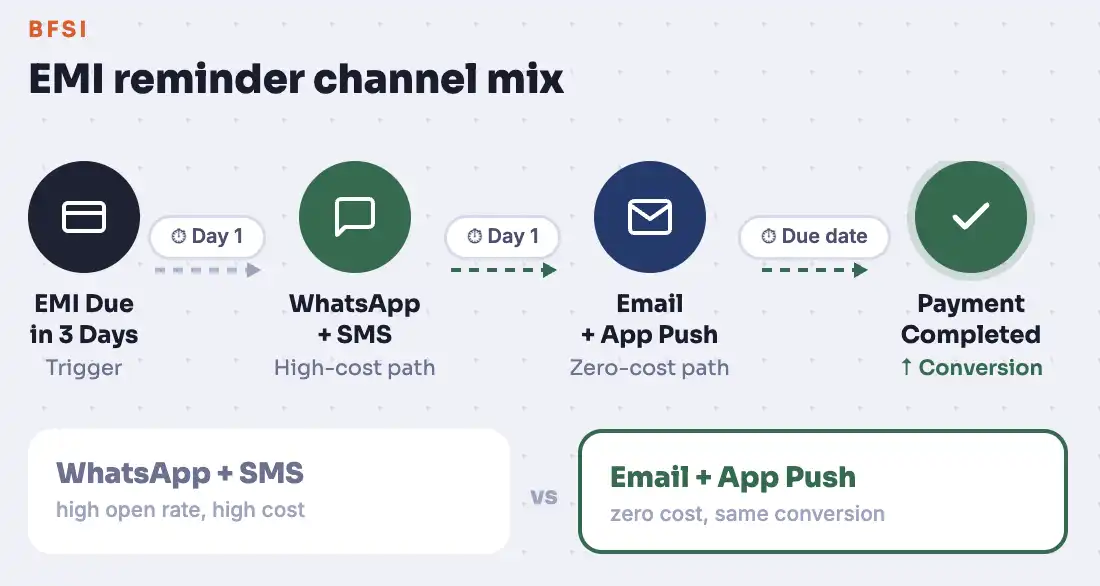
EMI reminders are non-negotiable. But sending every reminder via WhatsApp or SMS when email or in-app push might do the same job is a budget leak hiding in plain sight.
Create two paths for your monthly due-date reminder journey: a High-Cost Path (WhatsApp + SMS) and a Zero-Cost Path (email + app push). Both carry identical messaging. Journey Path Optimizer tracks repayment completion rates and cost-per-conversion in real time across both.
If the free channel path holds its own on conversion while slashing message costs, the optimizer shifts volume there automatically. If the premium channels prove their worth, the budget is justified with data, not assumptions. Either way, you stop paying a premium by default.
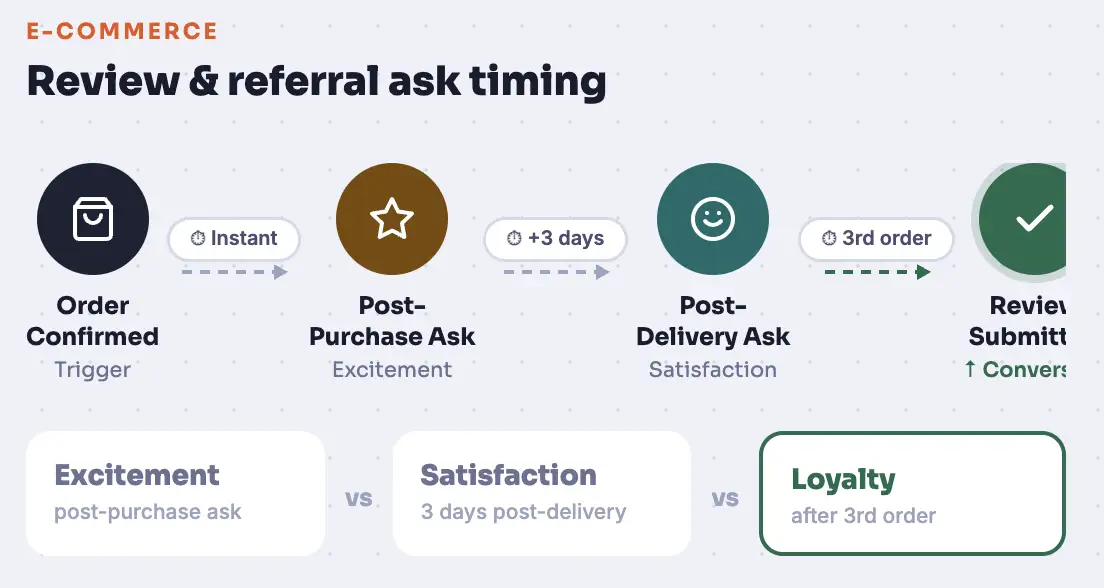
3. Offers and Promotions — E-commerce: Timing the Ask for Reviews and Referrals
A review request is only as good as the moment you send it. Ask too soon and the product hasn’t arrived. Ask too late and the excitement is gone. Ask at the wrong lifecycle stage and you’re just noise.
Set up three paths that trigger the review or referral ask at different milestones: immediately after order confirmation (riding the excitement of the purchase), three days post-delivery (when satisfaction has settled in), and after the customer’s third order (when loyalty has been established). Journey Path Optimizer tracks which milestone actually results in a completed review submission — not just an email open.
Over time, traffic shifts toward the stage where users are most receptive. The result is more reviews collected with fewer requests sent, and a referral program that asks at exactly the right moment in the customer relationship.
4. Drive Attention — BFSI: Finding the Emotional Hook That Drives Insurance Renewals
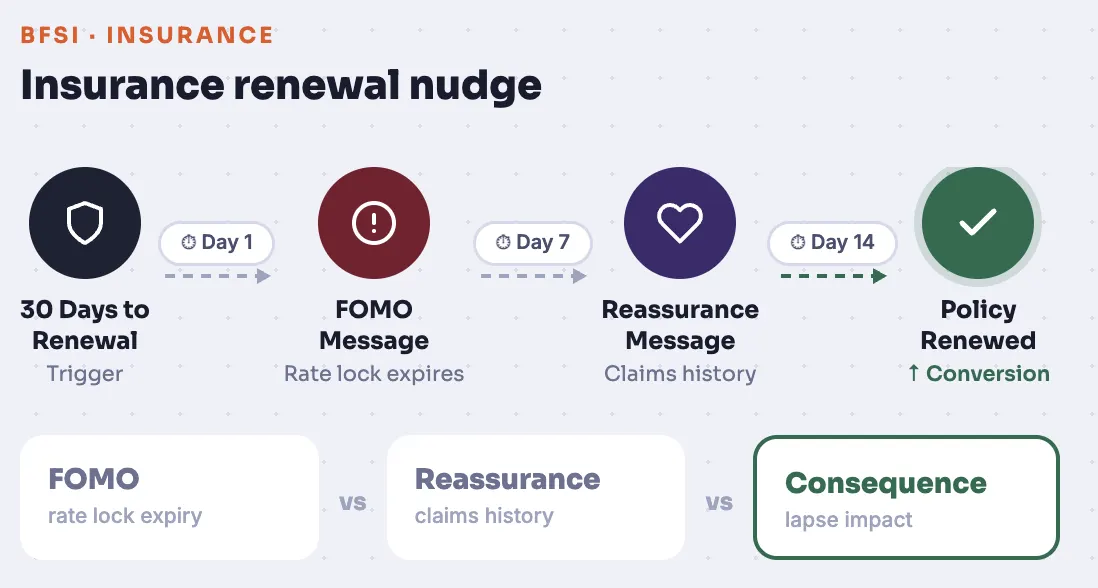
A policyholder’s renewal date is 30 days out. You need them to act. But the message that makes one person renew immediately makes another tune out entirely — and you won’t know which is which until you test it.
Build three renewal nudge paths, each pulling a different psychological lever. Path one leads with FOMO: their current premium rate locks in only if they renew before the deadline, after which rates may increase. Path two uses reassurance: a reminder of claims they’ve successfully made and the coverage that protected them. Path three leads with consequence: a clear, calm breakdown of what lapses in coverage would mean for their family or assets.
Journey Path Optimizer measures which narrative actually drives policy renewals — not just message opens or link clicks. As one story consistently outperforms the others, it funnels more of your at-risk renewal segment into that path automatically. You stop sending the same generic renewal reminder to every policyholder and start matching your message to the motivation that actually gets them to act — before the window closes.
BFSI — Loan offer journey: Which channel actually drives application clicks? Email with EMI calculator vs. App Push with “Apply Now” deep link → optimizing for Click Rate
Email gives you space to show an EMI calculator, build comfort, and pre-qualify the user mentally. App Push is frictionless — one tap to the application. The right answer depends on your audience’s loan literacy and where they are in the decision journey. Decision Agent figures that out per-audience as data accumulates.
Telecom — Recharge reminder Does cashback beat a direct link? SMS with direct recharge link vs. WhatsApp with cashback offer → optimising for Conversion Rate
Conventional wisdom says incentives drive conversions. But convenience often beats incentives for habitual actions like recharging — one SMS with a deep link to auto-fill the account can outperform a cashback offer that requires three more taps. Test it. Don’t assume.
EdTech — Free-to-paid conversion Countdown vs. consequence WhatsApp “7 days left in your trial” vs. App Push with countdown timer → optimising for Click to Upgrade
Language-based urgency and visual urgency tap different psychological triggers. Some segments respond better to being told; others to being shown. Path Optimizer figures out which is which without you having to manually segment and test separately.
BFSI · Insurance — Renewal nudge When the channel sequence itself is the experiment WhatsApp payment link → SMS follow-up vs. App Push → SMS with deadline urgency → optimising for Conversion Rate
This is a goal variation experiment — not channel vs. channel, but entire strategy vs. strategy. Two different channel sequences, two different user experiences. The kind of test that used to require months of sequential A/B experiments. Now it runs in parallel, automatically.
AI you can actually interrogate
The biggest barrier to AI adoption in marketing isn’t capability — it’s trust. Marketers don’t hand off decisions to systems they can’t understand. That’s a completely reasonable position.
Journey Path Optimizer’s analytics drawer is designed to solve that trust problem head-on. It doesn’t just tell you which variant won. It shows you when Decision Agent started shifting traffic, how much it shifted, and what performance looked like at each point along the way. You can see the system learning in real time.
The graph shows two things simultaneously: the performance trend per variant (the lines) and how impression share shifted between them over time (the bars). You can see Decision Agent learning — bars show where traffic went, lines show why. It’s a transparent audit trail, not a black box.
What 15+ enterprise clients found when they stopped guessing
Across 23+ active live journeys running on Journey Path Optimizer as of early 2026, spanning E-Commerce, Insurance, Retail, Healthcare, and Financial Services, the results are consistent enough to talk about publicly.
200% — peak lift in click-through rate in live production environments 24.7% — uplift in total conversions versus traditional manual routing 40–102% — average engagement boost across active journeys
The 40–102% engagement range tells you something important. The variance exists because what you test matters. Clients testing entire channel sequences against each other see higher lifts than those testing copy variations within the same channel. The more meaningful the difference between variants, the more room Decision Agent has to work with.
| “The clients getting the biggest lifts aren’t the ones with the most sophisticated journeys. They’re the ones willing to put genuinely different strategies in each variant branch — not just changing the subject line.” |
What good experimentation looks like with Path Optimizer
- Test variants that are meaningfully different. Changing the subject line from “Your cart is waiting” to “Don’t miss out” is fine — but it won’t give you the lift of testing WhatsApp urgency against Email nurture. The bigger the strategic difference, the more Decision Agent has to work with and the faster it finds a winner.
- Start with your highest-traffic journeys. Decision Agent needs data to learn. Low-traffic journeys take longer to optimize. Your cart abandonment or reactivation flows, where thousands of users move through every week, are the right starting point.
- Pick one metric and commit to it from the start. You can change the success metric after publishing, but changes only apply to future user entries. Set it correctly upfront: Conversion Rate if you have a Journey Goal configured, Click Rate if you don’t.
- Don’t re-deploy mid-experiment without reason. Re-deploying resets the optimizer — it starts fresh with no prior winner data. If you’re making significant structural changes, that makes sense. If you’re tweaking copy, do it within the existing deployment.
- Use the analytics drawer for stakeholder reporting. Export the graph as a PDF and the data table as CSV. Paste it directly into your monthly marketing review. The data does the explaining for you.
Change the Game with Journey Path Optimizer
Journey Path Optimizer is a powerful growth engine designed for marketers who want results, fast. With the power of Decision Agent at its core, Journey Path Optimizer enables instant decision-making, adapts to shifting user behaviors in real time, and ensures that your campaigns are always aligned with what your audience wants now, not what worked last quarter.