




Let’s be honest for a second: Email marketing still delivers the highest ROI compared to any other marketing channel. That is an undisputed fact.
But here is the uncomfortable truth: ROI means absolutely nothing if your platform cannot scale with customer expectations.
The gap between what customers want and what brands deliver is widening. Today, 42% of consumers explicitly expect personalized promotions. Nearly 70% expect brands to use their purchase history to craft personalized messaging. They don’t just want you to know their name; they want you to anticipate their needs.
The pressure on enterprise brands is real. According to recent Gartner data, over 33% of marketing organizations are expected to adopt agentic AI for autonomous decision-making by 2028. If your stack is still stuck in the “batch and blast” era, you aren’t just missing out on revenue; you’re actively hurting your brand reputation.
For modern marketers, finding the best email marketing solution isn’t about ticking boxes for basic templates. It’s about finding a partner that offers “Brand Twin” autonomy, zero-party data strategies, and frictionless “zero-hop” purchase journeys.
So, what does a future-ready stack look like? We’ve broken down the 10 mission-critical functionalities your email marketing solution needs to dominate the inbox in 2026.
Introduction: The Shift to Agentic Marketing and Shoppable Commerce
Consider the architecture of your current campaigns. Most legacy platforms were built for a desktop-first world. Yet, mobile email opens have surged in recent years. Over 50% of all emails are now opened on mobile devices, and one in three clicks happens on a small screen.
But this isn’t just about mobile optimization or responsive design. It is about behavioral responsiveness.
Rule-based systems work great when customer journeys are linear and predictable. But in 2026, buying patterns are dynamic and chaotic. A customer might browse on an app, click an email, abandon a cart, and then visit a physical store. A static email platform cannot keep up with that velocity.
This is where Agentic Marketing enters the chat.
Instead of marketers manually orchestrating every single touchpoint, intelligent AI agents anticipate customer states and respond in real-time. Paired with Shoppable Commerce, which turns the email itself into a functional storefront, this shift eliminates the friction between discovery and purchase.
Whether you are evaluating a new partner or auditing your current infrastructure, these ten capabilities are the foundation of a program that operates as a customer intelligence network, not just a message delivery system.
1. Shoppable Emails
The traditional customer journey is broken. Every time you ask a user to “Click Here,” wait for a browser to load, and navigate a landing page, you lose a percentage of your audience. These are abandonment points.
In 2026, the best email marketing solutions don’t just reduce friction; they eliminate it via Shoppable Emails.
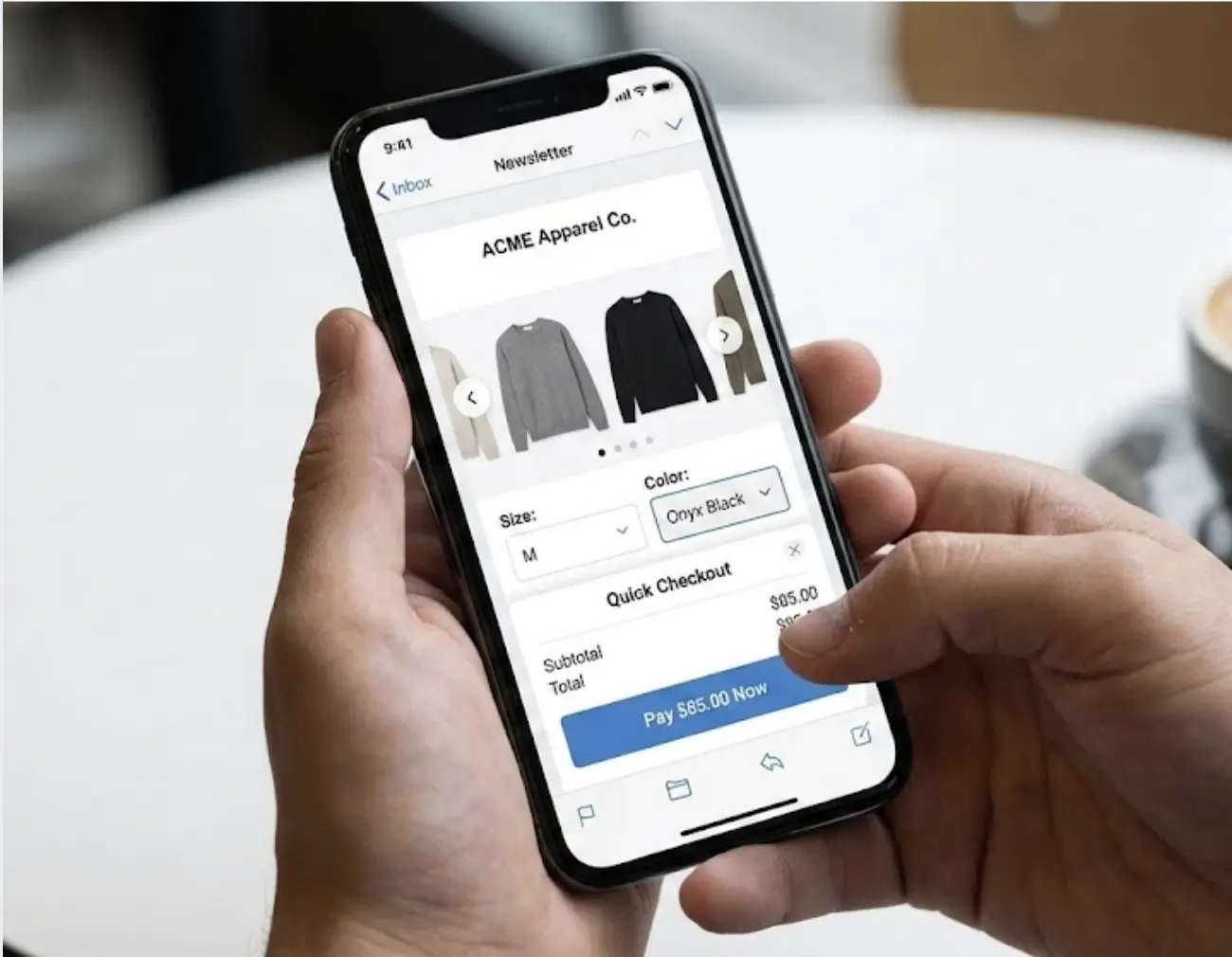
Here’s What Shoppable Emails Look Like in Action
The “Zero-Hop” Purchase Journey using AMP
Powered by Google’s AMP for Email technology, the new model is architectural. The email becomes the website.
Imagine a customer opening your newsletter. Inside, they see a dynamic carousel of products.
- They select their size.
- They choose a color.
- They click “Add to Cart.”
- They complete the payment.
All without ever leaving the inbox.
When browsing, selection, and purchasing happen in one continuous “Zero-Hop” experience, conversion rates don’t just improve, they multiply.
Real-Time Inventory Sync and Dynamic Content
Nothing kills brand trust faster than clicking “Buy” on a promotional email only to land on an “Out of Stock” page. This usually happens because the email content is static—it was fixed the moment you hit “Send.”
Modern platforms solve this with Open-Time Content.
- Live Stock Counters: The email queries your inventory API the moment it is opened. If there are only “3 left in stock,” the email says so.
- Dynamic Fallbacks: If the item sells out between sending and opening, the image automatically swaps to a “Recommended Alternative” or a “Waitlist” button.
- Live Pricing: Flash sale ended? The email automatically updates to show the regular price, preventing customer frustration.
Interactive Booking and Form Submission
This isn’t just for retail. Service-based businesses are seeing massive gains here.
Netcore Cloud recently helped Asian Paints embed complete booking experiences inside emails. Customers could see available calendar slots, select a time, and confirm an appointment in one tap. The result? A 400% increase in bookings compared to traditional static emails.
By 2026, if your email doesn’t function like a microsite, it’s just a digital flyer.
2. Agentic AI and Predictive Personalization
Artificial Intelligence has graduated. It is no longer just about automation; it is about anticipation.
Legacy platforms react to what a customer did yesterday. The best email marketing solution for 2026 predicts what they will do tomorrow.
“Brand Twin” Capabilities
Your platform should function as your brand’s digital twin—a “Brand Twin” AI (like Netcore’s Raman AI) that understands your tone, your goals, and your audience nuances.
This AI analyzes purchase history, browsing behavior, and engagement depth to build a “Segment of One.” It doesn’t just fill in a {{First_Name}} tag. It decides which product category to show, what tone of voice to use (urgent vs. friendly), and which offer will yield the highest margin.
Churn Prediction and Pre-emptive Retention
The most valuable application of this AI is saving customers before they leave.
- The Danger Zone: Every industry has a drop-off point. For supplements, it might be day 45. For fashion, day 90.
- The Solution: An intelligent platform identifies “at-risk” customers before they churn. It detects silence signals and automatically triggers a retention workflow—perhaps a satisfaction survey or a gentle reminder—before escalating to deep discounts.
AI-Driven Send Time Optimization (STO)
Send Time Optimization is the difference between blindly scheduling and intelligently delivering.
- Old Way: Send to everyone at 9:00 AM EST.
- New Way: The AI knows that Subscriber A reads emails during their 7 AM commute, while Subscriber B reads them at 10 PM in bed.
- The Impact: Adobe’s Journey AI and similar tools have shown that STO can lift click rates by 2-10%. It ensures your email is at the top of the inbox when the user is actually holding their phone.
3. Email Deliverability 2.0
You can have the most beautiful, interactive, AI-personalized email in the world, but if it lands in the Spam folder, it’s worth zero revenue.
Deliverability is not a “tech support” issue; it is a revenue issue.
AI-Optimized Inbox Placement and Throttling
In 2026, ISPs (Gmail, Yahoo, Outlook) are smarter than ever. They use AI to filter spam. To beat them, you need AI on your side.
Advanced platforms use AI Throttling. If the system detects that Gmail is starting to defer your emails (a sign you are sending too fast), it automatically slows down the delivery speed to protect your reputation. Manual systems would keep pushing, resulting in a block. Intelligent systems adapt.
Domain Reputation Monitoring
You need a dashboard that aggregates data from Google Postmaster Tools, Microsoft SNDS, and Signal Spam. But you also need Spam Trap Detection.
- Pristine Traps: Never-used emails hidden on websites to catch scrapers. Hit one, and you are blacklisted.
- Recycled Traps: Old emails (like [email protected]) that haven’t been used in years and are now used by Yahoo to catch lazy senders.
- Typo Traps: gmial.com or yaho.com.
A robust platform identifies and scrubs these before you hit send.
ISP-Specific Optimization
Inbox placement isn’t uniform. 2025 data shows Gmail placement at 87.2%, while Outlook hovers around 75.6%. Your platform needs to know the difference. It should automatically adjust headers and authentication protocols to match the specific requirements of the receiving ISP.
4. Visual Trust and Security Protocols
Trust is the new currency. With phishing attacks on the rise, customers are hesitant to click. Visual proof of identity is non-negotiable.
BIMI and Verified Mark Certificates (VMC)
Have you seen the brand logos appearing next to emails in your inbox? That is BIMI (Brand Indicators for Message Identification).
It serves two purposes:
- Security: It requires DMARC enforcement, proving the email is legitimate.
- Branding: It acts as a visual billboard in a crowded inbox.
However, to get that logo on Gmail, you need a VMC. The best platforms streamline this process, guiding you through the validation with Certificate Authorities like DigiCert.
Automated DMARC Enforcement
Implementing DMARC (Domain-based Message Authentication, Reporting, and Conformance) manually can take months of DNS wrangling.
- Only 53.8% of senders have implemented DMARC policies.
- The Advantage: Automated tools can get you to a “Reject” policy (maximum security) in 6-8 weeks. They monitor your domain traffic, identify legitimate 3rd party senders (like your HR or Finance tools), and block the imposters.
5. Zero-Party Data Collection
The cookie is dead. Third-party data is unreliable. In 2026, you need Zero-Party Data—data the customer wants you to have.
Interactive In-Mail Surveys
Use AMP to embed polls directly in the email.
- “What is your skin type?”
- “Are you shopping for men, women, or kids?”
- “When is your next vacation?”
Progressive Profiling
Don’t ask for 20 details in the welcome email. That’s creepy.
Use Progressive Profiling. The system remembers what it knows. If you already have their location, the next email asks for their birthday. The one after that asks for their product preference. Slowly, you build a 360-degree profile without ever causing friction.
Embedded Preference Centers
Give control back to the user. A modern preference center allows users to say, “I want emails about Sales, but not New Arrivals,” or “Only email me once a week.” This reduces unsubscribes and keeps the channel open.
6. Generative Content
Speed is the new competitive advantage. In 2023, a majority of marketers took two weeks to create an email. Today, that is unacceptable.
AI Copywriting and Subject Line Generation
Your editor should have a built-in AI assistant.
Need a subject line that is “witty,” “under 40 characters,” and “includes an emoji”? The AI generates 5 options in seconds. It can rewrite body copy to match different personas (e.g., formal for B2B, casual for Gen Z) and translate content into multiple languages for global campaigns.
Text-to-Image Creation
Stop searching for stock photos.
Integrated Text-to-Image tools (like those found in Netcore or HubSpot) allow you to type “A family eating dinner on a patio at sunset” and generate a royalty-free, unique image instantly. This keeps your creativity fresh and legally safe.
Smart Blocks for Scale
For enterprise teams, Reusable Smart Blocks are a lifesaver. You build a “Footer” or a “Product Grid” once. You save it. You drag and drop it into 50 different campaigns. If you need to update a link in the footer, you update the Smart Block, and it propagates across every template.
7. Advanced Automation and Visual Workflows
Automation without intelligence is just a robot making mistakes faster.
Behavioral Trigger Chains
The best platforms move beyond linear “Drip Campaigns.” They use Branching Logic.
- If user clicks Link A -> Wait 2 hours -> Send Email B.
- If user ignores Link A -> Wait 1 day -> Send SMS.
Cross-Channel Handoffs
Your email platform must play nice with others.
If an email regarding an “Abandoned Cart” is ignored, the workflow should automatically trigger a WhatsApp message or a Mobile Push notification. This Orchestration ensures the message reaches the user on their preferred channel, increasing the likelihood of conversion.
Visual Journey Mapping
You need to see the forest and the trees. A visual canvas allows you to map the entire lifecycle—from onboarding to loyalty, and spot the gaps where users are falling through the cracks.
8. Real-Time Analytics and Revenue Attribution
Vanity metrics are out. Revenue is in.
Revenue-First Dashboards
Your CMO doesn’t care about a 20% Open Rate. They care about the $50,000 in generated revenue.
Modern analytics connect the email click to the checkout conversion. They track “Direct Revenue” (immediate purchase) and “Assisted Revenue” (email opened, purchase made 3 days later).
9. Seamless Integration Ecosystem
Data silos are the enemy of personalization.
Bi-Directional Sync
Your email platform must be the beating heart of your stack.
- CRM (Salesforce/HubSpot): If a lead becomes a “Customer” in Salesforce, they should automatically move to the “Loyalty” segment in your email tool.
- Ecommerce (Shopify/Magento): Purchase data must flow instantly to trigger post-purchase flows.
API-First Architecture
For enterprise brands with custom apps, an API-First approach is critical. You need thousands of prebuilt endpoints that allow you to trigger emails based on custom events, like a “Loan Application Approved” or a “Loyalty Tier Upgrade.”
10. Scalability and Infrastructure
Finally, none of this matters if the system crashes on Black Friday.
High-Throughput Sending
When you have a Flash Sale, you need “Rapid Fire” delivery. You might need to send 10 million emails in 15 minutes.
Enterprise platforms guarantee throughput. They use cloud-based queue management to ensure your time-sensitive offer lands in the inbox while the sale is still active, not 2 hours later.
Enterprise-Grade Security
Compliance is not a feature; it’s a requirement.
SOC 2 Type II, GDPR, CCPA, ISO 27001. Your provider must encrypt data at rest and in transit. Security failures are not just technical glitches—they are business extinction events.
Conclusion: Preparing Your Stack for the Future of Email
The email marketing landscape of 2026 is defined by three pillars: Autonomy, Interactivity, and Trust.
Shoppable emails are collapsing the funnel. Agentic AI is automating decision-making. Visual trust protocols are safeguarding the brand.
These ten capabilities work as a system. Authentication enables trust, trust enables commerce, commerce generates data, and data feeds the AI. If you remove one component, the whole system degrades.
The shift is already happening. The question isn’t whether you should adapt to these features. The question is: Will you lead the transition, or will you be displaced by it?
Book a Demo with Netcore Cloud to Future-Proof Your Email Strategy