




TL;DR
Agentic marketing isn’t a future trend; it’s already delivering results. These agentic marketing examples show how brands are replacing manual campaign execution with an agentic marketing platform built for outcomes. Learn from the top 10 real-world examples from brands like Crocs, Bajaj Markets, igp, and Shriram Finance.
Before diving into examples, it helps to define what makes agentic marketing different.
Agentic marketing is the use of autonomous AI agents to perceive signals, make decisions, take action, and optimize toward business goals with minimal human intervention. Unlike traditional marketing automation, which follows rules marketers predefine, agentic systems can reason within guardrails, adapt in real time, and pursue outcomes such as retention, conversion, or revenue growth on their own.
That is a major leap from conventional AI-powered marketing. A copilot may suggest an audience or content variant. An agent can autonomously identify an opportunity, generate the right response, deploy it across channels, and improve based on results.
And this is no longer theoretical.
From dynamic segmentation and real-time decisioning to conversational commerce and autonomous churn prevention, brands are already using agentic marketing to drive measurable outcomes. Here are 10 real-world agentic marketing examples showing what that looks like in practice.
1. Finding Hidden Revenue Through Autonomous Insight Discovery
Most segmentation starts with assumptions.
Agentic segmentation starts with discovery.
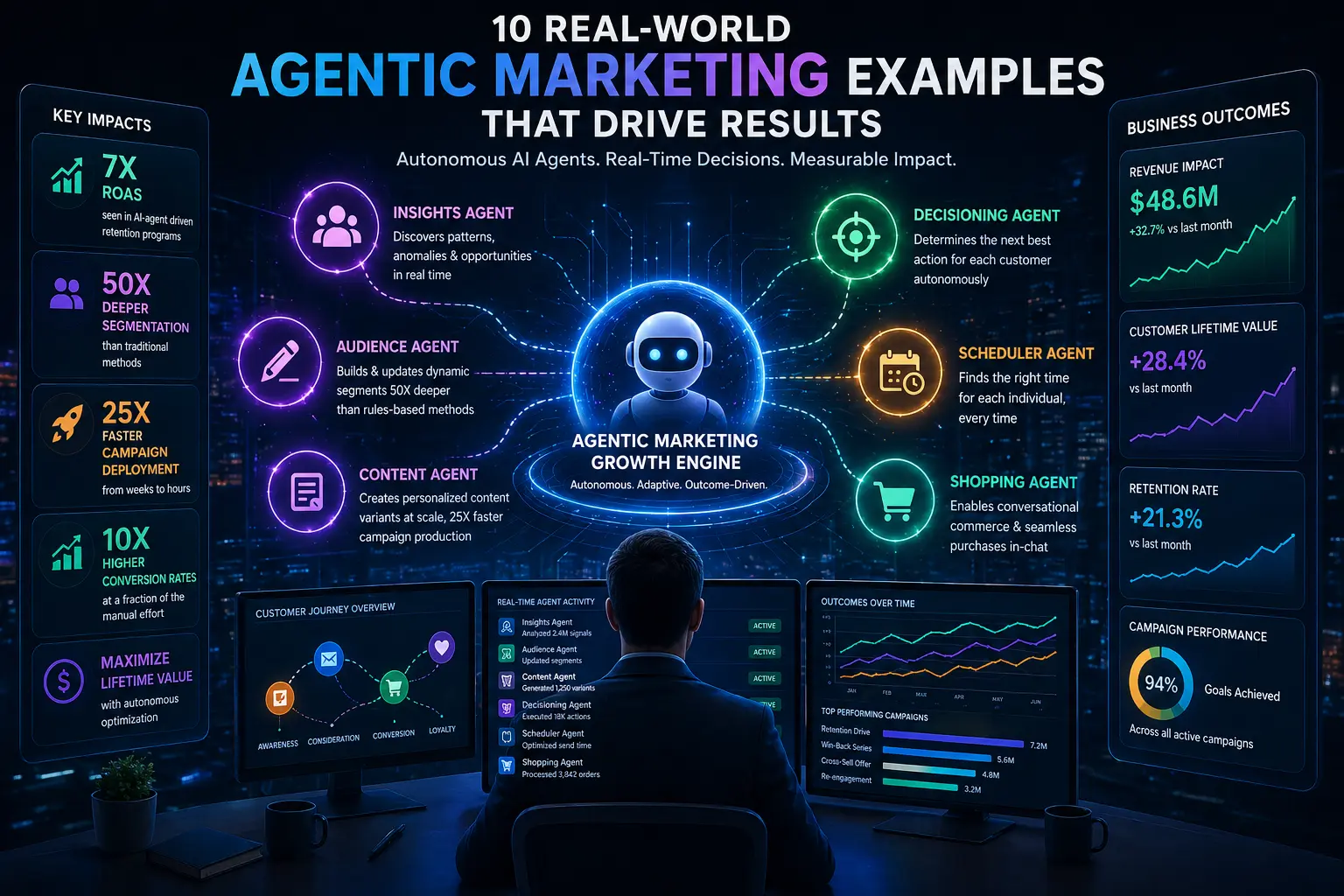
Using an Insights Agent to surface non-obvious audience patterns, Crocs uncovered a high-value “parent-plus-kid” buyer segment during a BOGO campaign that conventional cohorts had missed, generating $5 million in incremental revenue and 10X ROI. Read the full success story.
The lesson: sometimes the most profitable segment is one you didn’t know existed.
2. Continuous Experimentation That Never Sleeps
Traditional A/B testing runs in cycles. Agentic testing runs continuously.
Bajaj Markets used AI agents to identify engagement gaps, launch experiments autonomously, and optimize messaging in real time, driving 17% month-over-month growth in app lead conversions. Read the full success story.
Instead of campaigns punctuated by tests, experimentation became embedded in the system.
3. Autonomous Churn Prevention at the Individual Level
Predictive models can tell you who may churn. Decisioning Agent can intervene before they churn.
A powerful agentic use case is real-time churn prevention: detecting disengagement signals, choosing the right incentive or message for each customer, and executing instantly across channels.
This is where next-best-action orchestration moves from analytics into autonomous retention.
4. Micro-Segmentation at 50x Deeper Precision
Static segments age quickly. Audience Agents continuously refresh them.
Rather than broad cohorts like “high-value users” or “cart abandoners,” agentic segmentation can generate living micro-audiences based on behavior, affinities, timing, and intent, reportedly up to 50x deeper than conventional methods.
That level of precision changes personalization economics.

5. Send-Time and Channel Decisions Made Per Individual
Most send-time optimization still works at segment averages. Co-marketer optimizes at the customer level.
Instead of deciding “Tuesday at 10 AM works for this audience,” the system decides when this specific customer is most likely to respond, and through which channel.
At scale, this becomes decisioning infrastructure, not campaign scheduling.

6. Content Generation That Speeds Campaign Production 25x
Creative bottlenecks slow growth. Content Agent removes them.
By generating brand-governed creative variants across channels and audiences, agentic systems can reportedly accelerate campaign production up to 25 times.
The win is not just speed. It is the ability to test more hypotheses, more often.
7. Full-Funnel Orchestration That Improves ROI, Not Just Engagement
Agentic marketing compounds when agents coordinate.
Shriram Finance used autonomous funnel-aware journeys to coordinate engagement across channels and reportedly achieved 171X ROI while reducing acquisition costs. Read the full success story.
This illustrates the shift from isolated optimizations to full-funnel outcome orchestration.
8. Conversational Commerce That Reduces Drop-Offs
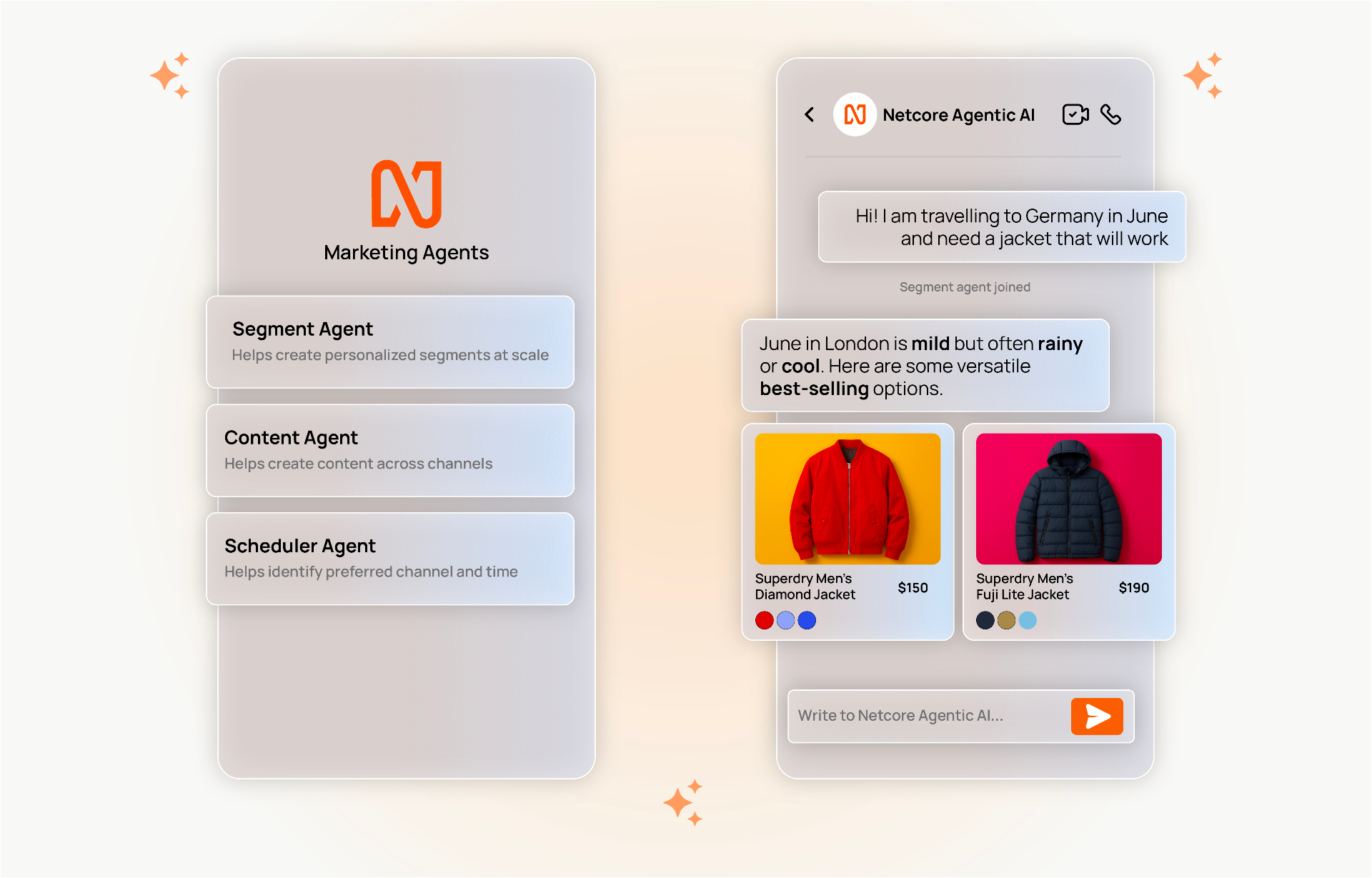
One of the most disruptive use cases is the Shopping Agent.
Instead of pushing customers from message to landing page to product page to checkout, commerce happens inside the conversation itself.
Product discovery, product recommendations, and transactions move into the engagement channel.
The gap between intent and purchase collapses.
And so do drop-offs.
9. Real-Time Insight Agents Replacing Dashboard Lag
Most marketers do not suffer from a lack of data. They suffer from lag between signal and action.
Insights Agent closes that gap by diagnosing anomalies, surfacing root causes, and recommending actions in real time, turning analytics from reporting infrastructure into decision infrastructure.
This changes how fast organizations can adapt.
10. Multi-Agent Orchestration as a Growth Engine
The biggest use case is not any single agent. It is many agents working together.
Insights informing audience formation. Content informing decision-making. Decisioning agent informing, and scheduling.
All learning from shared outcomes.
That is where agentic marketing stops looking like just an agentic marketing platform and starts looking like an autonomous growth engine.
And that is the long-term category shift you are about to witness in the coming days.
What These Examples Suggest
Across these examples, a pattern emerges.
The biggest gains do not come from using AI to make marketers marginally faster.
They come from giving autonomous systems bounded authority to improve outcomes continuously.
That is why the strongest reported gains in agentic marketing, 7X ROAS, 17% conversion lifts, 25x faster deployment, 50x deeper segmentation, look less like optimization metrics and more like leverage metrics.
And leverage changes categories.
Final Take
These examples point to something much larger than isolated AI wins or incremental campaign improvements. They signal a structural shift in how marketing operates, from managing campaigns manually to managing outcomes autonomously.
That is the promise of agentic marketing.
A model where marketers define goals, specialized agents execute against them, and systems optimize continuously in real time. Where growth is driven less by manual intervention and more by autonomous decisioning working at machine speed.
This is not simply better automation layered onto the old MarTech stack. It is a new operating model.
And increasingly, it is what high-performance marketing and high-performance results will look like. Want the same for your business? Talk to us.