




TL;DR
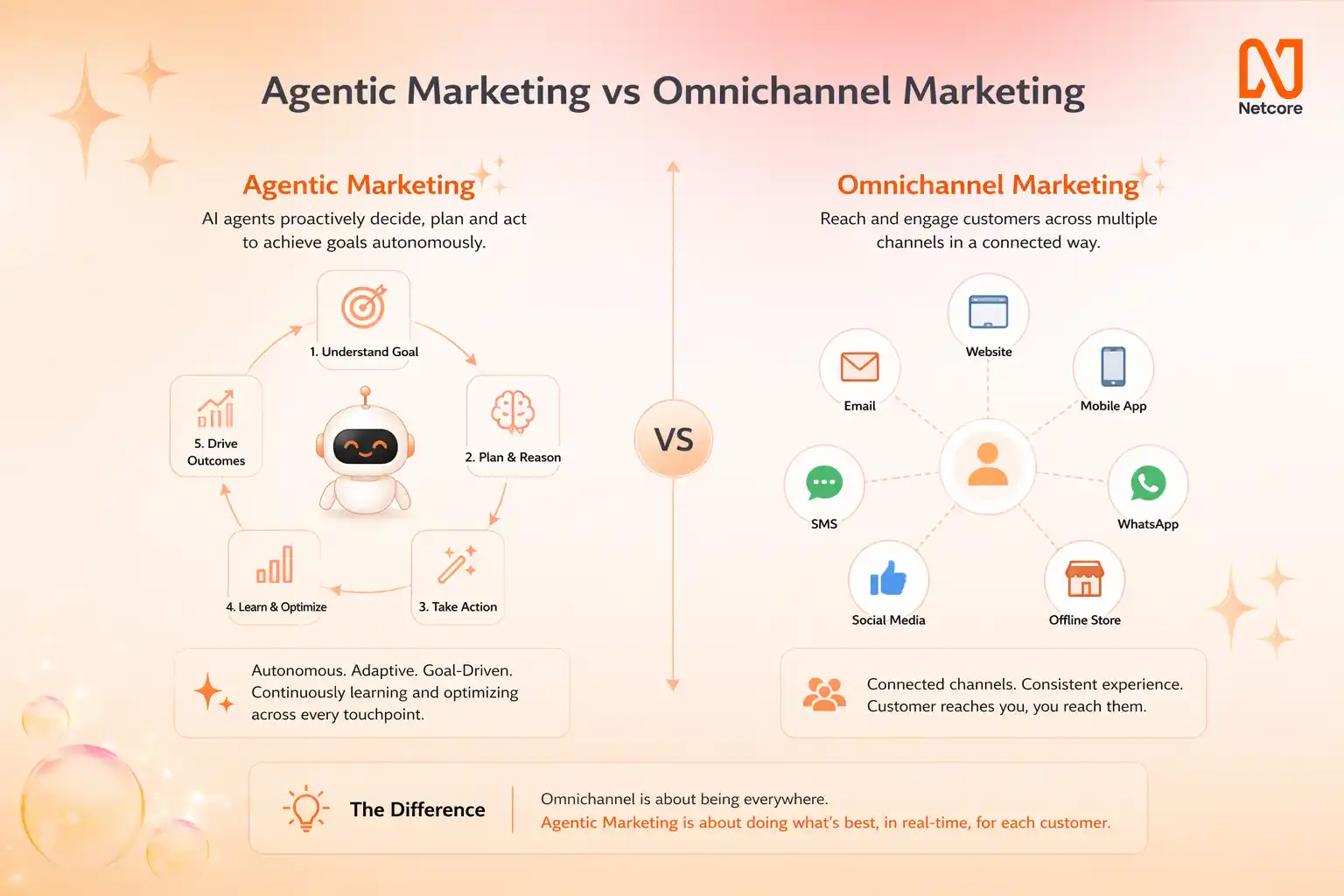
Agentic Marketing and Omnichannel Marketing are complementary yet distinct approaches in modern ecommerce and customer engagement strategies. Agentic Marketing leverages autonomous AI agents for proactive, real-time decision-making, while Omnichannel Marketing focuses on seamless integration across customer touchpoints.
This blog breaks down agentic marketing vs omnichannel marketing to help you understand why the future of CX is shifting from orchestration to intelligence.
For years, marketing teams have invested heavily in unifying customer experiences, connecting email, SMS, apps, and every possible touchpoint to deliver seamless omnichannel journeys. And while that promise has largely been achieved, the results haven’t always followed. Conversions still lag, teams are buried under complex “if/then” rules, and scaling personalization feels more like managing chaos than driving growth. In today’s rapidly shifting consumer landscape, where behaviors change in real time, these legacy, rules-based systems simply can’t keep up.
This is exactly where the shift begins. While omnichannel marketing solved for fragmented channels, it still relies on human-defined logic to operate. Agentic marketing, on the other hand, introduces autonomous systems that can track signals, make decisions, and act within seconds, optimizing for outcomes, not just execution. As the gap between connected experiences and actual business impact widens, it’s clear that the future of CX lies beyond orchestration; it lies in intelligence. In this blog, we’ll break down agentic marketing vs omnichannel marketing to understand what’s changing, why it matters, and what it means for the next phase of marketing evolution.
What is Traditional Omnichannel Marketing?
To understand where marketing is going, we have to establish the current baseline. Omnichannel marketing is the practice of integrating various channels to provide a unified brand experience.
According to McKinsey’s analysis of the foundational definition, omnichannel rests on connecting sales, marketing, fulfillment, and support to ensure a seamless transition for the customer across touchpoints.
In the marketing context, this relies on a specific set of operational pillars:
- Centralized Data Collection: Pulling behavioral and transactional data into a Customer Data Platform (CDP) to create a single view of the user.
- Cross-Channel Orchestration: Ensuring that campaigns communicate with each other so that a push notification suppresses an email if the user has already converted.
- Rules-Based Automation: Relying on human-programmed “if/then” logic trees. (e.g., If user abandons cart, wait 2 hours, then send Email. If no open, then send SMS.
Omnichannel marketing perfected the delivery of messages. It solved a massive problem in the industry by breaking down silos. However, it is fundamentally an execution layer. It only does exactly what a human tells it to do. If the human writes a suboptimal rule, the omnichannel system executes that poor rule flawlessly at scale.
What does Agentic Marketing Mean?
Agentic marketing represents the shift from automated execution to autonomous decision-making. Instead of human marketers writing rigid logic trees, they deploy AI agents tasked with specific business objectives.
Agentic AI in marketing operates as autonomous, goal-driven systems that optimize campaigns at scale. An agent is not a chatbot or a simple predictive model. It is an intelligent system capable of perceiving its environment (customer data), making autonomous decisions, executing actions (sending campaigns), and learning from the results to optimize future actions.
At Netcore, we engineer agentic systems to operate on a simple principle: you define the outcome; the AI defines the path.
If your goal is to “Maximize the 30-day LTV of this new user cohort,” the agentic system takes over. It autonomously tests different channel mixes, adjusts send times per user, dynamically changes copy based on behavioral signals, and continually refines its approach. It holds itself accountable for the overarching metric, not just the open rate of a single email.
5 Key Differences Between Agentic and Omnichannel Marketing?
| Capability | Traditional Omnichannel Marketing | Agentic Marketing |
|---|---|---|
| Core Philosophy | Channel-centric delivery | Goal-centric outcomes |
| Operational Logic | Manual “if/then” rules written by humans | Autonomous, predictive decisions made by AI |
| Role of the Marketer | Campaign operator and journey builder | Strategist and goal setter |
| Scalability Limit | Fails when segments become too complex for human logic | Scales infinitely through 1:1 behavioral adaptation |
| Primary Accountability | Message delivery and engagement metrics (Opens/Clicks) | Business results and ROI (Revenue/LTV/Conversion) |
Comparing Real-world Use Cases in Omnichannel vs. Agentic Marketing?
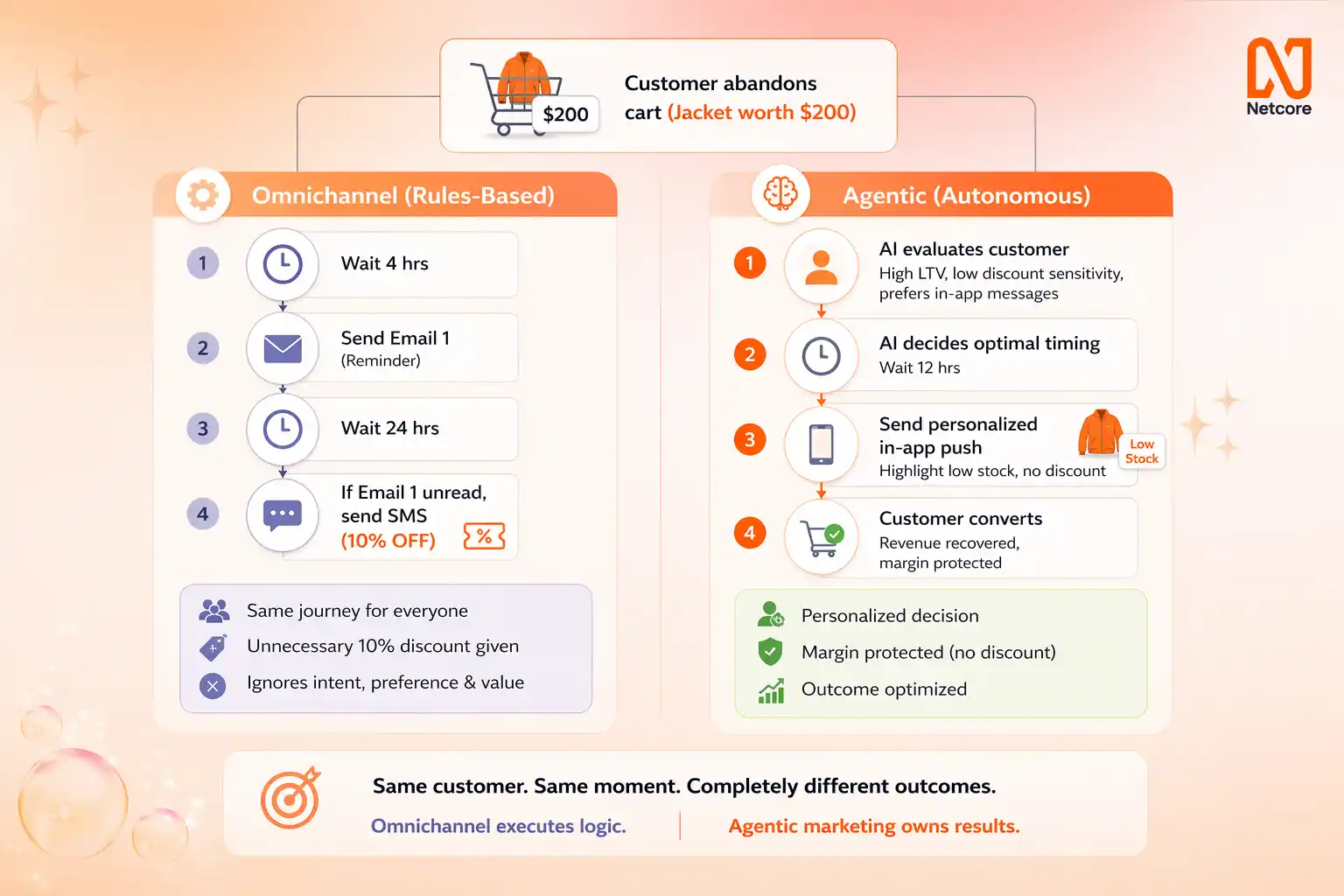
Theory only matters if it changes your daily operations. Let’s look at a standard enterprise use case: Cart Abandonment.
The Omnichannel Approach (Rules-Based)
A customer leaves a $200 jacket in their cart. The omnichannel platform triggers a static workflow: 1. Wait 4 hours. 2. Send Email 1 with a reminder. 3. Wait 24 hours. 4. If Email 1 is unread, send an SMS with a 10% discount.
This workflow treats every customer in that segment exactly the same. It gives away a 10% margin via SMS to a customer who might have converted tomorrow organically. It fails to account for the customer’s individual price sensitivity, preferred channel, or current intent level.
The Agentic Approach (Autonomous)
The same customer leaves the jacket. The agentic system takes the goal: “Recover cart while maximizing margin.”
1. The AI evaluates the customer. It notes they have a high historical LTV and usually buy without discounts, but they frequently open in-app messages.
2. The AI autonomously decides to wait 12 hours (the user’s optimal engagement time).
3. It triggers a personalized in-app push highlighting the jacket’s low stock status, without offering a discount.
4. The user converts, saving the brand a 10% margin while securing the revenue.
The difference is accountability for outcomes. Netcore’s systems are built to deliver your results, not just process your logic. Agentic workflows protect your margins, reduce discount reliance, and drive measurable revenue impact without requiring your team to manually map every contingency.
Will Agentic AI Replace Your Omnichannel Marketing Platforms?
One of the most common concerns we hear from enterprise leaders is the fear of ripping and replacing their entire tech stack. The reality is that agentic AI does not kill channels; it acts as the autonomous brain orchestrating your existing omnichannel body.
Agentic marketing is an intelligence layer that sits atop your execution layers (email, SMS, WhatsApp, site personalization). You still need the plumbing to deliver the messages. You still need a unified CDP to house the data.
What Agentic marketing replaces is the manual rules engine. You will stop using the rigid journey builder to dictate every step. Instead, you will plug your channels into an agentic marketing platform that decides when and how to fire them. This transition is an evolutionary step that supercharges your existing omnichannel delivery with predictive, autonomous decision-making.
Final Take
By now, you might have gotten this straight that Agentic marketing represents the next leap. It shifts the focus from orchestrating messages to achieving outcomes, using autonomous systems that continuously learn, decide, and act in real time. The question is no longer whether your channels are connected, but whether your marketing can adapt fast enough to drive revenue when it matters most.
The brands that will lead from here on aren’t the ones with the most channels; they’re the ones with the most intelligent systems behind them. Ready to make that shift? Let’s build your agentic marketing strategy. Talk to us.