





Six months ago, you lost a deal that was coming back to life.
The prospect had gone quiet. Your sales rep dutifully tagged them “Closed-Lost” and moved on — as you do. But last Tuesday, that same person spent 14 minutes on your pricing page. Clicked the enterprise plan. Read the FAQ twice. Then left without filling out a form.
Your marketing platform saw the whole thing.
Your CRM saw nothing.
No alert reached the rep. No task got created. The lead quietly warmed back up and then cooled again — because nobody on your team had any idea it was happening.
This is the silent tax that disconnected systems charge you every single day. Not in one dramatic moment, but in dozens of small misses: the onboarding journey that never fired, the nurture email that went out to someone who’d already bought, the “hot prospect” your sales team chased without knowing they’d already unsubscribed from everything.
The problem isn’t your team. It’s that your CRM and your marketing automation platform were never properly introduced.
This is why we have Salesforce Bi-directional integration in Netcore’s full-stack customer engagement module for you to import your cohorts so your campaigns and journeys can be enhanced with personalization.
Check out our Salesforce integration on the customer engagement panel.
Why this keeps happening (and why it’s not your fault)
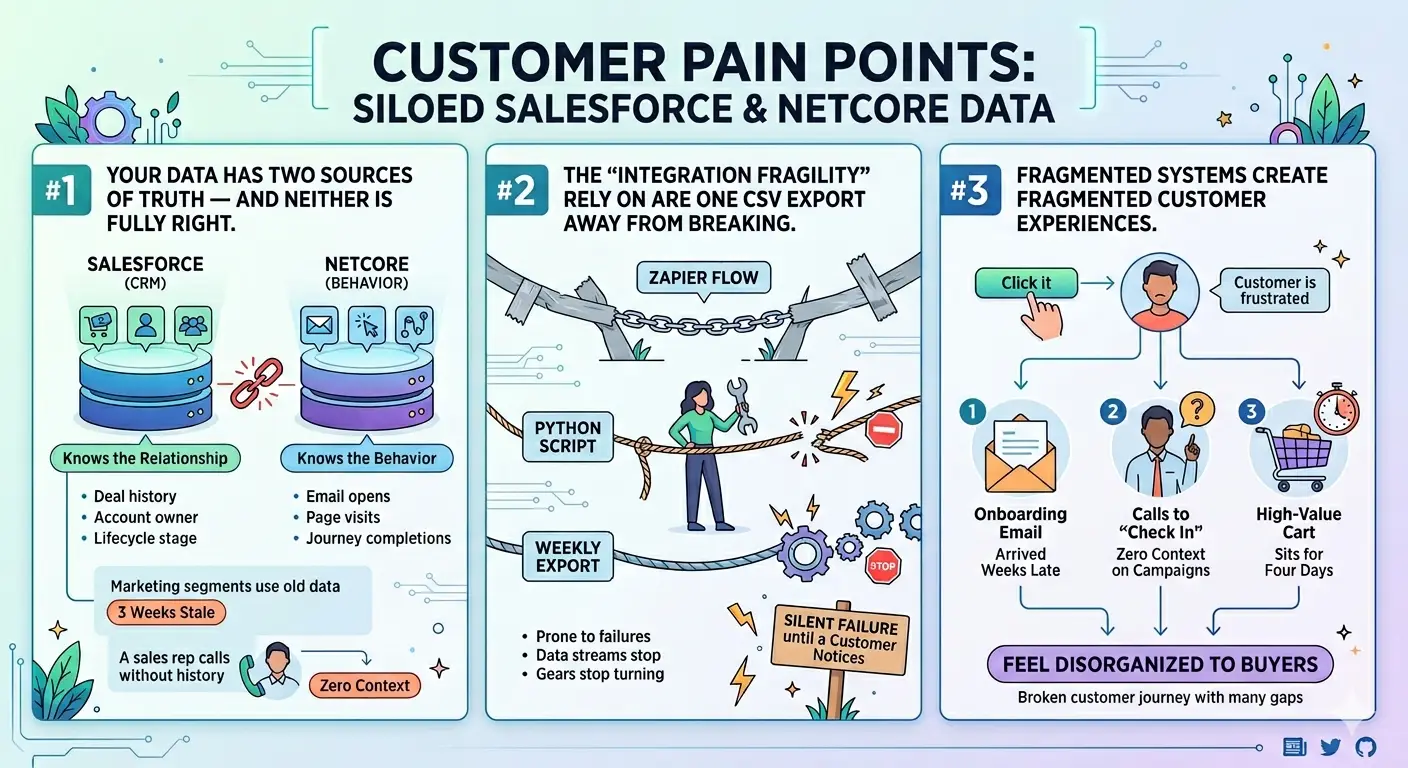
Let’s name the three things that need fixing here.
#1 Two “Sources of Truth” (Both are half-blind)
Salesforce knows the relationship (who they are), while Netcore knows the behavior (what they do). Without a native handshake, your data is never whole. Marketing targets stale CRM lists, and Sales calls prospects without any idea what they’ve been clicking.
#2 Fragile Workarounds (Built to break)
Most “integrations” are just duct tape: old Zapier flows, custom scripts no one maintains, or manual CSV exports. These aren’t true connections—they are silent failures waiting to happen. When they break, you won’t know it until a frustrated customer points it out.
#3 A Fragmented Customer Journey
When your tools don’t talk, your customers feel the friction. It looks like onboarding emails arriving weeks late, sales reps calling with zero context, and high-value leads sitting untouched for days. Disorganized internal systems make your brand look disorganized to your buyers.
Introducing Netcore’s Native Salesforce Bi-directional Integration
Today, we’re launching the Netcore Salesforce Bi-directional Integration, now listed on the Salesforce AppExchange.
Two-way, real-time, no middleware required.
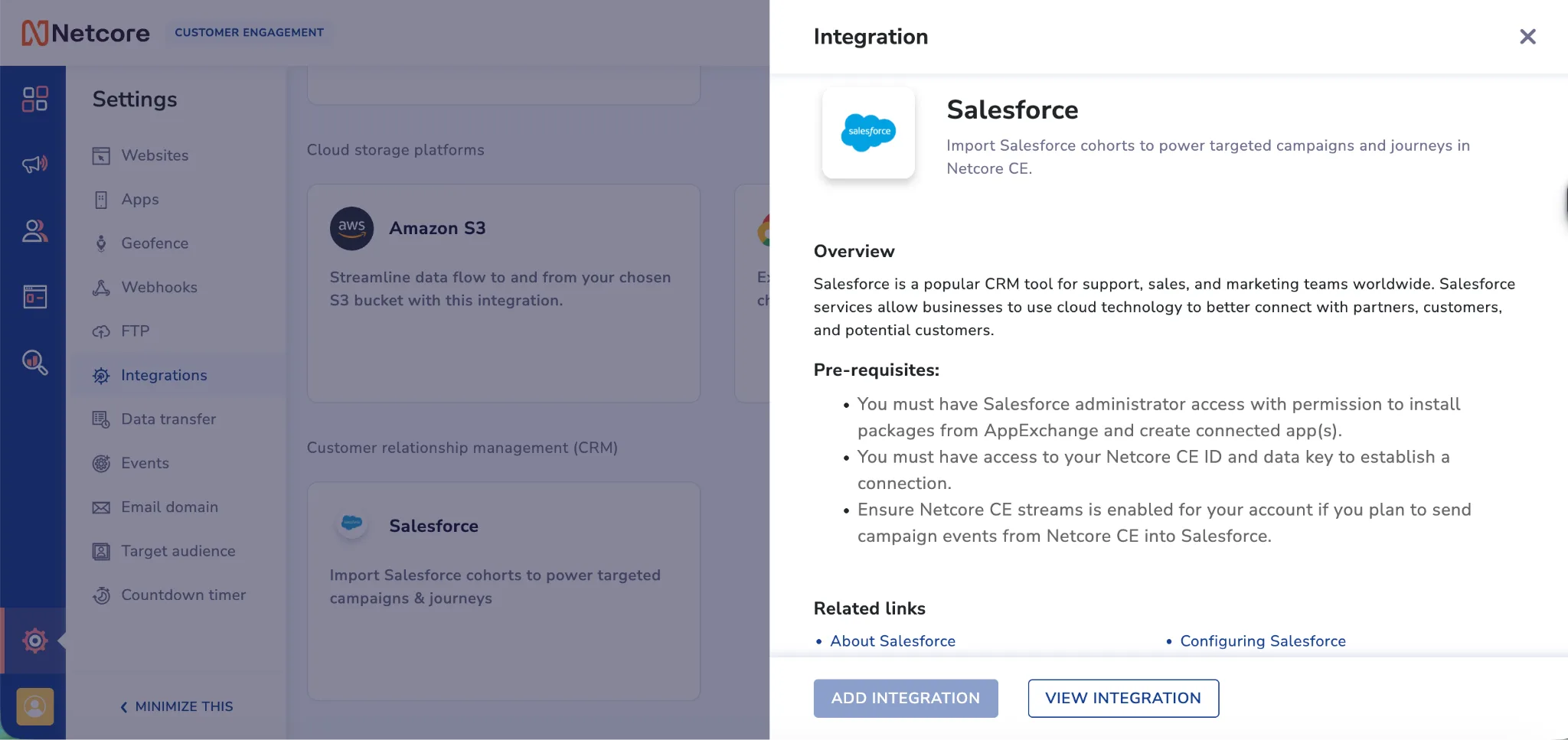
Salesforce updates can automatically trigger actions in Netcore. Netcore behavioral events can automatically write back to Salesforce records. The whole thing is configured through a guided UI wizard — not a developer ticket — and is designed to get you to your first data transfer in under 15 minutes from install.
We built this because enterprise teams particularly those running complex, multi-market operations told us clearly that patchwork integrations weren’t cutting it anymore.
Where Salesforce and Netcore Create Business Impact
A Salesforce x Netcore integration does more than sync records. It turns customer data into timely action across marketing, sales, and customer success, so every team can respond faster and more intelligently.
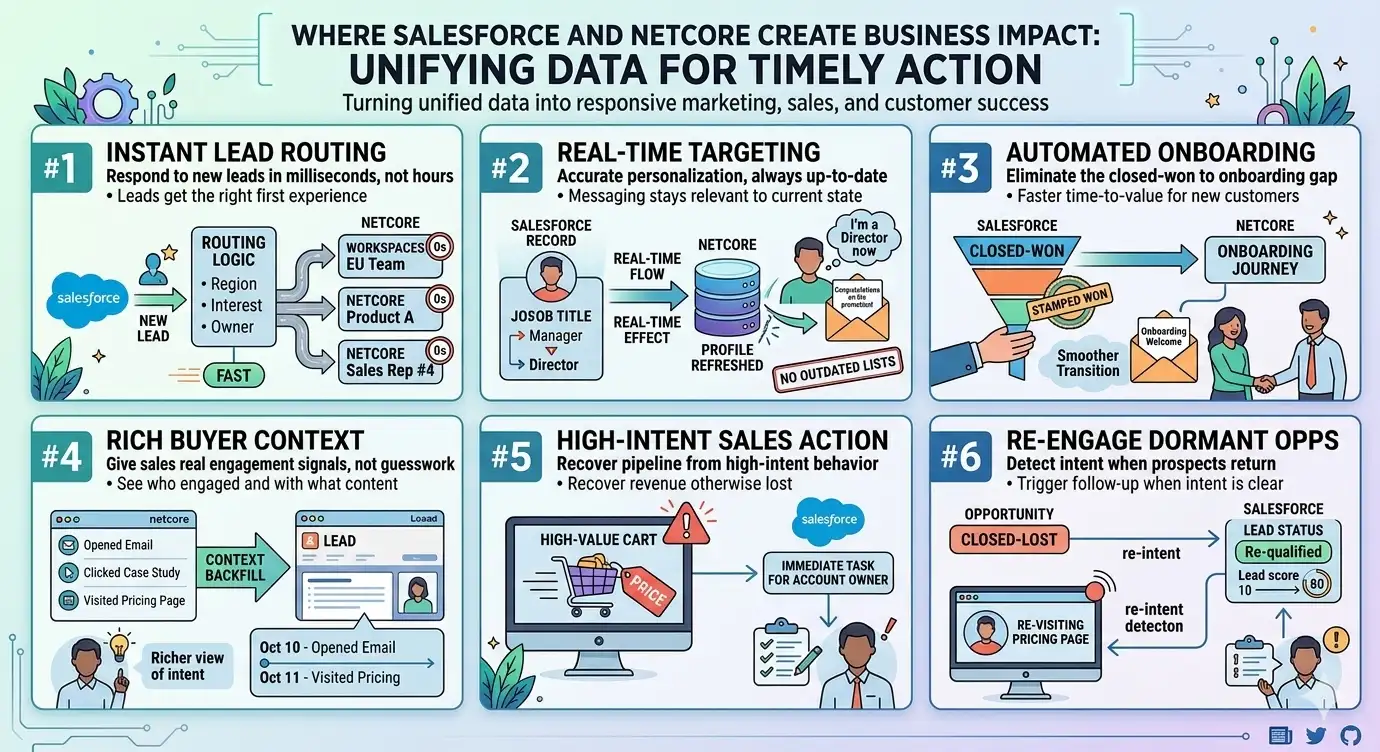
1. Respond to new leads instantly, not hours later
When a new lead enters Salesforce, Netcore immediately routes that lead to the right workspace, audience, and journey based on rules like region, product interest, or ownership.
The business impact is simple: leads get the right first experience from the start. There is no lag, no manual triage, and no risk of leads landing in the wrong funnel.
For businesses managing multiple teams, brands, or geographies, this also ensures cleaner data separation and better operational control.
2. Keep targeting accurate as customer data changes
Customer data is constantly evolving. Someone’s role changes, industry shifts, or account information gets updated in Salesforce.
With the integration in place, those updates flow into Netcore in real time, so segments, campaigns, and journeys stay aligned with the latest profile data.
That means marketing can stop relying on outdated exports and static lists. Messaging stays relevant, personalization improves, and customers receive communication that reflects who they are now, not who they were weeks ago.
3. Eliminate the gap between closed-won and customer onboarding
One of the biggest experience gaps happens right after a deal closes. Sales marks the account as a customer, but onboarding communication often waits on a manual handoff.
With Salesforce and Netcore connected, that handoff becomes automatic. As soon as an account or contact reaches the right stage in Salesforce, Netcore can trigger the onboarding journey immediately.
The result is a smoother transition from prospect to customer, faster time-to-value, and fewer chances for new customers to go cold in the critical first few days.
4. Give sales teams real engagement context, not guesswork
When prospects open emails, click key content, or engage with campaigns in Netcore, those signals can be written back into Salesforce as activities on the lead or contact record.
For sales teams, this creates a much richer view of buying intent. Reps no longer have to wonder whether a prospect is paying attention. They can see who engaged, what content resonated, and when it happened. That leads to better-timed outreach, stronger conversations, and follow-ups based on real interest rather than instinct.
5. Turn high-intent behavior into immediate sales action
Not every signal deserves follow-up. But some signals do. For example, when a known user abandons a high-value cart, the integration can automatically create a follow-up task for the account owner in Salesforce.
This is where the integration moves beyond reporting and starts driving pipeline. Instead of letting high-intent prospects slip away, sales teams get clear, actionable cues at the moment they matter most. Faster response to these moments can directly improve conversion rates and recover revenue that would otherwise be lost.
6. Re-engage dormant opportunities when intent returns
A prospect marked as closed-lost is not always gone for good. When that buyer comes back and visits pricing, upgrade, or other high-intent pages, Netcore can detect that behavior and push it back into Salesforce by updating lead status, increasing lead score, or triggering a follow-up motion.
In practice, Salesforce and Netcore work together to make sure customer data does not just sit in systems. It drives action. Marketing becomes more responsive, sales becomes more informed, and customer success starts every relationship with better timing and context.
Enterprise-grade Salesforce Integration
Trust is a word that gets thrown around a lot. Here’s what it means in practice for this integration.
Idempotent sync logic. If a retry fires for the same event — due to a timeout, a queue backup, or anything else — it won’t create a duplicate record in Salesforce. Data integrity holds, even when the network doesn’t.
Error handling that’s actually useful. Every failure surfaces an error category (Authentication Error, Validation Mismatch, Rate Limit Exceeded, Object Not Found), the raw Salesforce API error message, and the identifier of the failing record. Admins can retry manually where needed; recoverable errors retry automatically. You’re never left guessing.
Configurable limits, visible state. Concurrent running transfers, clear transfer states (Running, Draft, Stopped, In Queue), and a red-flag indicator for any transfer that’s failed in the last 24 hours. The ops team can see exactly what’s happening without filing a support ticket.
The teams who asked for this are already using it
Purvankara, Asian Paints, and PayU were among the companies that had specifically requested a native Salesforce connector. These are organizations with large, complex CRM deployments who needed something they could actually trust to run in production.
The early signal is consistent: less time spent reconciling data between platforms, and more time acting on it. Which is, at the end of the day, the entire point.
We’re onboarding enterprise customers now. If you want to be in the first cohort, this is the right moment.
Two ways to move forward
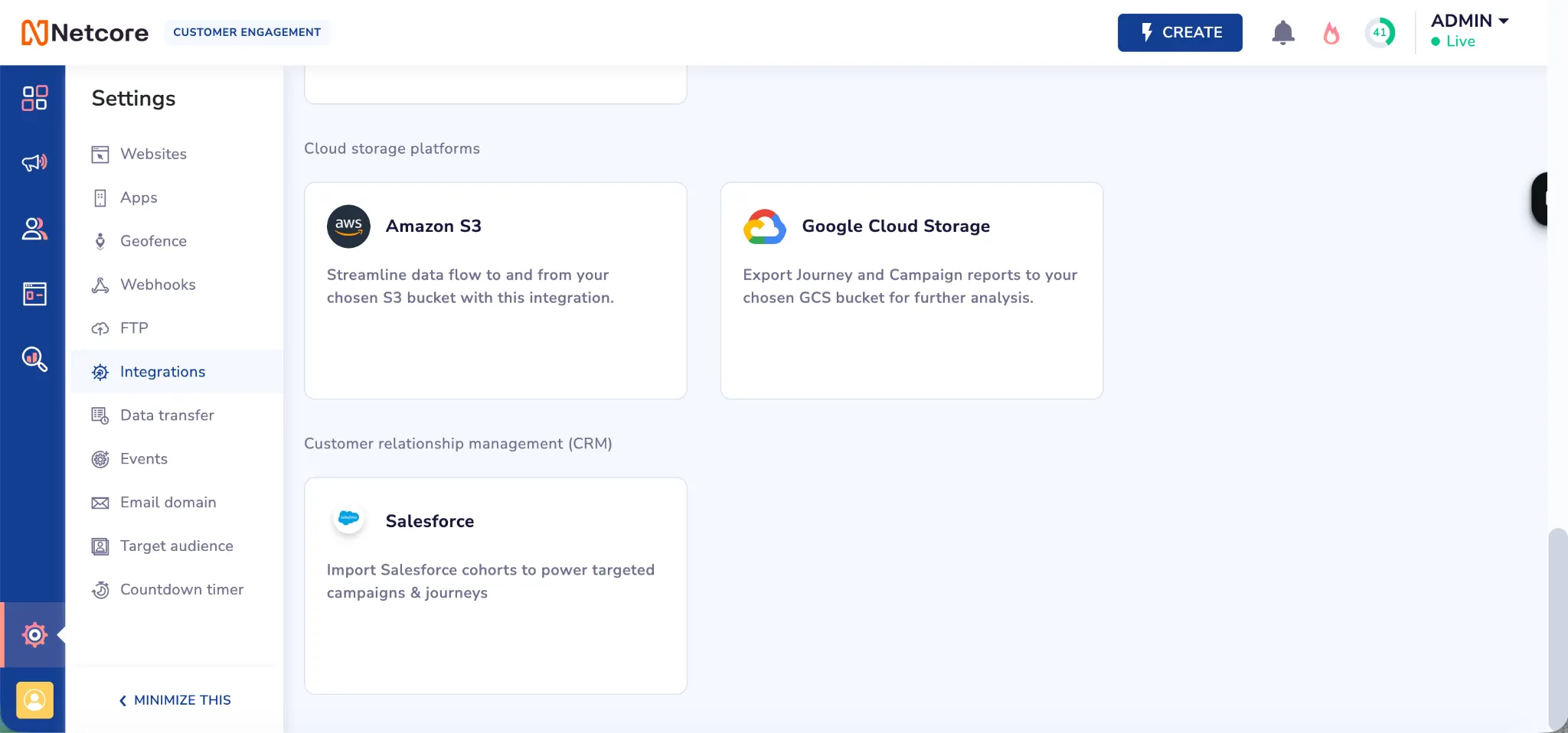
You’re already a Netcore customer. Go to Integrations in your Netcore CE dashboard, activate the Salesforce connector, and install the app from the AppExchange. Your first data transfer can be running today. If you’d rather have someone walk you through it, ping your CSM — they’re ready.
You’re evaluating Netcore. This integration is one of the things that separates Netcore from solutions that quietly require a middleware layer to do what we do natively. Book a demo and we’ll connect it to your Salesforce instance live, so you can see exactly what your team would have access to — not a slide deck version of it.
Your CRM and your marketing automation have been strangers for long enough. It’s time to introduce them.