




TL;DR
- Traditional personalization tools rely on static rules and disconnected channels that fail to adapt to real-time customer intent.
- We have compared the top 5 personalization tools like Netcore, Adobe Experience Cloud, Salesforce Agentforce, Braze, and Dynamic Yield.
- Modern personalization platforms use AI, first-party data, and autonomous decisioning to deliver 1:1 experiences across email, web, app, push, and WhatsApp.
- Netcore combines AI-powered search, dynamic recommendations, and Shopping Agents to help brands increase conversions, reduce cart abandonment, and improve customer lifetime value.
Personalization has crossed a threshold. What began as a nice-to-have, a first name in an email subject line, a “recommended for you” carousel, has become the defining infrastructure of revenue growth. According to BCG, brands deploying agentic AI in their personalization stack are seeing a tripling of marketing ROI alongside 15–20% cost efficiencies. The question for every CMO and VP of Marketing in 2026 is no longer whether to personalize. It’s which platform can actually deliver it at scale.
Here is the definitive list of personalization tools worth your attention in 2026, and why one of them is building an entirely new category.
What Every Personalization Tool Must Do in 2026
Before evaluating tools, here’s the baseline. Any tool or marketing personalization software you consider must deliver across four core capabilities:
- Real-time behavioral targeting that adjusts content based on live browsing signals, not last week’s session data, but what the customer is doing right now, on this visit, at this moment.
- AI-powered recommendations that use machine learning to surface the right product, content, or offer for each individual, not their segment, them specifically.
- Dynamic content replacement that automatically swaps headlines, images, and CTAs for different audiences without a campaign manager updating every variant manually.
- Continuous A/B and multivariate testing that optimises performance not as a one-time experiment but as an always-on improvement engine.
Top 5 Personalization Tools in 2026
The platforms below all meet all the requirements mentioned above to make your choice easier:
1. Netcore
Netcore helps brands move beyond static personalization by delivering real-time, intent-led customer experiences across every touchpoint with its personalization platform. From AI-powered search and dynamic product recommendations to personalized content across email, WhatsApp, push, web, and app, Netcore continuously adapts experiences based on customer behavior, affinity, and timing. Its Shopping Agent acts like a digital sales assistant, guiding discovery, reducing friction, and helping customers find the right products faster.
What makes Netcore different is its multi-agent AI architecture. Instead of relying on manual rules and disconnected automation workflows, specialized AI agents work together in real time to detect churn signals, optimize incentives, personalize messaging, and identify the best-performing channel automatically. The result is continuous, autonomous personalization that drives measurable business outcomes like higher cart recovery, improved customer lifetime value, and stronger loyalty retention at enterprise scale.
Best for: Enterprise brands in Ecommerce, Retail, BFSI, and D2C seeking to move from campaign-based marketing to continuous, autonomous customer engagement at scale.
2. Adobe Experience Cloud
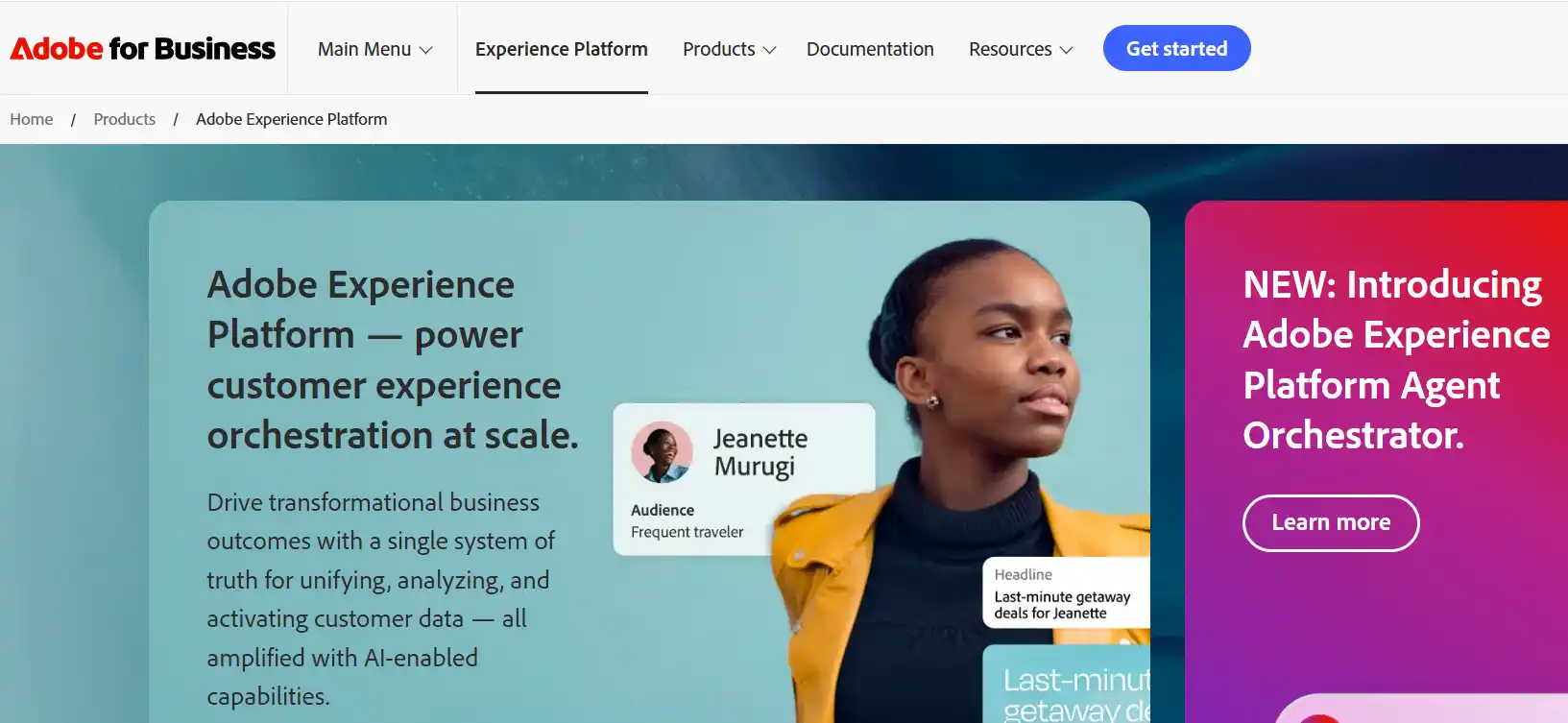
Adobe remains the enterprise standard for content-driven personalization. It’s Real-Time CDP stitches customer data across channels while Adobe Target handles experimentation and dynamic content delivery. The platform’s strength is its deep integration with Adobe’s creative ecosystem, making it powerful for brands where content production and personalization are tightly connected workflows.
Best for: Large enterprises with significant existing Adobe infrastructure and content-heavy personalization needs.
3. Salesforce Marketing Cloud or Agentforce
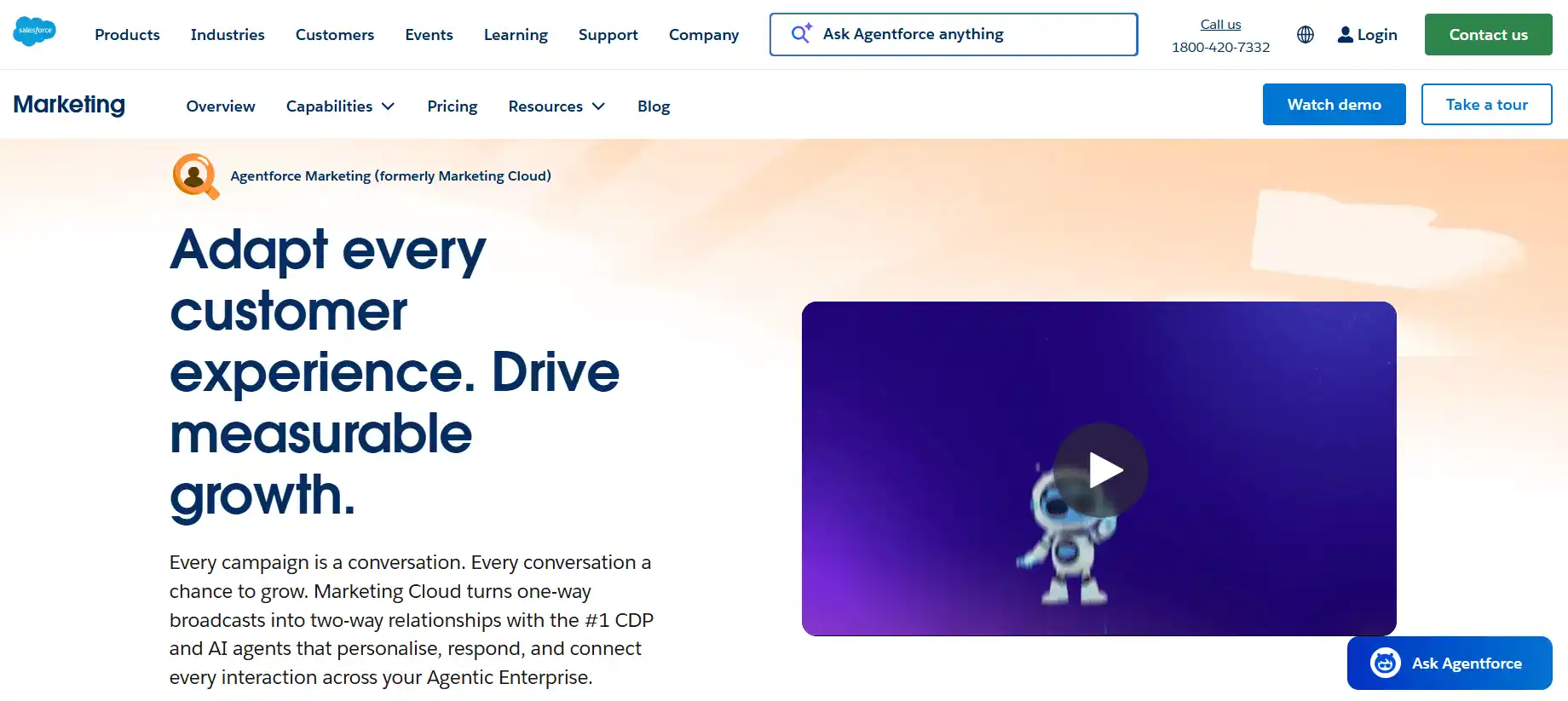
Salesforce’s personalization layer, formerly Interaction Studio, excels at real-time behavioral targeting and next-best-action recommendations within the broader Salesforce ecosystem. Its strength is the seamless connection between marketing personalization and CRM data, making it the natural choice for brands already deeply invested in Salesforce’s sales and service infrastructure.
Best for: Brands running Salesforce CRM who want personalization tightly connected to their sales pipeline and customer service data.
4. Braze
Braze has built one of the most respected cross-channel customer engagement platforms in the market, with particular strength in mobile-first personalization. Its Canvas feature allows marketers to build sophisticated multi-step journeys with real-time branching logic. Braze is the platform of choice for consumer apps and D2C brands that need to orchestrate personalized experiences across push, in-app, SMS, and email simultaneously.
Best for: Mobile-first brands and consumer apps requiring sophisticated cross-channel journey orchestration.
5. Dynamic Yield
Dynamic Yield pioneered algorithmic personalization for e-commerce and remains a strong choice for product-led businesses. Its strength is in on-site personalization, dynamically reordering product grids, homepage banners, and category pages based on real-time behavioral signals. The Mastercard acquisition has added financial intelligence to its recommendation engine, opening new possibilities for offering personalization.
Best for: Ecommerce brands prioritising on-site personalization and AI-driven product recommendations.
Final Take
Choosing a personalization platform in 2026 comes down to one central question: are you optimising the marketing you already run, or are you rebuilding how marketing operates entirely?
If it’s the former, Adobe, Salesforce, Braze, and Dynamic Yield are all excellent choices depending on your existing stack and primary channel mix.
If it’s the latter, if you believe, as BCG and Gartner both now argue, that the future of marketing is autonomous, continuous, and agent-orchestrated rather than campaign-driven, then the platform you need is not just a personalization tool. It is an agentic marketing operating system. Keen to know more about agentic marketing personalization? Consult with our experts, who will guide you through the process of building a new-age personalization system powered by Agentic marketing.