




TL;DR
Agentic personalization marks a fundamental evolution from static automation to autonomous, outcome-driven marketing. Unlike traditional AI that only provides insights, agentic AI takes real-time action like optimizing journeys, content, and timing across channels to drive measurable results.For years, marketers have relied on segmentation, grouping customers into personas, cohorts, and lifecycle stages, to deliver “personalized” experiences. It worked when expectations were low and channels were limited. But today’s customers don’t think in segments. They expect every interaction to reflect their context, their behavior, and their intent, in that exact moment.
Yet the average enterprise marketing team now operates with dozens of disconnected tools, martech utilization has plummeted to roughly 49%, and nearly 60% of martech implementations fail to deliver their promised ROI. Data is fragmented across CRM systems, e-commerce platforms, and isolated email tools. The problem isn’t a lack of data; it’s the inability to act on that data in real time, at an individual level.
This gap has given rise to a new standard: real-time 1:1 personalization, where every customer is treated as a segment of one. Meanwhile, the pressure from the C-suite to “use AI” has reached a fever pitch. But for a Head of CRM or VP of Growth, deploying AI isn’t about appeasing a board of directors with digital transformation buzzwords. It is about hitting rigid conversion targets, improving customer lifetime value (CLTV), and scaling operations without proportionally scaling headcount.
This is where the conversation around agentic marketing personalization must shift. It is not a futuristic novelty; it is a required architectural evolution. And its true power lies not in the ability of autonomous agents to operate independently, but in their ability to be held directly accountable for your business outcomes.
What Is Agentic Personalization in Modern Marketing?
Agentic personalization utilizes AI agents to deliver tailored, adaptive customer experiences at scale. Unlike traditional predictive AI that only surfaces insights, AI-driven personalization takes autonomous action toward specific goals like adjusting send times, generating content, and orchestrating multi-channel journeys in real-time to drive measurable business outcomes.
To understand what agentic personalization is, you must first understand what it replaces. Traditional marketing automation is fundamentally deterministic. A marketer builds a workflow: If a user abandons a cart, wait 2 hours, then send Email A. If they don’t open Email A, wait 24 hours, then send SMS B.
This rules-based approach gives the marketer a sense of control, but it is deeply flawed at scale. It forces millions of unique human behaviors into rigid, pre-defined funnels. It assumes the marketer knows the exact right channel, timing, and message for every conceivable scenario.
Agentic AI fundamentally changes this architecture. Instead of building rigid pathways, the marketer sets the destination (the KPI) and provides the guardrails (the brand safety rules). The AI agent then acts as an autonomous system, continuously analyzing real-time data to determine the optimal next-best-action for each individual user.
As noted by leading CDP providers, agentic personalization utilizes AI agents to deliver tailored, adaptive customer experiences at scale. But the key differentiator is action. Predictive AI tells you a customer is likely to churn; AI-driven personalization autonomously designs and executes the specific multi-channel sequence most likely to retain them, without requiring human intervention for every send.
What is N=1 Personalization?
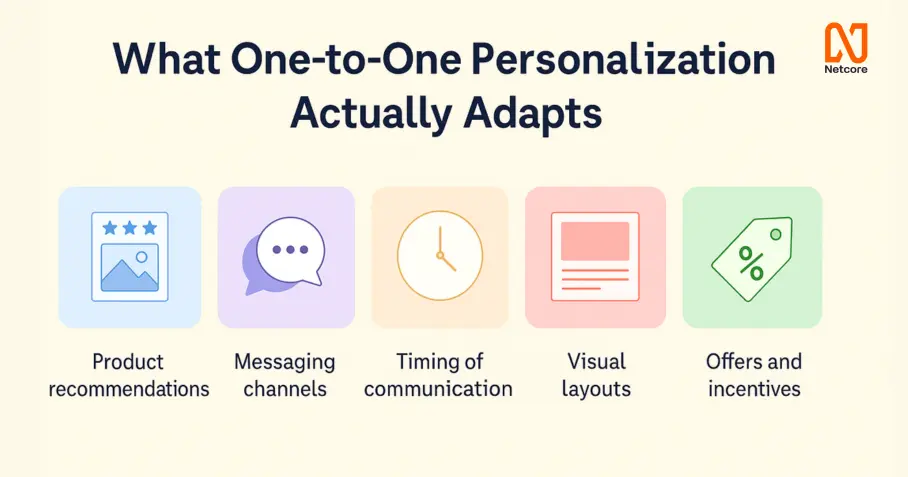
N=1 personalization is the idea that every customer experience should be uniquely tailored to an individual, not a segment.
Instead of asking, “What works for this group?”, marketers must now ask, “What is the best next action for this specific user right now?”
The Benefits of Agentic Personalization
The benefits of AI-powered personalization are beyond improved customer communications. It helps achieve real impact on business outcomes like:
Deeper Personalization at Scale
Traditional personalization struggles to scale because it relies on predefined segments and manual rule-building. As customer bases grow, so does the complexity, often leading to generic experiences disguised as personalization.
Agentic marketing personalization changes this by enabling true one-to-one engagement without operational overhead. AI agents dynamically adapt messaging, journeys, and timing for each individual in real time.
- According to Gartner, brands that successfully scale personalization can see up to a 20% increase in customer satisfaction and a 15% lift in commercial outcomes.
- BCG reports that companies leading in personalization generate 40% more revenue from these efforts compared to laggards.
The takeaway: scale is no longer the enemy of personalization; it’s where agentic systems create the most advantage.
Real-Time Decision-Making
Most marketing systems operate on delayed signals, campaigns are scheduled, journeys are pre-defined, and optimization happens after the fact. But customer intent doesn’t wait.
Agentic systems process behavioral signals as they happen and take immediate action, whether that’s triggering a message, adjusting content, or pausing outreach altogether.
- Gartner highlights that brands leveraging real-time personalization can improve conversion rates by up to 30%.
- Research from McKinsey shows that companies using advanced, real-time data-driven engagement strategies see 10–20% increases in marketing ROI.
In a world where timing is everything, the ability to act instantly becomes a core competitive advantage.
Increased Revenue and Retention
Personalization is often positioned as a CX improvement, but its real impact is financial. Relevance directly influences conversion, repeat behavior, and long-term loyalty.
Agentic marketing personalization ties every decision to business outcomes, continuously optimizing toward revenue, retention, and lifetime value.
- BCG estimates that personalization can reduce customer acquisition costs by up to 50% while increasing revenues by 5–15%.
- Gartner notes that brands that effectively leverage personalization across the customer lifecycle can improve retention rates by 25% or more.
By reducing wasted spend and increasing customer lifetime value, agentic systems don’t just improve marketing efficiency; they fundamentally improve unit economics.
What Are the Core Marketing Use Cases for Agentic Marketing Personalization?
When evaluating any AI capability, the most important filter is simple: How does this improve my core business metrics?
Agentic marketing personalization is not valuable because it is autonomous; it is valuable because it is outcome-driven. The most effective teams are already deploying it across high-impact use cases that directly influence revenue, retention, and efficiency.
Here’s how that looks in practice:
1. Autonomous Omnichannel Orchestration
In traditional marketing stacks, orchestrating journeys across email, SMS, push, and WhatsApp requires complex rule-based workflows. These systems are rigid, difficult to scale, and often result in wasted spend on channels customers ignore.
Agentic systems eliminate this friction entirely.
Instead of defining journeys manually, marketers define a goal: “Re-engage dormant users and achieve a 5% conversion rate.”
From there, the AI agent takes over.
It evaluates each user’s unified profile and behavioral history:
- One user may consistently ignore emails but engage with WhatsApp on specific days
- Another may respond instantly to push notifications after browsing
The agent dynamically selects:
- The right channel
- The optimal timing
- The ideal frequency
All at an individual level.
Impact:
- Higher engagement rates
- Reduced channel fatigue
- Lower wasted spend
- Improved conversion efficiency
2. Predictive Segmentation and Dynamic Audience Generation
Manual segmentation is inherently backward-looking. It groups users based on what they have done, not what they are about to do.
Agentic marketing personalization shifts segmentation from static to predictive.
A Segment Agent continuously scans behavioral signals across your customer base to:
- Detect micro-patterns invisible to human analysts
- Identify users showing early signs of churn
- Dynamically create micro-segments in real time
More importantly, it doesn’t stop at insights; it acts.
For example, when pre-churn signals are detected, the system can instantly trigger a personalized retention journey, before the user disengages completely.
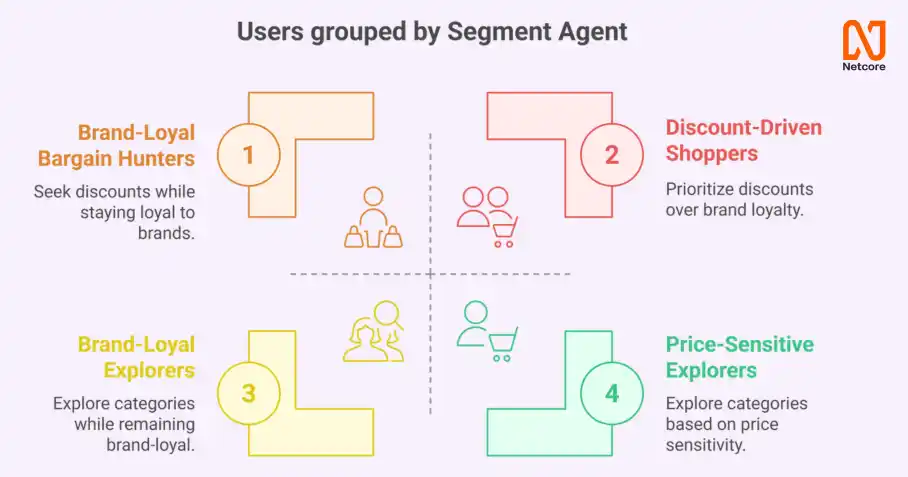
Visualizing user segmentation by affinity through the segment agent.
Example: VegNonVeg used affinity-based segmentation and automated journeys (cart abandonment, wishlist reminders, product notifications) to drive 6X uplift in revenue from retention marketing.
3. Personalized Content at Scale
Generative AI is often treated as a simple copywriting assistant. In an agentic system, it becomes an autonomous execution engine. If your goal is to increase email click-through rates, the Content agent can autonomously generate dozens of subject line variations, test them in real-time across micro-segments, analyze the results, and deploy the winning variants on copy.
The Content agent also generates images that align with your brand theme, and you are also able to insert product shots into the banners or Ad images, all within a few minutes.
4. Orchestrated Multi-Agent Campaigns
The real power of agentic marketing personalization emerges when multiple specialized agents work together.
Instead of siloed execution, you have:
- A Segmentation Agent identifying high-intent users
- A Content Agent generating personalized creatives
- A Decisioning Agent optimizing delivery
- An Insights Agent learning and refining performance
These agents coordinate autonomously to deliver end-to-end campaign outcomes.
- Example: Bajaj Markets used Netcore’s Co-Marketer to personalize push notifications and optimize campaigns, leading to 17% growth in lead conversions.
- Impact: Frees marketers from operational complexity, enabling focus on creativity and strategy.
5. AI-Powered Product Recommendations
Product discovery is one of the most critical levers for revenue growth, and one of the hardest to personalize effectively.
Agentic systems combine behavioral data, affinity modeling, and real-time context to deliver highly relevant product recommendations across channels.
This includes:
- Category preferences
- Price sensitivity
- Discount affinity
- Browsing and purchase behavior
Recommendations are not static; they evolve continuously based on user interactions.
Example: Crocs leveraged AI affinity segmentation to recommend products based on category, color, and discount preferences, achieving 7X ROAS and 447X ROI in 15 days.
What You Need to Make Agentic Marketing Personalization Work?
Agentic marketing personalization is powerful, but it is not plug-and-play. Today’s customers expect every interaction to reflect their context and intent in the moment, and meeting that expectation requires more than ambition. It requires infrastructure to build agentic AI customer journeys.
.
Specifically, it requires a unified customer data foundation, real-time processing capabilities, clearly defined goals and KPIs for AI agents, and robust experimentation and feedback loops. Without these foundations in place, autonomy doesn’t become an advantage. It becomes a liability.
Final Take
The era of manual, rules-based marketing automation is ending, replaced by the necessity of agentic personalization. N=1 personalization is not a tactic. It is the outcome of a system capable of understanding and acting on individual customer needs in real time at scale, without friction, and without delay.
Agentic marketing personalization is what makes that system possible. The brands that win won’t just study customer behavior. They will act on it, instantly and intelligently. And in doing so, they won’t just deliver better experiences. They will drive measurable, compounding growth.
Ready to move from manual campaigns to autonomous, outcome-driven intelligence? Discover how our agentic workflows can take accountability for your hardest KPIs. Explore Agentic Personalization with Netcore.