




TL;DR
Stop settling for passive reporting dashboards that only show you what happened yesterday. True omnichannel analytics unifies fragmented customer data into a single source of truth, serving as the intelligence core that drives autonomous customer experiences, eliminates conversion drop-offs, and delivers measurable marketing ROI your CFO can actually trust.
Today, marketers are no longer struggling with a lack of data; they’re struggling to make sense of it across channels. You might be tracking email performance in one dashboard, app engagement in another, and web analytics in a third. The result? Fragmented insights and missed opportunities to truly understand the customer journey.
This is where omnichannel analytics comes in. Instead of looking at channels in isolation, it brings all your data together to give you a unified view of customer behavior, campaign performance, and journey effectiveness. In this guide to omnichannel analytics, we’ll break down what omnichannel marketing really means, why it matters, and how you can use it to drive smarter decisions and better business outcomes.
What is Omnichannel Analytics?
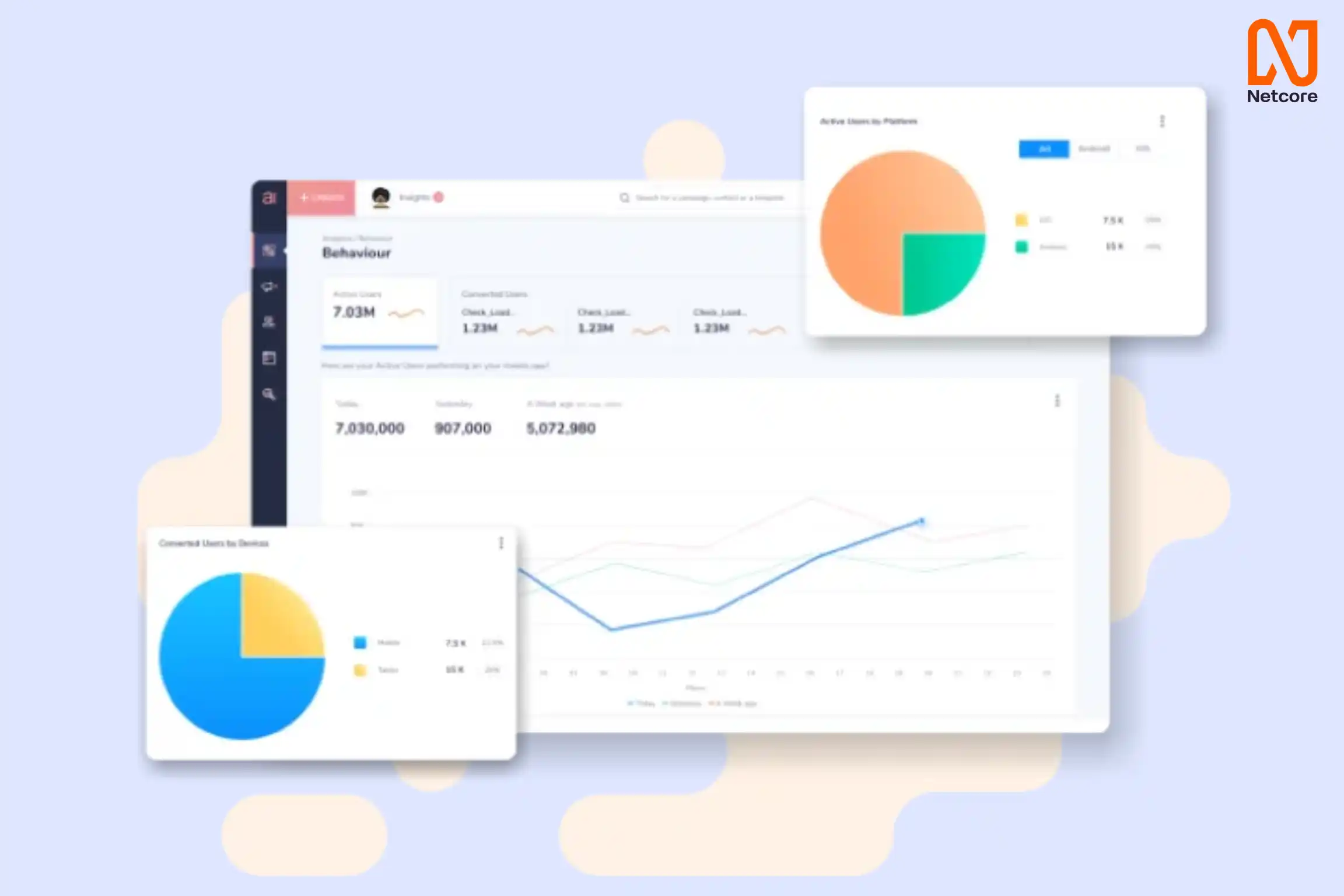
Omnichannel analytics is the strategic process of collecting, unifying, and analyzing customer interactions across all digital and physical touchpoints to create a single source of truth. It breaks down data silos, allowing brands to track complete customer journeys, optimize real-time engagement, and definitively prove cross-channel marketing ROI.
For years, enterprise software companies have treated analytics as an observational sport. As Adobe rightly points out, omnichannel analytics offers the essential capability of unifying disparate information to understand the complete customer journey. But at Netcore, we believe “understanding” is no longer enough. Acting on the data autonomously is how you win.
A unified customer view means the email team, the SMS team, the in-app push team, and the web optimization team are all working from the exact same dynamic profile. When a customer abandons a cart on their mobile app, that context immediately informs the subsequent email they receive on their desktop. Omnichannel analytics is the brain that maps these fragmented interactions to a single user identity, turning disconnected touchpoints into a fluid, highly accountable customer experience.
Why is Omnichannel Analytics Important?
If your analytics are fragmented, your customer experience is fragmented. There is no way around this reality. Most mid- to large consumer brands are currently suffering from severe martech sprawl. Over the past decade, teams bought a specific tool for email, another for SMS, a separate engine for website personalization, and a standalone dashboard for mobile app tracking.
Consolidating data across all business channels is essential for modern reporting and breaking down silos, but the cost of failing to do so goes far beyond messy reports. It directly affects your revenue.
When your tools don’t talk to each other, you end up spamming customers with redundant messages. You spend advertising dollars retargeting a customer on Facebook for a pair of shoes they already bought in your mobile app. This lack of intelligence skyrockets your Customer Acquisition Cost (CAC) and destroys brand loyalty.
We see it constantly: marketing leaders are under intense pressure from their CFOs to prove ROI, but they can’t because their attribution models are broken. They can see channel-specific vanity metrics, high open rates, and decent click-throughs, but they cannot confidently map those activities to actual revenue because the journey data is trapped in silos. The core tension is that omnichannel personalization is expected by the consumer, but most enterprise platforms still operate like it’s 2015, looking at one channel at a time.
Omnichannel Analytics Benefits
Once you have a unified view of your customer data, the real value of having accurate insights starts to show. This is where omnichannel marketing analytics moves from being just a reporting layer to a true growth driver. Instead of relying on fragmented metrics, you begin to see how customers actually move across channels, and what truly influences their decisions. With robust omnichannel reporting, teams can finally connect the dots between campaigns, channels, and outcomes.
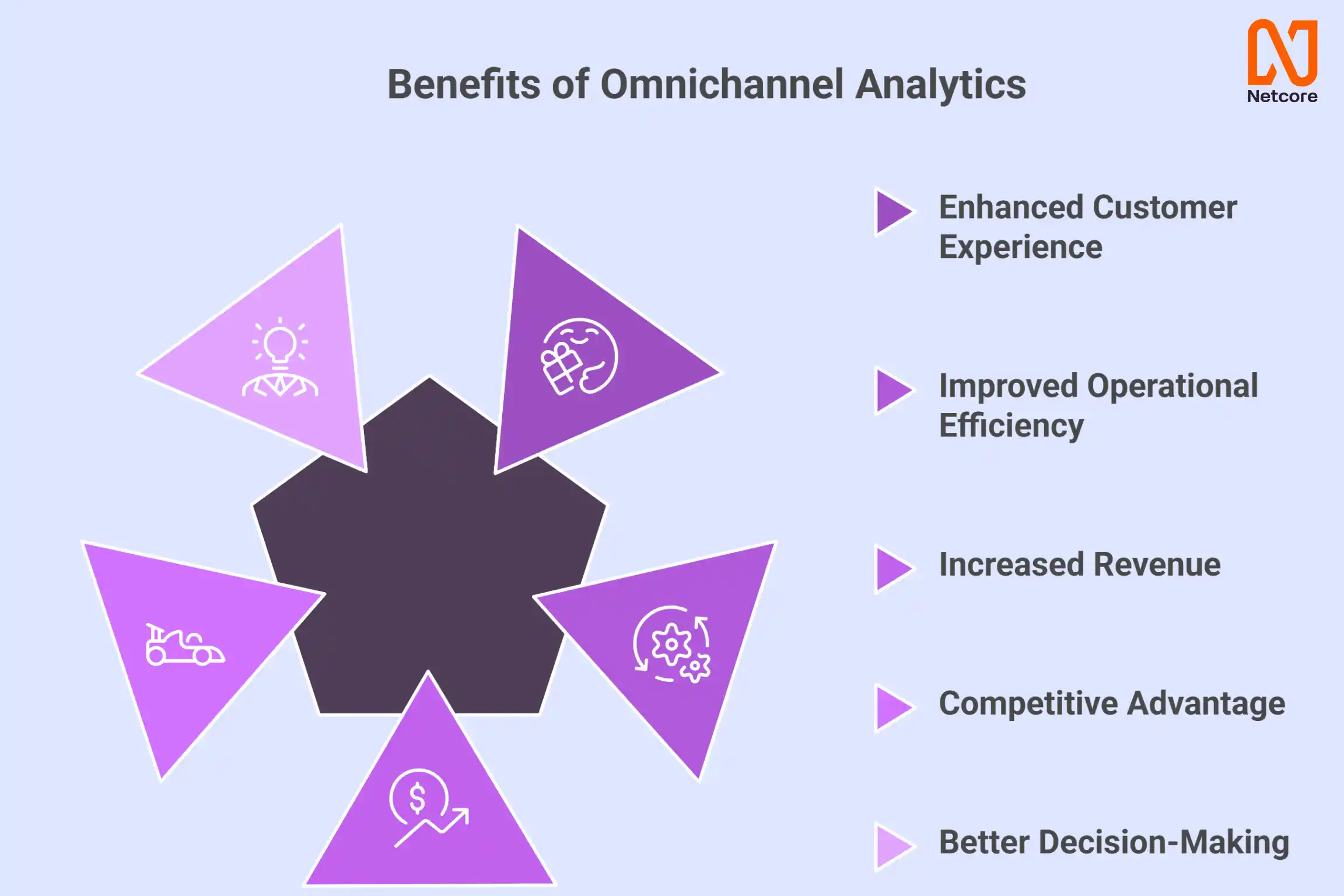
The benefits of omnichannel analytics go far beyond better visibility. Modern omnichannel analytics solutions directly impact key business outcomes, including:
The benefits of omnichannel analytics go far beyond better visibility. Modern omnichannel analytics solutions directly impact key business outcomes, including:
- Enhanced customer experience through consistent, personalized interactions
- Improved operational efficiency by eliminating data silos and manual effort
- Increased revenue with smarter targeting and optimized journeys
- Competitive advantage by responding faster to customer behavior and market shifts
- Better decision-making with a unified, data-driven view across channels
Together, these benefits enable marketers to not just measure performance, but also to continuously optimize it for stronger engagement, retention, and ROI.
Omnichannel Analytics Strategy
Having the right tools is only one part of the equation; without a clear plan, even the best data can fall short. This is where a well-defined omnichannel analytics strategy becomes critical. It’s not just about collecting data from multiple channels, but about structuring it in a way that drives meaningful insights and consistent action across teams.
Building an effective omnichannel marketing analytics approach requires a combination of the right processes, technology, and alignment. From setting clear goals to implementing the right omnichannel analytics solutions and enabling seamless omnichannel reporting, each step plays a role in creating a system that’s both scalable and actionable.
In this section, we’ll walk through the key steps to build a strong omnichannel analytics strategy, from unifying your data and defining KPIs to enabling real-time insights and continuous optimization across the customer journey.
1. Define Clear Goals & KPIs
First, figure out what you want to do, like getting more people to stay, getting more people to convert, or making the most of your money. Make sure your omnichannel marketing analytics work is focused on results by making sure these goals are in line with measurable KPIs across all channels.
2. Unify Customer Data
Bring together data from all touchpoints, like the web, apps, email, SMS, and offline sources, to break down data silos. A single view of the customer is the basis for good omnichannel analytics solutions.
3. Implement Identity Resolution
Make sure you are able to identify the same user across devices and channels. This step is very important for keeping track of journeys correctly and for making omnichannel reporting useful.
4. Choose the Right Analytics Stack
Get tools that can process data in real time, track data across channels, and do advanced analytics. The right omnichannel analytics platform should work well with the existing stack.
5. Allow reporting across channels
Go from dashboards for each channel to unified omnichannel reporting. This lets you see how well everything is working together and how different channels affect each other.
6. Use AI to get insights and personalize experiences
Find patterns, guess what people will do, and suggest the best next steps using Agentic marketing. This changes your omnichannel marketing analytics from just describing things to predicting things.
7. Turn on insights across journeys
Don’t just keep analytics to dashboards; use the information to improve your campaigns. Use them to improve the timing, messaging, and channel choice in real time.
8. Keep testing and improving continuously
Use a “test and learn” method. Try optimizing campaigns on a regular basis, use omnichannel analytics to see how well they work, and keep improving your strategies.
How does Behavioral Analytics Identify Friction in the Conversion Funnel?
Understanding the cross-channel journey requires more than just tracking links; it requires deep behavioral intelligence. Every mobile app user or website visitor navigates across your platform differently. If you are only looking at entry and exit pages, you are blind to the friction costing you sales.
At Netcore, our Behavioral & User Journey Analytics Platform is designed to dive deeper into your conversion funnel, to identify exactly where your customers drop off, and to discover the underlying reasons.
You cannot fix what you cannot see. By leveraging advanced funnel analysis, you can see if users are abandoning their purchase because of a broken form field, a poorly timed push notification, or a disjointed transition from email to app.
When you stop guessing how your customers behave, you can truly understand who they are, what they are doing, and what you need to do to engage, convert, and retain them. Our enterprise clients routinely benefit from this level of actionable analytics to reduce customer acquisition costs and deliver highly personalized experiences that pull users through the funnel seamlessly.
Final Take
Omnichannel analytics isn’t just about building better dashboards, it’s about replacing fragmented reporting with a unified, real-time view of your customer journey. As this blog highlights, relying on disconnected data leads to guesswork, missed opportunities, and ultimately, revenue left on the table. With the right approach to omnichannel analytics, you can quickly identify where spend is being wasted, take decisive action, and engage customers at the exact moments that matter.
In an era where speed and precision define success, omnichannel analytics becomes the foundation for smarter decisions, stronger personalization, and true ROI accountability. Ready to turn fragmented data into measurable revenue? See how Netcore’s omnichannel marketing platform helps you act faster, optimize continuously, and drive real business impact. Talk to us.