




TL;DR
True omnichannel capabilities require unifying customer data into a single, intelligent engine that orchestrates seamless, autonomous experiences across every touchpoint. To benefit from omnichannel capabilities you need to achieve real-time data syncing, predictive AI, and a fierce accountability to measurable ROI and customer lifetime value.
Today, due to hype around omnichannel marketing, everyone wants to deliver seamless omnichannel customer journeys, but very few actually understand what it takes behind the scenes. It’s easy to say “be everywhere your customer is,” but much harder to figure out what capabilities make that possible, or how your existing tech stack needs to evolve to support it. Is it just about adding more channels? Or is there a deeper shift required?
In this blog, we’ll break down what omnichannel capabilities really mean, the foundational building blocks behind them, and how modern marketing teams need to rethink their technology, data, and execution to truly deliver connected, cross-channel experiences.
What Are Omnichannel Capabilities?
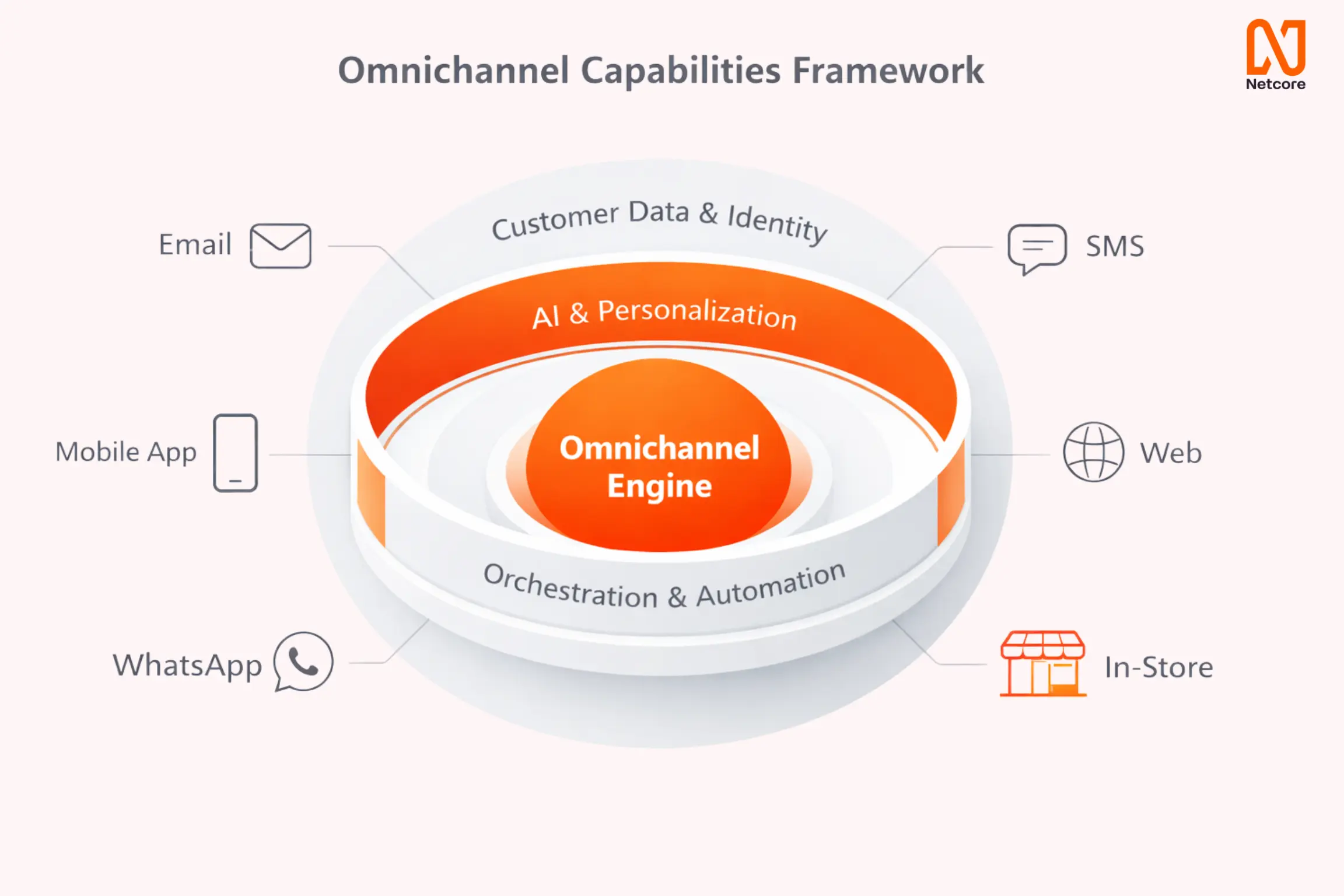
Omnichannel capabilities are the technical infrastructure and unified data systems that allow a brand to orchestrate a single, context-aware customer experience across all physical and digital touchpoints in real time. They rely on real-time data syncing and AI intelligence to maintain continuity regardless of the channel.
For years, software vendors have sold a highly simplified version of what it means to be everywhere your customer is. The baseline definition of omnichannel commerce spans physical and digital touchpoints, promising a unified brand experience whether a user is in a mobile app, browsing a desktop site, or walking into a brick-and-mortar store.
But that definition is entirely inadequate for the modern enterprise omnichannel.
Today, omnichannel capabilities are not about the channels themselves. They are about the underlying intelligence engine that connects those channels. If your customer engagement platform doesn’t know what your customer did in your mobile app three seconds ago, you do not have omnichannel capabilities; you just have multiple channels operating in isolation. We measure the maturity of a brand’s omnichannel infrastructure not by how many channels they can publish to, but by how seamlessly data flows between those endpoints to drive autonomous, revenue-generating decisions.
What are the 4 Core Pillars of a Scalable Omnichannel Strategy?
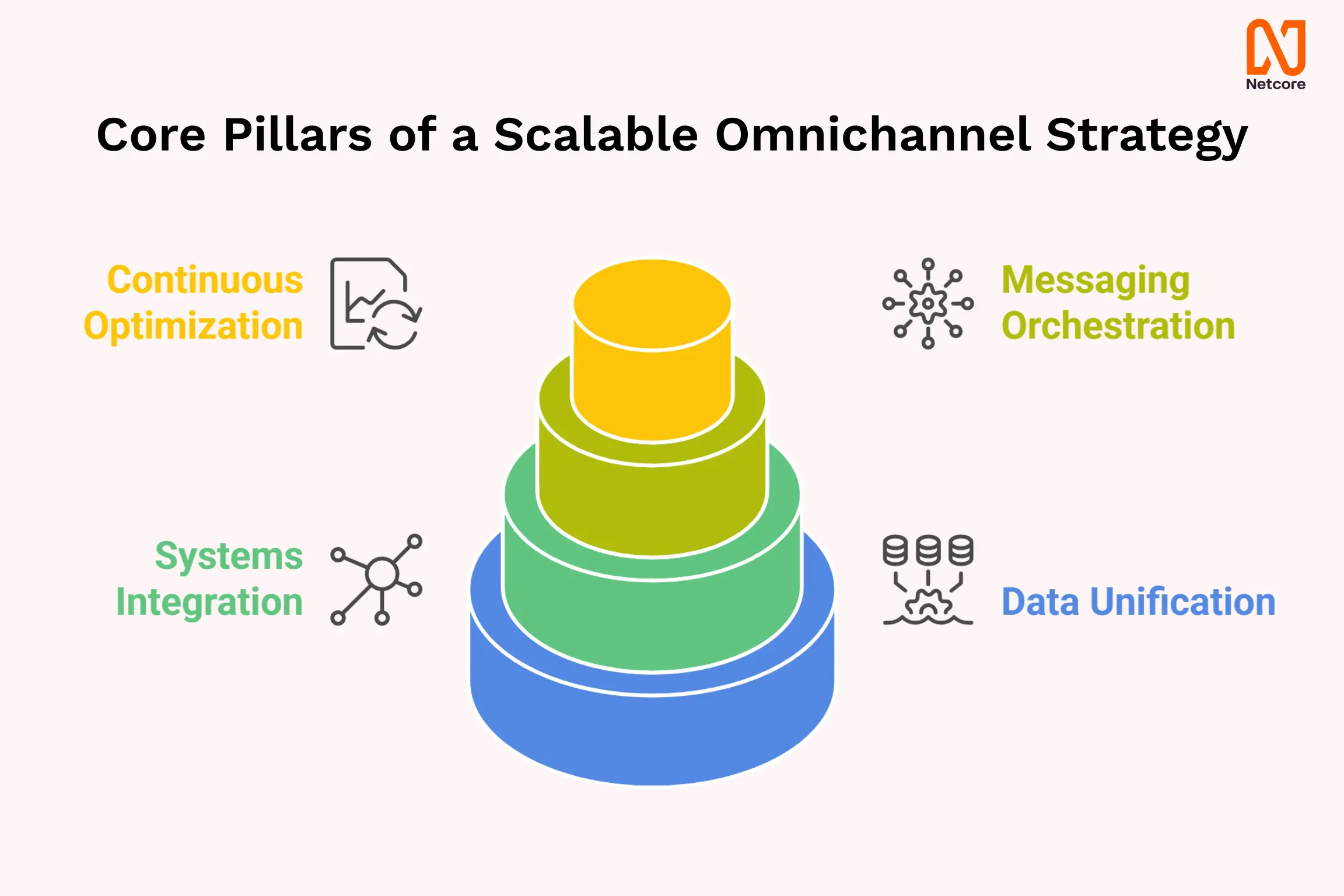
A scalable tech stack relies on four operational pillars, like Data Unification, Systems Integration, Messaging Orchestration, and Continuous Optimization. Together, these functional pillars replace fragmented multichannel campaigns with a cohesive, data-driven framework. This, in return, helps accelerate business growth and measurable ROI.
To break free from tech debt, organizations must shift from reactive campaign execution to proactive journey orchestration. Omnichannel personalization increases customer loyalty and repeat business, but only when built on a strict operational framework. Implementing this framework requires focusing on four distinct technical pillars.
- Data Unification: Centralizing customer profiles is mandatory for scale. This requires a robust Customer Data Platform (CDP) to ingest behavioral, transactional, and zero-party data in real-time, eliminating the risk of conflicting customer records.
- Systems Integration: Open APIs and bidirectional webhooks must connect the entire technology stack. This ensures seamless data flow between marketing clouds, commerce engines, and customer support hubs, preventing disjointed customer experiences. An omnichannel marketing platform is equipped with these capabilities already.
- Messaging Orchestration: Cross-channel delivery relies on dynamic, journey-based triggers rather than isolated batch campaigns. Logic must sequence communications across email, SMS, push, and in-app based on precise user context to prevent message fatigue.
- Continuous Optimization: True scalability demands AI-driven decision-making to handle complex segmentations. Machine learning models predict churn, optimize send times, and adjust content variants dynamically, removing the bottleneck of manual A/B testing.
Multichannel Silos vs. Omnichannel Capabilities
Many organizations mistakenly equate adopting multiple messaging channels with true omnichannel maturity. However, operating email, SMS, and push notifications through separate, unintegrated platforms merely creates multichannel silos. Unified capabilities require a fundamental shift in data architecture, event handling, and performance measurement.
| Architectural Layer | Multichannel Silos | Unified Omnichannel Capabilities |
| Data Storage | Fragmented lists across disconnected tools | Single source of truth via unified CDP |
| Trigger Logic | Channel-specific, isolated rules | Cross-channel orchestration with automated fallbacks |
| Personalization | Static demographic segmentation | Real-time behavioral and predictive targeting |
| Measurement | Inconsistent, duplicate attribution | Holistic impact tracking across the full user journey |
What Core Omnichannel Features Does Every Enterprise Need Today?
When evaluating the actual software infrastructure required to execute this architecture, enterprise leaders must look past marketing jargon and verify specific, non-negotiable features. A true omnichannel platform must deliver:
- Real-Time Event Streaming: The system must ingest customer behavior data in milliseconds, not in nightly batch jobs. If the data is stale, the experience breaks.
- Identity Resolution: The platform must automatically stitch together anonymous browser sessions, mobile device IDs, and authenticated logged-in states to maintain a persistent Unified Customer Profile.
- Autonomous Send-Time Optimization: AI capabilities that learn when individual users are most receptive and autonomously deliver messages at that exact moment, across the right channel.
- Cross-Channel Journey Builders: Visual, intuitive interfaces that allow architects to map logic that spans email, SMS, WhatsApp, push notifications, and site personalization in a single canvas.
- Predictive Churn & Conversion Modeling: Out-of-the-box machine learning models that identify users likely to purchase or churn, enabling proactive orchestration before the customer drops off.
These capabilities are not nice-to-haves; they are the bedrock of accountable, ROI-driven marketing especially for enterprise omnichannel. To unpack how to implement these systems, technical teams should go deeper on real-time cross-channel syncing or unified tech system.
Final Take
Omnichannel isn’t just a feature set you can plug into your stack; it’s a capability you build by bringing together the right data, intelligence, and execution layers. By now, you’ve seen what omnichannel capabilities look like, the features that power them, and why they go far beyond simply being present on multiple channels.
The real omnichannel enablement lies in how you connect these pieces by unifying customer data, enabling real-time decisioning, and orchestrating journeys that adapt across touchpoints. When done right, omnichannel capabilities don’t just improve engagement, they create consistent, context-aware experiences that drive stronger customer relationships, higher lifetime value, and measurable business impact. Talk to us, let’s build your omnichannel strategy today.