




TL;DR
- Most Valentine’s Day marketing ideas drive a short-term sales spike—but fail to convert seasonal buyers into repeat customers.
- The real opportunity is to treat Valentine’s Day as a relationship accelerator: capture intent early, reduce gifting friction, and collect preference signals.
- Retention-aware conversion tactics (bundles, opt-ins, replenishment hooks) increase AOV while setting up future purchases.
- Post-February 14 engagement is where loyalty is built—through usage content, care tips, and complementary recommendations timed to real behavior.
- Agentic, lifecycle-based marketing helps brands personalize at scale, optimize timing and channels, and keep engagement relevant after the urgency fades.
- Measure success beyond Feb 14 with repeat purchase rate, time-to-second-purchase, and CLTV uplift from Valentine’s cohorts.
For most brands, Valentine’s Day is treated as a sprint.
Campaigns go live in early February. Discounts peak around the 12th and 13th. Revenue spikes on the 14th. And then, silence.
By March, a large share of those Valentine’s Day buyers are gone.
This isn’t because Valentine’s shoppers are inherently disloyal. It’s because most Valentine’s Day marketing ideas are designed for transactions, not relationships.
That’s the missed opportunity.
Valentine’s Day attracts emotionally primed, high-intent buyers—many of them first-time customers. When handled right, it can become one of the strongest entry points into long-term customer relationships. When handled poorly, it becomes a one-day revenue event followed by churn. With Valentine’s Day spending set to reach $25.9 billion in 2025, the opportunity is massive. Capturing this market is step one, but retaining 40% of those customers would be a game-changer for your bottom line.
This blog breaks down how to design Valentine’s Day marketing ideas that convert seasonal buyers into repeat customers, and how agentic marketing helps brands optimize for revenue and lifetime value, not just February 14.
Why Most Valentine’s Day Marketing Ideas Fail to Build Long-Term Value
Let’s start with an uncomfortable truth: Most Valentine’s Day campaigns are optimized to end on Valentine’s Day.
The common playbook looks like this:
- Blanket discounts
- Generic gifting bundles
- Broad messaging to “everyone.”
- No post-purchase strategy
The result?
A spike in one-time purchases followed by silence.
Seasonal buyers don’t churn because they’re uninterested. They churn because brands stop engaging once the sale is complete. The relationship ends the moment the transaction does.
If the only thing tying a customer to your brand is a Valentine’s discount, there’s no reason for them to come back in March.
To change that, Valentine’s Day marketing needs a lifecycle lens.
Valentine’s Day Through a Lifecycle Lens

The brands that win Valentine’s Day long-term don’t think in terms of campaigns. They think in terms of customer progression.
A Valentine’s Day customer journey typically looks like this:
- Pre-event intent and discovery
- Purchase driven by urgency or emotion
- Post-gift experience and feedback
- Potential repeat purchase window
Most brands invest heavily in stages 1 and 2, abandoning stages 3 and 4 entirely.
That’s where long-term value is created.
By treating Valentine’s Day as the start of a relationship rather than the end of a campaign, brands can turn a single gifting moment into months or years of repeat revenue.
Pre-Valentine’s Day Marketing Ideas
Not all Valentine’s shoppers are the same.
Some are early planners. Some are last-minute buyers. Some are gifting partners. Others are buying for themselves. Treating them as a single audience leads to generic experiences that convert poorly and retain even worse.
Smarter Valentine’s Day marketing ideas focus on intent capture.
Examples include:
- Personalized gift guides based on browsing behavior
- Dynamic bundles built around viewed or wishlisted products
- Content that reduces gifting anxiety (“Not sure what to choose?” flows)
This does two things:
- It improves conversion by reducing friction
- It captures valuable preference data for post-purchase engagement
Agentic marketing plays a critical role here by observing real-time behavior and adapting experiences dynamically, rather than relying on static Valentine’s segments created weeks in advance.
The goal at this stage isn’t just to sell.
It’s to learn who this customer is and why they’re buying.
Valentine’s Day Conversion Ideas That Set Up Repeat Purchases
Conversion tactics determine whether a customer is a one-time buyer or a future loyalist.
Most Valentine’s Day offers are optimized for urgency:
- “Last chance” messaging
- Deep discounts
- Free shipping cutoffs
These drive conversion, but often at the expense of future value.
Retention-aware conversion ideas include:
- Value-based bundles that introduce customers to complementary products
- Subtle replenishment hooks (subscriptions, refills, add-ons)
- Opt-ins framed as helpful utilities (gift tracking, care tips, reminders)
Instead of maximizing one order, these tactics plant seeds for the next one.
Agentic marketing systems help here by differentiating:
- Price-sensitive buyers who need incentives
- High-intent buyers who don’t
That distinction protects margins while improving repeat potential.
Post-Valentine’s Day Marketing Ideas
The biggest mistake brands make is going quiet after February 14.
This is when the relationship should begin.
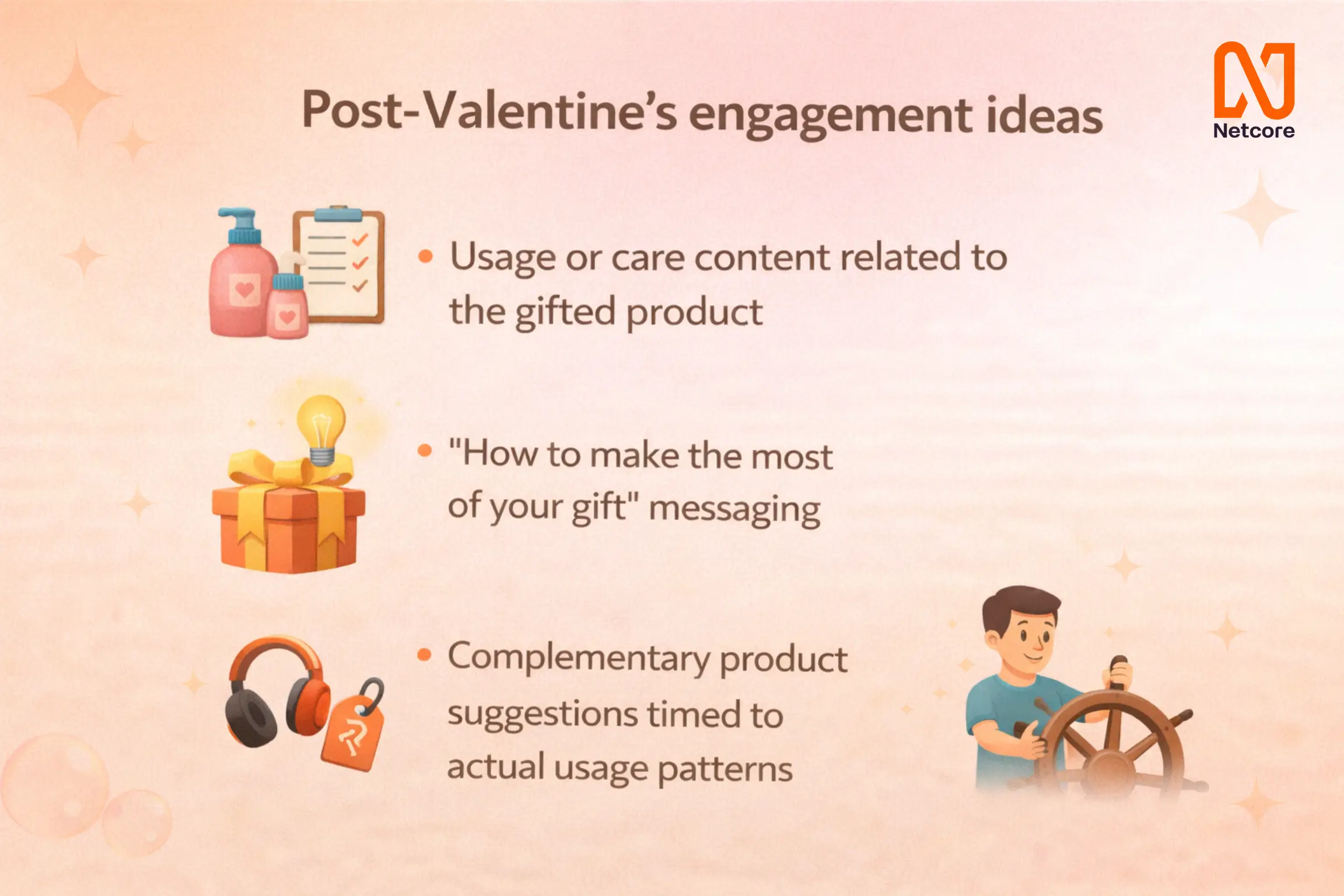
Post-Valentine’s engagement ideas include:
- Usage or care content related to the gifted product
- “How to make the most of your gift” messaging
- Complementary product suggestions timed to actual usage patterns
The key is contextual relevance, not volume.
Agentic marketing systems monitor post-purchase behavior to decide:
- Who is engaging and wants more?
- Who needs reassurance or guidance?
- Who should be left alone to avoid fatigue?
By adjusting tone, timing, and frequency automatically, brands avoid the common trap of over-messaging new customers and losing them.
This phase is where seasonal buyers turn into repeat buyers.
Segment-Specific Valentine’s Day Marketing Ideas
Valentine’s Day customers fall into distinct segments, each requiring a different strategy.
For example:
- First-time buyers: need trust, education, and reassurance
- Existing loyal customers: expect exclusivity and appreciation
- Repeat gifters: benefit from reminders and replenishment cues
Static segmentation struggles here because customer behavior shifts quickly around Valentine’s Day.
Agentic segmentation continuously adapts based on real-time intent, ensuring that messaging stays aligned with where the customer actually is, not where the brand assumes they are.
This precision is critical for building CLTV beyond the holiday.
How Agentic Marketing Turns Valentine’s Campaigns Into CLTV Engines
Agentic marketing changes Valentine’s Day execution in three fundamental ways:
- Outcome-first optimization
Instead of optimizing for clicks or one-day revenue, systems optimize for repeat purchase, engagement continuity, and lifetime value. - Real-time decision-making
Agents decide when to engage, when to guide, and when to stay silent—based on live signals, not preset schedules. - Continuous learning
Valentine’s behavior feeds future campaigns. Preferences, timing, and product affinity don’t reset on February 15; they compound.
This is how Valentine’s Day becomes a data-rich entry point into long-term relationships, not a disposable seasonal event.
Measuring Valentine’s Day Success Beyond February 14
If you measure Valentine’s Day success only by revenue on the 14th, you’ll always underinvest in retention.
Metrics that actually indicate long-term success include:
- Repeat purchase rate within 30/60/90 days
- Time to second purchase
- Engagement continuity after the event
- CLTV uplift from Valentine’s cohorts
Agentic platforms make these metrics actionable by linking early signals to downstream outcomes, so teams don’t have to wait months to understand what worked.
Final Take
Seasonal buyers don’t disappear because they’re fickle. They disappear because brands stop showing up with relevance once the urgency is gone.
The brands that win Valentine’s Day long-term design for relationships:
- Capture intent early
- Convert with future value in mind
- Stay present after the purchase
- Let intelligent systems guide the next interaction
Valentine’s Day is the perfect test case for how your brand treats every customer moment.
If you can turn a one-day emotional purchase into a lasting relationship, you can do it anywhere. And that’s what separates seasonal revenue from sustainable growth.