




TL;DR
- Personalization is now a revenue driver, not just a CX tactic.
- Brands using advanced personalization see higher conversions, retention, and up to 15% revenue growth.
- Generic tactics like first-name emails and static recommendations no longer work at scale.
- Customers expect real-time relevance across every touchpoint.
- This blog explores real personalization examples from leading brands and how AI-driven personalization is transforming modern marketing.
Across enterprise datasets, legacy personalization tactics consistently fail to deliver scalable revenue, trapping marketers in rigid, unmanageable journey maps. We see brands losing millions by treating individualized messaging as a superficial interface update rather than an autonomous revenue engine. The era of manual “if-this-then-that” segmentation is obsolete; outcome-driven Agentic marketing has taken its place as the definitive standard. We have separately covered a complete guide on ecommerce personalization and in this blog we’ve covered personalization examples.
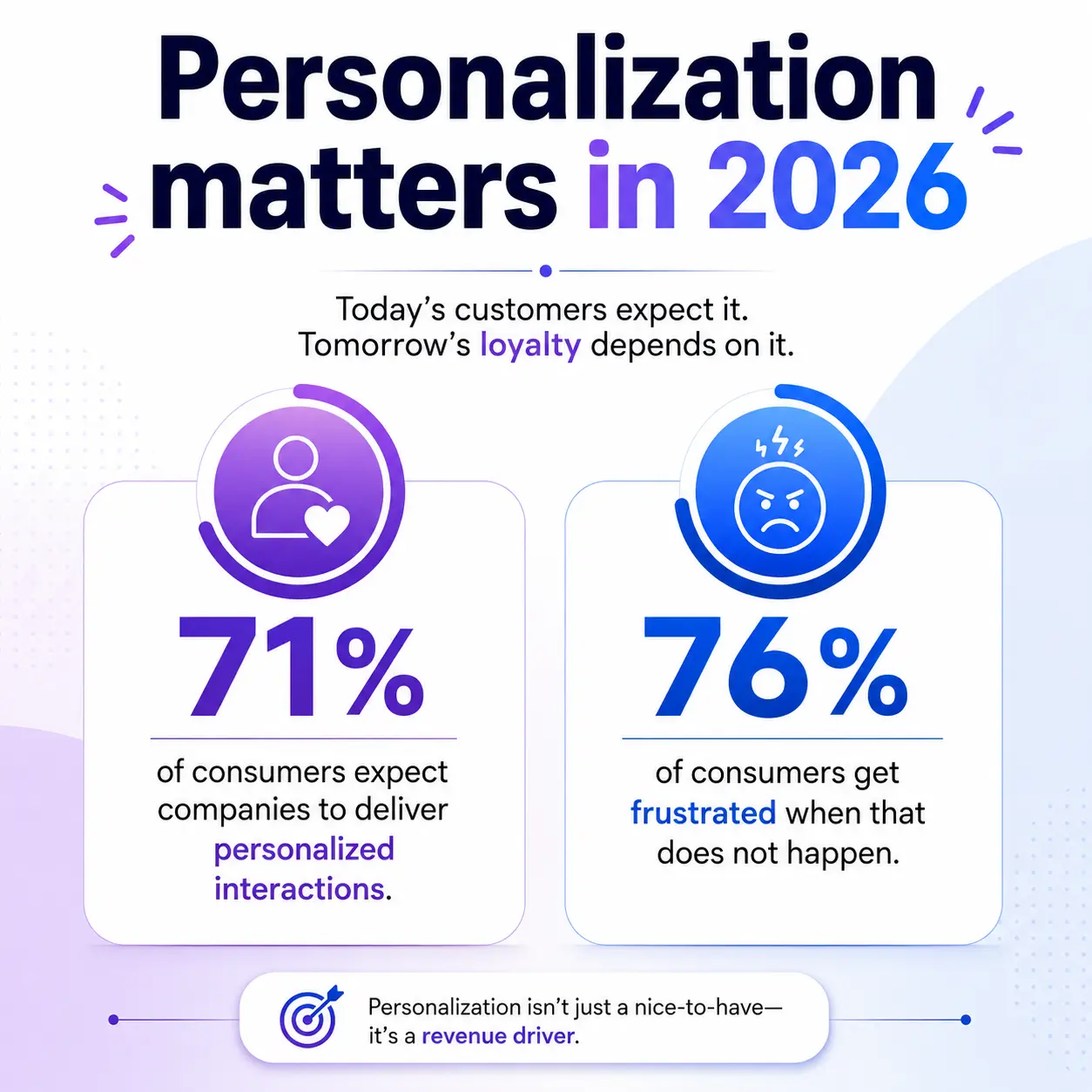
Source of data: McKinsey
Why Personalization Directly Impacts Revenue
Personalization is no longer a customer experience enhancement. It has become a core revenue driver.
According to industry research, brands implementing effective personalization strategies are seeing revenue lifts between 5% and 15%, with mature programs delivering even higher gains. The reason is simple: customers increasingly expect brands to understand their preferences, intent, and context in real time. Qualtrics reports that 81% of consumers prefer to shop with companies that deliver personalized experiences, while 62% believe personalized recommendations are significantly better than generic ones.
Yet most brands still operate with outdated personalization models. Adding a first name to an email or showing static product recommendations based on historical purchases may improve engagement slightly, but it rarely creates sustained business impact. Modern consumers expect relevance across every touchpoint, from offers and timing to channel and content.
This is where traditional systems begin to fail. Legacy marketing platforms rely on manually created segments, rigid customer journeys, and disconnected rules that become increasingly difficult to manage at scale. As customer behavior changes faster than campaigns can adapt, brands end up delivering irrelevant messages, repetitive promotions, and disconnected experiences that reduce both conversion and loyalty.
The brands outperforming today are moving toward intelligence-led personalization powered by AI and agentic systems. Instead of relying on static rules, these systems continuously interpret customer signals, predict intent, and dynamically optimize experiences toward measurable outcomes like higher conversion, retention, and lifetime value.
| Capability | Legacy Automation | Agentic AI in Marketing |
| Journey Creation | Manually drawn flowcharts and decision trees. | User paths optimized for conversion by Journey Orchestrator Agents. |
| Channel Selection | Hardcoded by the marketer (e.g., “Send Email, then SMS”). | Dynamically chosen per user based on real-time affinity scoring. |
| A/B Testing | Manual split tests that conclude after weeks. | Continuous, real-time multivariate optimization that allocates traffic instantly. |
Personalization Examples to Implement in 2026
Here are the data-led examples that have a direct impact on driving ROI:
Website Personalization Examples
1. Autonomous Homepage Adaptation
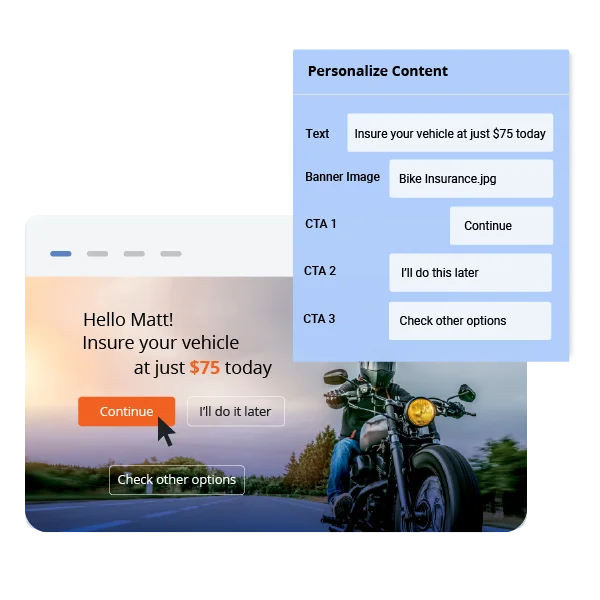
Rather than serving a static hero banner, AI-native platforms assess a visitor’s real-time traffic source, past purchase cadence, and active browsing session. If an anonymous user arrives via an Instagram ad for running shoes, the homepage instantly reconfigures to highlight high-margin athletic wear, bypassing generic promotions.
The ROI Impact: Across Netcore deployments, shifting from static homepages to autonomous, context-aware landing experiences consistently yields a 14-22% increase in immediate add-to-cart rates.
2. Predictive Bundling and Cross-Selling
Legacy systems recommend products that “others also bought.” Predictive personalization analyzes the specific user’s price sensitivity and affinity to construct custom bundles dynamically. If a user adds a specific camera to their cart, the system does not just suggest any lens; it recommends the exact lens that fits the camera model, discounted optimally based on the user’s individual conversion probability.
The ROI Impact: Dynamic predictive bundling directly increases Average Order Value (AOV) by up to 18%, replacing lost margin with strategic, probability-based discounting.
AI Product Recommendation Examples
3. Amazon’s “Frequently Bought Together” Engine
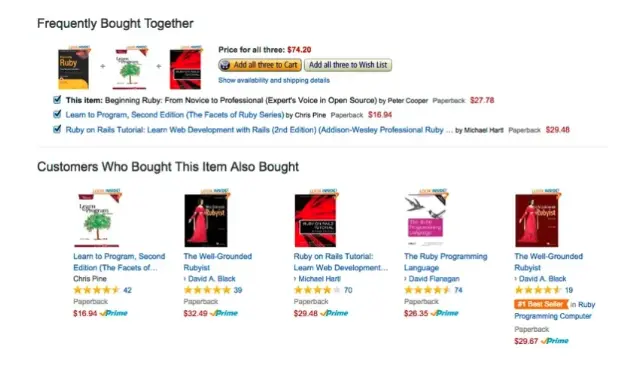
Amazon uses AI to analyze browsing, purchase history, and behavioral signals in real time to recommend complementary products. This increases basket size while helping customers discover relevant items faster across millions of SKUs. Netcore’s Insight Agent is also able to recommend product bundles based on the goal of the campaign.
4. Spotify’s Personalized Music Discovery
Spotify recommends songs, playlists, and podcasts using listening habits, skips, repeat plays, and contextual behavior. Its AI continuously adapts recommendations, making discovery highly individualized and improving long-term engagement. All this is possible onl with the help of AI-powered product recommendations.
Omnichannel and Mobile App Personalization Examples
Omnichannel marketing is standard operating procedure, yet most platforms continue to operate in isolated silos. Seamlessness Across Channels dictates that customers do not perceive your brand as separate email, mobile app, and SMS entities. They expect a singular, continuous experience.
5. Cross-Channel Session Continuity
Consider a user who adds an item to their mobile app cart but abandons the session due to an incoming phone call. A disconnected stack waits 24 hours to send a generic email. A seamlessly connected architecture immediately recognizes the drop-off and, based on the user’s historical channel affinity, triggers a highly contextual WhatsApp message two hours later containing a deep link directly back to the app checkout.
The ROI Impact: Executing session continuity across native mobile apps and messaging channels reduces cart abandonment revenue leakage by up to 31%.
6. Geolocation-Triggered In-App Experiences
App experiences must adapt to physical context. When a user enters a geofenced retail location, the mobile app autonomously transitions from a standard browsing interface to an “In-Store Mode,” highlighting loyalty QR codes, store-specific inventory, and real-time aisle navigation.
The ROI Impact: Bridging the digital-to-physical gap through behavioral triggers increases in-store mobile app engagement rates by over 40%, directly correlating with higher point-of-sale transaction volumes.
Email and Push Notification Personalization Examples
7. AI-Driven Send Time Optimization (STO)
Standard platforms allow marketers to schedule emails for “9:00 AM in the user’s time zone.” Predictive models analyze millions of historical engagement data points to determine the exact minute an individual user is most likely to open and engage with an app or email. The system autonomously delays or advances the send for every single recipient.
The ROI Impact: Implementing true, user-level Send Time Optimization increases aggregate open rates by 15-20% and drives a proportional downstream lift in click-to-conversion metrics.
8. Live-Inventory Dynamic Inbox Content
Push notifications and emails that promote out-of-stock items damage brand trust. Advanced personalization utilizes open-time personalization technology. If a user opens an email three days after it was sent, the product grid inside the email pings the inventory database in real-time. If the originally promoted item is sold out, the email dynamically swaps the image and link to a highly relevant, in-stock alternative.
The ROI Impact: Eliminating dead-end clicks via real-time adaptation protects user trust and recovers an estimated 8-12% of otherwise lost conversion opportunities.
Hyper-personalization Examples
9. Starbucks Real-Time Offer Personalization
Starbucks uses AI to personalize app offers based on order history, location, weather, time of day, and loyalty behavior. A customer may receive different promotions depending on their routines and purchasing patterns. Netcore’s agentic marketing platform is also able to do the same using
10. Netflix Dynamic Content Personalization
Netflix personalizes thumbnails, show recommendations, and homepage layouts for every user. Two people searching the same title may see different artwork and suggestions based on genre affinity, watch history, and engagement behavior.
When we deploy Agentic marketing platform into the workflow, the marketer’s role fundamentally shifts. Instead of building endless branching logic, the marketer sets the guardrails and the revenue goals. The machine autonomously tests thousands of variables—copy, creative, channel, timing, and sequence—identifying the highest-performing combinations and deploying them instantly. This enforces strict accountability for outcomes, ensuring every execution is mathematically aligned with ROI.
Steps to Implement Personalization at Scale
Transitioning from legacy marketing to autonomous, predictive personalization requires a structural approach. Marketers evaluating this shift must systematically upgrade their infrastructure to an agentic marketing platform.
- Audit your data fragmentation
Identify every silo where customer data currently lives. Document the latency between a user taking an action on your website and that data becoming usable in your messaging platform. - Establish baseline ROI metrics
Calculate the exact conversion rates and revenue generated by your current rules-based campaigns. You must establish a mathematical baseline to measure the impact of AI-driven optimization. - Consolidate your technology stack
Eliminate point solutions that only handle single channels (like standalone email or SMS vendors). Migrate to a unified platform that natively combines CDP capabilities with cross-channel execution. - Deploy predictive models gradually
Begin by activating low-risk, high-reward AI features like Send Time Optimization and predictive product recommendations before handing over full autonomous control of complex lifecycle journeys.
Final Take
Moving from manual journey mapping to autonomous decision-making transforms marketing departments from cost centers into accountable revenue engines. Brands that continue treating personalized messaging as a manual sequencing task will mathematically cap their conversion rates and exhaust their engineering resources. The performance ceiling for rules-based engagement is rapidly approaching, leaving organizations vulnerable to competitors wielding faster, predictive models. Netcore approaches this bottleneck by eliminating the manual orchestration layer entirely, replacing it with intelligence systems that dynamically adapt to behavioral signals at scale. We believe the future of customer experience relies on architectures that deliver measurable financial outcomes rather than just aesthetic interface updates. To evaluate the specific infrastructure required for this operational shift, examining platform capabilities is the logical next phase of integration planning.
Ready to upgrade your personalization infrastructure? Get in touch with us.