





TL;DR
Omnichannel personalization means giving every customer the same personalized experience in real time, no matter where they are or what they’re doing. It replaces broken, campaign-based methods with a centralized intelligence layer that understands and responds to each user in context.
The main parts are a Customer Data Platform (CDP) to bring together first-party data, AI/ML models for making decisions based on predictions, real-time orchestration across channels, and agentic automation that keeps improving journeys. Identity resolution, behavioral segmentation, dynamic content personalization, and cross-channel journey orchestration driven by live signals are some of the most important strategies.
The benefits are clear and focused on making money: more conversions, higher customer lifetime value, better retention, and real cross-channel consistency. Brands can get up to twice as good performance by moving from batch-and-blast to autonomous optimization. This lets them provide seamless, customer-focused experiences on a large scale.
Customers expect a smooth, 1:1 experience that follows them across all touchpoints in omnichannel marketing. However, most brands are stuck using separate tools that only work in their own silos. The main goal of modern marketing operations is to close the gap between a disjointed multichannel setup and a real-time omnichannel architecture. This guide looks at the basic frameworks and technical architectures needed to make omnichannel personalization have a measurable effect on revenue.
What is Omnichannel Personalization?
Synchronizing or connecting the customer data across all channels for omnichannel personalization means giving each customer a unique, one-to-one personalization in real time. And by customer data it does not just mean customer attributes like name, age, city but also It uses centralized intelligence, like a CDP, to make sure that the message is the same no matter what touchpoint it is, replacing disconnected campaigns with smooth, behavior-driven customer journeys.
For a long time, marketing technology was all about expanding channels. Brands used email platforms, SMS gateways, mobile push providers, and web personalization engines on their own. This made it easier for businesses to talk to each other in many ways, but it also made a system with huge data silos and broken user profiles. When people interact with a brand, they don’t see separate channels; they see one entity. Omnichannel personalization takes this into account by building a technology stack that reflects how the customer thinks as per the customer’s mental model.
To go beyond basic multichannel, you need to change your focus from the point of delivery to the data architecture that supports it. In a legacy setup, an email tool doesn’t know that a user just bought something in the mobile app, which often leads to duplicate promotional messages that make the customer experience worse. A unified customer profile that updates instantly across all endpoints and a centralized nervous system are both necessary for true omnichannel execution. It is recommended that organizations view this not as a messaging strategy, but as a comprehensive data orchestration strategy.
Benefits of Omnichannel Personalization
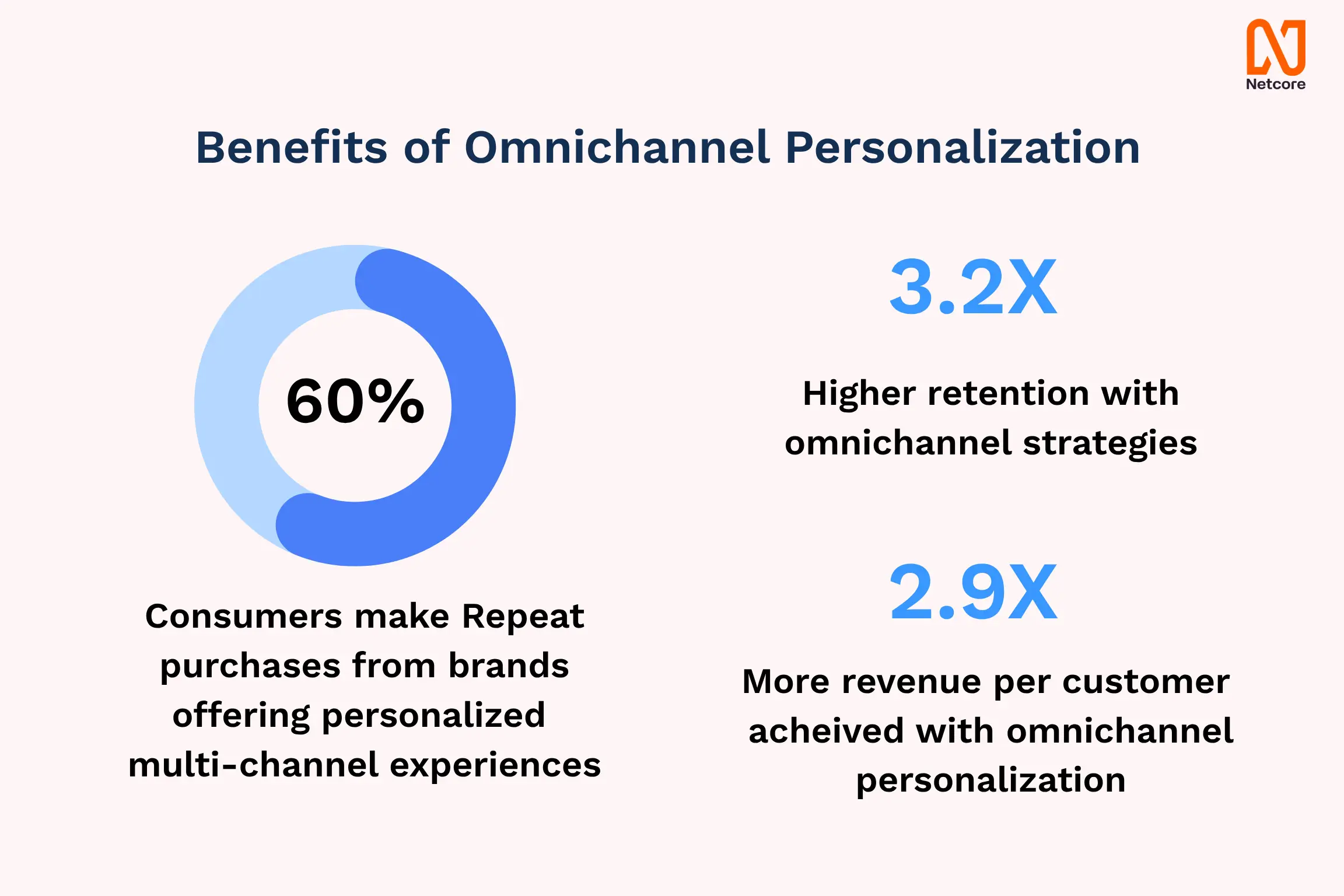
The driving force behind the transition to an omnichannel architecture is accountability. In the modern economic environment, marketing and growth teams are under intense pressure from financial leadership to prove the tangible revenue impact of their technology investments. Vanity metrics such as open rates, click-through rates, and general engagement are no longer sufficient to justify enterprise software expenditures.According to extensive industry analysis detailed in McKinsey’s research on the boundaries of omnichannel personalization, a cohesive strategy significantly increases revenue across the entire customer base. The economic validation rests on three core pillars of business impact:
1. Reduction of Customer Acquisition Cost (CAC)
Getting new customers is more expensive than ever because advertising channels are getting more crowded and data privacy laws make it harder for third parties to track customer behaviour. Omnichannel personalization helps you get the most out of the traffic you get. Brands stop expensive top-of-funnel traffic from bouncing off or leaving by giving users highly relevant, context-aware experiences as soon as they land on a site or their app.
2. Maximizing Customer Lifetime Value (LTV)
It’s much more likely that you’ll sell to an existing customer than to a new one. An interconnected architecture makes sure that journeys after a purchase are as good as they can be. For example, sending proactive replenishment reminders through WhatsApp and personalized email suggestions based on past purchases are two ways to consistently get people to buy again.
3. Decreasing Churn Through Relevancy
Customers abandon brands when they feel misunderstood. Receiving an SMS promotion for a product they returned yesterday is a rapid driver of churn. When you use AI-powered omnichannel personalization there is no question of sending irrelevant offers to the customer, making them leave the brand, protecting the brand’s relationship with the user and retaining revenue that would otherwise be lost to competitors.
What are the Core Pillars of an Omnichannel Strategy?
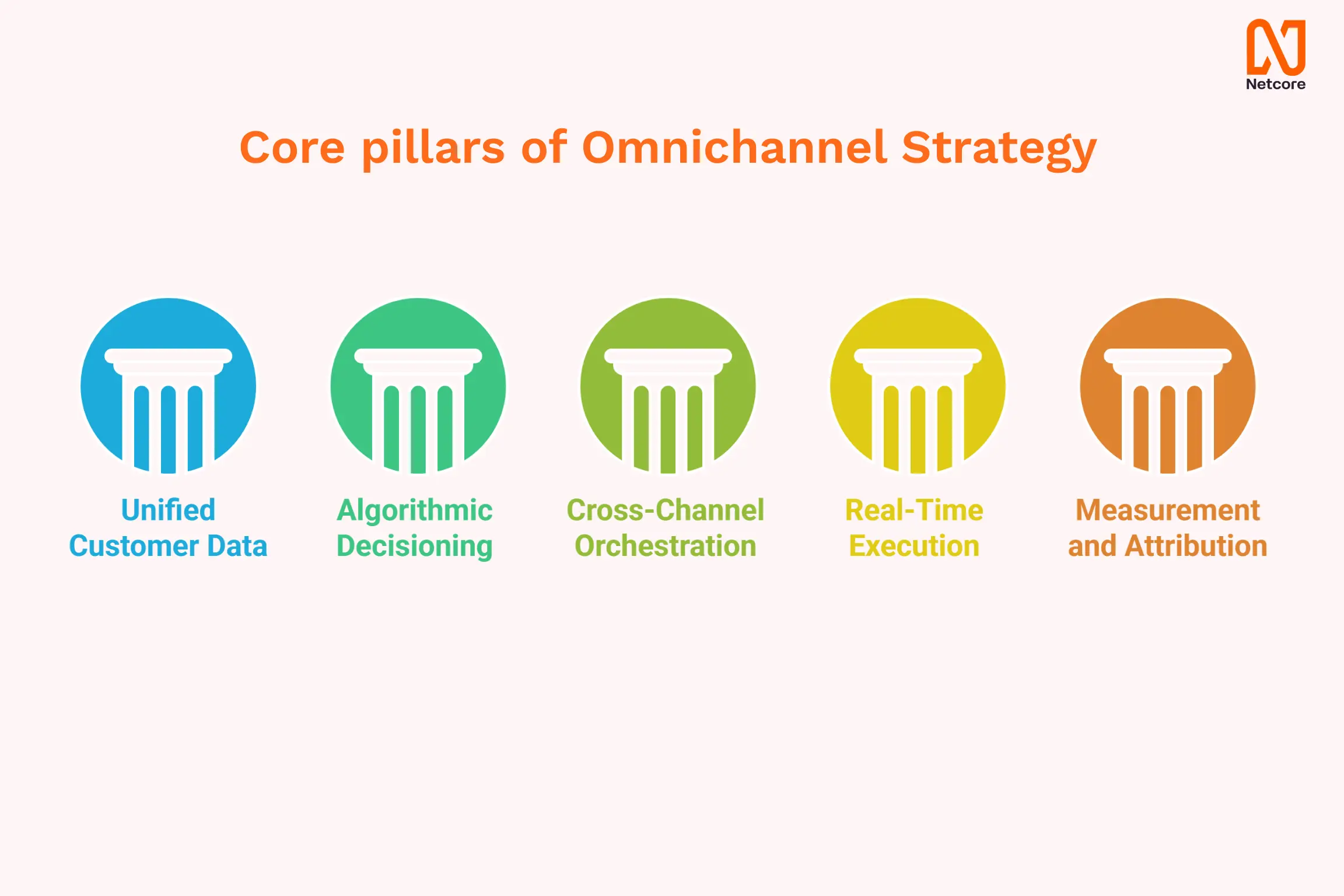
Organizations cannot simply purchase a new software license and expect immediate cross-channel fluidity. The strategy must be built on established, proven pillars.
Drawing inspiration from industry frameworks, a comprehensive architectural approach includes the following vital components:
1. Unified Customer Data
Unified customer data creates a real-time single source of truth by stitching together interactions from POS, websites, apps, and support systems into one profile. This eliminates batch delays and enables context-aware decisions at an enterprise level where different teams work on the data profile. For example, if a user browses a product, abandons a cart, and contacts support, brands can instantly trigger a relevant offer, avoid redundant messaging, and assist with full context, delivering seamless, high-conversion omnichannel experiences.
2. Algorithmic Decisioning
Human marketers cannot manually map the millions of potential journey permutations. Algorithmic decisioning utilizes machine learning to determine the optimal next-best-action for every individual user at scale.
3. Cross-Channel Orchestration
Orchestration is the ability to map workflows or customer journeys to different channels like SMS, Email, WhatsApp, RCS, push notifications. Let’s understand this with an example. If a user ignores a push notification, the system should intelligently route a fallback message via email or SMS, depending on historical engagement preferences. This is known as cross-channel orchestration.
4. Real-Time Execution
Data has a highly perishable shelf life, especially the speed at which customers move between different channels today. If a user abandons a cart, the personalized intervention must occur while the purchase intent is still high, often within minutes, requiring an infrastructure capable of sub-second processing.
5. Measurement and Attribution
Organizations must implement robust attribution modeling to understand exactly which sequence of touchpoints drove the final conversion, ensuring that future marketing spend is allocated efficiently to the highest-performing channel combinations.
What are the 4 C’s of omnichannel?
When evaluating the effectiveness of a customer journey, industry standards suggest framing the audit around the “4 C’s.” This framework helps operational leaders quickly identify gaps in their user experience:
- Consistency: The brand’s tone, visual identity, and core messaging must remain identical whether the user is interacting with a mobile app, an email, or an in-store associate.
- Context: Every interaction must acknowledge where the customer is in their journey. A user researching a product requires educational content, while a user at the checkout stage requires frictionless transactional support.
- Convenience: The transition between channels must be effortless. A user should be able to start a support query on social media and seamlessly continue it via email without repeating their issue.
- Connection: The overall experience must feel empathetic and human, utilizing behavioral data to foster a genuine relationship rather than feeling mechanically automated.
Multichannel vs. Omnichannel: How do you break down the data silos?
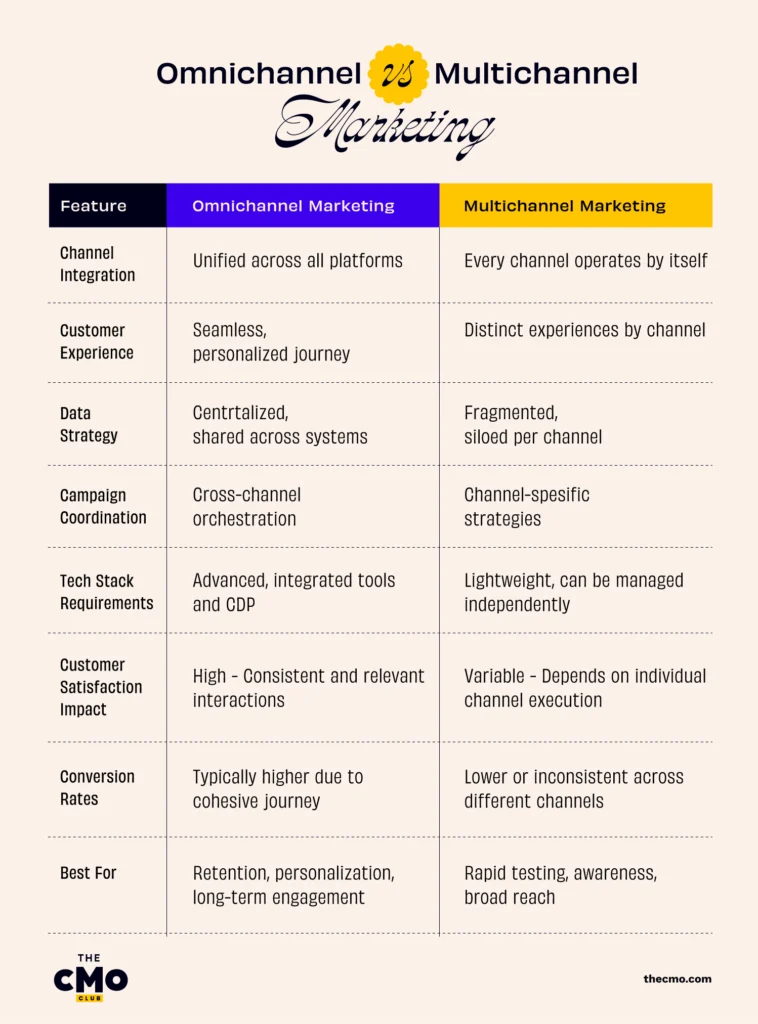
Source: The CMO Club
The fundamental tension facing modern growth teams is the friction caused by disjointed tools. The key difference in Omnichannel Vs Multichannel marketing lies in integration. Multichannel is a product-centric approach where the brand blasts messages outward. Omnichannel is a customer-centric approach where the brand synchronizes data inward to surround the user with a singular experience.
Breaking down these silos requires phasing out legacy point solutions in favor of unified platforms. Managing separate vendors for email, mobile marketing, and web analytics creates inherently fragmented data structures.
To move from multichannel to omnichannel, organizations must conduct a ruthless audit of their tech stack, identifying tools that cannot share data via open APIs and replacing them with natively integrated solutions. For deeper context, review our satellite guide on auditing legacy marketing architectures.
What is the role of AI and CDPs in real-time personalization?
Achieving true omnichannel personalization is mathematically impossible without the integration of a Customer Data Platform (CDP) and Artificial Intelligence (AI). The modern consumer generates thousands of data points daily, from cursor movements and hover times on a website to email open durations and location pings.
The CDP acts as the central brain of the operation. It ingests this massive volume of unstructured data, cleanses it, resolves multiple device identifiers into a single unified profile, and makes that profile accessible to execution layers. However, having unified data is only half the battle. Organizations must shift from “rules-based” execution to “intelligence over execution.”
Historically, marketers relied on “if/then” logic: If a user visits the pricing page, then send a discount email. This linear approach fails to account for nuance, intent, or optimal timing. AI-native, agentic systems replace this rigid logic with autonomous decision-making. Predictive algorithms analyze millions of historical patterns to calculate the precise probability of conversion, churn, or engagement. The AI determines not just what content to show, but the exact channel and the exact time of day that will yield the highest measurable ROI for that specific individual.
What are real-world omnichannel personalization examples in action?
Theoretical frameworks must be validated by real-world business outcomes. Brands that successfully navigate the transition from multichannel to omnichannel experience significant operational and financial gains.
Good Doctor: Driving 3X Prescription Purchases
Good Doctor, a leading digital healthcare provider in Indonesia with a network of over 1,000 doctors and 4,600 pharmacies, faced the challenge of converting app users into fully registered members and increasing teleconsultations. By implementing a strategic omnichannel engagement model, they moved away from siloed communications.
Utilizing a unified co-marketing approach, Good Doctor orchestrated seamless journeys that connected insurance registration workflows with telemedicine prompts and pharmacy delivery updates. By ensuring the customer context was preserved across every touchpoint, the healthcare provider achieved a remarkable 3X increase in prescription purchases. This proves that omnichannel strategies are not just for retail; they are critical for complex, trust-based user journeys. Read full success story here.
Clovia: Increasing Conversions by 200%
Clovia, one of India’s fastest-growing underfashion brands, faced the common e-commerce challenge of high traffic but lower-than-desired conversion rates due to product discovery friction. Customers struggled to navigate an expansive catalog of intimate apparel.
Instead of blasting generic promotional emails, Clovia deployed an omnichannel recommendation engine capable of predicting behavioral intent. By analyzing user behavior, the platform generated hyper-personalized product suggestions displayed dynamically in a “You may also like” widget on Product Detail Pages, as well as a dedicated “Picked Just for You” personal boutique. Furthermore, these algorithmic recommendations were seamlessly pushed to users via email, SMS, WhatsApp, and push notifications. This synchronized, cross-channel intelligence engine resulted in a 200% increase in conversion rates, highlighting the direct correlation between AI-driven relevance and revenue. Read full success story here.
How do you choose the right omnichannel personalization platform?
The vendor landscape is saturated with omnichannel personalization platforms claiming omnichannel capabilities, but many are simply legacy multichannel platforms repackaged with new marketing terminology. Growth and Operations leaders must evaluate technology partners based on their ability to fundamentally impact the bottom line.
When building an RFP or evaluation scorecard, prioritize omnichannel personalization software that offers native unification rather than forcing API integrations between disparate acquired tools. The ideal platform must possess an integrated CDP, robust identity resolution, and an AI-native decisioning engine capable of agentic execution. How do omnichannel personalization platforms improve engagement? Omnichannel personalization platforms boost engagement by unifying behavioral and attribute data across channels to deliver 1:1 personalized experiences. This ensures every customer receives the right message, in the right context, with the most relevant offer. Look for vendors that can provide concrete proof of accelerating time-to-value and minimizing Total Cost of Ownership (TCO).
Organizations should heavily scrutinize a vendor’s ability to process real-time behavioral data across email, SMS, WhatsApp, and in-app channels simultaneously. To make the decision making easier for you, we have evaluated and compared top omnichannel marketing platforms.
Final Take
True omnichannel personalization is not just a marketing tactic, it’s a fundamental architectural shift. It requires moving beyond siloed, rules-based multichannel campaigns to a unified, AI-native intelligence core that orchestrates the entire customer journey in real time. Brands that successfully make this transition go beyond surface-level engagement metrics to unlock measurable, scalable revenue growth.
Ready to architect a unified customer experience? Discover how to consolidate your tech stack and drive measurable ROI with an AI-driven approach. Connect with us to see how Netcore’s agentic marketing solutions can elevate your omnichannel personalization strategy.


