





Introduction
For years, the baseline expectations for email marketing platforms remained largely stagnant. As noted in The Forrester Wave™: Email Marketing Service Providers, Q1 2026, previous evaluations “found little change in vendor capabilities”.
Historically, vendors solved the “same primary set of marketer needs: Create email campaigns, send high volumes of email messages, report on results” using the “same primary set of functionalities”. These basic features, drag-and-drop editors, basic deployment infrastructure, and simple heatmaps, were sufficient when email was viewed merely as a low-cost, top-of-funnel communication tool.
However, the modern go-to-market strategy demands far more. The marketer of 2026 cannot rely on basic batch-and-blast infrastructure. Email must now function as an intelligent, high-performance revenue system that connects seamlessly to broader customer journeys.
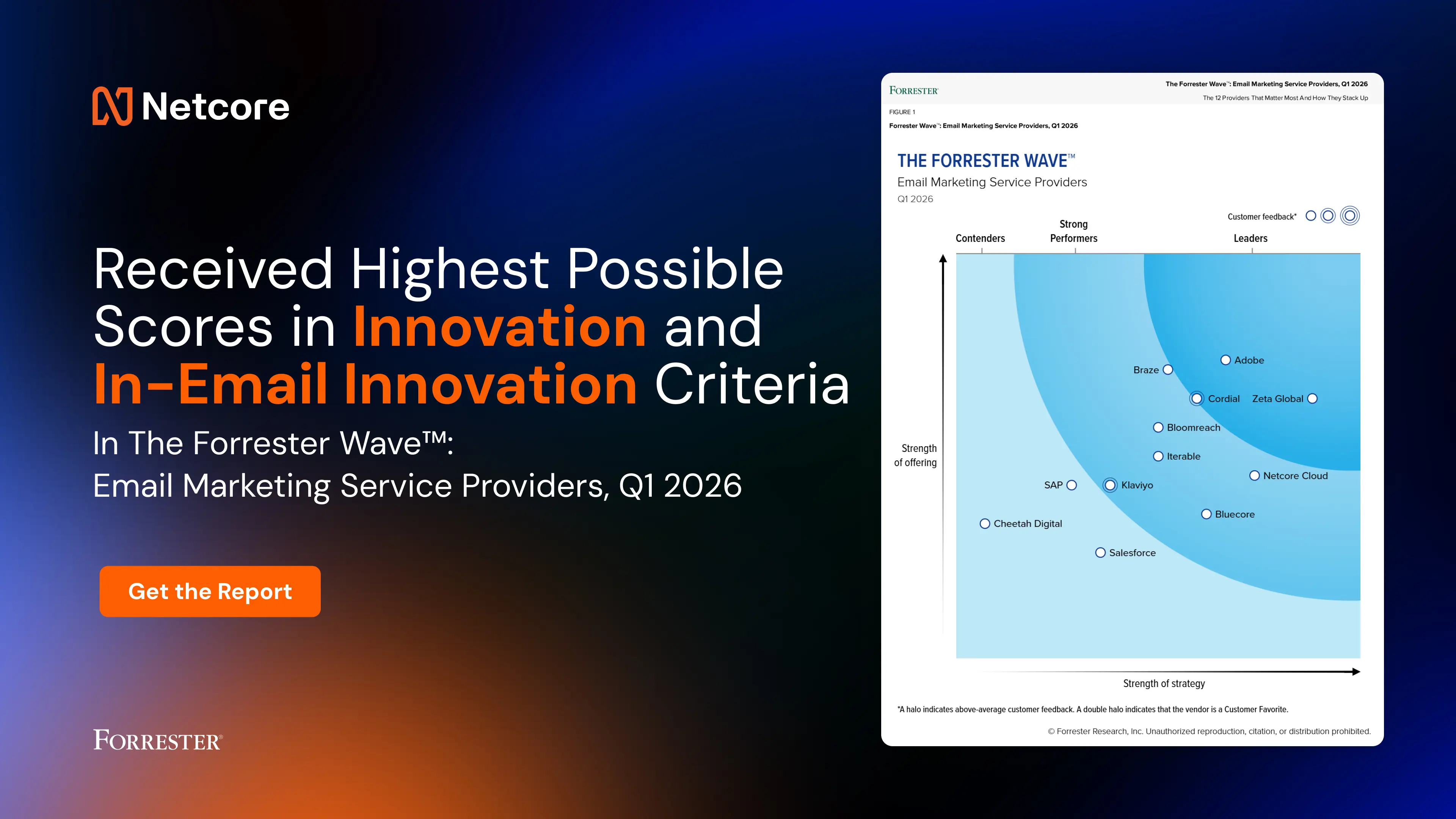
In its comprehensive evaluation of the market, Forrester identified the 12 Providers That Matter Most. Vendors were rigorously evaluated across three core categories: Current offering, Strategy, and Customer feedback. We are proud to share that Netcore has been named a Strong Performer in this critical evaluation. We view this placement not merely as an industry acknowledgment, but as hard evidence of our core strategic logic: to drive real business growth, marketing platforms must push the absolute limits of what the email medium can achieve.
The Paradigm Shift:
The era of manual, prompt-based campaign execution is officially behind us. The industry is currently undergoing a massive structural shift driven by advanced technology. In the report, Forrester explicitly mentions this transformation, stating that “competitive pressure plus the revolutionary power of AI pushes the limits of what the email medium can do”.
The future belongs to dynamic, buyer-centric models. According to Forrester, brands should “Expect conversational inboxes where customers can dialog with a brand, engaging in individualized cross-channel and brand-customer interactions that are auto-assembled from smart content assets at optimal moments”.
But achieving this level of sophistication requires extreme technical discipline. Forrester astutely advises buyers to look for “Al as a functionality-enabler, not as a feature”. Instead of being swayed by platforms claiming to be “good at AI,” organizations must “scrutinize how it uses AI to automate, error-proof, and streamline core use cases”. The report emphasizes that the superior vendors in the study “applied Al to amplify sophistication, relieve marketer stress, or to introduce opportunities”. For example, AI can optimize delivery frequency according to user preferences and business goals and improve positioning within “Gmail’s tabular inbox organization”.
This is the exact engineering philosophy driving our architecture at Netcore. We are actively shifting the marketer’s role from a tactical campaign operator to a strategic outcome architect, utilizing intelligent systems to manage the heavy lifting of buyer-stage enablement and revenue generation.
The Economics of Innovation:
Transitioning to this advanced state of marketing requires a technology partner capable of aggressive, sustained innovation. The market is moving far too quickly for sluggish product roadmaps or legacy codebases. As Forrester points out, “The difference between your emails being relevant and being ignored is a partner that can develop a faster-than-average pace of AI-fueled development”. Top solutions are those that “fund research and development well,” “cocreate with clients and partners,” and “encourage innovations from all corners of their company”.
At Netcore, we back our commitment to this rigorous development pace with substantial, deliberate capital investment. We believe that an email platform must serve as the intelligent communication layer for a brand’s entire go-to-market motion.
We see our position in the evaluation as a reflection of this strategic prioritization. According to the report, “Netcore has superior innovation, partner ecosystem, and pricing because it invests half of its revenue in R&D, opens its application architecture to partner development, and offers performance-based pricing to offset the risk of experimentation”. By heavily funding our own research and development, we ensure our clients always have access to cutting-edge revenue tools. Furthermore, Forrester’s evaluation noted that “Netcore’s vision, roadmap, and community are solid; it grew its email customers by 30% in 2025”.
Deconstructing the Scores:
In The Forrester Wave™: Email Marketing Service Providers, Q1 2026, Netcore achieved the highest possible scores (5.00) in six evaluation criteria. To us, these specific capabilities represent the foundational building blocks of a modern, revenue-generating email system:
- Innovation (5.00): We innovate to solve complex revenue bottlenecks. We are building the intelligent communication layer required for complex, agentic marketing ecosystems.
- In-email innovation (5.00): Perhaps the most significant evolution in reducing buyer friction is collapsing the distance between product discovery and the final purchase. Every time a customer is forced to click out of an email to load a mobile website, conversions drop. Forrester’s report specifically highlighted “Netcore’s in-email innovation, specifically its shoppable emails”. By allowing users to transact directly inside the inbox interface, we transform messaging from a simple notification into a frictionless point of sale.
- Queries and segmentation (5.00): Precision targeting is useless if the data takes hours to load. Our strength in audience targeting is engineered for speed. As Forrester’s evaluation states, “Netcore’s querying and segmentation strength comes from its rapid query return time”. This allows for highly agile, real-time data activation across large customer bases. This speed is no longer just a nice-to-have; it is absolute table stakes as marketing moves toward agentic and autonomous systems. To truly transform messaging and buyer-stage enablement, the ability to query the best segment instantly to drive real-time, 1-1 personalization is essential.
- Partner ecosystem (5.00): A modern platform cannot exist in a silo. We prioritize strategic integrations and co-innovation, deliberately opening our application architecture to partner development to power a stronger, unified martech ecosystem.
- Pricing flexibility and transparency (5.00): Traditional SaaS pricing often penalizes growth and creates friction. We offer performance-based pricing models that align directly with measurable business outcomes, thereby offsetting the risk of experimentation for our enterprise clients.
- Adoption (5.00): The most advanced AI features are utterly worthless if your marketing team cannot effectively adopt and deploy them. We maintain a relentless focus on ensuring our clients achieve immediate time-to-value and deep platform utilization.
From Platform Capability to Direct Business Impact
Ultimately, technology assessments and evaluation criteria are only valuable measurements if they translate into a stronger bottom line. We do not view our role as simply providing the infrastructure for campaign deployment. We actively partner with our clients to scale complex experimentation, optimize multi-channel journeys, and connect everyday tactical decisions directly with long-term financial growth.
This philosophy, focusing on revenue outcomes rather than just software utilization, is reflected for us in the direct feedback provided by our customers during the Forrester evaluation process. A vendor’s technology is only as good as the service that supports it. Our company values are inherent in this, we firmly believe that “We Win When Our Customers Win.” By acting as an AI-powered insight system for your team, our success is entirely predicated on our ability to help you hit your KPIs, scale your strategies, and drive sustainable growth.
According to the report, “Customers laud Netcore’s high-touch customer service, quick resolution, and proactivity”. Furthermore, this close collaboration drives quantifiable business results. The Forrester report notes that our clients “love their early access to beta features and can attribute revenue lift directly to Netcore’s recommendations”. When you integrate Netcore into your technology stack, you are not merely purchasing an email service provider; you are acquiring a dedicated extension of your revenue operations.
The Future of Email Marketing
The Forrester Wave™: Email Marketing Service Providers, Q1 2026 comes at a moment when email marketing itself is being redefined. What was once viewed primarily as a campaign channel is now becoming a far more intelligent, adaptive, and commerce-aware growth engine. The future of email marketing will be shaped by how effectively brands can turn customer signals into action, improve visibility in increasingly crowded inboxes, and create frictionless paths from engagement to conversion.
1. Autonomous Goal-Based Marketing
One of the most important shifts ahead is the move from prompt-based systems to goal-based decisioning. For years, marketers have relied on platforms that require manual inputs at every stage, from audience creation to content selection to campaign optimization. But the future of email marketing will be defined by systems that can work backward from business goals and autonomously determine the best course of action.
Instead of asking teams to specify every test, rule, and variant, modern platforms will increasingly help marketers define outcomes such as improving conversion, increasing retention, driving repeat purchase, or reactivating dormant users. From there, intelligent systems will continuously evaluate signals, identify the right audience, decide timing and message strategy, and optimize journeys in ways that are aligned to those goals. This is where email becomes more than a messaging channel; it becomes an active decisioning layer in the customer lifecycle.
Explore Agentic Marketing Today!
2. Inbox Visibility
Another critical priority for the future is inbox visibility. Delivery and inbox placement remain important, but they are no longer sufficient measures of performance. An email may be successfully delivered and still fail to make an impact if it is overlooked, ignored, or buried in a crowded inbox. For brands focused on efficiency and revenue, visibility has become just as important as deliverability.
That means marketers need to optimize not only for whether an email arrives, but whether it is actually seen and acted on. Relevance, timing, trust, recognition, and message value all play a role in earning attention. As competition in the inbox intensifies, brands will need to treat visibility as a business outcome tied directly to engagement and return on ad spend.
Explore Inbox Visibility today!
3. Shoppable Emails
Email itself is becoming a more interactive and commerce-led environment. Shoppable emails represent a major step forward because they reduce friction between discovery and purchase. Rather than asking customers to click through multiple steps before taking action, brands can create experiences that allow users to browse, engage, and move closer to conversion directly within the email experience.
This shortens time-to-purchase, simplifies the customer journey, and can improve conversion by making the path from interest to action more immediate. It also changes the role of email from a traffic-driving tool to a more direct commerce channel.
Learn more about Shoppable Emails by reading this blog.
4. Power of the Ecosystem
One vendor can’t solve this alone. To fully realize this vision, brands must explore the personalization journey that matters across the entire ecosystem and work with partners (both tech and agency) to drive more innovative solutions at scale. The customer sits at the center and collaborates with the ecosystem to drive shared success together.
Taken together, these shifts point to a broader transformation in how marketers will think about the channel. The future of email marketing will not be defined by batch campaigns alone, but by how intelligently brands can orchestrate outcomes, win attention in the inbox, and reduce friction in the journey to purchase.
Looking ahead, agents will accelerate this transformation even further. Their role will go well beyond assisting with copy generation or workflow support. AI agents will increasingly analyze signals, make recommendations, execute decisions across campaigns and journeys, and optimize toward business goals in real time. As that becomes reality, email marketing will become more autonomous, more adaptive, and more tightly connected to customer intent, helping brands move from manual execution to truly intelligent engagement.
Ready to explore the data and the logic for yourself? Access the full Forrester Wave™ report to review the complete, rigorous evaluation methodology and learn exactly why “Netcore Cloud is a good fit for moderately sophisticated marketers who want help graduating to a more advanced state as well as brands needing a partner who is experienced in global use cases.”
Forrester does not endorse any company, product, brand, or service included in its research publications and does not advise any person to select the products or services of any company or brand based on the ratings included in such publications. Information is based on the best available resources. Opinions reflect judgment at the time and are subject to change. For more information, read about Forrester’s objectivity here .