




Why Mother’s Day Is the Marketing Moment You Can’t Afford to Wing
Mother’s Day is not just a feel-good holiday. It is one of the highest-revenue retail moments on the calendar, second only to the winter holidays. In 2025, according to an NRF study, American consumers spent $34.1 billion celebrating the mothers, grandmothers, stepmothers, and mother figures in their lives. The average celebrator spent $259 on gifts, experiences, and outings, and nearly half said they planned to spend more than the year before. But here is what makes 2026 especially interesting: the economic backdrop has changed the rules.
Consumers are dealing with tighter budgets, inflation fatigue, and the psychological weight of ongoing economic uncertainty. A survey found that 56% of gift-givers say the current economy directly impacts what they spend on Mother’s Day. Spending on traditional physical gifts, jewelry, electronics, and apparel is declining. What is rising? Experiences. Gift cards. A really good brunch. Gift card spending grew 7.3% year over year, and spending on special outings like dinners climbed 4.8%.
This shift is not just about money. It is about meaning. Consumers who are spending less in absolute terms are actually thinking harder about what they buy. They want gifts that feel personal, that create memories, that say something real. And that is a profound opportunity for marketers who know how to read the room.
This guide walks you through what the data says, what the smartest brands are doing, and how to build an omnichannel Mother’s Day campaign that converts, without feeling like just another promotion in someone’s inbox.
The Numbers Behind the Holiday
Let’s ground ourselves in what the research actually shows before we talk strategy.
Mother’s Day 2025 generated $34.1 billion in consumer spending. Of those celebrating, 74% planned to buy flowers, 73% a greeting card, and 61% a special outing like dinner or brunch. Jewelry, while still popular, saw a notable decline. Online shopping accounted for 35.9% of purchases, while 24.8% of consumers planned to shop at local or small businesses, a stat worth paying attention to if you play in the direct-to-consumer space.
The planning window is also important. Most consumers start thinking about Mother’s Day three to four weeks out, in the early inspiration phase. But intent really accelerates in the ten to fourteen days before the holiday, when people move from browsing to buying. Your campaign calendar should reflect these two very different mindsets.
One more signal worth noting: 48% of consumers say finding a gift that is unique or different is their top priority, they most want something that creates a special memory. This is not a holiday where generic presents and the recommendations associated with it will cut it.
Three Brands That Got Mother’s Day Right
Real campaigns are worth more than any theoretical framework. Here are three examples that demonstrate what a thoughtful Mother’s Day marketing actually looks like in practice.
- Pandora Jewelry ran a campaign called “Thank You, Mom” that centered on authentic customer stories rather than product shots. They built a video series featuring real moments between customers and their mothers, then distributed it across email, in-store displays, and social channels simultaneously. The emotional resonance translated directly into engagement, and the multi-touchpoint approach meant customers encountered the campaign wherever they naturally spent time.
- Lancôme offered something simple but memorable: personalized engraving on perfume bottles. The product stayed the same. The experience changed completely. Personalization at this level does not require a massive budget; it requires understanding that your customer wants to feel like they found something, not that they were sold something.
- Sephora approached Mother’s Day with a practical intelligence: they built a curated “Beauty Gifts for Mom” page organized by interest and budget, paired with influencer collaborations showing real-life gifting scenarios. This addressed a real consumer pain point, the fear of buying the wrong thing, and made the path to purchase much shorter.
Understanding What Shoppers Are Actually Looking For
There is a version of Mother’s Day marketing that treats the holiday as a traffic-driving exercise. Blast the list, push a discount, watch the numbers move. And yes, some of that will convert. But it misses something important about the psychology of this particular holiday.
Mother’s Day is one of the few shopping occasions where the emotional stakes are genuinely high for the buyer. People are not buying for themselves; they are buying to express something: gratitude, love, or acknowledgement. And when the gift misses the mark, they feel it personally.
This means your marketing needs to do more than describe your product. It needs to help your customer feel confident that what they are buying will land the way they hope it will.
10 Things You Should Absolutely Do This Mother’s Day
By transforming messaging and buyer-stage enablement through AI-powered insight systems, you can meet shoppers exactly where they are. Here are ten distinct, highly effective plays to execute this season:
1. Deploy a Conversational Shopping Agent
Finding the right gift is stressful. Turn your app or website into a conversational concierge. When a shopper types, “I need a meaningful gift for a mom who has everything,” the AI can guide them through follow-up questions to recommend the perfect, highly relevant product, shortening the path to purchase.

Did you know? Traditional site search relies on rigid keyword matching, which fails when emotional intent is high. Unbxd uses Natural Language Processing (NLP) to parse semantic intent. When a shopper types, “meaningful gift for a mom who has everything,” the AI maps the conceptual meaning of “meaningful” and “has everything” against product catalog metadata, guiding them through follow-up questions to recommend the perfect product and shortening the path to purchase. That is revolutionary!
2. Shift from Static Segments to Real-Time Audiences
Don’t lock in your segments three weeks out. Use Agents to dynamically update lists in real-time. If someone abandons a cart on your curated gift guide on May 8th, they should instantly move into a high-intent recovery flow, receiving a highly contextual follow-up rather than a generic inspiration email.
3. Eliminate Checkout Friction with Shoppable Emails
Every redirect is a chance to lose a sale. Bring app-like features directly into the inbox so customers can browse gift bundles, select variants (like perfume sizes), and add items to a cart entirely within the email. Frictionless buying is your biggest conversion lever during peak weeks.
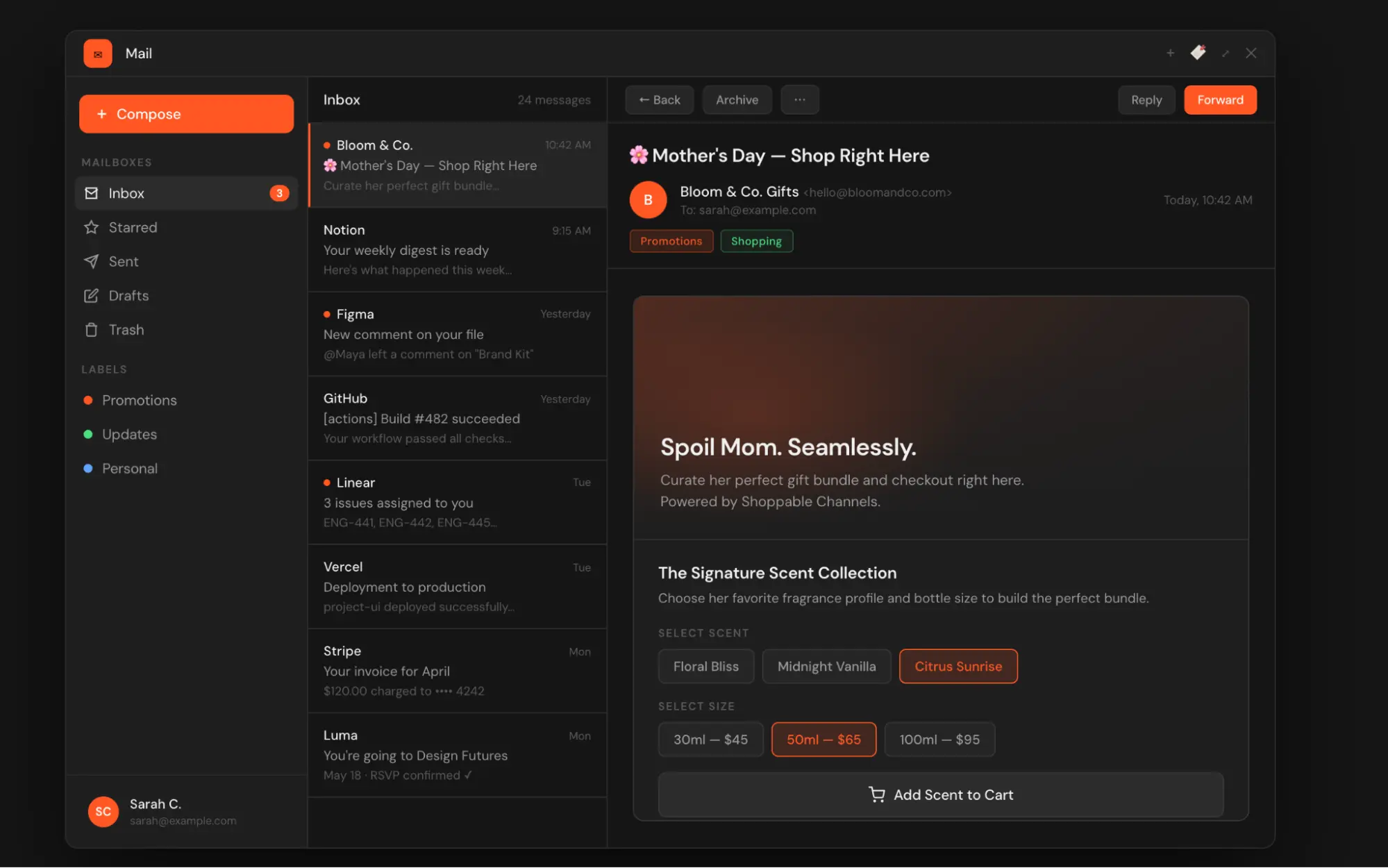
4. Blend Authenticity with Commerce
Scale the authenticity of brands like Pandora by pulling User-Generated Content directly into your owned channels, like emails. Embed real customer unboxing videos or reviews next to an interactive product grid. The emotional resonance builds trust, and the shoppable elements let them buy instantly.
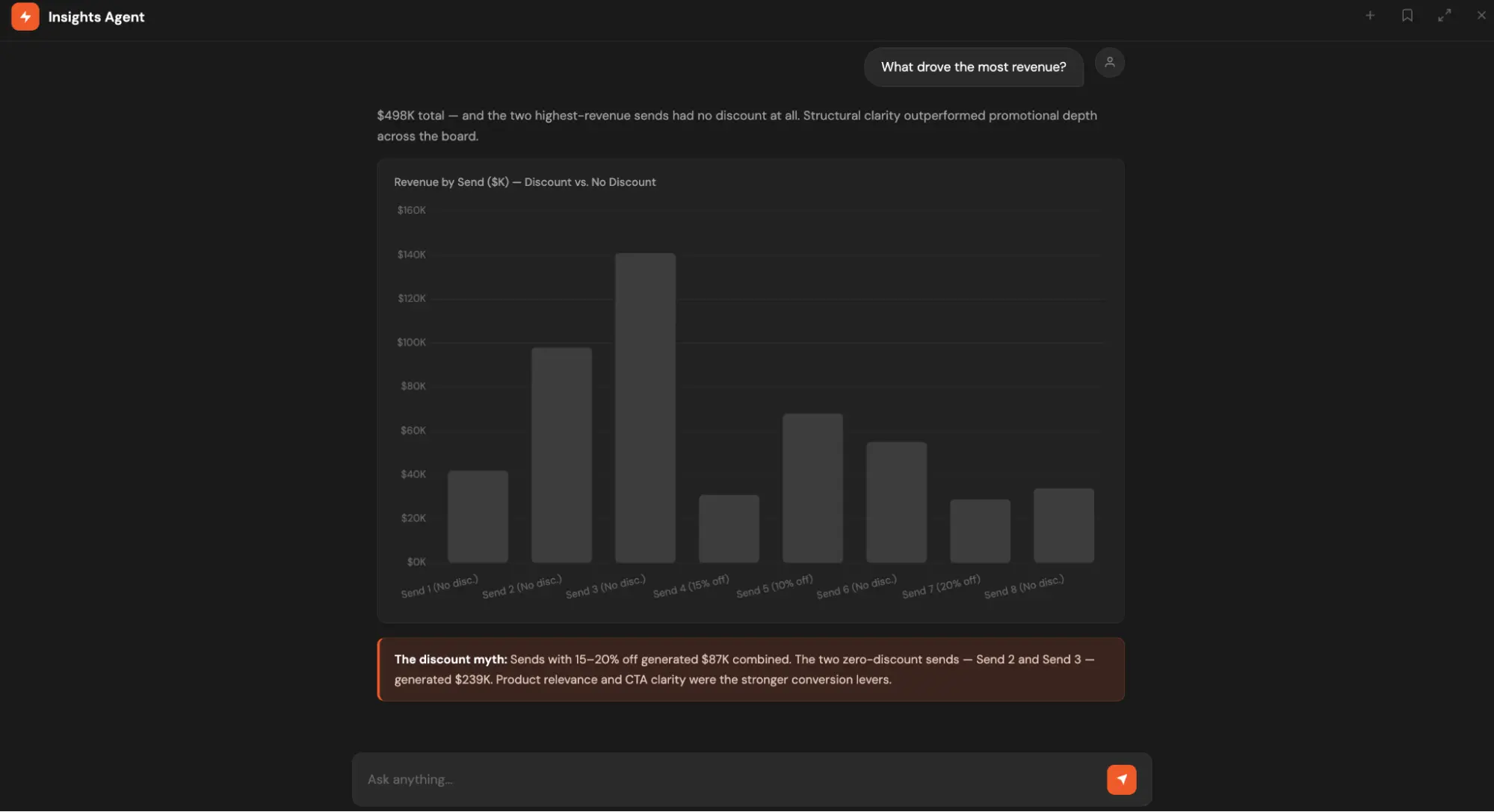
5. Uncover Hidden Purchase Intent with AI Insights
Stop guessing what people want. Let an Insights Agent continuously analyze behavior and purchase history. It can surface a signal that customers who bought wellness products in Q4 are prime candidates for a Mother’s Day spa set, allowing your team to target based on predictive intent.
Did you know? Moving beyond basic rule-based segments requires unsupervised machine learning. The Insights Agent uses clustering algorithms to identify latent patterns across millions of historical transaction logs and behavioral data points. It can automatically surface the statistical probability that customers who bought wellness products in Q4 are prime candidates for a Mother’s Day spa set.
6. Turn Homepage Traffic into Curated Experiences
Don’t force customers to hunt for relevance. Use Web Personalization to alter the site experience based on the user’s past behavior. If a shopper previously browsed budget-friendly jewelry, your homepage banners should instantly reflect those specific price points when they return.
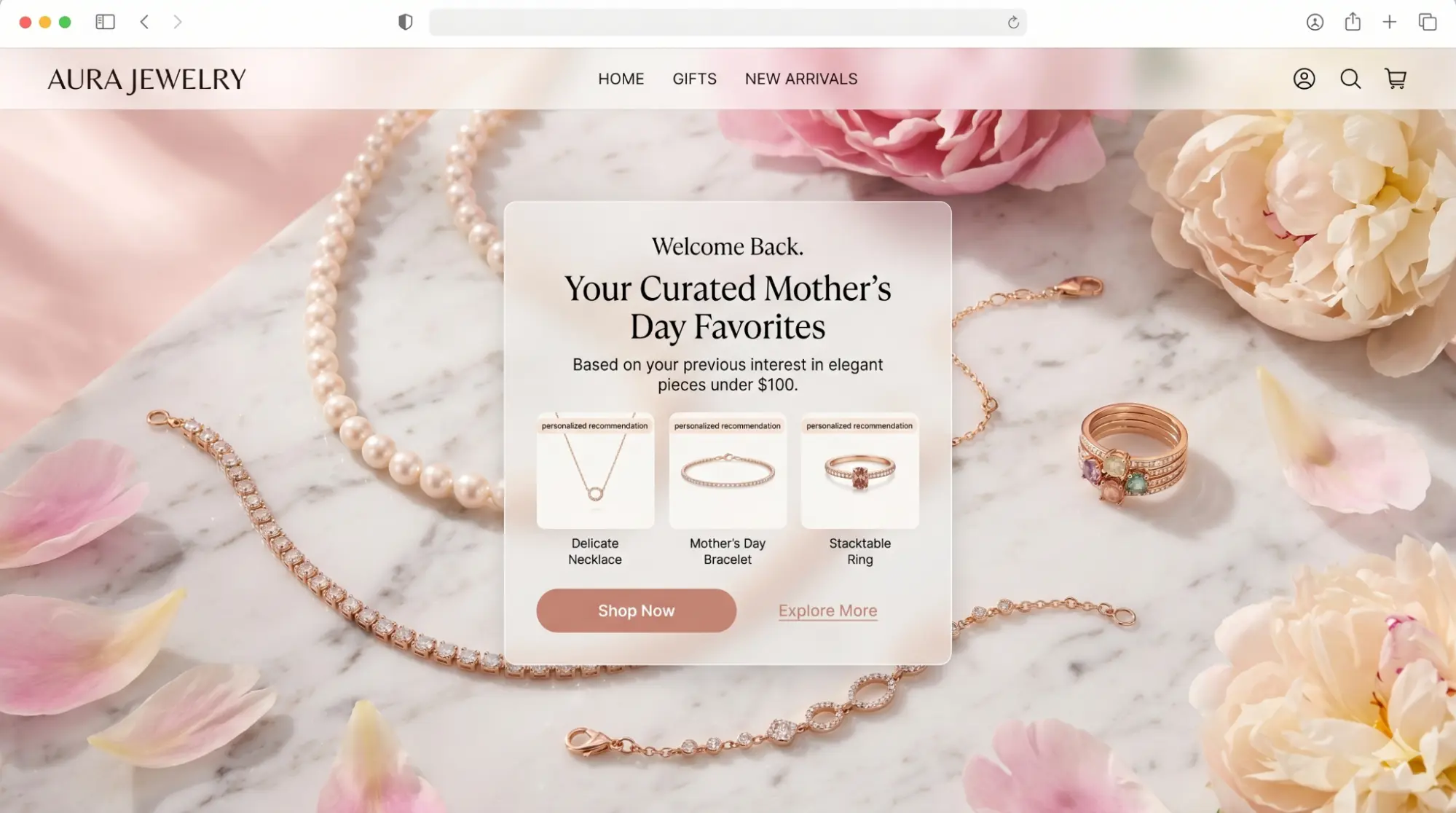
7. Orchestrate the Journey Across Channels
A unified Customer Engagement platform ensures your messaging is coherent, not chaotic. If a push notification introduces a gift guide on Monday, and the customer converts, the CE platform automatically suppresses the scheduled SMS cart reminder for Wednesday, preserving the customer relationship.
8. Predict the Perfect Add-on to Boost AOV
Use Product Recommendations to suggest high-margin add-ons based on the cart’s contents dynamically. If a customer adds a luxury watch, seamlessly recommend a premium watch winder or personalized engraving, enhancing emotional value while lifting Average Order Value.

9. Drive Urgency via Messaging Apps
Urgency messaging is highly effective in the final week. Cut through the noise of crowded inboxes with WhatsApp and SMS, which boasts a 98% open rate. Send a helpful countdown to shipping deadlines or offer a quick two-way conversational flow to confirm a delivery address. It feels like a service, not a sales pitch.
10. Elevate the Post-Purchase Journey
The experience doesn’t end at checkout. Use In-App Messaging or rich transactional emails to confirm delivery timelines, offer real-time tracking, and suggest adding a personal digital note to the physical gift. Ensure the gift lands exactly the way the buyer hoped it would.
Bringing It Together
Mother’s Day 2026 is going to reward marketers who lead with empathy and back it up with infrastructure. The data is clear: consumers are spending more thoughtfully, prioritizing meaning over merchandise, and responding to brands that feel like they understand what the holiday is actually about.
That means starting early enough to catch the inspiration phase. It means segmenting by intent, not just demographics. It means building omnichannel journeys that reduce friction rather than add it. It means letting AI agents do the heavy lifting on audience intelligence while your team focuses on the creative and strategic work that requires human judgment.
And it means knowing that the brands that win Mother’s Day are not necessarily the ones with the biggest budgets, they are the ones that made their customers feel understood.
If you want to see how Netcore brings customer data, Unbxd discovery, segmentation, and omnichannel execution together in a single unified system to build campaigns that actually convert. we would love to show you around.