




TL;DR
Marketing automation in 2026 has shifted from executing basic, rules-based email campaigns to deploying autonomous, agentic workflows that actively hunt for revenue. The highest-impact examples include Predictive Cart Interventions, Autonomous Replenishment Cycles, Generative Content Personalization, Preemptive Churn Interventions, etc. Adopting these predictive models allows marketing leaders to move beyond vanity metrics and directly attribute automated workflows to measurable revenue generation.
You’ve probably noticed your basic automated campaigns aren’t converting like they used to. Marketing leaders today can no longer afford to run simple batch-and-blast logic while their CFOs demand hard proof of ROI. The future belongs to autonomous, agentic workflows that actively hunt for revenue opportunities across the entire customer lifecycle.
What Changed in Marketing Automation?
For years, marketing automation was treated as a time-saving utility, a way to send welcome emails or internal alerts without manual effort. However, as customer acquisition costs continue to rise, the core function of marketing automation has fundamentally changed. It is no longer about just delivering messages; it is about delivering results. Our Marketing automation guide talks about how it worked traditionally, but here in this article, we will understand how it actually works now.
Industry standards suggest that the platforms and strategies succeeding today are those prioritizing measurable business outcomes over simple message delivery. This evolution marks the transition from legacy automation to autonomous customer experience (CX). The most effective marketing teams are actively leveraging predictive AI to identify when a customer is ready to buy, churn, or upgrade, and intervening autonomously.
When you treat automation as a revenue engine rather than a digital mailroom, every workflow you build becomes an asset that generates compounding returns.
Marketing Automation Examples that Drive Revenue
Ecommerce is highly transactional, making it the perfect testing ground for revenue-focused automation. The following examples demonstrate how you can use AI to drive marketing revenue:
1. Predictive Cart Interventions
The legacy “abandoned cart email” sent a generic reminder 24 hours after a shopper left your site. In 2026, predictive cart interventions analyze behavioral signals in real-time. If a high-value shopper displays exit intent, the system autonomously calculates their discount affinity. Rather than a static email, it triggers an immediate in-app message or SMS with a dynamically generated, margin-preserving offer.
Revenue Impact: Recovers up to 15-22% more abandoned cart revenue compared to static 24-hour email triggers by capturing intent at the exact moment of highest conversion probability.
2. Browse Abandonment with Price Drop Alerts
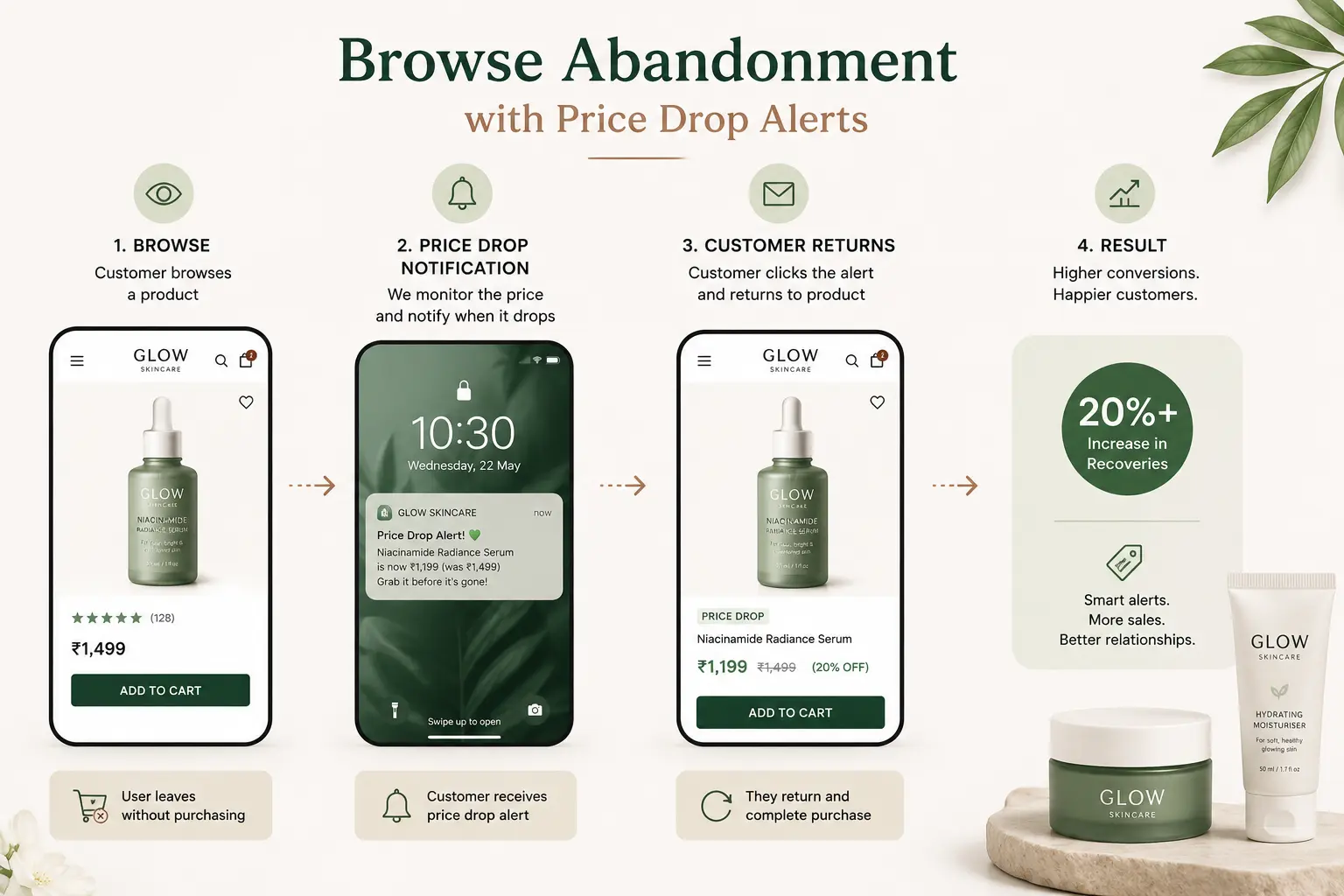
Shoppers rarely buy on their first visit. Modern browse abandonment workflows track the specific SKUs a user investigates. When that item experiences a price drop or low-stock event, the automation triggers a highly personalized alert across the channel the user most frequently engages with. It shifts the messaging from “Come back and look at this” to “The item you want is about to sell out.”
Revenue Impact: Generates a 3-5x lift in conversion rates for returning traffic, turning casual browsers into buyers through manufactured urgency.
3. Autonomous Replenishment Cycles
If you sell consumable products like skincare, coffee, or pet food, relying on a customer’s memory to reorder is a massive liability. Autonomous replenishment uses predictive modeling to calculate an individual customer’s consumption rate based on their past purchase frequency. The system then automatically messages them exactly when they are likely running out, pre-filling their cart with a single-click checkout link.
Revenue Impact: Increases customer lifetime value (LTV) by locking in recurring purchases and reducing average time-between-orders by 12-18%.
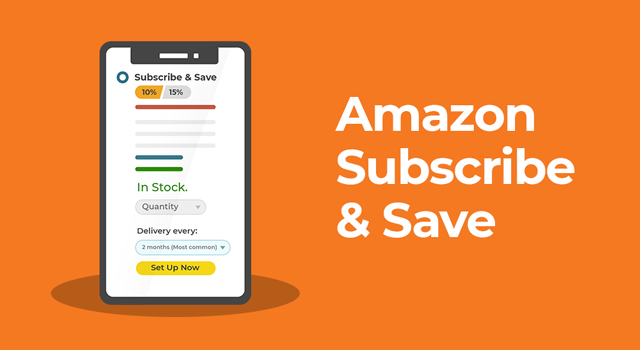
Caption: Amazon’s subscribe and save is an example of Autonomous Replenishment Cycles.
4. Dynamic Pricing Triggers
Dynamic pricing automation ties your inventory management directly to your marketing engine. When an algorithm detects slow-moving inventory, it identifies the segment of users who previously engaged with those products. The workflow then autonomously triggers targeted promotional campaigns, dynamically adjusting the discount level based on the individual user’s predictive LTV and historical price sensitivity.
Revenue Impact: Protects profit margins by ensuring you only offer discounts to price-sensitive cohorts, while capturing revenue from aging inventory that would otherwise become dead stock.
5. Behavioral trigger campaigns
Behavioral trigger campaigns activate the moment a user shows intent—like browsing a product, abandoning a cart, or dropping off mid-journey. AI enhances this by analyzing real-time signals, predicting next-best actions, and personalizing timing, channel, and content. Instead of static journeys, brands deliver adaptive, context-aware nudges that significantly improve conversions and reduce drop-offs.
6. Multi-Threaded Re-engagement Campaigns
Dormant accounts represent millions of dollars in untapped pipeline. Instead of a basic “Are you still interested?” email, modern multi-threaded re-engagement campaigns detect when a previously dead account shows renewed intent (e.g., a new stakeholder visits your pricing page). The workflow autonomously sequences touchpoints across LinkedIn, email, and targeted display ads, engaging multiple stakeholders simultaneously to wake the account up.
Revenue Impact: Reactivates 8-12% of stalled pipeline by automatically capitalizing on renewed organizational intent without requiring manual sales outreach.
7. Intent-Based Content Nurturing
Sending the same weekly newsletter to your entire B2B database dilutes your value. Intent-based nurturing dynamically assembles the content of your emails based on the lead’s current Buyer’s Journey stage. If they are reading API documentation, the automation sends technical integration guides. If they are reading case studies, it sends ROI calculators and peer reviews.
Revenue Impact: Drives a significant increase in marketing-qualified leads (MQL) to sales-qualified leads (SQL) conversion rates by serving the right friction-reducing content at the perfect moment.
8. Automated Post-Webinar Sales Handoff
Webinars are massive lead-generation engines, but the follow-up is often slow and generic. An intelligent handoff workflow analyzes participant engagement, how long they stayed, which polls they answered, and what questions they asked. It then immediately segments attendees into “Ready for Demo,” “Needs Nurturing,” or “Unqualified,” triggering customized follow-ups and booking links before the prospect even closes the webinar tab.
Revenue Impact: Captures high-intent prospects at the peak of their interest, directly attributing webinar marketing spend to booked sales meetings and accelerated closed-won revenue.
9. Churn Prediction and Preemptive Interventions
By the time a customer clicks “cancel subscription,” you have already lost them. Predictive churn automation monitors product usage, login frequency, and support ticket sentiment. When a user’s behavior patterns match historical churn profiles, the system triggers a preemptive intervention, such as an automated offer for a complimentary account review, a targeted tutorial, or a strategic discount, before the customer makes the conscious decision to leave.
Revenue Impact: Reduces overall churn by 10-15%, directly protecting your monthly recurring revenue (MRR) baseline and extending average customer lifespan.
10. Milestone Triggers and Loyalty Amplification
Customer loyalty requires continuous validation. Automation workflows that trigger on user milestones, such as their one-year anniversary, their 100th login, or reaching a specific spending tier, create positive friction. These workflows dynamically generate personalized celebration messages paired with exclusive rewards or tier upgrades, making the user feel recognized and deeply embedded in your ecosystem.
Revenue Impact: Boosts repeat purchase rates and drives organic advocacy, significantly lowering the blended customer acquisition cost (CAC) for the brand.
11. Cross-Sell and Upsell Propensity Workflows
Pitching a premium upgrade to every user is inefficient and annoying. Agentic cross-sell workflows analyze a customer’s current product adoption and cross-reference it against the behavior of your most successful premium users. When the system detects a high upsell propensity, it triggers an educational sequence highlighting the exact premium features the user is currently constrained by, smoothing the path to an upgrade.
Revenue Impact: Increases net revenue retention (NRR) and expands average contract value by presenting upgrades logically, exactly when the user experiences a capability ceiling.
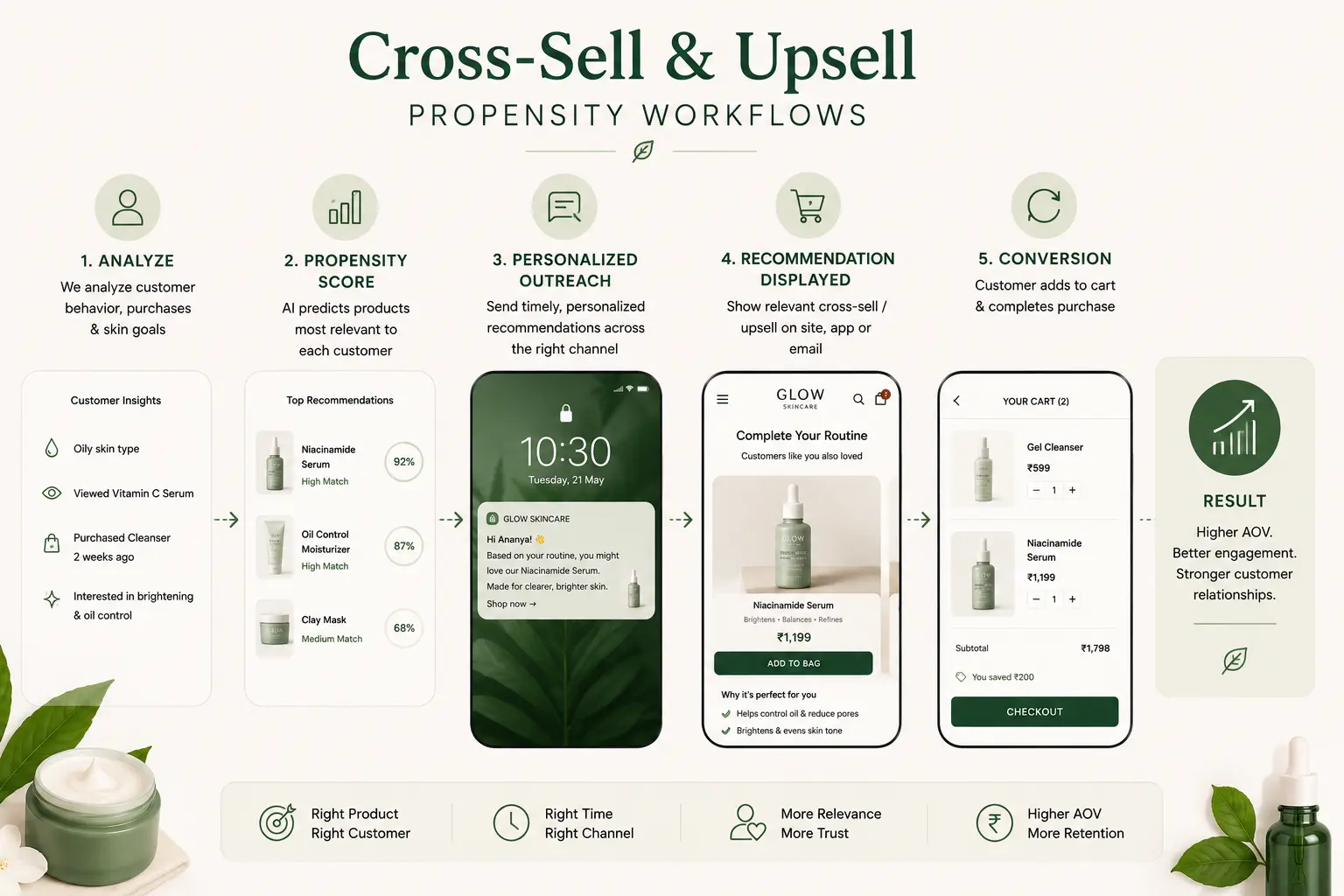
Caption: Example of cross-sell and upsell workflows for a skincare brand.
12. Generative Content Personalization at Scale
Manually writing dozens of email variations for micro-segments is no longer feasible. As highlighted by the rise of predictive AI and generative content in 2026 automation workflows, modern platforms use AI to dynamically write subject lines, body copy, and generate imagery tailored 1:1 for every single recipient based on their behavioral profile.
Revenue Impact: Eliminates the bottleneck of creative production, allowing for infinite segmentation that drives higher engagement and a 20%+ lift in campaign ROI.
13. Omnichannel Send-Time Optimization
Sending a global campaign at 9:00 AM EST guarantees you will reach most of your database at the wrong time. Omnichannel send-time optimization calculates exactly when an individual user is most likely to open an app, check their email, or read an SMS. The automation holds the message and delivers it at the precise minute the user’s attention is statistically closest.
Revenue Impact: Consistently yields a double-digit increase in open and click-through rates, ensuring your promotional messaging actually gets seen by the people most likely to buy.
14. Sentiment-Triggered Support Escalations
Customer experience and marketing are deeply intertwined. If a customer replies to an automated marketing text with frustration, a rules-based system ignores it. An agentic workflow uses natural language processing to detect negative sentiment, immediately pausing all promotional marketing to that user and routing a high-priority alert to your customer success team for intervention.
Revenue Impact: Prevents catastrophic brand damage and saves high-value accounts from churning due to tone-deaf marketing during a support crisis.
15. Cross-Channel Journey Orchestration
A user might discover you on Instagram, research you via email, and buy from you via SMS. Cross-channel journey orchestration ensures that if a user opens a push notification about a sale, they do not receive a redundant email about that same sale an hour later. The workflow tracks the user across all touchpoints, autonomously deciding which channel is the next best action for conversion. Go deeper into cross-channel journey orchestration.
Revenue Impact: Reduces messaging fatigue and lowers unsubscribe rates, preserving your marketable database while maximizing omnichannel conversion efficiency.
Final Take
If your marketing automation platform requires you to manually script every rule, guess the best send times, and settle for open rates as your primary success metric, you are operating at a severe financial disadvantage. Treating automation as a basic delivery system leaves massive amounts of pipeline and recurring revenue on the table. When you transition to predictive, agentic workflows, your technology stops being a simple execution tool and becomes an active, autonomous partner in your company’s revenue generation strategy. The mandate for 2026 is clear: stop optimizing for activity and start engineering for outcomes. Interested in understanding how? Talk to us.