




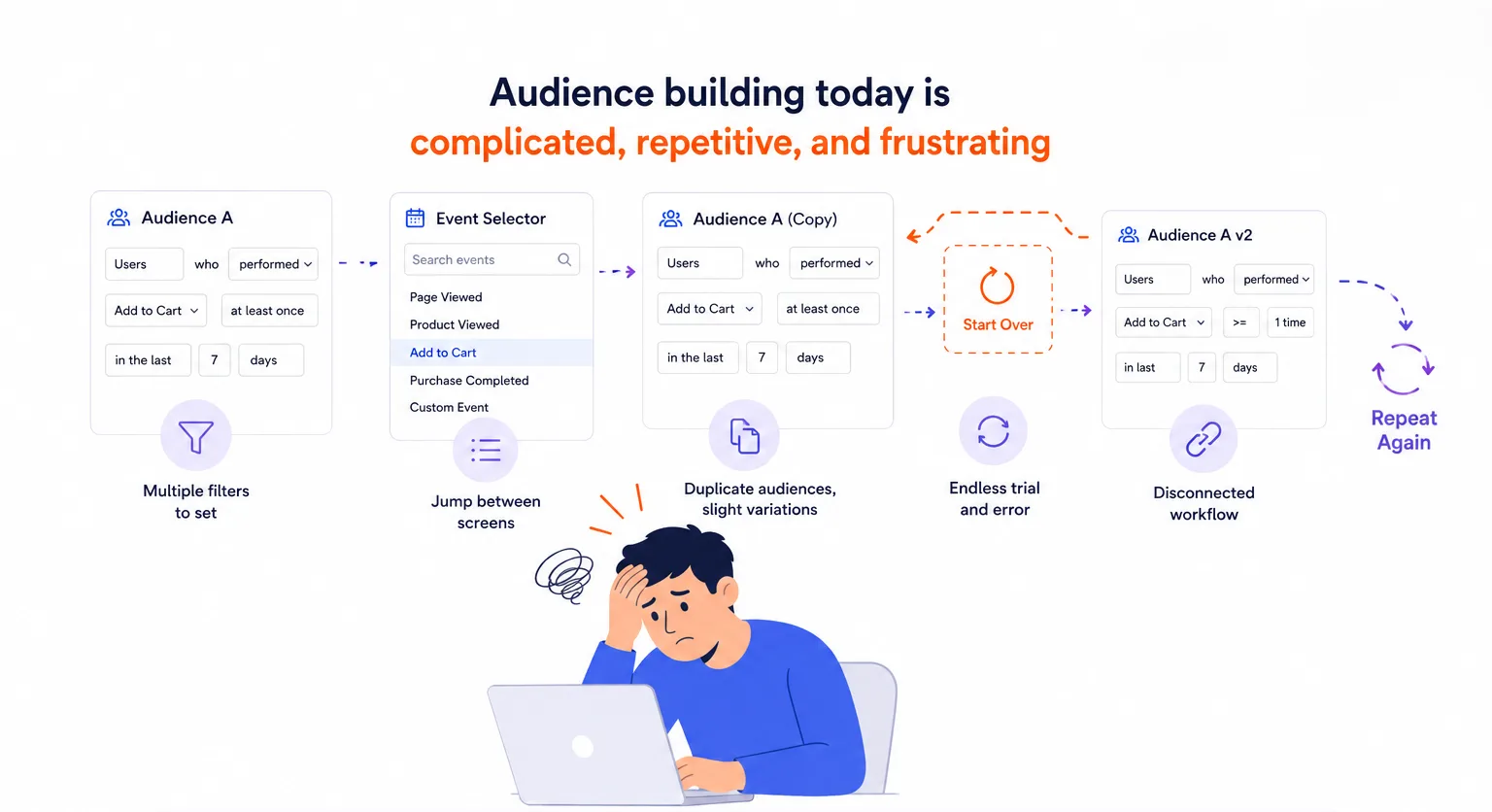
Segmentation is the first step of any campaign. It also tends to be one of the most repetitive. Marketers spend time navigating menus, configuring events, and rebuilding rules every time a campaign idea evolves. Even the AI-based segmentation tools available today only work in single shots, so refining a segment means starting over.
That repetition adds up. Campaigns ship slower, fewer ideas get tested, and targeting gets broader than it needs to be.
Audience Agent changes that. It turns segment building from a series of resets into a single, continuous conversation.
The Problem with How Marketers Build Segments Today
Three things consistently slow marketing teams down:
Segmentation is slow and effort-heavy. Even a basic segment takes more clicks, configurations, and event lookups than it should.
Iteration breaks the workflow. Every refinement means manually reworking the logic, or starting a fresh prompt with an AI tool that has already forgotten the context. Teams experiment less, and fewer winning audiences get found.
Targeting lacks business context. Every brand defines its customers differently. “Dormant” means one thing to a luxury fashion brand and something completely different to a grocery app. Most segment builders force those definitions through generic dropdowns and produce approximations instead of precision.
The net effect: slow execution, limited experimentation, and missed revenue.
The Solution: Segmentation Built on Conversation
Audience Agent is a conversational segmentation engine that enables marketers to build, refine, and generate high-performing audiences without relying on manual workflows.
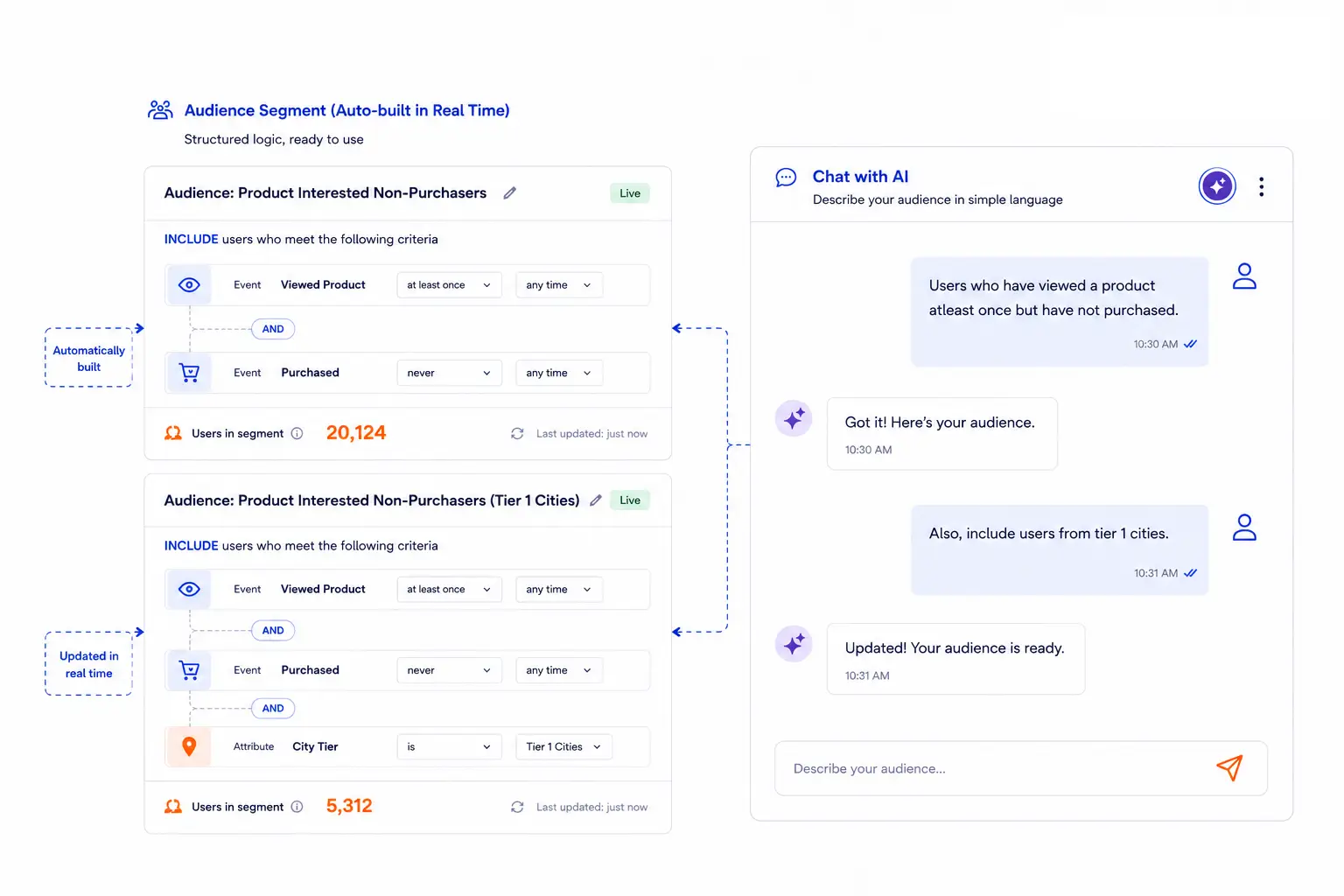
The shift is simple: instead of configuring a segment, the marketer describes it. The Agent maps that description to rule logic instantly, populates the canvas in real time, and stays in the conversation as the campaign idea evolves.Three steps, one conversation. Describe what you need. The Agent builds it. Refine by typing.
What Audience Agent Can Do
Build any segment, just by describing it. The marketer types out the audience they want in plain language, and the Agent builds the segment with the right rules and conditions applied. A follow-up message in the same chat refines it further, with the previous logic kept intact. No starting over, no losing context, no dropdowns.
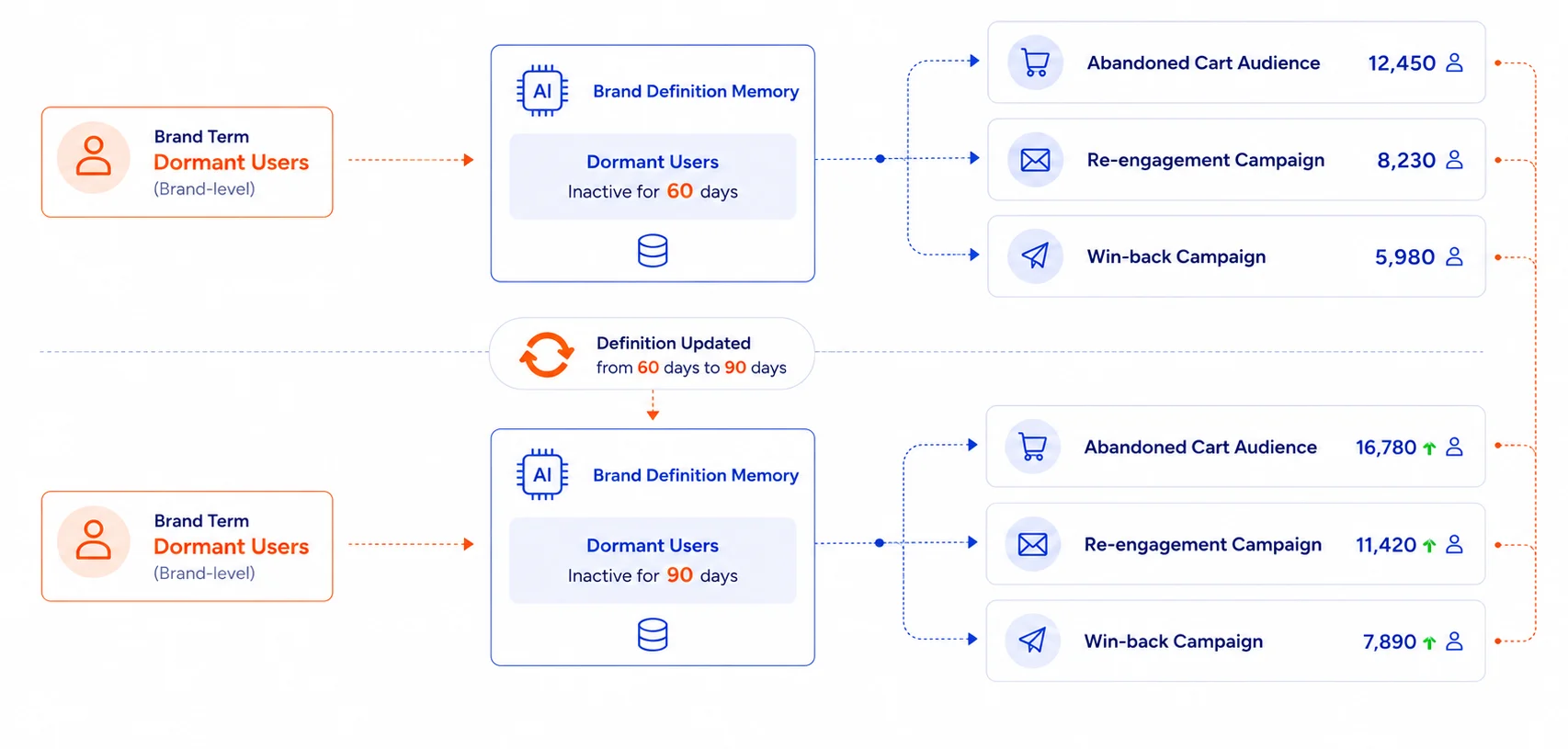
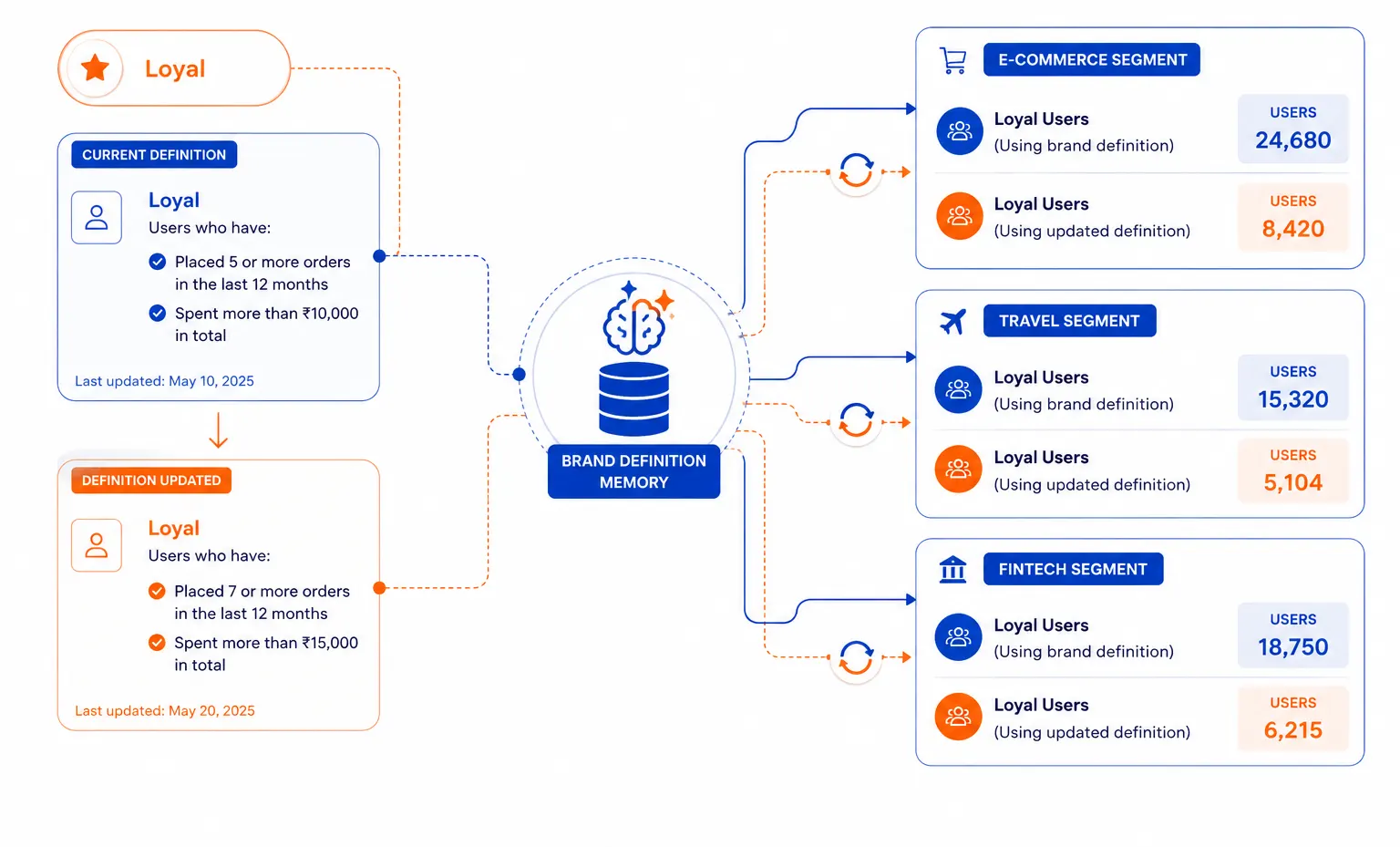
Segments that speak your brand’s language. When you type “dormant users,” the Agent doesn’t guess at what dormant means. It applies your brand’s own definition, the one your team has agreed on, configured into the Agent’s memory. And when that definition needs to change, the marketer just says so in the same chat. The Agent recalibrates the segment instantly and saves the new definition for every future use. The same logic applies to every term your business uses to describe its customers, so segments stop being approximations and start reflecting how your business actually works.
Start with the goal. The Agent finds the audience.* Sometimes the marketer doesn’t know who to target. They know what they want to achieve. Describe the campaign goal, not the customer, and the Agent works backwards from the outcome to surface multiple audience strategies, each grounded in seasonal context, intent signals, and your brand’s customer definitions. Compare them on the canvas. Pick the one that fits.
*Goal-based audience generation is currently available only in beta for select clients.
How Audience Agent Is Different
Most segmentation tools today, including the AI-powered ones, treat segment-building as a one-time transaction. The marketer makes a request, the tool produces an output, and the conversation ends there. Any refinement means going back to manual configuration or starting fresh.
Audience Agent treats segmentation as a continuous conversation instead. The marketer describes what they need, the Agent translates it, and the dialogue stays open as the idea evolves. Refinements happen in the same flow, with full context preserved across every turn.
The other meaningful difference is how visible the work is. Every rule the Agent builds populates as logic the marketer can see in the chat, with the corresponding fields and conditions laid out on the canvas. The marketer can audit any condition, change any dropdown, and one click reverts the canvas to its pre-AI state. Manual edits and AI edits coexist without conflict, so the Agent picks up from wherever the marketer leaves off. Even the brand’s own definitions stay editable. A marketer can change what “dormant” means mid-conversation, and the Agent updates the logic and remembers the new definition for next time.
Combine the two, and you get an AI tool marketing teams can actually trust to take live. Not because it claims to be trustworthy, but because it shows its work.
See How Anveshan Turned WhatsApp Into a High-Efficiency Channel with Audience Agent
The clearest test of any segmentation tool is whether the audiences it builds actually convert.
Anveshan, a D2C food brand, used Netcore’s Affinity and Propensity Model powered by Audience Agent to move beyond broad WhatsApp sends. Instead of messaging the entire list, they built a precision cohort from high-intent signals, carved from the broader user base.
The results:
- 13X WhatsApp ROI vs 7X from manual targeting
- +94% conversion rate
- 3.5X revenue per message sent
WhatsApp is a high-cost channel. Every message sent to a low-intent user is a real budget loss, not just a missed opportunity. With sharper segmentation, the high-cost channel became a high-efficiency one.
Segmentation Was a Task. Now It’s a Conversation.
Audience Agent gives marketing teams a faster, sharper way to build the audiences their campaigns depend on. Describe what you need, the Agent builds it. Keep refining, the conversation stays open. Bring in your brand’s own definitions, and segments stop being generic approximations and start reflecting how your business actually works. And as Goal-Based Generation rolls out, the conversation will extend further still, from describing the audience to describing the outcome.
Request a demo of Audience Agent to see how your team can build smarter segments, in a fraction of the time.