





TL;DR
As conversational AI platforms like ChatGPT increasingly influence product discovery, retailers face a new risk: invisibility. Traditional ecommerce was built for search engines. Agentic commerce runs on structured, contextual data.
If your catalogue has missing attributes, inconsistent taxonomy, or vague descriptions, AI agents cannot interpret your products accurately, and they won’t recommend them.
The shift is accelerating the need for agentic marketing retail. With initiatives like the Agentic Commerce Protocol introduced by OpenAI and Stripe, AI-driven checkout and agent-to-agent transactions are moving from theory to infrastructure.
The foundation is an agent-ready catalogue — structured, enriched, and semantically complete product data with platforms that offer metadata.
Let me take you back to how omnichannel retail worked; not that long ago, actually.
A customer would spot a pair of sneakers on Instagram, Google the brand, visit the website, maybe wander into the store to try them on, and then buy online with a discount code from an email. That was the omnichannel journey. The retailer’s job was to stitch together those touchpoints — consistent pricing, inventory visibility, unified branding — so the experience didn’t feel like three different companies duct-taped together.
It was complicated, but it was manageable. The rules were known: own your channels, optimise for search, retarget with ads, and keep your CRM clean.
Then agentic ai in retail walked in and flipped the table.
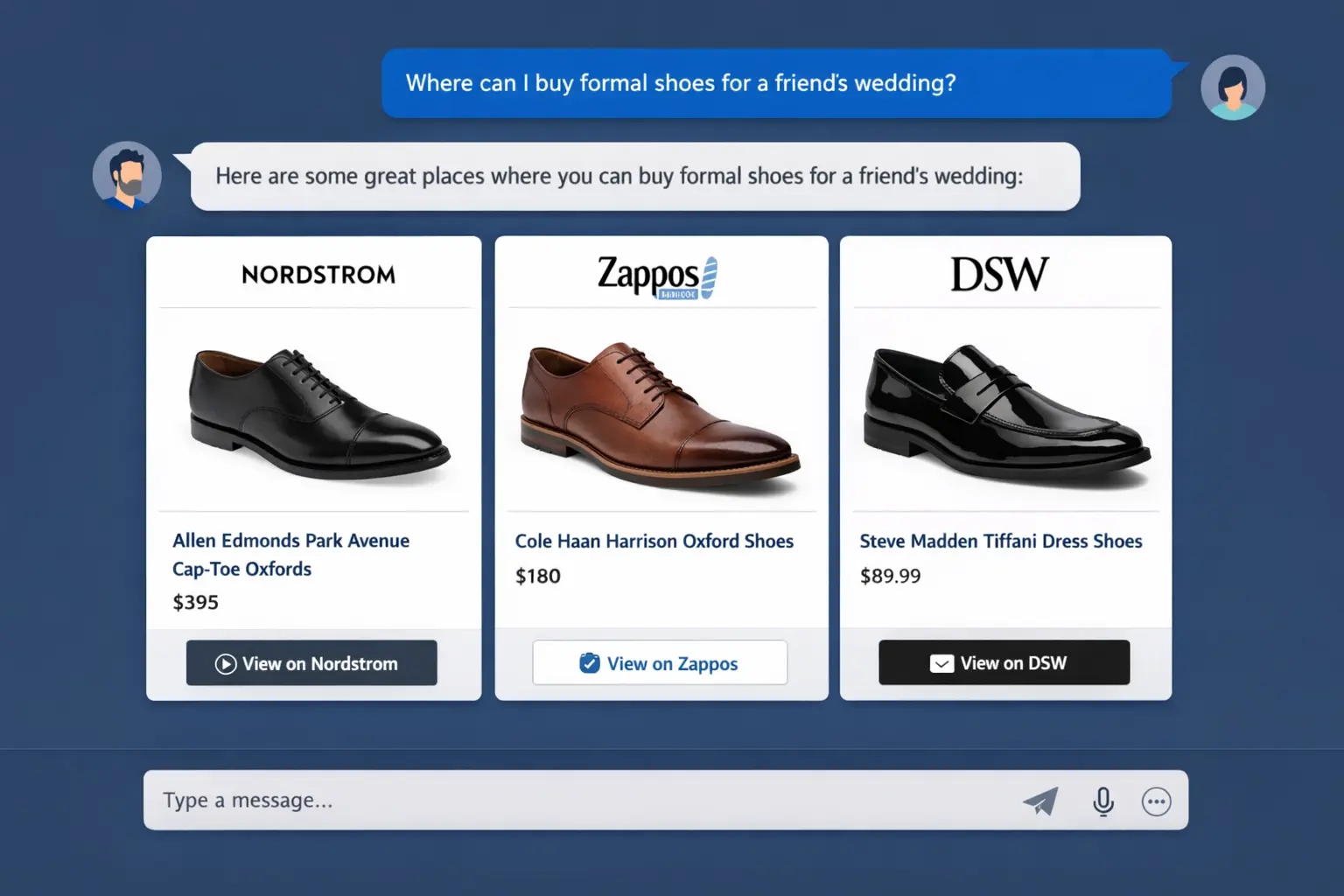
Today, a shopper might ask ChatGPT for the best waterproof running shoes under a certain budget, get a curated answer without visiting a single website, and check out via an AI agent, all in under two minutes. No search bar. No product page. No journey the retailer designed or controlled.
Here’s what’s agentic marketing retail changed recently:
• Conversational AI is replacing search as a product discovery tool — Google, ChatGPT, and Perplexity are all surfacing products through natural language queries.
• OpenAI and Stripe launched the Agentic Commerce Protocol (ACP), which lets AI agents complete purchases on behalf of users.
• AI-powered shopping assistants are now embedded into browsers, apps, and devices — not just retailer websites
• Shoppers are increasingly starting their journey outside the retailer’s owned channels
The omnichannel problem used to be about connecting your own channels. Now it’s about showing up in channels you don’t own, and that requires a very different kind of preparation.
That preparation starts with one thing: your product data. And I’ll walk you through exactly why, and what to do about it.
Why Are Retailers Going Invisible to AI?
Most retail catalogues were built for humans to browse, not for machines to interpret. And AI agents can only recommend what they can understand.
Here’s something most retail teams don’t realise: when an AI agent processes a product query, it isn’t “searching” the way Google does. It isn’t looking for keyword matches. It’s interpreting context — use case, occasion, material, fit, environment — and trying to match that against structured product attributes.
If those attributes aren’t there, or they’re inconsistent, or buried in unstructured prose? The product might as well not exist.
The most common catalogue problems I see retailers sitting on are:
• Missing attributes like size guides, materials, and colour variants are described differently (or not at all) across product listings.
• Inconsistent taxonomies, the same product filed under different categories across markets or channels.
• Unstructured descriptions, beautifully written copy that a human loves and a machine cannot parse.
• No schema compliance, product data that doesn’t meet Schema.org or ACP standards that AI agents rely on.
The financial knock-on effects are real. Lower AI discoverability means fewer qualified visits from conversational channels. Weaker attribute data means recommendation engines make poor matches. Poor matches mean lower conversion. And if an AI agent can’t transact with your catalogue, it’ll transact with a competitor whose data is cleaner.
The good news? This is entirely fixable. And fixing it starts with understanding what an agent-ready catalogue actually looks like.
What Does an Agent-Ready Catalogue Actually Look Like?
It’s structured, enriched, semantically tagged, and built to be read by machines as fluently as by humans. Think of it as your product data getting a proper upgrade, not a cosmetic one.
An agent-ready catalogue isn’t just a well-organised spreadsheet. It’s a living data infrastructure powering retail businesses. Here’s what it includes:
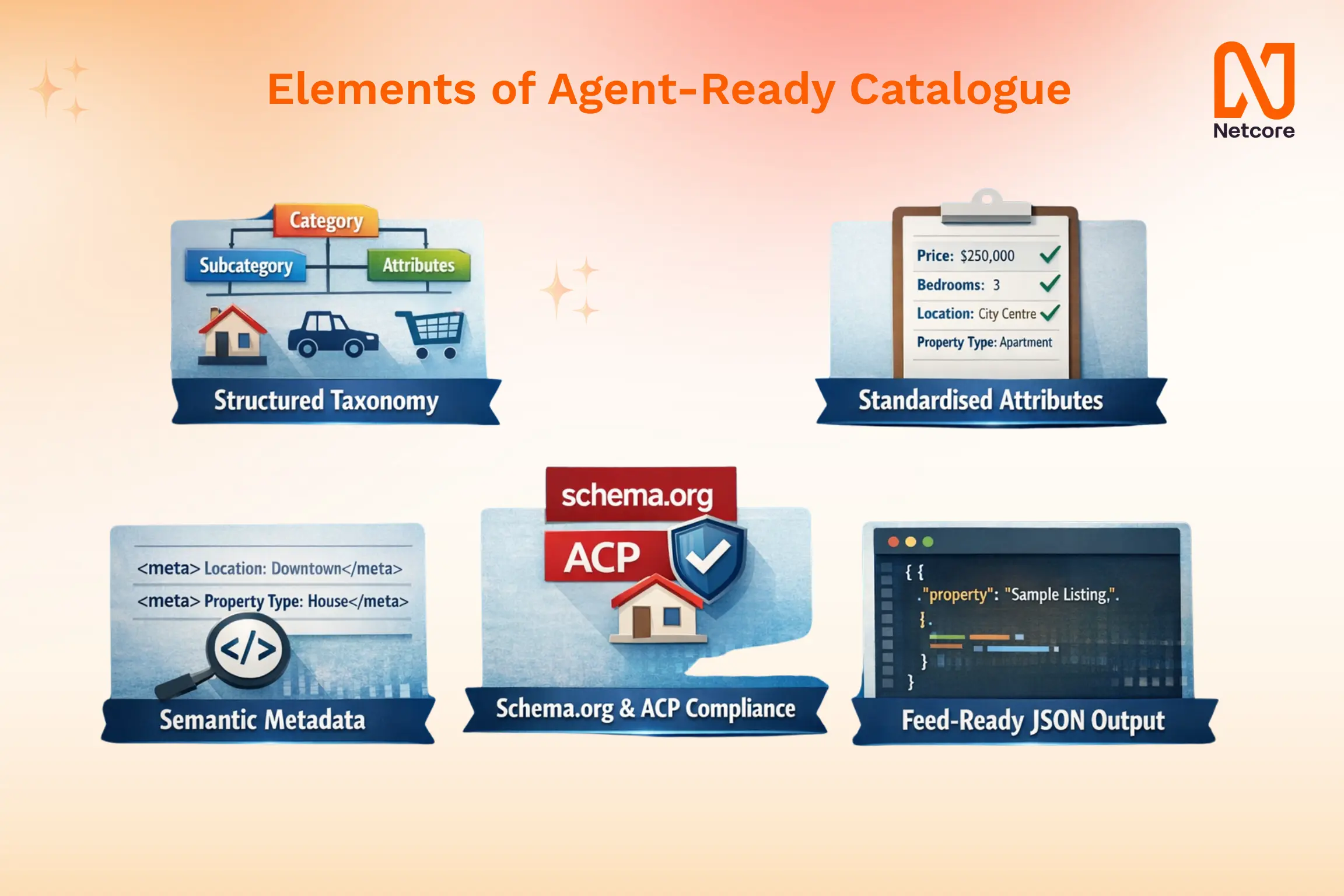
• Structured taxonomy that includes consistent category hierarchies that translate accurately across every channel and market.
• Normalised attributes like product characteristics in standard, machine-comparable formats (not ‘navy blue’ in one listing and ‘dark blue’ in another)
• Semantic metadata — context layers covering colour, material, use case, occasion, and sustainability credentials.
• Schema.org and ACP compliance, so AI agents and commerce protocols can read your data natively
• Feed-ready JSON output — enabling seamless integrations across marketplaces, ad platforms, and AI agent ecosystems.
The mechanism that gets you there is an enrichment layer, an AI-powered system that sits between your raw product data and its downstream outputs. A good enrichment layer that exists in AI solutions for retail will:
• Analyse and normalise product data across inconsistent source formats
• Identify and close attribute gaps automatically
• Add semantic context that human copywriters wouldn’t think to include
• Generate titles and descriptions that work for both shoppers and AI agents
• Continuously validate against evolving structured data standards
Attribute completeness directly correlates with recommendation accuracy, which directly correlates with conversion. Better data reduces dependency on paid acquisition. It increases lifetime value through smarter recommendations. And AI discoverability, while still maturing, is fast becoming a meaningful revenue channel in its own right.
Using AI solutions for retail isn’t just a technology upgrade. It’s a revenue infrastructure decision.
5 Ways Agentic AI Delivers Omnichannel Experiences That Convert
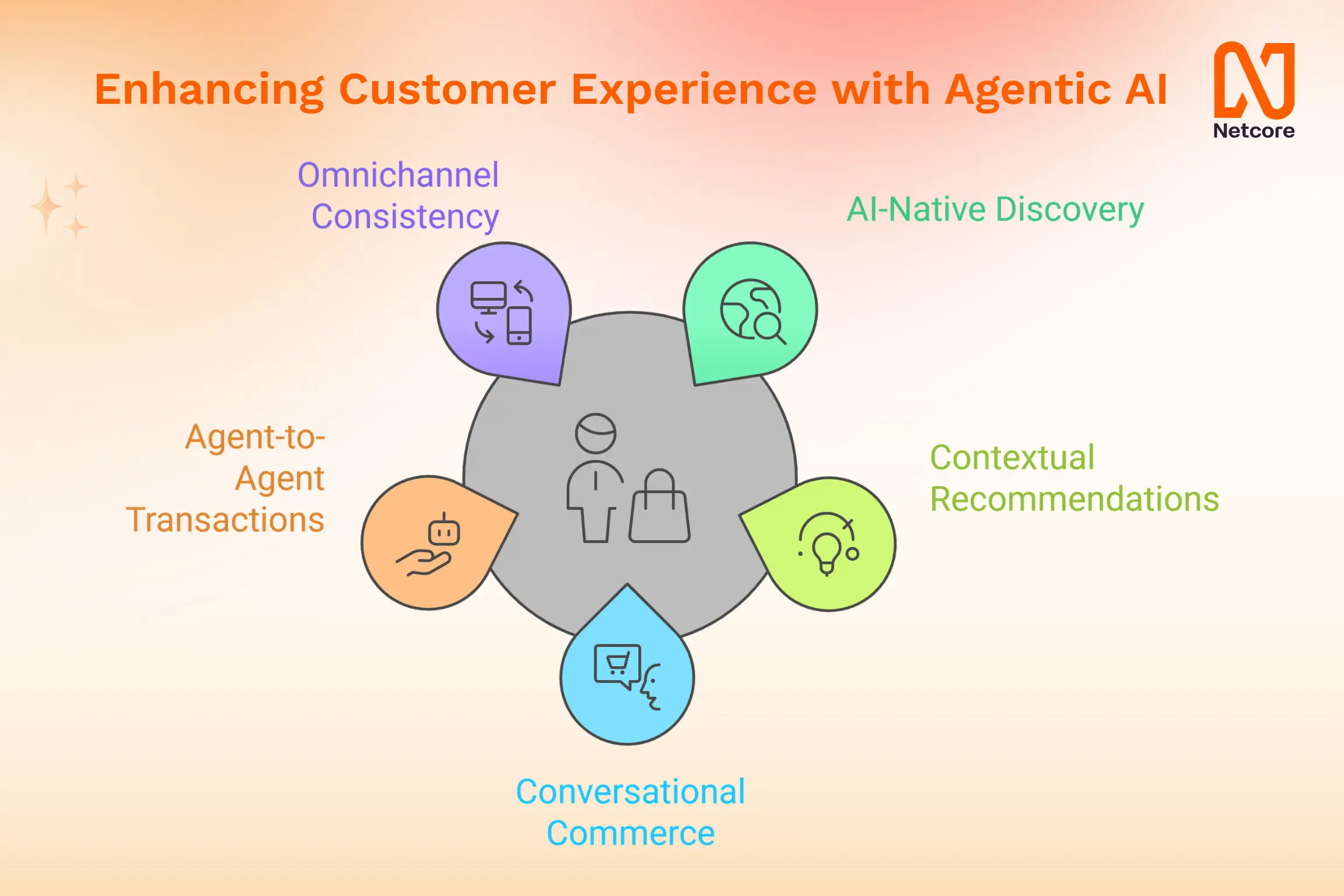
1. AI-Native Product Discovery Across Every Channel
When a shopper asks a conversational AI for “a breathable kurta for a summer wedding in Jaipur under ₹2,500”, your product either appears or it doesn’t. There’s no page two. No second chance. No sponsored slot to buy your way into.
Structured semantic enrichment is what makes that appearance possible. It allows AI agents to interpret product suitability in context — matching occasion, climate, price, and style simultaneously.
The impact: higher-quality traffic from channels where intent is already established. Shoppers who arrive have already been matched. Conversion rates reflect that.
2. Contextual Recommendations That Grow Basket Size
Traditional recommendation engines are largely behavioural: you bought X, so here’s Y that other buyers of X also liked. That’s fine. Agentic recommendations go further.
Rich attribute tagging, like covering use case, occasion, complementary products, and lifestyle context, enables genuine cross-sell logic. An agent can surface a matching dupatta, clutch, and footwear alongside a kurta because the data relationships between those products are explicitly defined.
The impact: higher average order value driven by relevance rather than guesswork. Store-level personalisation with AI agents means every shopper’s experience is different and genuinely useful.
3. Conversational Commerce That Removes the Friction
Most product filters are, frankly, a UX nightmare. Thirty options you didn’t ask for, a price range slider that barely works on mobile, and category names your customer doesn’t use.
Conversational commerce replaces all of that with a dialogue. The shopper describes what they need. The AI responds with accurate, specific options.
But here’s the catch: a conversational AI is only as good as the structured data behind it. Without clean, enriched attributes, AI assistants give vague answers, wrong recommendations, or — worst of all — confident answers that are simply incorrect. That erodes trust fast.
The impact: lower drop-offs at the discovery stage and faster purchase decisions as shoppers move through the funnel with genuine confidence.
4. ‘Buy For Me’ and Agent-to-Agent Transactions
This is the part that sounds like science fiction but is already live. The Agentic Commerce Protocol (ACP) from OpenAI and Stripe creates a framework for AI agents to browse, select, negotiate, and purchase — without the shopper visiting your site at all.
A shopper’s personal AI assistant identifies a need, finds the best-matched product, confirms availability and pricing, and completes the transaction. All of this happens machine-to-machine.
Brands without ACP-compliant catalogues don’t participate in these transactions. It’s not that they lose; they simply aren’t in the room.
The impact: access to an entirely new transaction layer, running at a speed and scale that no traditional checkout funnel can match.
5. Omnichannel Consistency Without the Operational Chaos
One of the quiet frustrations of omnichannel retail is the data maintenance problem. A price changes. An attribute gets updated. A product goes out of season. Now someone has to update 12 different places and they’ll miss one, and something will be wrong somewhere.
Feed-ready enriched JSON solves this. A single enrichment event updates all downstream systems simultaneously. The website, the marketplace listing, the ad creative, the AI agent interface — all consistent, all current.
The impact: reduced operational overhead, consistent brand messaging across every touchpoint, and the ability to scale your product range without proportionally scaling your data team.
Why Does the C-Suite Need to Care About This Now?
Here’s the honest reality: most retailers are not agent-ready. They’re still investing in traditional SEO, PPC, and channel-by-channel optimisation. That means the window to get ahead is genuinely open right now.
Early optimisers gain algorithmic preference in AI recommendation systems and store-level personalization with AI agents. The retailers who feed clean, structured, semantically rich data into these systems first will be surfaced more often, and that advantage is self-reinforcing.
The risk of doing nothing is not just a missed opportunity. It’s a structural one:
- Third-party AI agents own the customer data from transactions they facilitate, not the retailer.
- Brands risk becoming fulfilment suppliers rather than customer destinations
- AI-led price comparisons put margin pressure on brands that can’t control the discovery narrative
The future of agentic AI in retail belongs to retailers who don’t wait for consensus before acting. The infrastructure decisions being made today will define who gets recommended, and who gets bypassed, for the next several years.
How Do You Actually Become Agent-Ready?
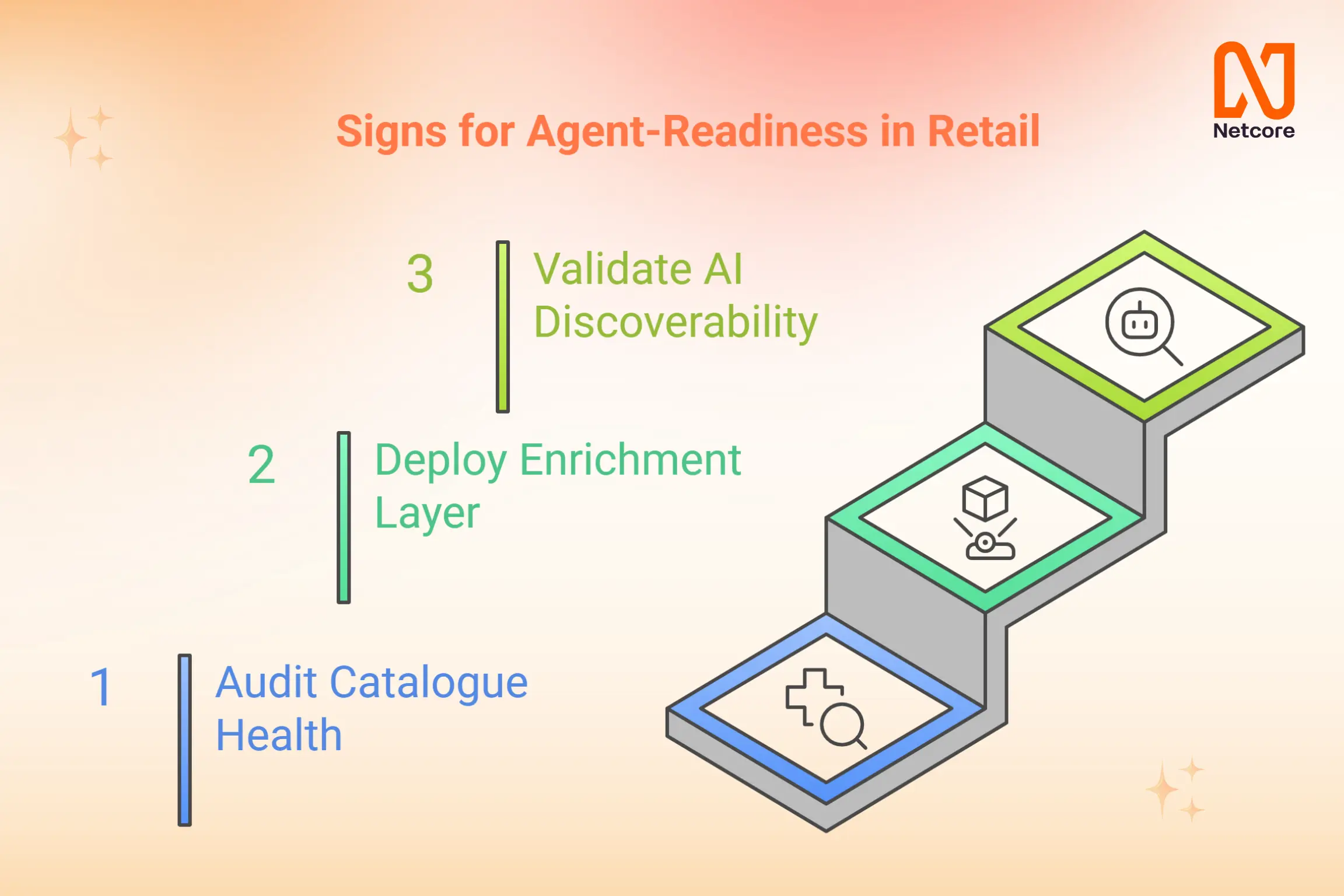
Step 1: Audit Your Catalogue Health
Before building anything, understand what you’re working with. A catalogue health audit should cover:
- Attribute completeness: What percentage of products have full, consistent attribute sets?
- Taxonomy consistency: are products categorised identically across channels and markets?
- Schema compliance does your structured data meet Schema.org and emerging ACP standards?
Step 2: Deploy an Enrichment Layer
An LLM-driven enrichment layer automates the work of closing attribute gaps, normalising taxonomy, expanding semantic metadata, and generating AI-optimised product content at scale. Critically, this is not a one-time project. It’s an ongoing infrastructure layer that keeps pace with catalogue changes, seasonal updates, and new market requirements.
Step 3: Validate AI Discoverability
Test your products in conversational AI environments. Actually, ask the questions your target shoppers would ask. Monitor agent-led traffic in your analytics. Identify which categories surface accurately and which don’t, then optimise based on the query patterns that represent your highest-value segments.
Final Take
The old omnichannel playbook — own your channels, optimise for search, retarget with ads — still matters. But in an agentic AI world, it’s no longer enough. Retail’s next growth engine runs on enriched catalogue metadata and agentic marketing. AI agents don’t browse; they interpret structured, standardised, semantically rich product data to decide what gets recommended. If your catalogue isn’t machine-readable and context-ready, your products won’t just rank lower they won’t meaningfully participate.
Retailers who invest in catalogue metadata enrichment and deploy agentic marketing systems that autonomously personalise, optimise, and learn in real time will win disproportionate visibility at high-intent moments. This isn’t about being present on more channels, it’s about being chosen by AI intermediaries. The agentic shift is already operational. The only question is whether you’ll re-architect your data and marketing before your competitors do. Talk to us to know how to get started.