




Most marketing leaders are spending on two very different capabilities, personalization and agentic marketing, without realizing they’re not the same thing. That confusion leads to misallocated budgets, duplicated tools, and a competitive blind spot that’s getting more expensive by the quarter.
Here’s a situation I keep hearing about. A company spends two years building out a personalization engine, segments, journeys, dynamic content, and the whole stack. Then someone in a board meeting asks, “What are we doing with AI agents?” And suddenly, everyone’s scrambling to explain whether what they already have counts.
It doesn’t. Or at least, not entirely. Forrester’s research from 2024 found that a significant portion of marketing leaders couldn’t clearly distinguish between the two when asked to define them, which is remarkable, given that the investment decisions around each are fundamentally different.
So let me make the distinction clear by comparing agentic marketing vs personalization in the blog ahead.
What Personalization Actually Is?
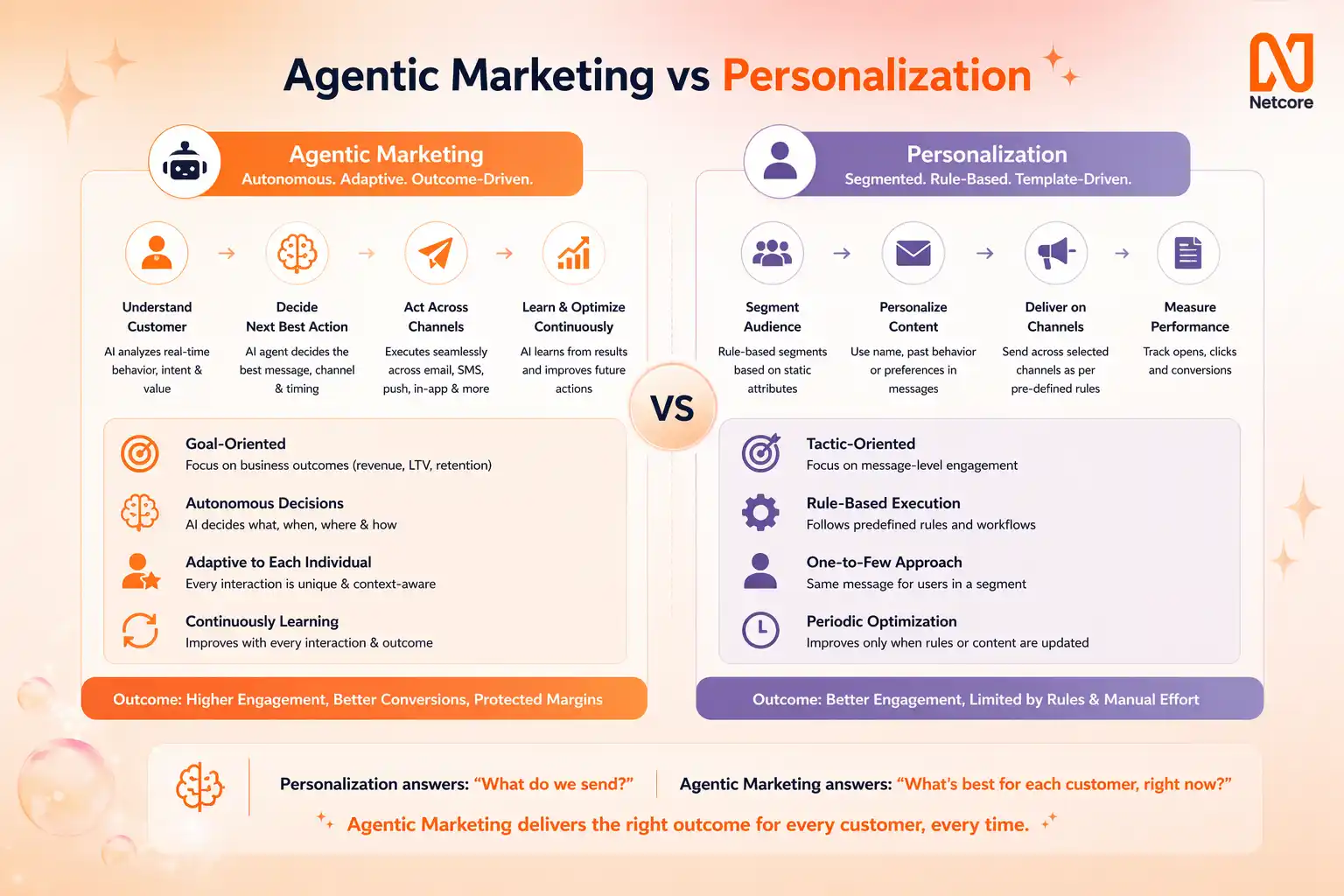
Personalization is a responsive capability. It adapts what a customer sees based on what you already know about them, but it never acts outside the boundaries you set for it.
Think of personalization as a very well-briefed assistant who works only from a pre-approved script. They’re fast, they’re consistent, and they know which version of the message to deliver to which person. What they won’t do is go off-script.
Here’s how it works in practice:
- Input: Historical data, declared preferences, and behavioral signals (pages visited, emails opened, products purchased)
- Process: A rules engine or ML model selects the best pre-built variant for that customer or segment
- Output: A message, product recommendation, or journey route, one that a human wrote and approved in advance
The examples are everywhere:
- Netflix recommends a show based on your watch history
- Your e-commerce site shows “Recommended for you” based on your last three purchases
- A B2B SaaS platform sends a different onboarding email sequence to enterprise buyers vs. SMBs
All personalization. All impressive when done well. All operating within a decision boundary that humans set in advance.
What personalization cannot do:
- Initiate contact based on something it noticed in real time
- Negotiate, escalate, or change course mid-interaction
- Take actions outside the marketing channel in which it was deployed
- Create new content, it picks from a library, not a blank page
That last point is the critical one. Personalization is a selection mechanism. It doesn’t create. It doesn’t act autonomously. And it doesn’t learn what to do next; it executes what you already decided.
What is Agentic Marketing?
Agentic marketing is an autonomous capability. AI agents set their own sub-goals, take multi-step actions, and iterate toward an outcome, without requiring a human to define every decision in advance.
This is genuinely different. Not a little different. Architecturally different.
What are the Limitations of Rules-based Personalization?
Rules-based personalization is limited by its reliance on manual logic, requiring human operators to anticipate and map every possible customer action. This creates unscalable manual overhead, rigid customer journeys, and fragmented experiences that fail to adapt in real-time, ultimately limiting marketing ROI and scalability.
For the past decade, marketing automation has relied heavily on rules-based infrastructure. In these systems, personalization is achieved by human operators who segment audiences, map theoretical customer journeys, and build complex logic trees. A marketer might configure a workflow dictating that if a user abandons a cart and possesses a high lead score, they receive an email 24 hours later.
While this approach was a significant step forward from mass batch-and-blast campaigns, it presents structural limitations for modern enterprises. The primary failure point is the combinatorial explosion of user behavior. As channels multiply and customer data expands, attempting to map every permutation of a user’s potential path becomes a mathematical impossibility. Marketers find themselves managing hundreds of overlapping automation rules, leading to marketing sprawl and fragmented customer experiences.
Furthermore, rules-based personalization is inherently reactive and static. It executes instructions exactly as written, regardless of changing context. If a rule specifies a generic 10% discount for all cart abandoners, the system will offer that discount even to users who would have converted at full price or those requiring a 15% discount to return. This lack of dynamic decision-making creates massive inefficiencies and prevents organizations from optimizing for true ROI. The focus remains heavily on campaign execution rather than intelligence and accountability.
How Agentic Marketing Changes Personalization in the AI Era?
Traditional personalization picks from pre-built content and waits for a trigger. Agentic marketing acts autonomously, detecting signals, orchestrating journeys across channels, and responding in real time without human intervention at every step.
What’s driving the shift is customer behaviour itself. Customers now expect experiences that are relevant, convenient, well-timed, and unique. And brands have roughly five seconds to prove it.
The upgrade agentic marketing delivers:
- Segment-level → 1:1 personalization
- Reactive responses → proactive outreach
- Channel silos → omnichannel orchestration
Gartner calls it “the end of channel-based marketing as we know it,” and by 2028, 60% of brands are expected to use agentic AI to deliver one-to-one interactions. You also check my take on The Role of Agentic Marketing in N=1 Personalization.
What Personalization with AI Agents Looks Like?
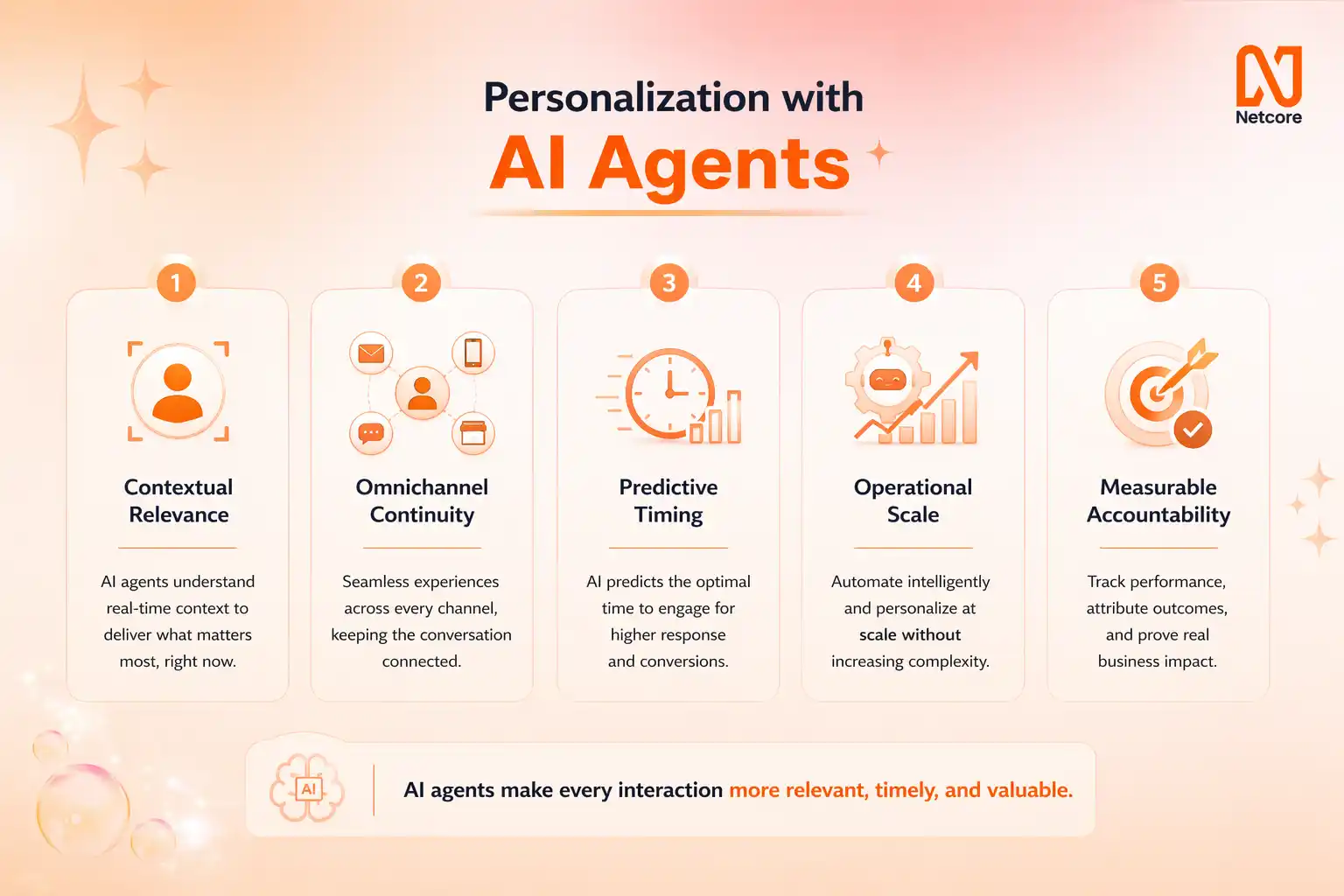
For years, marketing technology vendors have sold a vision of hyper-personalization that manual platforms failed to fulfill. Agentic systems are engineered to finally close the gap between these promises and operational reality.
- Contextual Relevance.
Rules-based systems often struggle with context, sending promotional emails for items a customer just purchased in-store. Autonomous agents maintain unified control over data, ensuring every interaction is hyper-aware of real-time context. - Omnichannel Continuity.
Consumers do not think in terms of marketing channels; they expect seamlessness. Agentic AI breaks down channel silos, maintaining a continuous conversation whether the user moves from a push notification to a website, to an email. - Predictive Timing.
Sending messages at scale usually relies on generalized “send time optimization” based on broad averages. Agents optimize timing down to the individual 1:1 level, predicting the precise moment of highest receptivity. - Operational Scale.
Scaling manual personalization requires linear increases in headcount to build more journeys and segments. Agentic execution scales exponentially. One agent can manage millions of individual user journeys simultaneously without additional operational drag. - Measurable Accountability. The ultimate promise is ROI. Traditional metrics like open rates obscure true business impact. Agentic systems are designed around accountability, optimizing strictly for CFO-approved metrics like incremental revenue and customer lifetime value.
Final Take
Personalization got us far. Agentic marketing takes us the rest of the way.
The difference isn’t just technical, it’s strategic. Personalization optimizes moments. Agentic marketing orchestrates entire relationships, autonomously, at scale, without waiting for someone to build the next campaign.
Customers have already moved. They expect brands to anticipate, not just respond. They’re bringing their own AI agents to every interaction. The five-second attention window is real.
The organizations that win won’t be the ones with the most sophisticated segmentation. They’ll be the ones that stopped asking “what’s the best message for this person?” and started asking “what does this person actually need right now, and how do we act on it before they have to ask?”
That’s the shift. Talk to us and let’s build toward it.