




Most ecommerce brands today have more customer data than ever before , yet conversions, retention, and customer loyalty continue to decline. The problem is not the lack of data. It is the inability to act on customer intent in real time.
Traditional ecommerce personalization was built for a different era. They rely on static audience segments, manual “if/then” rules, and disconnected channels that create fragmented customer experiences. A customer may browse products on your app, receive an irrelevant email hours later, and then see a completely different promotion on your website. The experience feels disconnected because your technology stack operates in silos.
Modern customers no longer tolerate that inconsistency. They expect brands to recognize their intent instantly, adapt recommendations dynamically, and create seamless experiences across every touchpoint.
This shift has made hyper-personalization one of the biggest revenue drivers in modern ecommerce.
What Is Hyper Personalization?
Hyper personalization uses AI, first-party data, predictive analytics, and real-time behavioral signals to deliver highly individualized customer experiences across channels.
Unlike traditional personalization, which relies on broad audience segments, hyper-personalization continuously adapts to customer behavior, context, preferences, and intent in real time.
For example:
- Traditional personalization sends a generic cart abandonment email hours later.
- Hyper personalization dynamically updates website recommendations, adjusts offers instantly, triggers personalized WhatsApp messages, and optimizes the next customer interaction automatically.
The difference is simple:
Traditional personalization reacts slowly. Hyper-personalization predicts and adapts instantly.
How Hyper Personalization Works
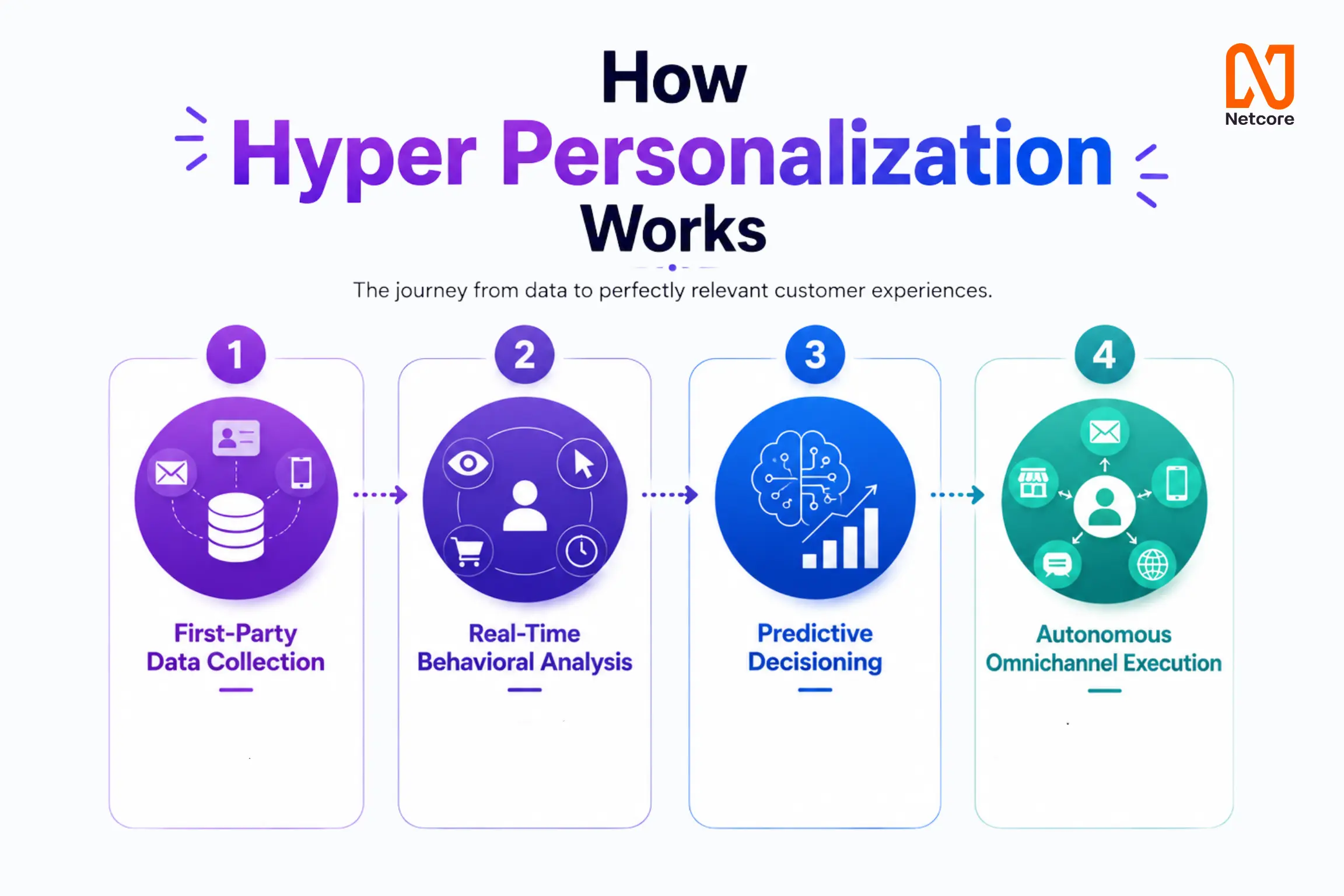
Modern hyper-personalization systems operate through four core layers:
1. First-Party Data Collection
Brands unify behavioral, transactional, and engagement data from websites, apps, email, search, CRM systems, and loyalty programs into a single customer view.
This creates the foundation for understanding customer intent.
2. Real-Time Behavioral Analysis
AI models continuously analyze:
- Browsing behavior
- Search intent
- Purchase history
- Scroll depth
- Time-on-site
- Cart activity
- Product affinity
Instead of relying on historical segments alone, the system interprets what customers are likely to do next.
3. Predictive Decisioning
Predictive algorithms identify:
- Churn probability
- Purchase likelihood
- Next-best products
- Discount sensitivity
- Preferred communication channels
- Optimal timing
This allows brands to personalize experiences before customers leave or disengage.
4. Autonomous Omnichannel Execution
The system then activates personalized experiences across:
- SMS
- Push notifications
- Website recommendations
- Search results
- In-app experiences
Every interaction dynamically updates based on customer behavior in real time.
Benefits of Hyper Personalization
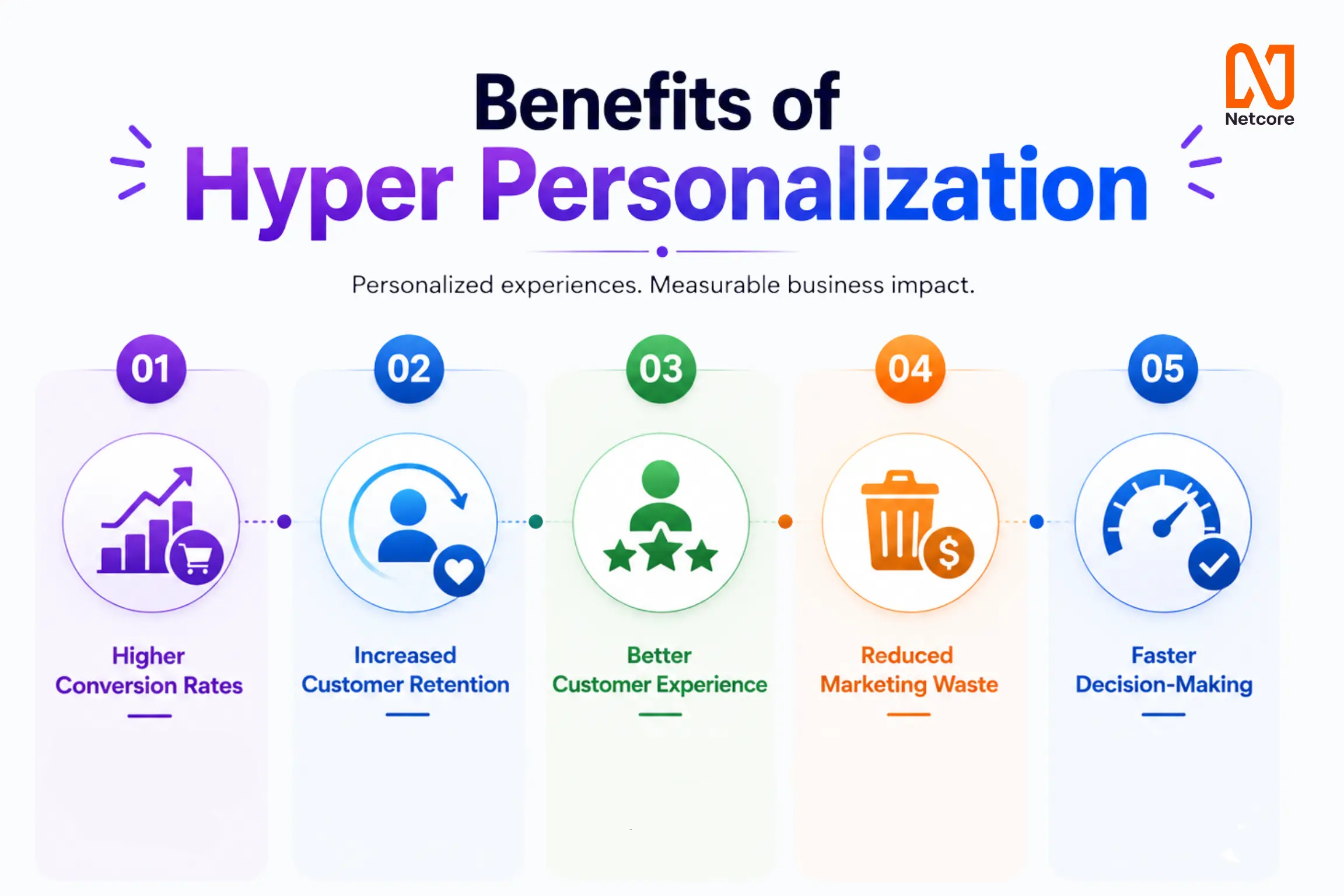
Sharing below the major benefits of hyper-personalization has an impact on:
- Higher Conversion Rates
Customers are more likely to purchase when product recommendations, offers, and messaging align with their immediate intent.
Personalized recommendations significantly improve product discovery and reduce decision fatigue.
- Increased Customer Retention
Hyper personalization helps brands detect churn signals early and proactively engage customers before they disengage.
This directly improves customer lifetime value and repeat purchase rates.
- Better Customer Experience
Modern consumers expect relevance. Hyper personalization creates seamless, contextual experiences that feel intuitive instead of intrusive.
- Reduced Marketing Waste
Instead of sending broad campaigns to static segments, brands can focus on delivering relevant experiences to the right users at the right time.
This reduces wasted impressions and improves ROI.
- Faster Decision-Making
AI-powered systems continuously optimize campaigns automatically, reducing manual operational work for marketing teams.
Hyper Personalization Examples
We have already covered personalization examples earlier in dept so here we will just cover quickly what are hyper-personalization examples:
Dynamic Product Recommendations
Streaming and ecommerce platforms personalize product recommendations in real time based on browsing behavior, purchase history, and engagement patterns.
Predictive Cart Recovery
Instead of generic abandonment emails, AI systems dynamically personalize recovery messages, offers, and timing based on purchase intent.
Personalized Search Experiences
Modern product pages now adapt product rankings based on customer affinity, preferences, and behavioral signals.
Loyalty-Based Experiences
VIP customers may receive personalized offers, early access, exclusive pricing, or tailored rewards based on their engagement patterns.
Real-Time Cross-Channel Journeys
A customer browsing sneakers on mobile may instantly receive personalized recommendations through email, push notifications, or WhatsApp without manual campaign setup.
Challenges and Considerations
While hyper personalization creates significant business value, implementation is not without challenges. Sharing below come common challenges faced by marketers while building hyper-personalized experiences:
Data Silos
Many organizations still operate with fragmented customer data spread across multiple platforms.
Without unified data infrastructure, personalization becomes inconsistent.
Privacy and Compliance
As third-party cookies disappear, brands must rely heavily on first-party and consent-driven data strategies.
Privacy regulations also require greater transparency and governance.
Integration Complexity
Legacy martech stacks often struggle to support real-time decisioning and omnichannel orchestration.
This creates operational friction and slows deployment.
Over-Personalization Risks
Poorly executed personalization can feel invasive rather than helpful.
Brands must balance relevance with customer trust.
Measuring True ROI
Many teams still measure vanity metrics like opens and clicks instead of business outcomes such as conversion uplift, retention, and customer lifetime value.
The Future of Hyper Personalization
The future of personalization is shifting from automation to autonomy.
Traditional systems require marketers to manually define journeys, audiences, and triggers. Emerging agentic marketing platforms can now make decisions dynamically in real time.
This evolution is driving the rise of agentic marketing, where AI agents not only recommend actions but also execute campaigns autonomously based on business goals.
Future hyper personalization systems will increasingly:
- Predict customer intent before actions occur
- Dynamically optimize customer journeys
- Coordinate experiences across channels automatically
- Personalize search, pricing, and promotions in real time
- Continuously learn and improve without manual intervention
The brands that succeed in 2026 and beyond will not be the ones with the most data. They will be the ones that can operationalize intelligence fastest.
Final Take
Hyper personalization is no longer a competitive advantage, it is becoming a baseline customer expectation.
As customer acquisition costs rise and retention becomes harder, brands must move beyond static segmentation and disconnected campaigns. AI-powered hyper personalization enables businesses to deliver relevant, real-time experiences that directly improve conversions, retention, and revenue growth.The shift is clear: the future belongs to brands that can combine first-party data, predictive intelligence, and autonomous execution into one continuous customer experience. Wondering how to do it? Talk to us.