




TL;DR
Traditional automation is built to execute predefined rules, while agentic marketing is designed to achieve outcomes autonomously. The biggest differences lie in decision-making, adaptability, workflow logic, data utilization, and the level of human intervention required.
Automation works well for structured, repeatable tasks like triggered campaigns and rule-based workflows. Agentic marketing goes further, observing signals, adapting in real time, reallocating effort dynamically, and acting toward goals like improving ROI or conversion rates.
This blog breaks down when to use automation, when to adopt agentic systems, and why many brands will need both, using automation for execution and agentic marketing for intelligent optimization.
Enterprise marketing teams are drowning in a sea of rigid “if/then” journey maps that break the moment human behavior becomes unpredictable. Traditional automation successfully executes static instructions, but it takes absolutely zero accountability for whether those instructions actually drive conversion. The era of static workflows is over; the future belongs to intent-driven, agentic AI in marketing that makes autonomous decisions to optimize for real revenue outcomes.
Why Traditional Marketing Automation Falls Behind?
The fundamental difference is that a marketing automation platform executes rigid, human-defined “if/then” rules, whereas agentic marketing utilizes autonomous AI to dynamically determine the best path to achieve a specific revenue goal, adapting to real-time intent without requiring manual journey mapping.
We see it constantly across enterprise marketing teams: massive, sprawling journey maps resembling complex circuit boards. Marketers spend months building out hundreds of nodes on a canvas, attempting to predict every possible permutation of customer behavior. But customer journeys are not linear, and attempting to map them with rigid rules has reached its breaking point.
The core tension lies in the shift from execution to intelligence. Legacy platforms gave us the tools to send millions of messages, but they left the burden of logic entirely on the human operator. If a customer deviates from your meticulously planned “if/then” workflow, the automation fails. It is a system built on assumptions rather than real-time realities.
You don’t need a faster way to build static journeys; you need a system that thinks alongside you and takes accountability for the actual conversion and revenue.
What is Rules-based Marketing Automation?
Rules-based automation is the baseline infrastructure of the last decade of digital marketing. It operates on a simple, deterministic logic: If X happens, do Y.
When a customer abandons a cart, wait two hours, then send an email. If they don’t open the email, wait twenty-four hours, then send an SMS. This system is entirely dependent on explicit instructions. It cannot improvise, it cannot learn from contextual nuances in real-time, and most importantly, it has no concept of the ultimate goal.
The system is “successful” if it successfully delivers the email and the SMS. It does not care if the customer actually bought the product. This lack of accountability for outcomes is why so many CMOs find themselves flush with activity metrics, open rates, click-through rates, and messages sent but starved for verifiable ROI.
What Agentic Marketing Changes?
Agentic marketing flips the traditional model. Instead of providing the system with a rigid map of instructions, you provide it with a destination.
You define the goal, for example, maximizing the lifetime value (LTV) of a specific high-intent cohort or driving a 15% increase in repeat purchases this quarter. The autonomous system then determines the best path to reach that destination. As industry analysts note, Agentic AI goes beyond automation to plan, execute and optimize marketing across channels with minimal human intervention.
AI Agents Orchestrating Workflows
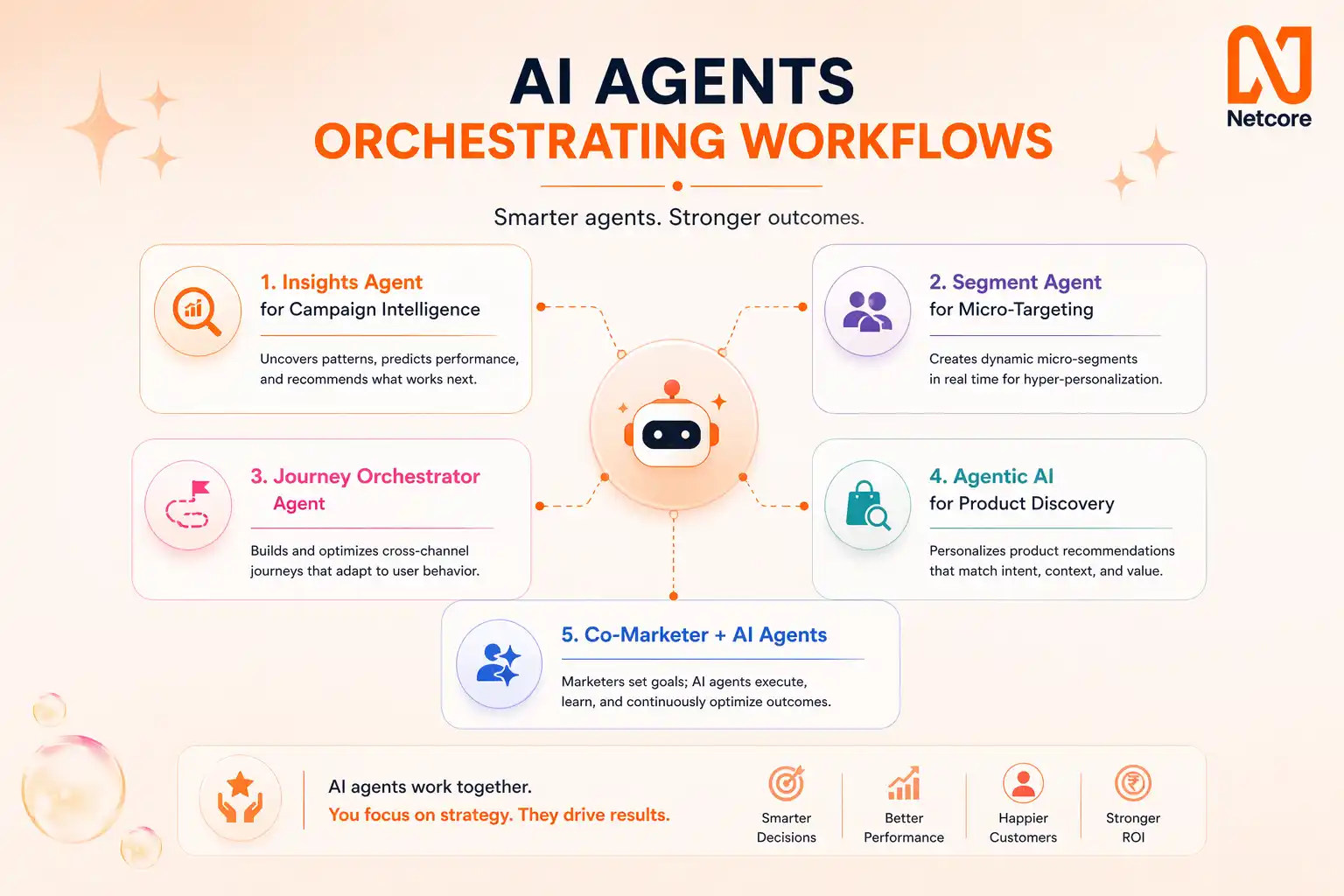
Traditional automation executes predefined workflows. Agentic marketing goes further by using AI agents to orchestrate workflows dynamically, adapting decisions, interactions, and journeys in real time to drive outcomes.
Insights Agent for Campaign Intelligence
An Insights Agent analyzes customer signals and campaign performance continuously, helping marketers uncover opportunities and optimize faster.
Segment Agent for Micro-Targeting
Instead of static audience lists, a Segment Agent uses AI to create dynamic micro-segments and enable personalization at scale.
Journey Orchestrator Agent
This agent designs and optimizes journeys across channels automatically—choosing the right message, timing, and channel for each customer.
Agentic AI for Product Discovery
AI agents can also power smarter product discovery and recommendations, improving relevance and driving conversions.
Co-Marketer + AI Agents
With agentic marketing, marketers work alongside Co-marketer AI agents to strategize, create, launch, and optimize campaigns, shifting from manual execution to intelligent orchestration.
Core Differences Between Agentic Marketing and Automation?
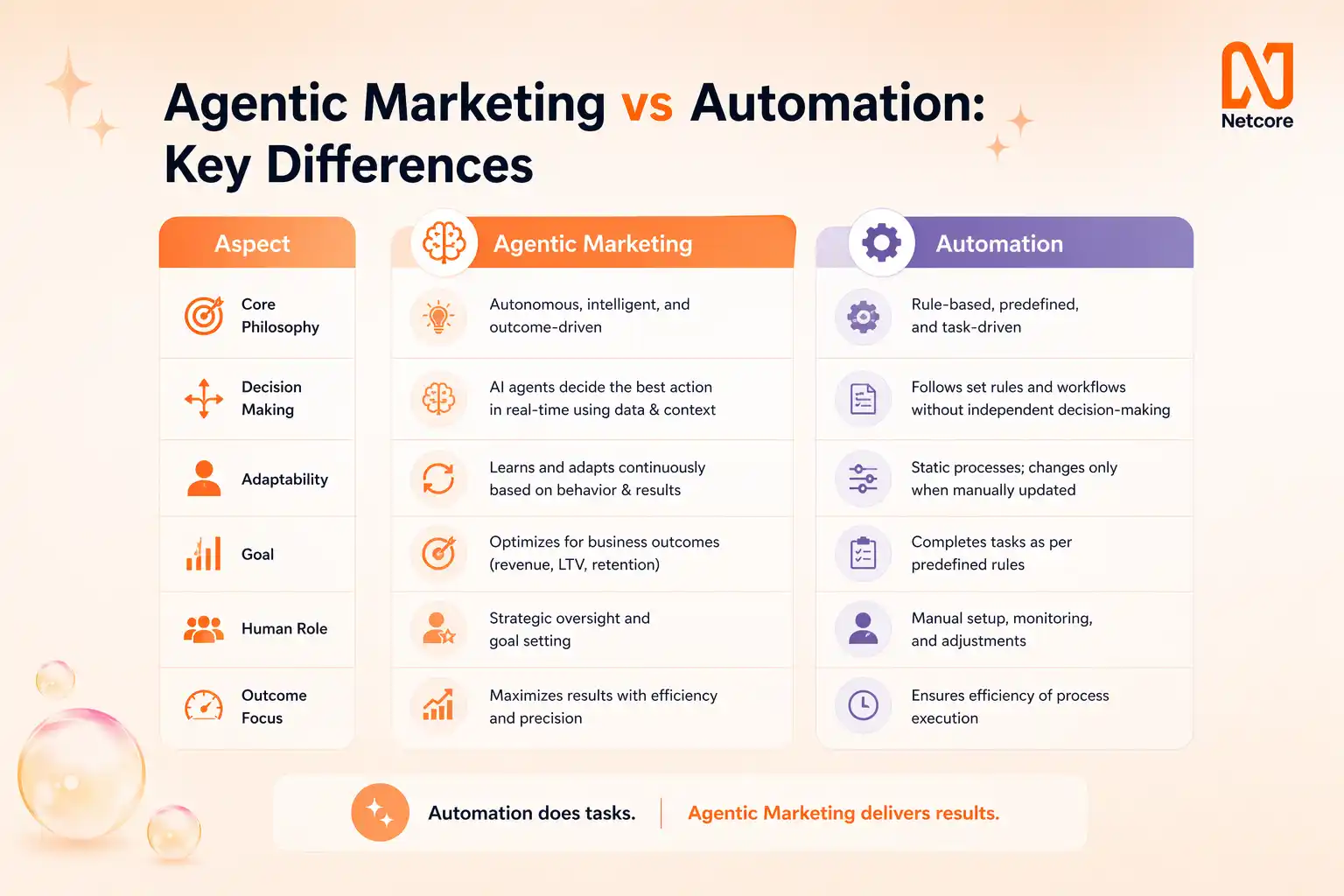
The distinction between these two paradigms becomes stark when evaluated side-by-side. As technology leaders have documented, automation follows a set of rigid instructions, whereas agentic systems adapt to complex, dynamic inputs.
| Capability | Traditional Automation | Agentic Marketing |
|---|---|---|
| System Logic | Deterministic (“If/Then” rules) | Goal-oriented (Intent-driven autonomy) |
| Human Requirement | Must map every possible step and node | Defines the boundaries and the final KPI |
| Adaptability | Static. Fails if a user acts unpredictably | Dynamic. Adapts to change in user behaviour |
| Measurement of Success | Activity (Was the workflow executed?) | Outcome (Did we generate the revenue?) |
| Scale of Personalization | Broad segments (1:Many) | True 1:1 personalization at the segment of one |
Why the Shift to Agentic Marketing is Essential?
For years, marketing automation has been propped up by four foundational pillars: list segmentation, email scheduling, static lead scoring, and basic workflow reporting. In the era of autonomous systems, these pillars are not just insufficient; they are actively holding your revenue back.
When consumers expect real-time, cross-channel experiences, a weekly segmented batch-and-blast is obsolete. Static lead scoring degrades the moment a user’s intent shifts. Basic reporting tells you what happened yesterday, but offers zero predictive power for tomorrow.
Agentic marketing platforms dismantle these pillars and replace them with dynamic audiences, predictive intent scoring, and autonomous channel orchestration. We believe that if you are still manually dragging and dropping segments into a campaign builder, you are wasting valuable strategic bandwidth on tasks that an intelligent system should handle autonomously.
How does agentic AI transform the marketing workflow to drive real-world ROI?
Agentic AI transforms marketing from manual execution into autonomous optimization. Instead of marketers managing countless rules, AI agents continuously analyze signals, make decisions, and act in real time to improve outcomes. They can identify high-intent audiences, optimize journeys across channels, personalize offers, and even reallocate budget based on performance, without waiting for manual intervention.
This shift improves ROI in tangible ways: reducing wasted spend, improving conversion rates, increasing retention, and accelerating time-to-action when customer intent is highest. More importantly, agentic AI moves teams from reactive campaign management to proactive revenue orchestration. Rather than measuring success by workflows executed or messages delivered, marketers can optimize directly for business outcomes like revenue, customer lifetime value, and acquisition efficiency. That’s what makes agentic AI not just an automation upgrade, but a fundamentally different model for growth.
Final Take
Traditional automation helped marketers scale execution, but agentic marketing scales intelligence. As this blog shows, the shift is about moving from rule-based workflows to autonomous systems that optimize decisions, adapt in real time, and drive measurable ROI.
Ready to take your agentic marketing efforts further? Get in touch with the best in the business and see how Netcore can help you build autonomous marketing systems for real growth.