




TL;DR
An agentic marketing strategy abandons manual, rules-based automation in favor of autonomous AI systems that plan, execute, and optimize campaigns to hit specific revenue goals. Moving beyond simple generative AI prompts, these agents eliminate workflow bottlenecks, saving enterprise teams hundreds of operational hours while driving measurable ROI. At Netcore, we believe managing autonomous systems, not building rigid campaigns, is the only way to achieve true 1:1 personalization at scale.
The era of manual, rules-based marketing automation is dead. Prompting a generative AI tool to write email copy is a tactical band-aid, not a scalable agentic marketing growth engine. At Netcore, we believe the future belongs to autonomous, agentic systems that orchestrate entire workflows and deliver measurable business outcomes without constant human intervention. Agentic marketing strategies leverage autonomous AI agents to plan, execute, and optimize campaigns in real-time, focusing on data-driven decisions across customer journeys.
What makes Agentic Marketing Strategy Different?
79% of organizations have implemented some form of AI agent technology, with 96% planning expansion as per trends shared around agentic framework recently. Agentic marketing is the deployment of autonomous AI agents capable of planning, executing, and optimizing customer engagement workflows to achieve specific business goals. Unlike generative AI, which requires human prompts to create assets, agentic AI operates independently, making real-time decisions across channels autonomously to maximize measurable ROI.
For the last decade, marketers have been trapped in a paradigm of building complex, rigid “if/then” journey flows. These flows break the moment a customer deviates from the expected path. We see marketing operations teams spending hundreds of hours mapping out granular contingencies, only to yield a fraction of their intended engagement.
Agentic marketing shifts the operational model entirely. Instead of mapping every possible customer action, you define the goal, such as maximizing the conversion rate of an abandoned cart segment, and set the operational guardrails. The system’s agents then take over. They analyze the customer’s historical data, select the highest-converting channel, generate the appropriate asset, deliver it at the optimal time, and autonomously adjust the strategy based on the customer’s real-time reaction.
This is the core of our philosophy at Netcore: intelligence over execution. Technology should not just send your messages faster; it should be accountable for delivering your results.
Why is Prompting Generative AI Not a True Marketing Strategy?
Marketing leaders frequently confuse generative AI with autonomous strategy. They purchase subscriptions to AI writing assistants and assume they have modernized their MarTech stack. But creating content faster does not solve the fundamental bottleneck of campaign orchestration.
Generative AI answers the question: “Can you write this for me?” Agentic AI in marketing answers the question: “Can you achieve this revenue target for me?”
If your team is still manually deciding which segment receives which message, setting up A/B tests, and pulling data to see what worked, you are executing a manual strategy with AI-assisted tools. You are not executing an agentic strategy.
What Are the Core Principles of an Agentic Marketing Workflow?
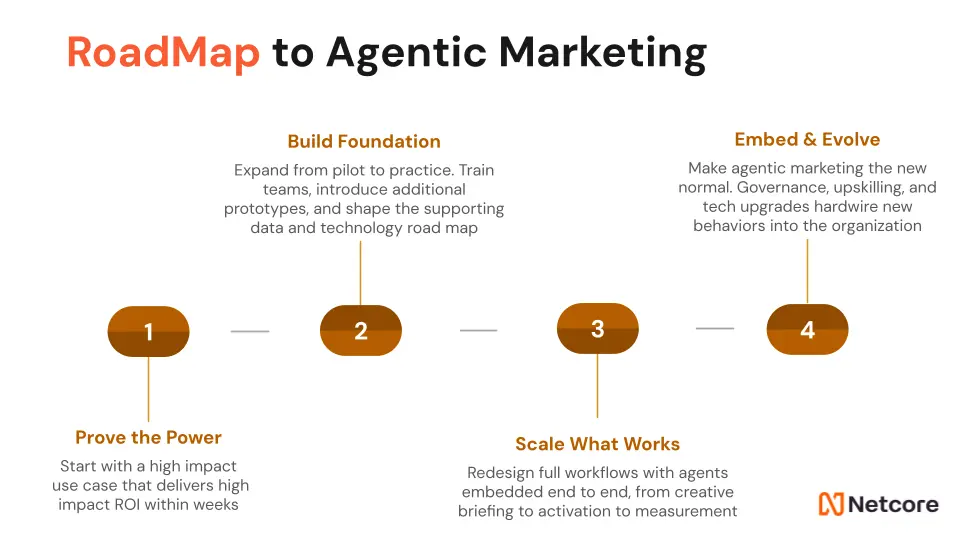
To architect an autonomous customer experience (CX), you must understand the mechanics that make an agentic system work. At Netcore, we anchor our autonomous orchestration engine on three non-negotiable principles.
- Goal-Oriented Autonomy
Agentic systems are not task-runners; they are goal-seekers. You do not tell the agent to “send an SMS at 10 AM.” You tell the agent to “maximize trial-to-paid conversions within a $5 CPA.” The system works backward from that financial mandate, testing and deploying the right mix of channels and messaging to achieve the outcome. - Contextual Memory
Traditional automation triggers based on a single event (e.g., “User clicked link”). Agentic workflows retain continuous context. The agent remembers that a user ignored the last three emails but engaged with an in-app message, adapting its future strategy autonomously. - Real-Time Accountability
We believe technology must be held to the same standard as a human employee. Agentic systems constantly measure their own performance against the assigned KPI. If an orchestration path is failing to generate incremental revenue, the agent kills the path and reallocates resources instantly, without waiting for a marketer’s end-of-month report.
Why is Legacy Rules-Based Automation Costing You Revenue?
The financial drain of legacy automation is twofold: the invisible cost of operational drag, and the very visible cost of missed revenue opportunities.
Consider the typical enterprise campaign build. A Marketing Operations Director spends weeks gathering requirements, mapping complex branching logic, configuring cross-channel delivery, and setting up control groups. By the time the campaign launches, the customer’s intent window has often closed.
Furthermore, rules-based logic forces customers into generalized cohorts. If you build a workflow with 10 branches, you are offering 10 variations of an experience. But your customers demand 1:1 personalization. When a high-LTV customer falls into a generic “unengaged” branch because they missed one email, the system sends a standard win-back offer that degrades your margin.
An agentic workflow prevents this revenue leak. It recognizes the individual’s lifetime value and autonomously crafts a bespoke intervention. The business case for agentic marketing is fundamentally about reclaiming lost margin and eliminating the friction that prevents agile execution.
5-Steps to Build Agentic Marketing Strategy Workflows
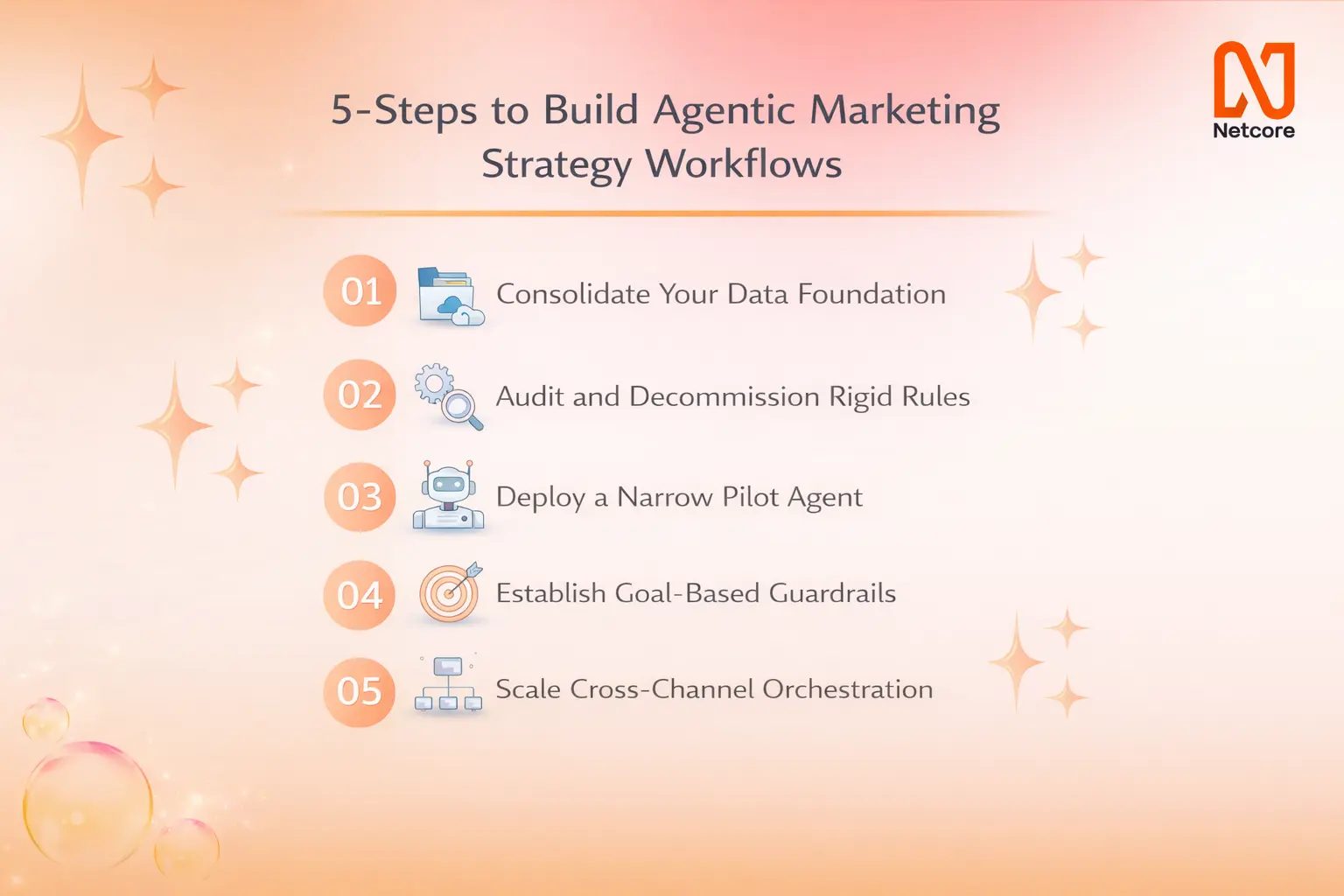
Before we get started here are few agentic marketing use cases to help you understand how to start. Here is how we guide Netcore clients through this transformation:
- Consolidate Your Data Foundation
Agents cannot orchestrate without a single source of truth. Unify your zero-party, behavioral, and transactional data into a cohesive customer profile. Disconnected silos will result in erratic AI decisions. - Audit and Decommission Rigid Rules
Identify your most complex, lowest-performing “if/then” journeys. Document the business objective of these journeys, then sunset the manual workflows to make room for autonomous routing. - Deploy a Narrow Pilot Agent
Do not boil the ocean. Assign an agent like Journey Orchestrator Agent to a specific, highly measurable KPI, such as optimizing send times across email and push notifications for a single onboarding segment. - Establish Goal-Based Guardrails
Define the financial and brand safety boundaries. Tell the agent its maximum discount limits, frequency caps, and excluded segments. Let it experiment freely within that fenced perimeter. - Scale Cross-Channel Orchestration
Once the pilot proves ROI, expand the agent’s mandate across all channels. Shift your team’s focus from building individual campaigns to tuning the agent’s strategic parameters.
How Do You Transition Your Team to Hybrid Human-Agent Operations?
The most significant hurdle in adopting agentic marketing is not the technology; it is the organizational culture. Marketing teams are conditioned to find security in control. Handing the steering wheel to an autonomous system creates acute anxiety for legacy operators.
To build a hybrid human-agent operation, marketing leaders must redefine job roles. Campaign Managers must transition into AI Strategists. Instead of writing SQL queries to pull lists or spending afternoons in drag-and-drop journey builders, your team should be analyzing agent performance, defining higher-level business goals, and feeding the system better creative inputs.
We tell our clients to treat AI agents as new hires. You give a new hire clear instructions, monitor their early output closely, correct their mistakes, and gradually increase their autonomy as they prove their competence. This approach demystifies the technology and aligns human creativity with machine scale.
What Are Real-World Examples of Agentic AI in Marketing Campaigns?
Theory must always translate into practice. When we deploy Netcore’s autonomous systems, the shift in execution is stark. Check out agentic marketing case studies for real world examples.
Take the classic abandoned cart scenario. In a rules-based world, a marketer builds a flow: wait 2 hours, send Email 1. Wait 24 hours, send SMS 2. If no purchase, offer a 10% discount.An agentic workflow approaches this entirely differently. The agent identifies a cart abandonment event. It calculates the user’s propensity to buy and recognizes that this specific user never opens emails but frequently engages with WhatsApp notifications in the evening. At 7:30 PM, the agent autonomously generates a personalized WhatsApp message highlighting a product feature (not a discount, preserving margin) and sends it after approval from human checker. The user converts. Zero human intervention was required. Just like that with an agentic marketing platform.
How Do You Measure the ROI of Autonomous Marketing Agents?
CFOs do not care about open rates, and they certainly do not care how many AI prompts your team wrote this week. They care about revenue, operational efficiency, and margin preservation. If your agentic marketing strategy cannot prove its impact on the P&L, it is just an expensive science experiment.
At Netcore, we enforce strict accountability metrics for autonomous systems:
- Incremental Revenue Lift: We measure the direct revenue generated by the agentic workflow against a strictly held universal control group.
- Operational Hours Saved: We quantify the time marketing operations teams previously spent building and QAing manual journeys, converting those hours into hard cost savings.
- Margin Protection: We track how often the agent achieves a conversion without defaulting to a discount, directly proving its impact on bottom-line profitability.
When evaluating the financial impact of your transition, you need a robust framework. Learn exactly how to build this business case in The CMO’s Guide to Agentic ROI ->
How Do You Evaluate Agentic MarTech and Choose the Right Platform?
If you are ready to evaluate platforms, you must look past the generative AI features vendors are rushing to staple onto their legacy infrastructure. A true agentic platform is built from the ground up for autonomous orchestration.
When assessing vendors, demand proof over promises. Ask them directly:
- Can your platform independently adjust channel delivery based on real-time behavioral shifts, or does it rely on static rules?
- How does your system handle goal-oriented constraints (e.g., “maximize engagement without exceeding a specific frequency cap”)?
- Can you show me a concrete attribution model that proves the autonomous agent drove incremental revenue?
If the vendor pivots the conversation back to how easily their AI can generate subject lines, you are looking at a legacy tool wearing an AI mask.
What is the Future of CX: Are We Managing Agents Instead of Campaigns?
The trajectory of customer experience is irreversible. As noted in Google’s strategic insights on managing AI agents, not prompts, the marketing leaders of tomorrow will function more like conductors of a digital orchestra.
We are moving rapidly toward a reality where your MarTech stack is essentially a team of specialized, highly accountable digital workers. You will have an agent dedicated to churn prevention, an agent focused on VIP upsells, and an agent managing cross-channel frequency. Your competitive advantage will no longer be how fast you can build a campaign, but how effectively you can direct and govern your autonomous systems to deliver unmatched results.
Final Take
The brands that win the next decade won’t just experiment with AI, they’ll operationalize it through well-defined, agentic marketing strategies. In this blog, you’ve seen how to actually build an agentic marketing strategy, not just in theory, but through practical steps and real-world examples that show what autonomous, outcome-driven marketing looks like in action.
Agentic marketing isn’t about writing better prompts, it’s about orchestrating intelligent systems that continuously learn, optimize, and stay accountable to measurable revenue. Ready to create a similar strategy tailored to your business? Let’s build it together. Talk to us.