




I was in the room when our Founder, Rajesh Jain, took the stage at one of the world’s biggest marketing events, in partnership with Google Cloud, and said something that I haven’t been able to stop thinking about since.
“Nearly 70% of advertising spend targets buying back known customers, equating to $500 billion in annual AdWaste.”
Let that land for a second. Not $500 million. $500 billion. Spent every year, across the industry, reacquiring customers that brands already owned. And with 90% of total marketing budgets flowing into adtech, the platforms collecting that money have very little incentive to tell you it’s happening.
That was the moment I stopped treating reacquisition as a line item problem and started treating it as the defining margin crisis of most brands. And what I am going to do is tear this problem apart, understand exactly how it happens, and find a realistic alternative that doesn’t require handing your customer relationships back to platforms every time someone goes quiet.
That’s what I’m going to walk you through.
The Question Most Marketers Aren’t Asking
There’s a question most marketing dashboards are not designed to answer:
Is your marketing spend building an asset, or simply renting access to one?
On the surface, most marketing campaigns look healthy. Customer acquisition cost is within target. Return on ad spend appears acceptable. Quarterly performance reports show green indicators. In that environment, there’s little incentive to look deeper.
But strong surface metrics can hide a structurally inefficient cost model. Many brands are not truly growing their customer base; they are simply paying repeatedly to reach the same customers, often under the label of “acquisition.
The real question every marketing leader should ask is simple:
Are your marketing investments compounding over time, or running on a treadmill that becomes more expensive every quarter?
For many organisations, the data needed to answer that question is never examined. And the margin impact of that blind spot is far larger than most teams realise.
What’s Really Inside Your Marketing Budget
Consider a common scenario.
A brand spends $50,000 on performance marketing during a quarter. The cost-per-acquisition falls within acceptable limits, the dashboard metrics look clean, and the investment appears justified.
But when the audience composition is analysed more closely, the picture often changes.
A meaningful portion of that spend, sometimes 20–40% of the total budget, is directed toward reaching customers who already exist in the brand’s own database. These are people who have purchased before, interacted before, and simply drifted away over time.
In other words, the brand is not always acquiring new customers. It is buying back customers it previously had, often at full market acquisition cost.
The reason this rarely surfaces is structural. Marketing budgets typically classify this spend as acquisition, not recovery. Retargeting, remarketing, and “prospecting” campaigns frequently contain a mix of both new and previously known customers. The result is that reacquisition costs remain hidden inside performance marketing reports.
The margin impact, however, is very real.
The Reacquisition Math
Reacquisition does more than duplicate marketing spend. It fundamentally alters the economics of customer growth.
A customer acquired organically may carry a healthy gross margin after fulfilment. But if that same customer must later be reacquired through paid media, the business effectively absorbs two acquisition events for the same individual.
Lifetime value remains unchanged. Acquisition cost doubles.
When this pattern scales across a marketing program, the impact becomes significant. Many ecommerce brands unknowingly direct 20–40% of their paid marketing budgets toward reacquiring existing customers each quarter.
At an industry level, analysts estimate that hundreds of billions of dollars in global digital advertising spend are consumed by this cycle every year.
The loss rarely appears on performance dashboards, because the metrics being measured were never designed to expose it.
What is Behind the Reacquisition Loop?
The underlying issue is not marketing inefficiency alone. It is customer decay.
Customers rarely disappear overnight. Engagement typically declines gradually: purchase frequency drops, email interactions decrease, and brand touchpoints become less frequent. Because this process unfolds slowly, it rarely triggers immediate alarms inside reporting systems.
By the time the decline becomes obvious, the customer may have already crossed an invisible threshold, the point where owned channels can no longer easily reach them. At that stage, paid platforms often become the only reliable mechanism to reconnect.
What began as a retention issue becomes a reacquisition expense.
What is The Reacquisition Loop?
Once this pattern forms, it becomes self-reinforcing.
Customers disengage gradually. Paid retargeting campaigns bring them back at full acquisition cost. They convert, re-enter the database, and the cycle begins again months later.
Over time, the marketing budget begins circulating through the same audiences rather than expanding the customer base.
This dynamic is amplified by the concentration of marketing spend on a small number of digital advertising platforms. When most reach is rented rather than owned, brands become increasingly dependent on those platforms every time customer engagement weakens.
The result is a marketing system that appears to scale but quietly erodes margin.
How to Diagnose the Reacquisition Leak?
Fortunately, the problem is measurable.
Marketing teams can begin by analysing paid campaign audiences and comparing them with CRM data. Specifically, they should identify what percentage of paid media spend targets customers who have previously purchased.
For many brands, the answer falls between 20% and 40% of total paid spend.
A second step is cohort analysis. By examining customer groups acquired 12–18 months earlier, brands can identify the point where engagement begins to decline, the early stages of customer decay.
This moment represents the intervention window, where targeted engagement through owned channels can prevent customers from becoming expensive reacquisition events later.
Find the answer to one of the questions below to evaluate your reacquisition cost:
- What percentage of paid media campaigns target customers who have already bought from you?
- What percentage of my customers qualify as reacquired users? Total acquisition cost of the reacquired user?
Steps to Identify Marketing Reacquisition Cost
Step 1: Audit Your CRM Database
Before touching your ad platform data, start with what you own.
Pull a complete export of your customer database and segment it into three buckets:
- Active customers purchased or meaningfully engaged in the last 90 days.
- Lapsing customers’ last purchase or engagement between 90-180 days ago.
- Dormant customers have no meaningful activity beyond 180 days.
First, establish the rule for reacquisition.
Examples:
- A user who previously purchased but was inactive for 90+ days
- A past app user reinstalling via paid ads
- A churned subscriber returning through remarketing ads
This segmentation becomes your baseline. Every paid impression that lands on the lapsing or dormant bucket is a reacquisition cost, not an acquisition cost, regardless of how your platform reports it.
Step 2: Export Your Paid Audience Lists
Go into every active paid platform, Meta, Google, TikTok, and programmatic. Pull the audience lists currently in use across your campaigns. Specifically look for:
- Custom audiences built from customer lists
- Website retargeting audiences
- Email engagement-based audiences
- Lookalike audiences seeded from existing customers
These audiences are where reacquisition spend concentrates. If your existing customers are inside these audiences and being served paid impressions, you are paying for reach you should already own.
Step 3: Cross-Reference Paid Audiences Against Your CRM Segments
This is the step most brands skip, and it’s where the real number lives.
Match your paid audience lists against your CRM export. The overlap between your dormant and lapsing customer segments and your active paid audiences is your reacquisition audience. Calculate:
- Total size of the overlapping audience
- Estimated impressions served to that audience over the last quarter
- CPM and total spend attributed to that audience segment
This gives you the raw reacquisition spend figure for the first time — likely as a percentage of total paid budget that will be uncomfortable to look at.
Step 4: Pull Campaign-Level Spend Data By Audience Type
Go into your ad platform reporting and break down spend by audience type rather than campaign objective. Most platforms allow you to filter by audience segment at the ad set level. Categorise every active ad set into one of three buckets:
- Net new acquisition, audiences with no overlap with your existing customer database.
- Reacquisition audiences with direct overlap with lapsing or dormant customers.
Step 5: Calculate Your Reacquisition Cost
Once you have spend assigned to each bucket, calculate two core metrics:
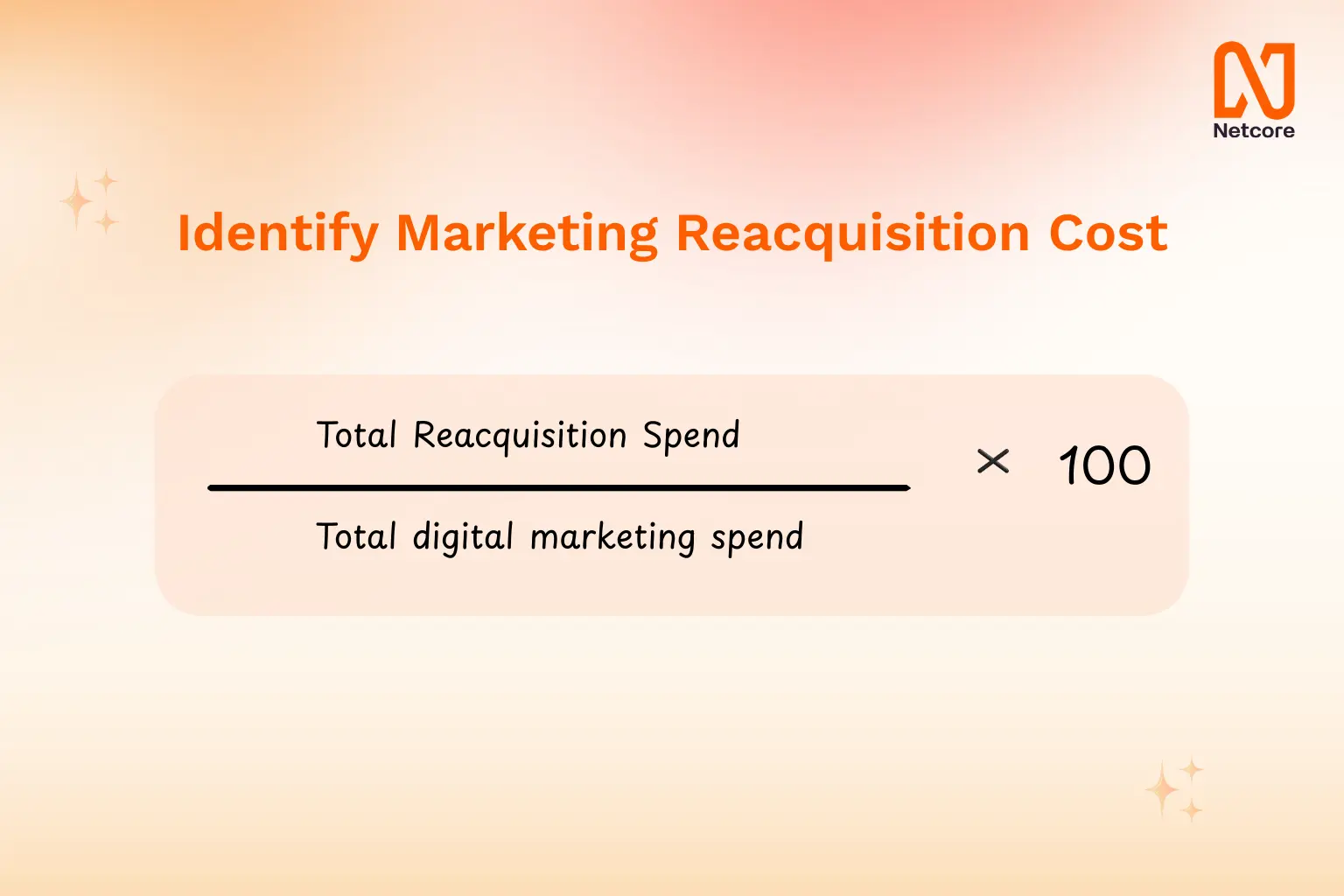
Reacquisition Spend: Total reacquisition spend ÷ Total paid marketing spend × 100
Compare this directly against your original CAC for the same customer cohort. The delta between the two numbers is your reacquisition premium, the additional cost you paid to win back a customer you already owned.
At the end of these five steps, you will have something most marketing teams have never actually seen: the true cost of your reacquisition bleed in revenue.
That number is uncomfortable. It will almost certainly be larger than you expected. But it is the most important number your marketing team isn’t currently measuring, because it represents the exact margin available to recover the moment you stop funding the buyback loop and start investing in owned channels instead.
This is where the real budget conversation begins.
How to Get Out of the Reacquisition Loop?
Breaking the reacquisition loop requires a structural shift in marketing strategy.
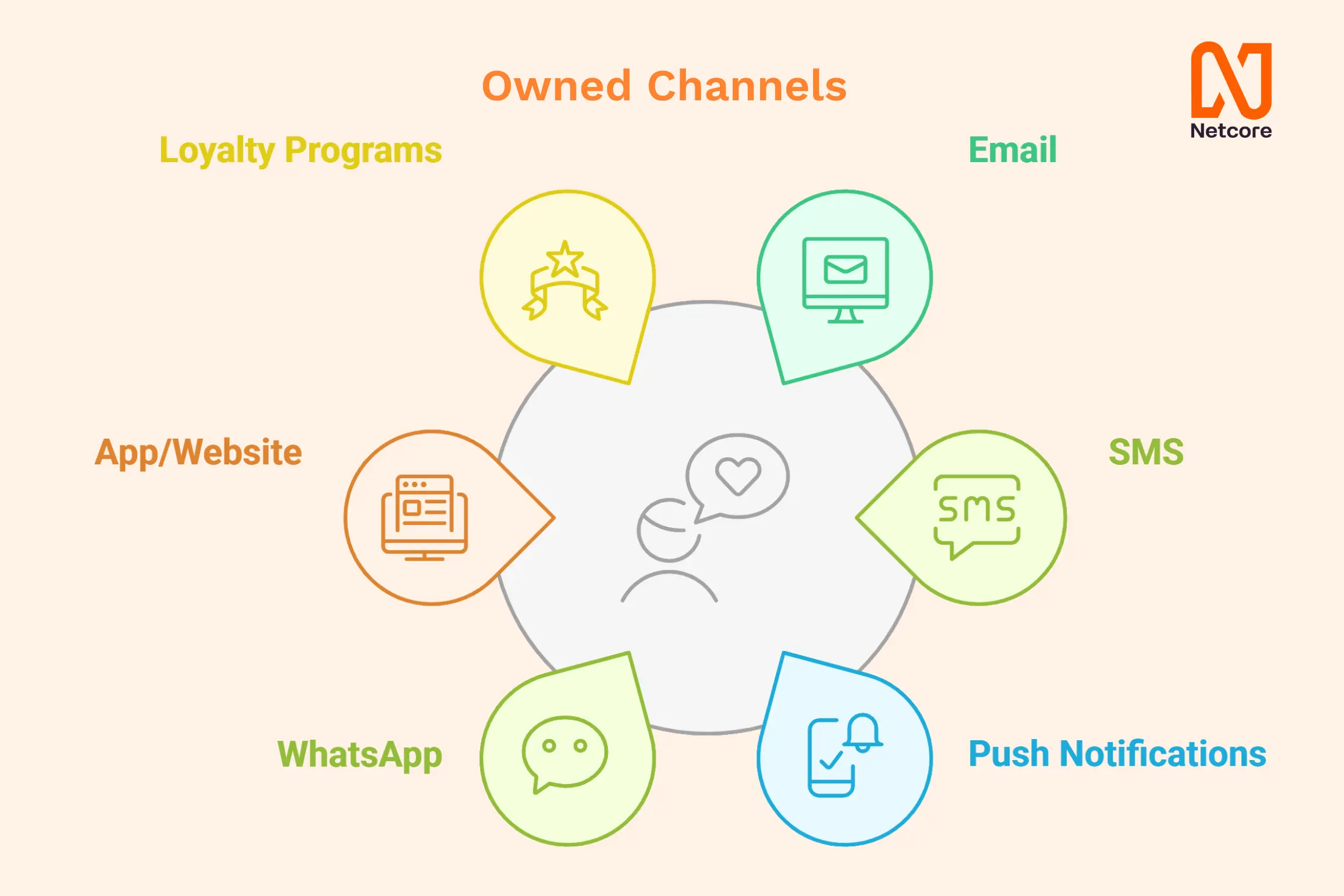
Instead of relying primarily on rented reach through advertising platforms, brands must strengthen their owned channels, email, SMS, push notifications, WhatsApp, in-app messaging, and website experiences.
Agentic marketing makes these channels significantly more powerful because it can continuously identify and recognise users across touchpoints, even when they are not explicitly logged in. By analysing behavioural signals, device patterns, browsing activity, and historical engagement data, agentic systems can intelligently match interactions to existing customer profiles.
This means many users who would otherwise appear “anonymous” in traditional analytics can still be recognised as known customers.
Once identified, brands can engage them through owned channels with personalised, timely communication, nudging them back before disengagement turns into paid reacquisition.
The result is a fundamentally different marketing loop: instead of paying to rediscover lost customers, brands proactively retain and grow existing relationships through owned channels where engagement compounds over time.
What’s the Margin Impact of Investing in Owned Channels?
The financial impact of this shift can be substantial.
If a brand currently allocates 40% of its paid marketing budget to reacquisition, redirecting even a portion of that investment toward proactive retention through owned channels can significantly improve unit economics.
The benefits operate in two ways:
First, the business reduces the need to reacquire customers at full acquisition cost.
Second, the lifetime value of existing customers increases as engagement is sustained for longer periods.
Unlike paid media spend, which delivers a fixed return before resetting with each campaign, investments in owned relationships compound over time.
Brands that recognise this dynamic are not necessarily spending less on marketing. They are investing in systems that strengthen customer relationships before those relationships require expensive recovery.
Final Take
Industry estimates suggest that hundreds of billions in digital ad spend each year go toward reacquiring customers brands already had. This happens because reacquisition is largely invisible in performance reporting and because many strategies prioritise rented reach over owned relationships.
The first step for marketing leaders is simple: measure the reacquisition bleed. Identify how much of your budget is spent reaching customers already in your database and quantify the margin impact.
Owned channels like email, push, SMS, and app change this equation. They allow brands to drive repeat purchases from existing customers at near-zero marginal cost.
That means higher revenue through more repeat buying, and stronger margins by eliminating paid reacquisition.
The real difference isn’t just growth. It’s the difference between renting revenue and owning it.