




A few months back, a colleague forwarded me a customer complaint. The customer had bought something, got a confirmation email, and then spent the next four days being retargeted with ads for the exact product they’d already purchased.
Classic, we’ve all seen it. And it’s a perfect example of the gap between cross-channel marketing and omnichannel marketing, even if, on paper, both were “working.”
That gap is what I want to talk about today, the real difference between omnichannel vs cross-channel.
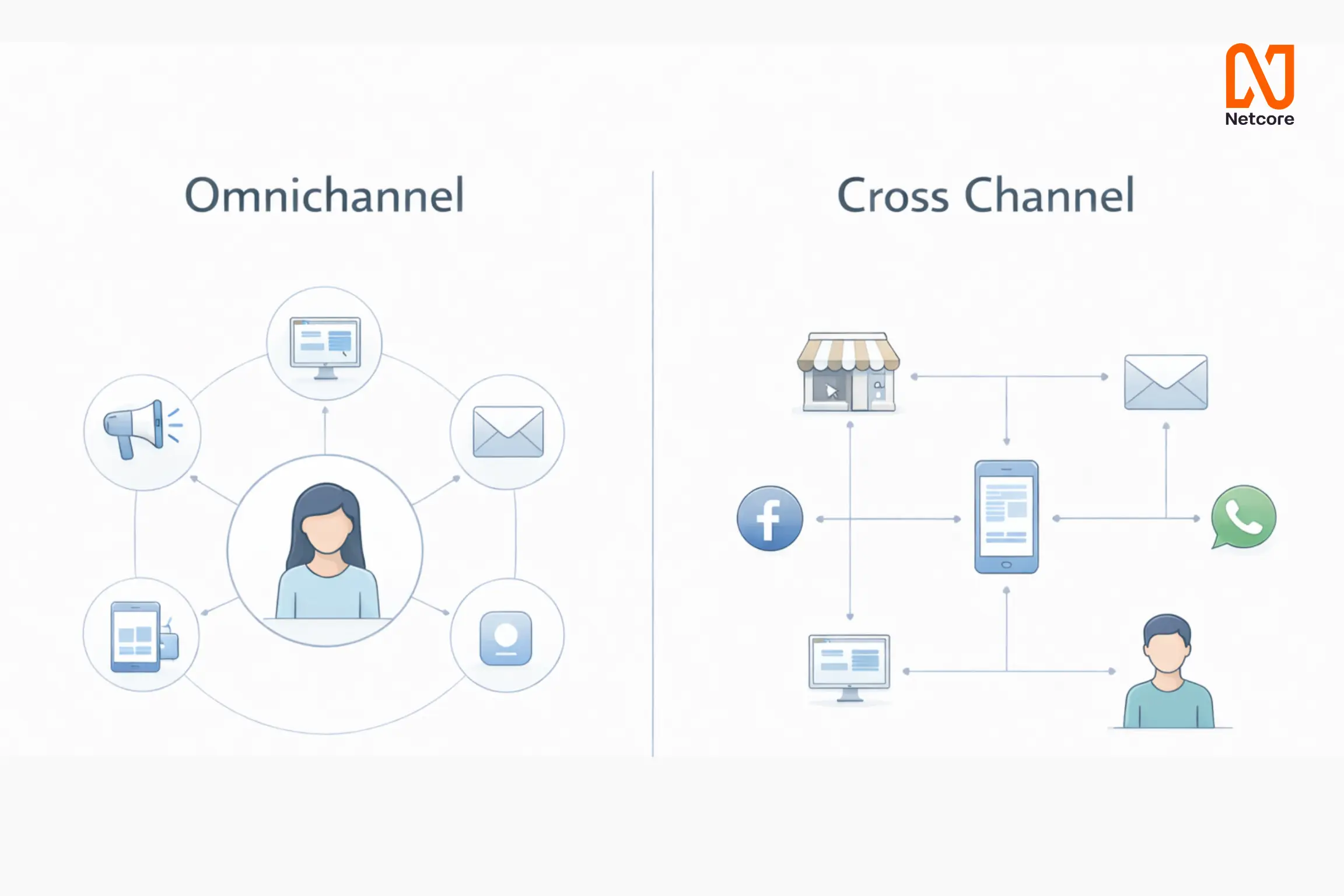
Evolution of Multichannel → Cross-Channel → Omnichannel
I like to think of these three as stages of a marketing maturity journey, not three competing philosophies you have to pick between.
Multichannel: You show up on email, social, paid, and maybe SMS. Each channel does its own thing. There’s no data sharing, no coordination. You’re basically running parallel campaigns that happen to belong to the same brand.
Cross-channel: Your channels start talking to each other. A cart abandonment on your website triggers an email. That email feeds a retargeting list on Meta. Data flows between platforms, but usually in batches, and usually in one direction.
Omnichannel: The customer experience becomes continuous and seamless, no matter which channel they’re on. You’re not just connecting channels anymore. You’re building a single, real-time view of the customer and responding to their entire journey, not just their last click. The key distinction? Cross-channel is still organised around channels. Omnichannel is organised around the customer. That one shift changes everything.
What is the Core Difference Between Omnichannel and Cross-channel Marketing?
Cross-channel marketing connects various isolated channels to the brand, allowing marketers to send messages across multiple devices using disconnected data silos. Omnichannel marketing connects all channels directly to the customer through a unified, real-time data layer, ensuring every interaction instantly informs the next to drive measurable revenue.
The fundamental difference between cross-channel and omnichannel isn’t about the number of channels you use. It is about where the customer data lives and how it is activated in real-time. Cross-channel marketing connects various channels to the brand, but they remain functionally isolated from one another.
As noted by AdRoll, cross-channel marketing allows retailers to deliver a journey across devices, but often lacks the full interconnectivity of true omnichannel systems. An email platform doesn’t inherently know what a user did on the mobile app five minutes ago. Omnichannel architecture removes this friction entirely.
| Aspect | Cross-Channel Marketing | Omnichannel Marketing |
|---|---|---|
| Core Approach | Uses multiple channels that are partially connected | Fully integrated, customer-centric approach across all channels |
| Customer View | Fragmented view across channels | Unified, single customer view (single source of truth) |
| Data Usage | Data is shared but often delayed or limited | Real-time data flows across all touchpoints |
| Personalization | Basic personalization within channels or campaigns | Deep, real-time hyper-personalization at an individual level |
| Journey Orchestration | Predefined paths across select channels | Dynamic, AI-driven journeys adapting to behavior and context |
| Channel Coordination | Channels work together but not seamlessly | Channels are fully synchronized and context-aware |
| Customer Experience | Can feel slightly disjointed | Seamless, consistent experience across every touchpoint |
| Decision Making | Rule-based and campaign-driven | Intelligent, predictive, and behavior-driven |
| Optimization | Often post-campaign analysis | Real-time, in-flight optimization |
| Goal | Improve engagement across channels | Maximize customer lifetime value and revenue |
Why does Cross-channel fail to Deliver ROI?
When a brand operates in a cross-channel model, the customer still feels the friction of disconnected systems. This fragmentation destroys conversion rates and makes true ROI attribution mathematically impossible.
A fragmented stack means redundant messaging, wasted ad spend, and a broken customer experience. If a user buys a product in-store but receives a promotional email for that exact product an hour later, the cross-channel system has failed. This lack of interconnectivity prevents marketing teams from proving true ROI to their CFO.
Accountability requires a unified view of the customer. Unified platforms, like Netcore, replace these silos with autonomous orchestration. By centralizing the data, businesses can tie every interaction back to measurable revenue impact rather than vanity engagement metrics.
Steps to Transition Your Stack from Cross-channel to Omnichannel
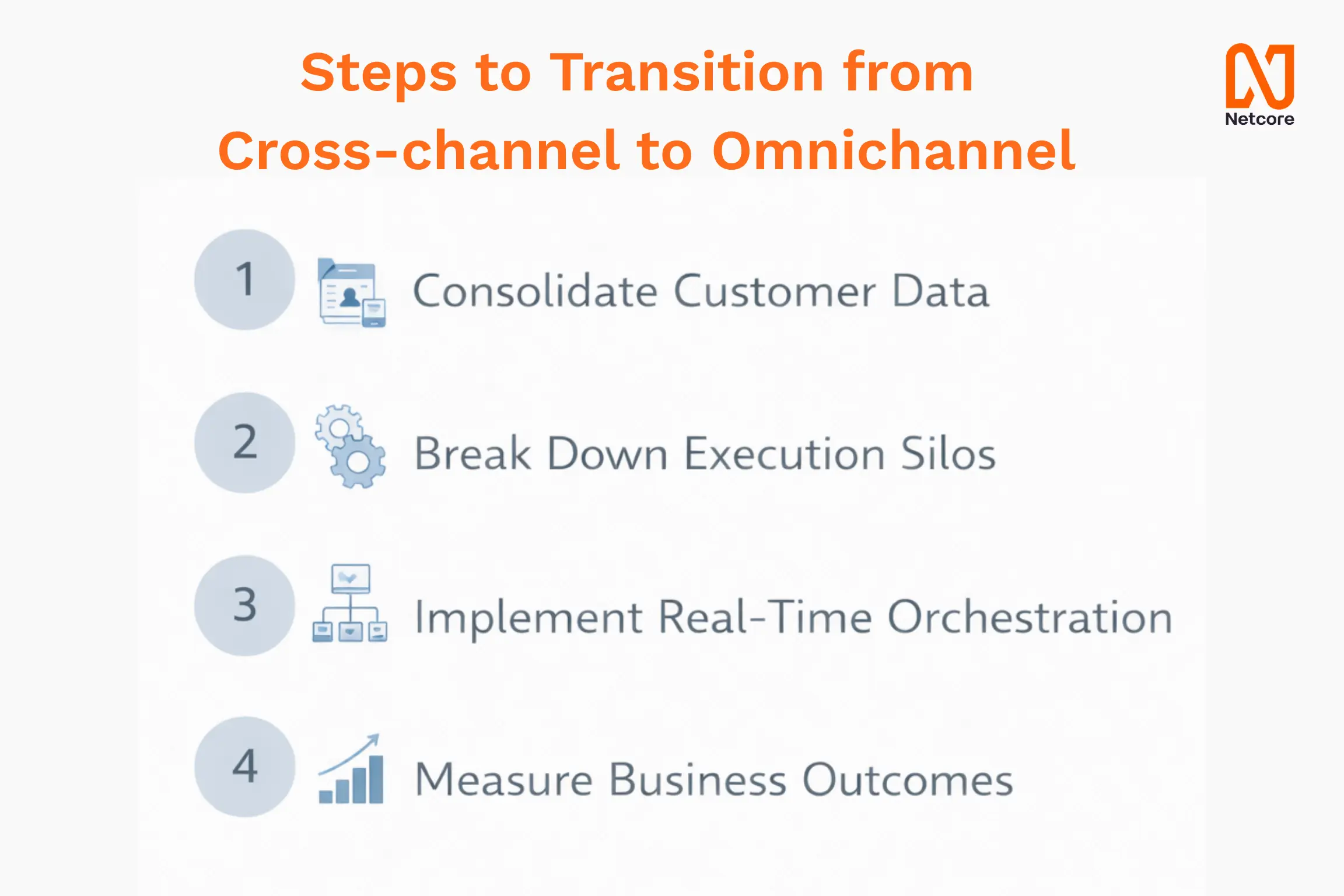
Moving from a fragmented stack to a unified, CDP-driven omnichannel architecture requires a strategic overhaul of how data is processed. You cannot simply buy another messaging tool; you must fix the data foundation.
- Consolidate Customer Data
Identify where customer data is trapped and deploy a modern CDP. This establishes a single, real-time customer profile that serves as the single source of truth for all marketing activities. - Break Down Execution Silos
Integrate SMS, email, push, and in-app messaging so they share the same intelligence. A message sent on one channel must immediately update the behavioral logic for all others. - Implement Real-Time Orchestration
Shift from scheduled batch-and-blast campaigns to real-time, behavioral triggers. Use AI to determine the next best action and deliver messages precisely when the customer is most likely to convert. - Measure Business Outcomes
Abandon channel-specific vanity metrics. Realign your analytics to track holistic business outcomes, focusing on customer lifetime value, overall conversion rates, and unified revenue impact.
Final Take
If there’s one thing I’d want you to walk away with, it’s this: the difference between cross-channel and omnichannel isn’t really about how many channels you’re on. It’s about whether your data holds your marketing accountable for actual revenue, or just activity.
Most of us have inherited some version of a Franken-stack, a patchwork of tools that technically “integrate” but never quite talk to each other the way you need them to. And honestly? That’s fine as a starting point. But at some stage, the duct tape stops working, and a centralised platform starts making a lot more sense.
If you’re at that stage, a good next step is running a proper platform assessment before jumping to any decisions. Talk to us for an expert lead assessment.