




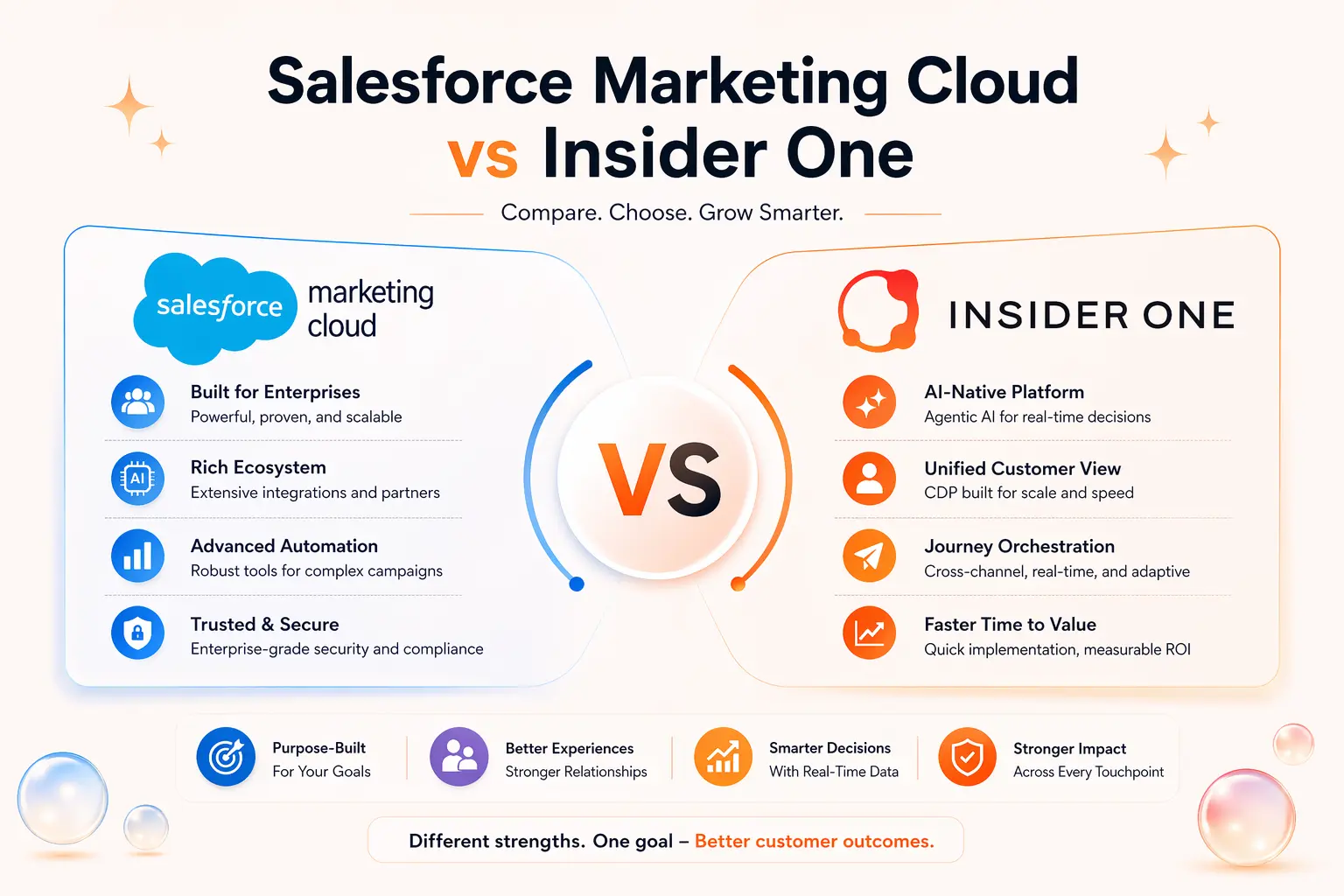
Salesforce Marketing Cloud is known for enterprise-grade orchestration and deep ecosystem integrations. Insider has gained traction for faster deployment, AI-led personalisation, and agile cross-channel execution.
In this guide, we’ll break down Salesforce Marketing Cloud vs Insider One across capabilities, usability, pricing, and performance to help you determine which platform best fits your growth goals and martech strategy.
Why This Comparison Matters
This is one of the most consequential shortlist comparisons in enterprise marketing right now, because the gap between what each platform promises in a demo and what it delivers in production is wider here than almost anywhere else in the category.
Salesforce Marketing Cloud (SFMC), recently rebranded as Agentforce Marketing, is a household name. It’s deeply embedded in enterprise tech stacks, and its native integration with Salesforce CRM is a genuine structural advantage for teams already in that ecosystem. But it comes with implementation timelines measured in months, pricing that requires a spreadsheet to decode, and a complexity that demands dedicated administrators to operate.
Insider One is a different kind of platform entirely. Named a Leader in the 2026 Gartner Magic Quadrant for Personalisation Engines, it’s built AI-first, deploys faster, and is designed for teams that want to move from contract to live campaigns in weeks, not quarters. It doesn’t have Salesforce’s ecosystem depth. But increasingly, for the buyers who don’t need that ecosystem, it doesn’t need to.
A Quick Comparison Table
| Dimension | Salesforce Marketing Cloud | Insider One |
|---|---|---|
| Primary Positioning | Enterprise marketing suite + CRM ecosystem | AI-native cross-channel personalization platform |
| Core Strength | Salesforce CRM integration + journey orchestration at scale | Sirius AI + web/app personalization + speed to value |
| Best Fit | Enterprises already on Salesforce CRM; complex B2C + B2B use cases | B2C enterprises, e-commerce, retail, travel, BFSI seeking fast AI-led engagement |
| AI Capabilities | Einstein AI, predictive scoring, send-time optimization, next-best action | Sirius AI, autonomous segmentation, channel selection, content optimization |
| Implementation Timeline | Months; often requires Salesforce partners | Weeks; in-house support team, no third-party SI required |
| Ease of Use | Steep learning curve; complex UI across Studios | More intuitive; praised for speed of adoption |
| G2 Overall | 4.4 / 5 | 4.8 / 5 |
| Gartner Peer Insights | 4.2 / 5 | 4.9 / 5 |
Salesforce Marketing Cloud Strengths
SFMC earns its place on enterprise shortlists through one structural advantage that no competitor has fully replicated: native, deep integration with Salesforce CRM. Everything else it does well flows from that foundation.
Where SFMC genuinely pulls ahead:
- Native Salesforce ecosystem integration. This is the headline differentiator, and it matters more than most comparisons acknowledge. For organisations where Salesforce CRM is the backbone of customer data, SFMC connects marketing, sales, service, and commerce into a single data view in a way that third-party integrations genuinely cannot replicate. As one Capterra reviewer put it, other marketing automation systems offer Salesforce integrations, but they’re essentially iframed in; once you dive into the details, data sync gaps and human error opportunities appear. Native integration eliminates those gaps.
- Journey Builder for complex orchestration. The Journey Builder is especially powerful for orchestrating complex, multi-channel customer journeys across email, SMS, push, and mobile. For enterprises running intricate, multi-conditional lifecycle programs, onboarding, upsell, winback, and post-purchase. Journey Builder handles logic complexity at a depth that smaller platforms struggle to match.
- Enterprise-grade data capabilities. Data extensions, SQL queries, AMPscript, and Automation Studio give technically sophisticated teams fine-grained control over data operations. For organisations with complex data warehouses, custom audience logic, or regulatory data handling requirements, SFMC’s data layer is built for that level of sophistication.
- Einstein AI for predictive intelligence. Einstein AI covers send-time optimisation, engagement scoring, content recommendations, and next-best-action suggestions.
- Compliance and security at enterprise scale. SFMC is built for regulated industries. Consent management, GDPR and CCPA compliance tooling, enterprise-grade security, and data residency controls are robust and well-documented. For healthcare, financial services, and global enterprises with complex compliance requirements, this is not a detail; it’s a requirement.
- Breadth of the Salesforce ecosystem. Commerce Cloud, Service Cloud, Data Cloud, Advertising Studio, the ability to orchestrate marketing alongside every other customer-facing function within a single vendor relationship is a real strategic advantage for enterprises that want to reduce the number of vendors they manage.
Salesforce Marketing Cloud Limitations
SFMC or Salesforce Agentforce is powerful. It is also genuinely expensive, genuinely complex, and genuinely dependent on a Salesforce-first world. If your organisation doesn’t fit that world, the tradeoffs multiply.
Where SFMC falls short, and where it falls short significantly:
- Complexity is not just a learning curve, it’s an operational commitment. The platform has a steep learning curve, particularly for non-technical users or smaller teams. Initial setup and implementation can be time-consuming and often require specialised expertise or external support. Full proficiency in Journey Builder, AMPscript, and Automation Studio takes months. This isn’t a onboarding problem; it’s the platform’s design philosophy. It was built for power, not speed.
- Implementation requires external resources and months of runway. Implementation projects typically involve Salesforce partners, take months, and cost five to six figures beyond license costs. This is not optional for most enterprise deployments. If your team is expecting to be live in six weeks, SFMC is the wrong platform.
- Pricing is notoriously opaque. Understanding what you’re paying for requires spreadsheets and negotiations. Modules, editions, contact tiers, super messages, pricing complexity is notorious. Real-world TCO regularly reaches $280,000+/year once you add implementation, partner support, add-on modules, and premium support tiers. One verified G2 reviewer reported being quoted $200,000+ just to match the AI personalisation and web capabilities that another platform included at the base price.
- Dependent on Salesforce CRM, and that dependency is double-edged. If you’re not on Salesforce CRM, or if your CRM data is incomplete, SFMC’s core value proposition weakens substantially. The platform is basically not usable without Salesforce CRM, according to one Capterra reviewer, and even within the ecosystem, the integration between Salesforce CRM and Marketing Cloud has historically been more complex than the vendor pitch suggests.
- Mobile app capabilities are weaker than alternatives. Salesforce lacks breadth of messaging channels, and its Mobile App offering is weak compared to dedicated mobile-first platforms. For B2C brands where the mobile app is the primary customer relationship, this is a significant gap.
- Reporting workflows are not intuitive. Multiple G2 and Capterra reviewers flag that while SFMC’s data capabilities are deep, the reporting layer is not built for day-to-day marketer use. Building custom attribution models or cross-channel performance reports requires SQL knowledge or partner support.
- Add-on dependency limits experimentation. The dependency on add-on licenses for key features also limits flexibility and slows experimentation. Capabilities that competitors include at base price, AI features, personalisation modules, advanced analytics, often require separate purchases in the SFMC pricing model.
Insider One’s Strengths
Insider One is what happens when a platform is built AI-first from the ground up, rather than having AI layered onto a legacy automation architecture. The result is faster implementation, deeper personalisation, and analyst recognition that has now matched or exceeded platforms twice its age.
Where Insider One genuinely excels:
- Sirius AI autonomous, not advisory. Insider One’s Sirius AI is the platform’s foundation, autonomous segmentation, channel selection, and content optimisation. This is not an AI module that makes suggestions for marketers to approve. It’s an AI layer that acts, selecting the best channel, best message, and best timing for each individual customer without requiring a human to define every decision. For enterprise teams running millions of customer interactions, this is a material operational advantage.
- Analyst recognition across every major evaluator. Insider One is recognised as the #1 Leader in all capabilities marketing and customer engagement teams need. Specifically: 2026 Gartner Magic Quadrant Leader for Personalisation Engines, Gartner Customers’ Choice for Multichannel Marketing Hubs 2025, Forrester Wave Leader for Cross-Channel Campaign Management, IDC MarketScape Leader for AI-Enabled Marketing Platforms, and G2 #1 Leader in 11 categories. That breadth of independent recognition across different evaluation methodologies is unusual and worth noting.
- 12+ channels in a single platform. Insider One supports web, app, email, SMS, WhatsApp, push notifications, in-app messaging, on-site personalisation, e-commerce search, and more, all within a unified platform. There’s no separate module to purchase for mobile or for web personalisation. Insider One’s web personalisation and AI recommendations were included in the base price, according to a verified G2 reviewer who had evaluated both SFMC and Insider One side by side.
- Speed to value is genuinely faster. Insider One deploys without requiring third-party system integratorsit, s in-house global support team handles implementation. For comparison, SFMC implementations typically take months; Insider One clients are frequently live in weeks.
- Web and app personalisation depth. This is where Insider One most clearly outperforms SFMC. Visitor behaviour monitoring, on-site personalisation, Smart Recommender, and in-app experience personalisation are all nativen, ot bolted on.
- CDP with 100+ connectors. Insider One’s built-in Customer Data Platform integrates data from 100+ connectors to build unified customer profiles. For teams not locked into Salesforce’s ecosystem, this flexibility is a practical advantage over SFMC’s CRM-dependent data model.
- Agentic and generative AI capabilities. Insider One enables marketers and customer engagement teams to design, orchestrate, and optimise highly personalised journeys using predictive, generative, conversational, and agentic AI, including 150+ out-of-the-box triggers spanning predictive and behavioural signals. This is not a roadmap item. It is live.
Insider One’s Limitations
Insider One’s strengths are real, but so are its gaps. For buyers evaluating it honestly, the limitations mostly come down to ecosystem depth and the price of entry.
Where Insider One falls short:
- No native CRM. It integrates with CRMs, but it doesn’t own one. For enterprises where Salesforce CRM is the system of record and the primary source of customer data, this means additional integration work and the possibility of sync gaps that a native solution wouldn’t have. It’s manageable, but it’s real.
- Complexity grows with scale. While Insider One is praised for faster implementation and better usability than SFMC, it is still an enterprise platform with a broad feature set. Some reviewers note that navigating the full platform, particularly advanced journey logic and reporting, carries its own learning curve once teams move beyond standard use cases.
- B2B use cases are less developed. Insider One’s strongest documented outcomes are in B2C contexts, e-commerce, retail, travel, fintech, media. For complex B2B marketing programs that require account-based marketing, multi-stakeholder journey orchestration, and deep sales team integration, Insider One’s B2B capabilities are less mature than SFMC’s.
- Less established in highly regulated industries. While Insider One has strong security practices, SFMC’s longer enterprise track record in regulated verticalsp, articularly financial services, healthcare, and government, gives it a practical advantage in procurement processes that weigh vendor maturity alongside capability.
- Reporting and attribution customisation. Some users flag limitations in building fully bespoke attribution models and custom dashboards outside of the standard reporting structure. For teams with highly specific analytics requirements, this is worth probing in the evaluation.
Use Case Scenarios: Which Platform for Which Business?
Bottom line: This decision is less about which platform is technically superior and more about what your organisation is actually built around, and where you need to be in 36 months.
Choose Salesforce Marketing Cloud if:
- Salesforce CRM is your system of record, and you need true native integration. If your customer data lives primarily in Salesforce CRM and your marketing team is downstream of sales operations, SFMC’s native data sync is a structural advantage no competitor genuinely matches. This is the one use case where SFMC’s complexity tax is worth paying.
- You are running complex enterprise B2B and B2C journeys in parallel. SFMC’s breadth, Account Engagement for B2B, Marketing Cloud Engagement for B2C, plus Commerce Cloud and Service Cloud in the mix, gives it a multi-use-case flexibility that Insider doesn’t match at the B2B end.
- You have a dedicated Salesforce administration team and budget. SFMC rewards investment. Teams with Salesforce-certified administrators, a Salesforce implementation partner relationship, and $100k+ annual budgets can get significant value from the platform. Teams without these resources will consistently underutilise them.
- Your industry requires a highly established vendor with a long audit trail. For procurement processes in regulated verticals, government, healthcare, large-scale financial services, SFMC’s history, compliance documentation, and established enterprise track record reduce procurement risk in ways that newer platforms haven’t yet accumulated.
- You are already deep in the Salesforce ecosystem. If Commerce Cloud, Service Cloud, or Data Cloud are already live in your organisation, the incremental cost of adding SFMC to a unified Salesforce stack is lower than spinning up a separate vendor relationship.
Choose Insider One if:
- You are a B2C enterprise where personalisation at the individual level is the primary growth lever. Insider Onewas built for this use case and has the analyst recognition to prove it. If your primary marketing objective is delivering the right experience to the right person across every touchpoint, and doing it with AI rather than manual segment rules, Insider One is the stronger platform.
- You want to get live in weeks, not quarters. For organisations that have already experienced one long SFMC or Adobe Experience Cloud implementation and don’t want to go through another, Insider One’s deployment model and in-house support team are a genuine operational advantage.
- Web and app personalisation are as important as messaging channels. Insider One’s native web personalisation, Smart Recommender, and in-app experience tools are included at the base price and are significantly more capable than SFMC’s equivalent offerings. For e-commerce and retail brands where on-site conversion is as critical as email engagement, this matters.
- You want AI that acts, not just advises. Sirius AI’s autonomous operation across segmentation, channel selection, and content optimisation is architecturally different from Einstein AI’s advisory model. For teams that want AI to reduce human decision-making burden rather than just surface suggestions, Insider One’s approach is more operationally useful.
- You are in e-commerce, retail, travel, BFSI, or media with a digital-first customer base. These are Insider One’s strongest verticals with the best-documented outcomes. These use cases clearly shaped the platform’s product feature set.
- Your organisation is not deeply embedded in the Salesforce ecosystem. If you’re not running Salesforce CRM as your primary data backbone, you’re paying for SFMC’s biggest strength while deriving limited value from it. Insider One delivers comparable or superior marketing capability without the Salesforce dependency.
Here’s how the comparison of Salesforce Marketing Cloud vs Insider, head-to-head across pricing, user satisfaction, and features, using data from actual users on G2, looks:
| Category | Salesforce Marketing Cloud | Insider One |
|---|---|---|
| Meets Requirements | 8.6 | 9.4 |
| Ease of Use | 8.4 | 9.4 |
| Ease of Setup | 7.9 | 9.0 |
| Ease of Admin | 8.2 | 9.1 |
| Quality of Support | 8.3 | 9.6 |
| Partner in Doing Business | 8.7 | 9.4 |
| Product Direction (% Positive) | 8.3 | 9.8 |
Why Choose Netcore
right direction, but you want enterprise capability at a more defensible price point, with deeper email infrastructure and a genuinely differentiated Inbox Commerce capability, Netcore belongs on your shortlist.
Here’s the honest positioning: Salesforce Marketing Cloud and Insider One both have strong cases for specific buyer profiles. SFMC owns the Salesforce ecosystem buyer. Insider One owns the AI-native B2C personalisation buyer.
Netcore sits in a different space and serves buyers that neither platform fully addresses.
Specifically:
- All-in-one platform. Netore consists of a unified ecosystem packed with its own channel infra + analytics + CDP along with agentic marketing capabilities.
- Full channel ownership. Netcore owns its own AMP + email infrastructure, RCS BSP, and WhatsApp Alpha Partners, which means deliverability is not dependent on third-party providers. For high-volume senders, this is a material operational advantage.
- If email is your highest-ROI channel and deliverability is non-negotiable. Netcore owns its email sending infrastructure. That means inbox placement of 95%+ is within Netcore’s direct control, not dependent on a third-party ESP. Neither SFMC nor Insider can say the same. For high-volume senders in e-commerce, BFSI, or D2C, where email revenue is directly tied to inbox placement rates, this is a structural advantage.
- Suppose Inbox Commerce is a priority. Netcore’s Inbox Commerce embeds product carousels, add-to-cart flows, and booking confirmations directly inside email and messaging inboxes. Neither SFMC nor Insider offers this natively. For retail and e-commerce brands, this is a conversion mechanism that removes friction between intent and purchase in a way no other platform currently replicates.
- If you want agentic marketing that’s live today. Netcore’s AI agents operate across segmentation, campaign execution, and insight discovery in production. SFMC’s Agentforce Marketing is still evolving, and Insider’s agentic capabilities, while strong in personalisation, are narrower in scope than Netcore’s agentic marketing platform. Netcore has proven success stories of agentic marketing in use across leading brands like Crocs, Navia Markets and Constance.
Final Take
Salesforce Marketing Cloud can be the right fit if your business runs deeply on Salesforce CRM, you have the resources to manage enterprise-grade complexity, and your use cases span large-scale B2B and B2C engagement. Insider One, meanwhile, stands out for teams prioritizing faster time to value, AI-led personalization, and agility. As this comparison shows, the decision isn’t just about current features, it’s about choosing a platform aligned to your operating model, growth stage, and customer engagement ambitions.
But the bigger question buyers should ask goes beyond Salesforce Marketing Cloud vs Insider One today: which platform is built for where marketing is headed next? As agentic marketing becomes the standard, platforms designed around autonomous intelligence, owned infrastructure, and personalization as core architecture, not an add-on, will have compounding advantages. If you’re evaluating for the future, not just the present, it may be time to rethink the category. Talk to us.