Worried About Your AI Marketing Strategy? Read the Agentic Marketing 2026 Predictions Report! →





In this blog, we break down the five predictive capabilities every marketer should demand from their customer retention platform—and why forecasting churn, conversions, and ROI before campaigns launch is now essential for scalable growth.
TL;DR
- Modern marketing has shifted from reacting to results to forecasting outcomes before campaigns launch.
- Traditional retention platforms report what happened; predictive platforms anticipate what will happen next.
- Marketers should demand predictive capabilities that identify churn risk, conversion propensity, product affinity, channel effectiveness, and expected ROI.
- These predictions enable smarter targeting, higher conversions, improved LTV, and more efficient spend—without increasing campaign volume.
- Predictive insights only create value when they’re activated automatically, not left in dashboards.
- Platforms with true predictive intelligence turn retention into a proactive, revenue-driving system rather than a reactive reporting engine.
For years, marketing teams have worked in hindsight.
Campaigns launch. Results come in. Dashboards update. Reviews happen. Optimizations follow, usually when it’s already too late to change the outcome.
This reactive loop has become so normal that many teams don’t question it anymore. But in a world of rising acquisition costs, shrinking attention spans, and increasing competition, reacting after the loss is no longer good enough.
The most effective marketers today don’t wait to see results.
They forecast them to achieve a powerful customer retention system.
Instead of asking “What happened?”, they ask:
- Who is likely to churn next month?
- Which customers are most likely to convert right now?
- What will this customer want next?
- Which channel will work best for them?
- What will be the actual revenue impact of this campaign before we launch it?
This is the shift from reactive marketing to predictive marketing, and it’s being driven by modern customer retention platforms.
In this blog, we’ll break down the five predictive capabilities every marketer should demand from their customer retention platform, and why anything less leaves growth to chance.
What Predictive Really Means in Customer Retention
Before we proceed, it’s essential to clarify what predictive capability actually means and what it doesn’t.
Predictive marketing is not:
- Static segmentation based on last month’s behavior
- Historical reports dressed up with AI labels
- One-time propensity scores that never update
True predictive capability means:
- Continuously analyzing behavioral patterns
- Assigning probabilities, not certainties
- Updating predictions in real time
- Automatically influencing what happens next
Most importantly, prediction without activation is useless.
If insights don’t change decisions, messaging, or journeys, you’re still operating reactively, just with better charts.
1. Predictive Churn Risk Scoring: Knowing Who Will Leave Before They Do
Churn rarely happens suddenly. It builds quietly through disengagement, hesitation, and loss of relevance.
Traditional retention platforms only recognize churn when:
- A customer goes inactive
- A subscription is canceled
- Revenue disappears
By then, the relationship is already broken.
What Predictive Churn Risk Solves
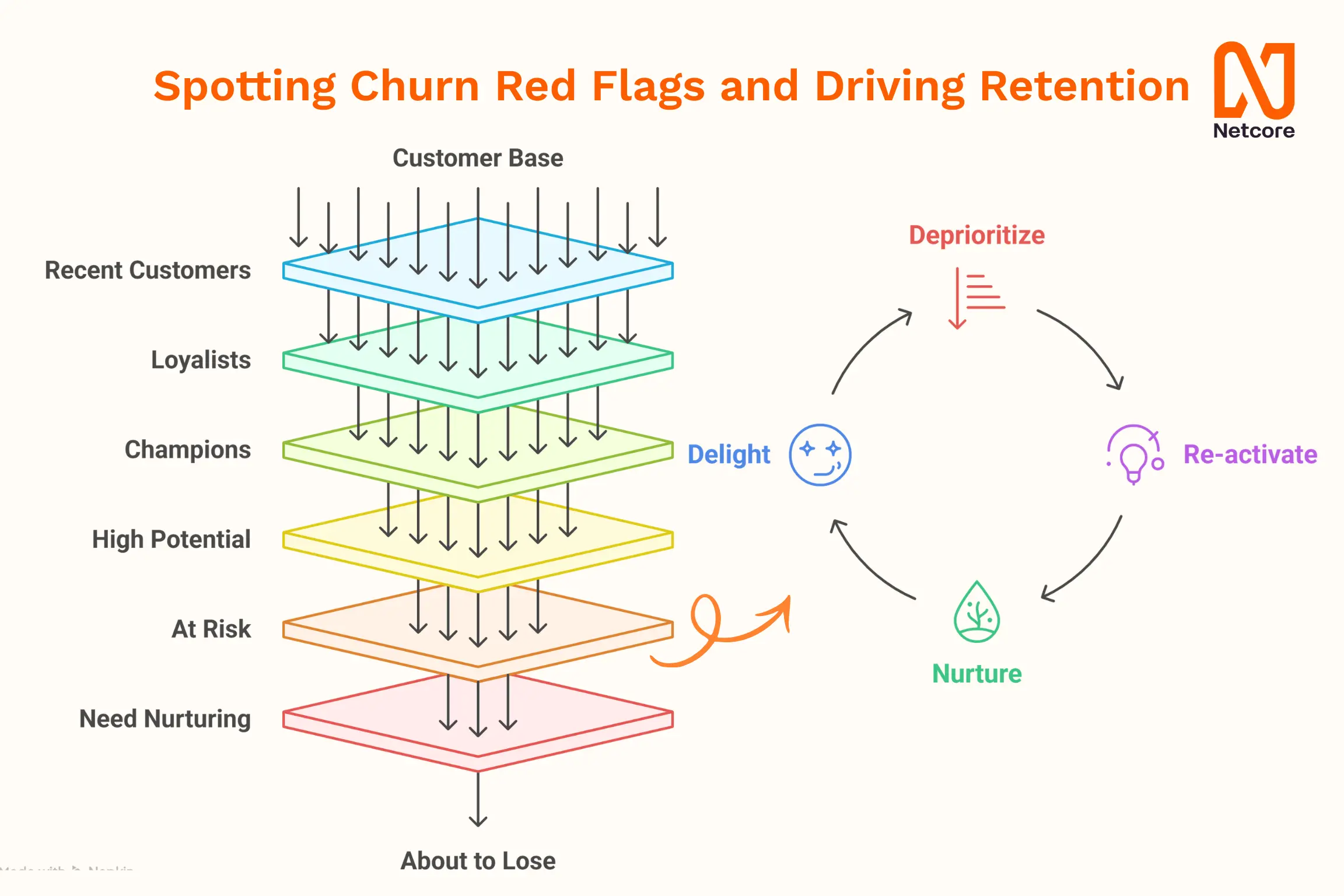
Predictive churn models identify:
- Which customers are likely to churn in the near future
- How severe the risk is
- How that risk changes over time
Instead of a binary “churned / not churned” view, marketers get a probability-based risk spectrum.
Why This Matters
Early churn detection allows you to:
- Intervene before customers go dormant
- Protect high-value customers proactively
- Reduce reliance on discounts and win-back campaigns
- Preserve lifetime value and brand trust
The most valuable churn is the churn that never happens.
How Leading Platforms Use It
Modern retention platforms:
- Continuously update churn scores using live behavioral data
- Trigger proactive journeys the moment risk increases
- Adjust interventions based on customer value and sensitivity
- Suppress unnecessary messaging for low-risk users
This turns churn prevention into an always-on system, not a reactive campaign.
2. Predictive Conversion & Propensity Modeling: Knowing Who Is Ready to Buy
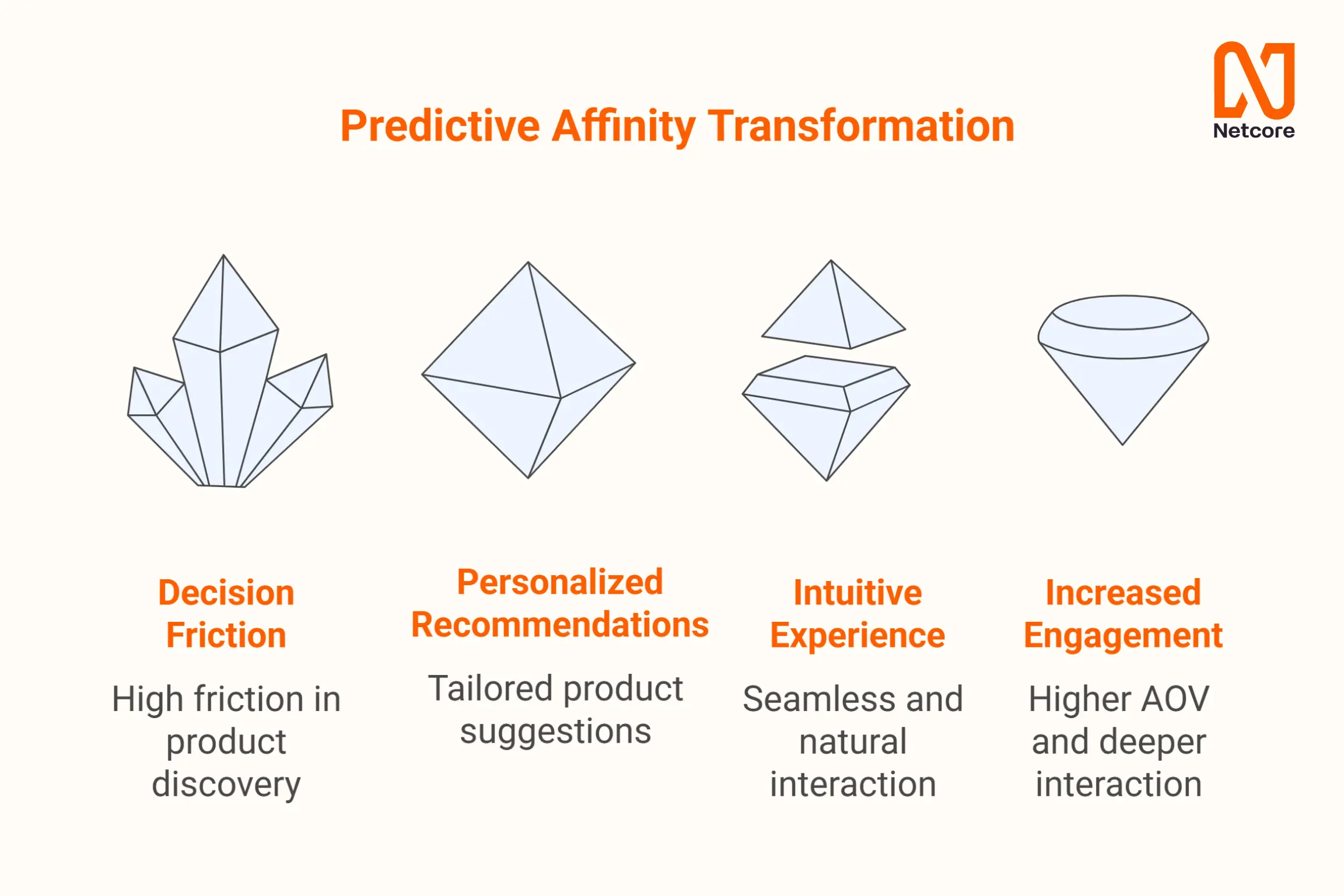
Not every customer is equally ready to convert. Treating them as if they are leads to wasted effort, message fatigue, and lower ROI.
What Conversion Propensity Models Predict
These models estimate:
- Likelihood of purchase or conversion
- Readiness to act, not just interest
- Relative priority across users
Instead of sending the same campaign to everyone, marketers can focus on customers who are closest to a decision using predictive segmentation.
Why This Matters
Predictive propensity modeling helps:
- Increase conversion rates without increasing volume
- Reduce over-messaging low-intent users
- Improve efficiency across paid and owned channels
- Align incentives with actual readiness
It’s not about pushing harder. It’s about pushing smarter.
How Leading Platforms Use It
High-performing platforms:
- Rank customers by conversion probability
- Adjust messaging intensity dynamically
- Reserve incentives for customers who actually need them
- Coordinate propensity scores with churn risk and affinity data
This ensures marketing pressure is applied where it will work, not where it’s convenient. Netcore leveraged its AI-powered predictive segmentation to identify the right set of audience for Big Basket who are likely to engage. Their new approach resulted in 57% increase in their click-through rates and whooping 117% increase in average open rates across all campaigns.
3. Predictive Product & Content Affinity: Knowing What Customers Will Want Next
Relevance is the single biggest driver of engagement and conversion. And relevance is inherently predictive.
Customers don’t want what they bought last; they want what makes sense next.
What Affinity Models Predict
These models forecast:
- Products a customer is most likely to purchase next
- Categories they’re gravitating toward
- Content formats they’re most likely to engage with
Affinity goes beyond “customers like this also bought” and looks at evolving intent.
Why This Matters
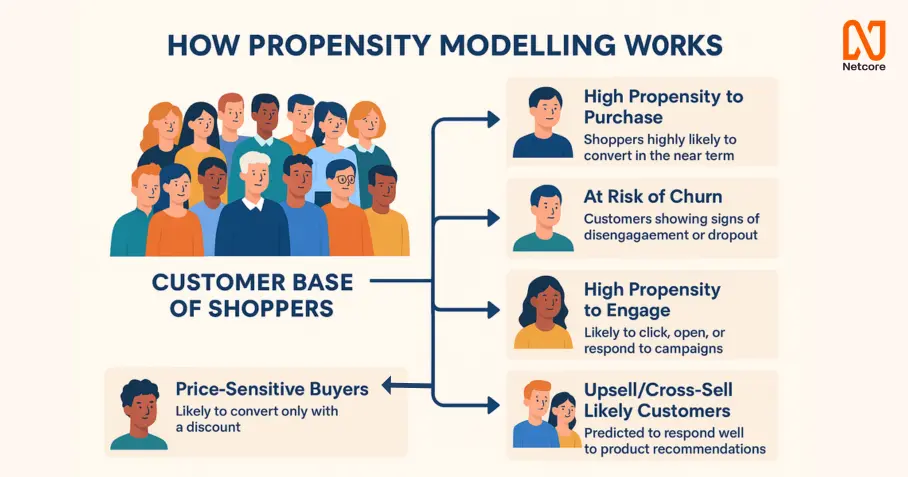
Predictive affinity:
- Reduces decision friction
- Improves product discovery
- Increases AOV and engagement depth
- Makes personalization feel intuitive, not creepy
When customers feel understood, they move faster.
How Leading Platforms Use It
AI-powered retention platforms:
- Power personalized recommendations across website, app, email, and WhatsApp
- Build dynamic bundles based on predicted needs
- Adjust content sequencing in journeys
- Surface guidance intent when customers appear overwhelmed
This shifts personalization from reactive recommendations to anticipatory experiences.

4. Predictive Channel & Timing Optimization: Knowing Where and When to Engage
The right message in the wrong channel, or at the wrong time, still fails.
Most teams decide channels and timing at the campaign level. Predictive platforms decide them at the customer level.
What This Capability Predicts
Predictive channel optimization estimates:
- Which channel a customer is most likely to respond to?
- When they’re most receptive?
- How frequently should they be contacted?
Why This Matters
This capability helps:
- Reduce channel fatigue
- Improve open, click, and response rates
- Prevent over-communication
- Increase effectiveness without increasing sends
More messages don’t drive growth. Better timing does.
How Leading Platforms Use It
Advanced platforms:
- Select channels dynamically per user
- Suppress messages during low-engagement windows
- Balance omnichannel orchestration automatically
- Learn from response patterns over time
This turns omnichannel marketing into intelligent orchestration, not synchronized noise.
5. Predictive Revenue & ROI Forecasting: Knowing What Will Work Before You Launch
The final, and most powerful, predictive capability answers a question every CMO cares about:
What impact will this campaign actually have?
What ROI Forecasting Predicts
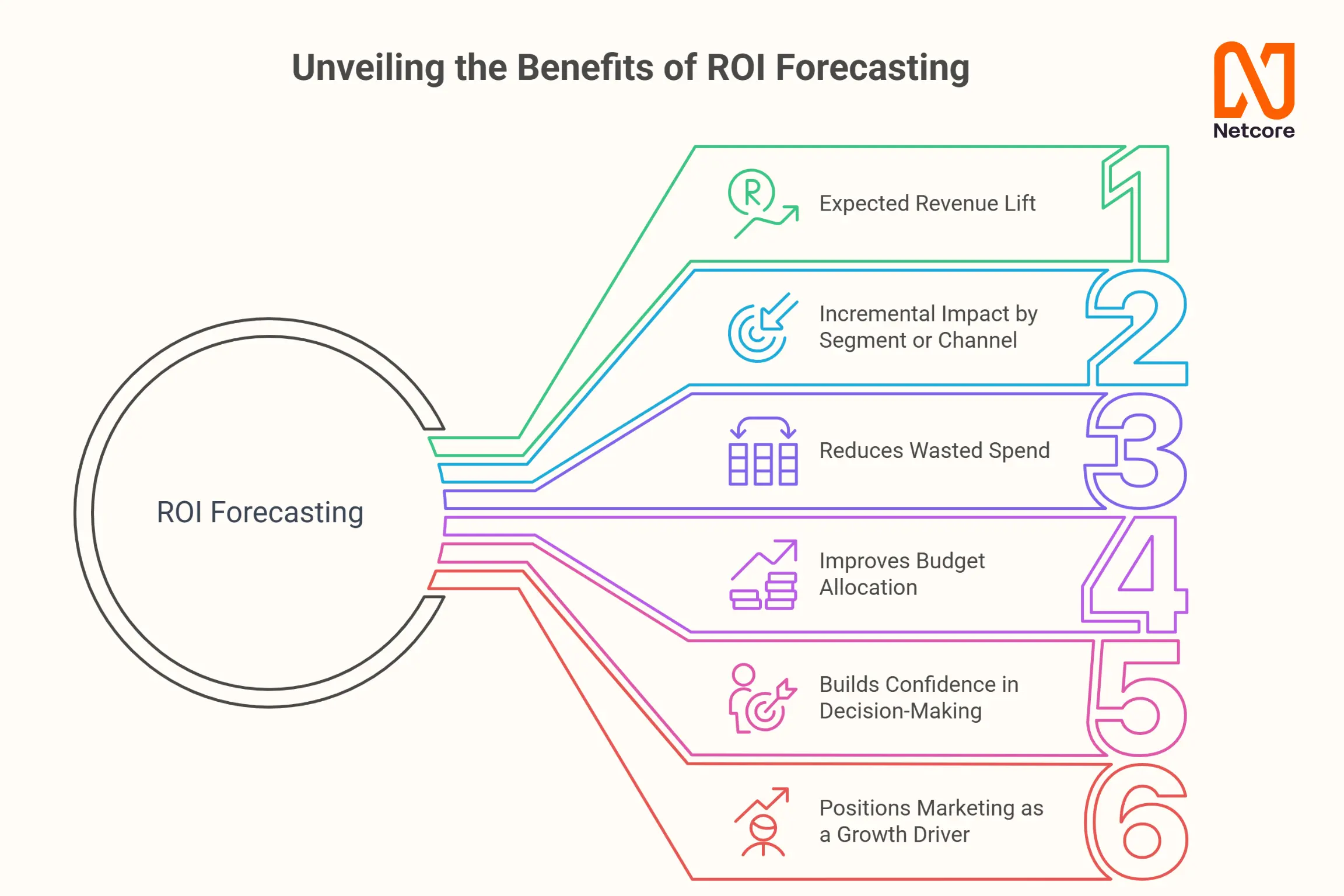
This capability estimates:
- Expected revenue lift
- Incremental impact by segment or channel
- ROI before launch, not after
Instead of guessing or hoping, marketers can simulate outcomes.
Why This Matters
Predictive ROI forecasting:
- Reduces wasted spend
- Improves budget allocation
- Builds confidence in decision-making
- Positions marketing as a growth driver, not a cost center
When you can forecast outcomes, marketing becomes disciplined—not reactive.
How Leading Platforms Use It
Best-in-class platforms:
- Compare campaign scenarios before execution
- Recommend budget reallocation
- Optimize journey paths based on projected impact
- Continuously refine models based on real outcomes
This closes the loop between strategy and execution.
How These Predictive Capabilities Work Together
The real power doesn’t come from any single model of predictive analysis for customer retention. It comes from combining them.
- Churn risk + propensity → smarter intervention timing
- Affinity + channel optimization → higher relevance
- ROI forecasting → better prioritization
Together, these capabilities create a predictive operating system for marketing, one that anticipates customer behavior across the complete customer lifecycle.
Common Mistakes Marketers Make With Predictive Platforms
Even strong customer retention platforms fail when used poorly.
Common pitfalls include:
- Treating predictions as static segments
- Ignoring automation and relying on manual execution
- Expecting certainty instead of probability
- Failing to build feedback loops into models
Prediction works best when teams trust it, activate it, and let it evolve.
Final Take
Predictive marketing is no longer a nice-to-have. It’s how modern brands unlock higher conversions, stronger retention, and measurable ROI—without increasing spend.
Customer retention platforms with true predictive capabilities help you:
- Lift conversions by focusing only on high-propensity customers.
- Increase LTV by intervening before churn begins.
- Improve ROI by allocating budget to channels and campaigns that are proven to work before launch.
And this isn’t about complexity. Leading predictive retention platforms are designed to be easy to deploy, integrate seamlessly with your existing stack, and come with guided support so teams see value fast.
Every month you delay, you’re leaving revenue on the table, sending messages to the wrong users, discounting unnecessarily, and reacting to churn after it’s already happened.