Worried About Your AI Marketing Strategy? Read the Agentic Marketing 2026 Predictions Report! →





TL;DR
- Platform integrations fail not because of features, but because of poor integration design.
- Modern stacks are inherently multi-platform, making clean data flow and orchestration essential.
- Different integration types—data, events, identity, channels, and workflows, solve different problems.
- Successful integration requires clear ownership of data, identity resolution, and real-time freshness.
- Phased, low-risk integration prevents disruption and preserves campaign continuity.
- Netcore is designed to integrate seamlessly with leading CRMs, CDPs, analytics, ecommerce, and cloud platforms.
- The right integration approach turns new platforms into leverage, not complexity.
Adding a new platform to your tech stack should create leverage.
Too often, it creates friction instead.
Data stops flowing cleanly. Campaigns take longer to launch. Teams debate where the “source of truth” lives. And instead of accelerating growth, the new platform quietly adds complexity.
The problem isn’t the platform.
It’s how integration is approached.
In a world where no brand runs on a single system, integration isn’t a technical afterthought—it’s the moment where value is either unlocked or lost. This guide walks through how to integrate any new platform into your existing stack without breaking data, disrupting teams, or slowing execution.
Why Integration Is the Real Make-or-Break Moment
Most platforms don’t fail because they lack features. They fail because they never fully integrate into how the business actually operates.
Modern stacks are inherently multi-platform:
- A CRM for customer records
- A CDP or warehouse for behavioral data
- An ecommerce platform
- Analytics tools
- Engagement and personalization platforms
Each system serves a purpose. But without deliberate integration, they become silos connected by brittle pipes.
The hidden cost of poor integration shows up as:
- Inconsistent customer views
- Delayed personalization
- Manual workarounds
- Teams are hesitating to act because they don’t trust the data
Integration isn’t about “connecting tools.”
It’s about designing how information moves, where decisions are made, and who owns outcomes.
The Reality of the Modern Martech Stack
Stacks grow because no single platform does everything well.
Best-of-breed tools outperform monoliths in specific areas—CRM, analytics, personalization, messaging, search, recommendations. Over time, organizations adopt multiple systems to stay competitive.
This makes integration inevitable.
The real challenge is not the number of tools, but:
- How customer data is shared
- How events flow in real time
- How identities are resolved
- How actions are triggered across platforms
Without clarity here, adding a new platform increases noise instead of signal.
Types of Platform Integrations
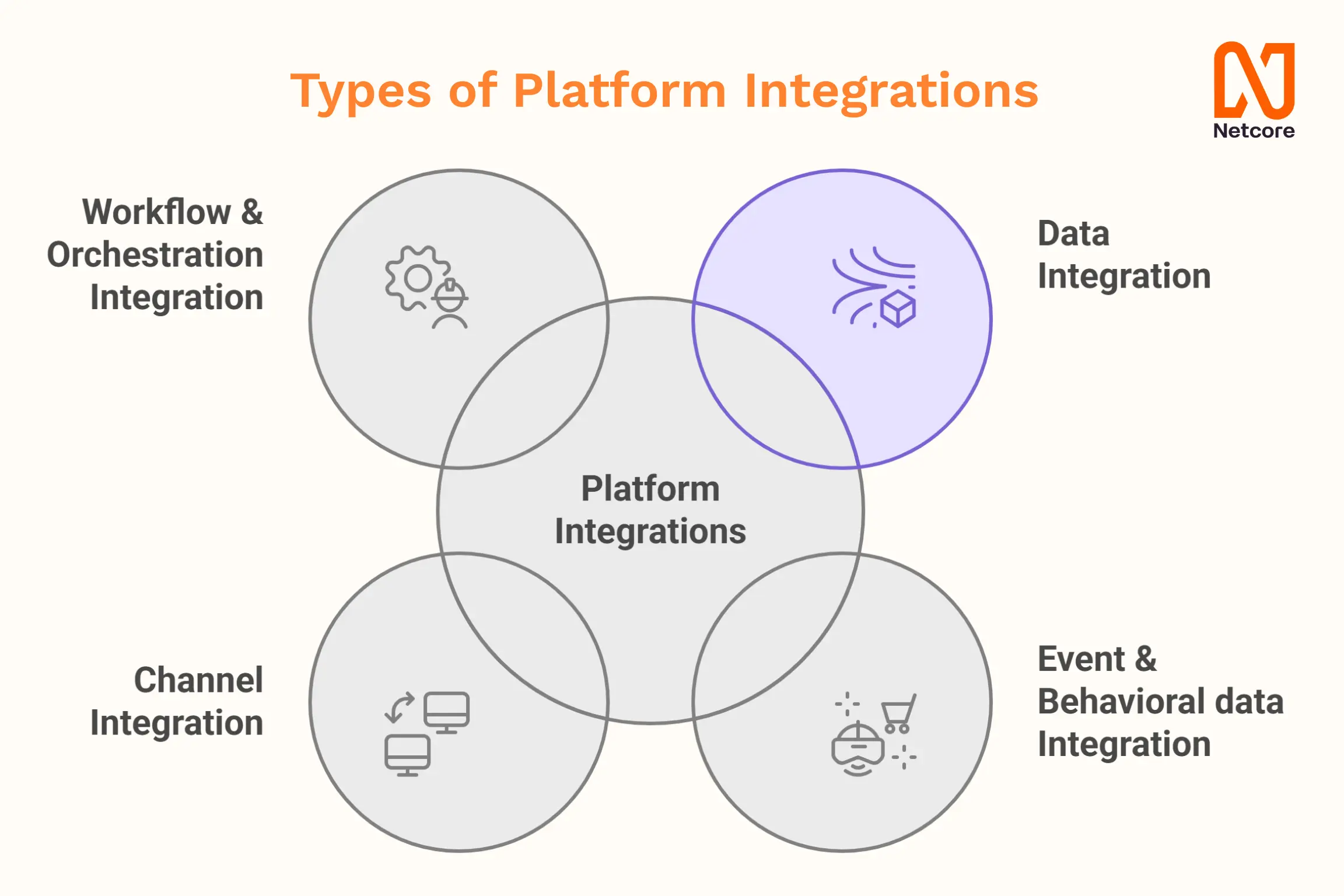
Not all integrations serve the same purpose. Understanding the types helps teams design the right approach without over-engineering.
1. Data Integration
This is the foundation.
Data integration involves syncing customer profiles, attributes, and transactional data between systems. It can be one-way or bi-directional, depending on which platform owns which fields.
This works well when:
- The new platform is a system of engagement
- Core customer records already exist elsewhere
Poor data integration leads to stale profiles and unreliable segmentation.
2. Event & Behavioral Integration
Behavioral data powers real-time experiences.
This includes events like:
- Page views
- Product interactions
- Add-to-cart
- Purchases
- App actions
Event integration ensures the new platform reacts to customer behavior as it happens—not hours later. Latency here directly affects personalization and journey relevance.
3. Channel Integration
Channels are where value is realized.
This includes email, SMS, WhatsApp, push notifications, in-app messages, and web messages. Integration determines whether channels are:
- Natively owned
- Or dependent on third-party vendors
Fragmented channel integration slows execution and increases failure points.
4. Identity Resolution Integration
Customers don’t exist as a single identifier.
Emails, phone numbers, devices, cookies, and app IDs all represent the same person. Identity integration defines how these signals are stitched together.
Weak identity resolution results in:
- Duplicate profiles
- Inconsistent messaging
- Broken journeys
This is often the hardest and most overlooked layer.
5. Workflow & Orchestration Integration
This governs how actions are triggered across systems.
Examples include:
- Triggering campaigns based on CRM updates
- Syncing lifecycle stage changes
- Coordinating journeys across platforms
Without orchestration clarity, teams don’t know where logic should live.
Key Considerations Before Integrating Any New Platform
Most integration failures are decided before implementation begins. Here are some actionables that you need to consider before implementing platform integration:
- Define the Role of the New Platform
Is it a system of record, system of engagement, or system of intelligence?
Unclear roles create overlap and confusion.
- Decide the Direction of Truth
Every data point needs an owner.
Which platform is authoritative for:
- Customer profiles?
- Consent and preferences?
- Behavioral history?
Conflicts without rules erode trust.
- Data Granularity and Freshness
Not all data needs to be real-time, but some does.
Define:
- What must be streamed live
- What can be batched
- Acceptable latency per use case
This prevents unnecessary complexity.
- Security, Compliance, and Consent
PII, consent, and regulatory controls must remain intact across systems. Integration should strengthen, not weaken, compliance posture.
- Operational Ownership
Who monitors integration health post go-live? Who fixes failures at 2 a.m.? Ownership gaps cause prolonged outages.
A Phased Approach to Platform Integration
Integration should be iterative, not all-at-once.
A proven approach:
- Map core data, events, and dependencies
- Start with high-impact use cases
- Validate identity resolution early
- Run parallel testing
- Monitor behavior post-launch
Phased integration protects continuity and confidence.
Common Integration Challenges
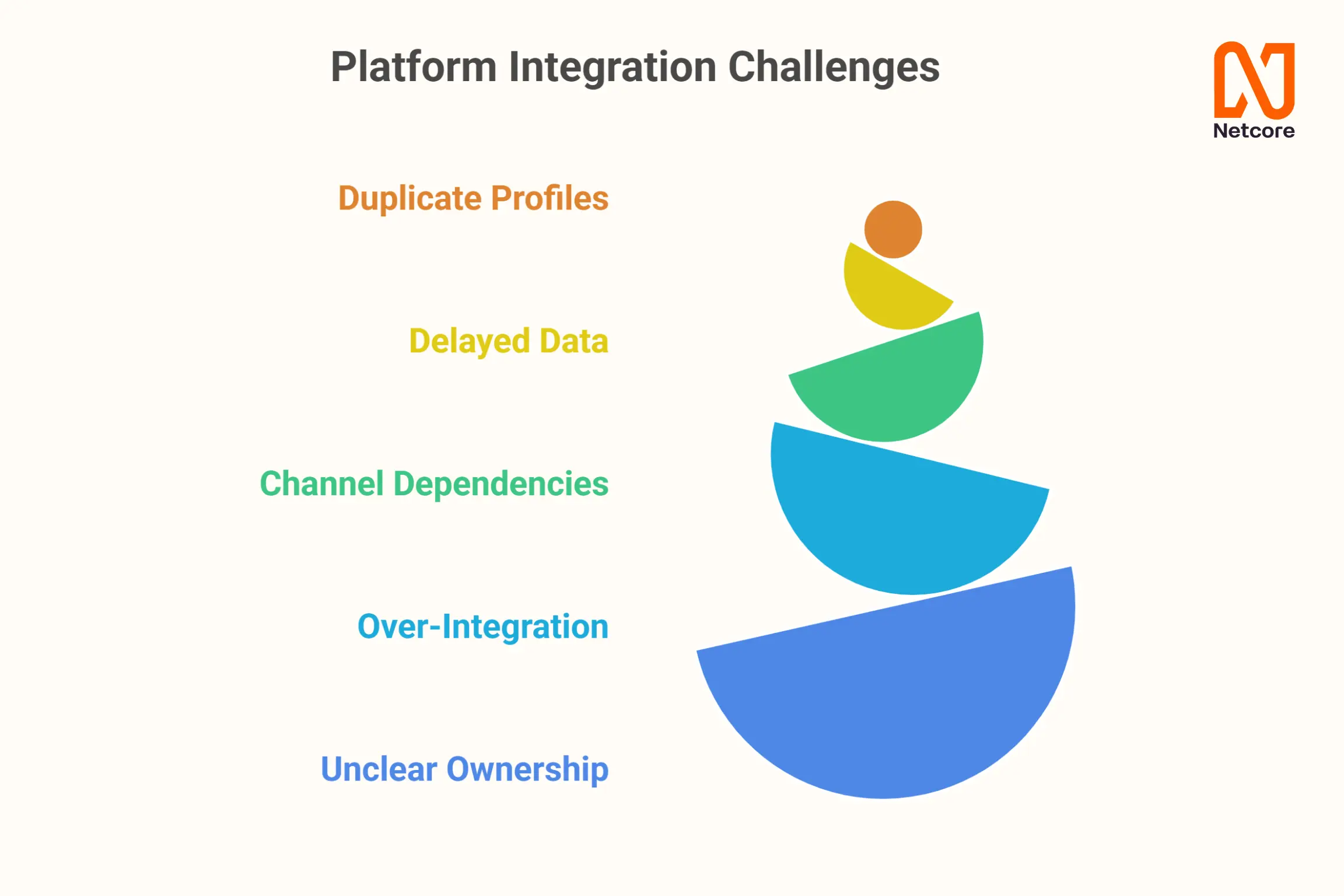
Most integration challenges are predictable.
- Duplicate profiles from poor identity stitching
- Delayed data breaks real-time journeys
- Channel dependencies are slowing launches
- Over-integration creates unnecessary complexity
- Unclear ownership when things break
These issues are rarely platform flaws; they’re integration design flaws.
Data Platforms Supported When Integrating or Migrating to Netcore
Netcore is designed to integrate into existing stacks, not replace them overnight.
Common integrations include:
- CRMs: Salesforce and custom CRM systems
- CDPs & Data Warehouses: Segment, mParticle, BigQuery, Snowflake
- Ecommerce Platforms: Shopify, Magento, and custom setups
- Analytics Tools: Behavioral and attribution systems
- Transaction & Payment Systems
This flexibility allows brands to migrate or integrate incrementally while staying live.
How Netcore Simplifies Platform Integration
Netcore is built to integrate into existing ecosystems, not disrupt them.
Instead of forcing businesses to re-architect their stack, Netcore is designed to connect seamlessly with the platforms teams already rely on, ensuring data flows cleanly, workflows remain intact, and value is unlocked faster.
Integration at Netcore isn’t an add-on. It’s a core design principle.
A Broad, Battle-Tested Integration Ecosystem
Netcore integrates with a wide range of industry-leading platforms across analytics, data, commerce, messaging, and automation. This allows teams to activate customer engagement and personalization without introducing operational friction.
Analytics & Product Insights
Netcore connects with modern analytics platforms to ensure behavioral insights remain continuous and actionable:
- Mixpanel
- Amplitude
These integrations allow engagement strategies to be informed by real usage patterns, not isolated campaign metrics.
Customer Data Platforms (CDPs)
To support flexible data architectures, Netcore integrates with leading CDPs, enabling unified customer profiles and real-time segmentation:
- Twilio Segment
- Tealium
- Ascent 360
- HCL Unica
- Lytics
This ensures customer data remains portable, consistent, and activation-ready.
Attribution & Measurement Partners
Netcore integrates with attribution platforms to maintain accurate performance measurement across channels:
- Adjust
- AppsFlyer
- Branch
This preserves attribution continuity during migration and ongoing operations.
Messaging & SMS Partners
For brands with existing messaging providers, Netcore supports integrations with:
- Kaleyra
- Infobip
This enables continuity while allowing teams to transition at their own pace.
Data Warehouses & Cloud Infrastructure
Netcore supports direct integration with modern cloud and data warehouse environments:
- Google BigQuery
- AWS
- Google Cloud
This allows brands to retain full ownership of their data and analytics pipelines.
Ecommerce Platforms
Netcore integrates seamlessly with leading ecommerce platforms to enable real-time behavioral and transactional engagement:
- Magento (Plugin)
- Shopify (Plugin)
- BigCommerce
These integrations reduce implementation effort while accelerating time-to-value.
Workflow & Automation Tools
To support operational efficiency and custom workflows, Netcore integrates with:
- Zapier
This allows teams to automate actions across systems without custom development.
CRM Systems
Netcore integrates with popular CRM platforms to ensure alignment across sales, marketing, and support:
- Salesforce
- LeadSquared
- Zendesk
This ensures lifecycle stages, customer context, and engagement signals remain synchronized.
Cloud Storage & Data Management
For secure data handling and backups, Netcore supports integration with:
- Amazon S3
Email Validation & Deliverability
To protect sender reputation and data hygiene, Netcore integrates with:
- AtData
- Valimail
These integrations ensure engagement performance isn’t compromised by poor data quality.
Integration That Reduces Complexity, Not Adds to It
What differentiates Netcore isn’t the number of integrations, it’s the intent behind them.
By supporting leading platforms across every layer of the stack, Netcore allows brands to:
- Integrate incrementally, not disruptively
- Preserve existing investments
- Reduce dependency on brittle custom builds
- Activate use cases faster with fewer handoffs
Integration should feel invisible when done right.
Netcore is designed to make that possible.
Measuring Integration Success
Integration success isn’t “data is flowing.”
It’s measured by:
- Data accuracy and completeness
- Event freshness and reliability
- Speed to launch first campaign or journey
- Reduction in manual work
- Team confidence in acting on insights
If teams hesitate to act, integration is incomplete.
Final Take
Integrating a new platform isn’t about adding another tool to your stack, it’s about protecting the ROI of every tool you already have.
When done thoughtfully, integration becomes a growth enabler: data stays reliable, teams move faster, and customer experiences remain uninterrupted. When rushed or poorly designed, it quietly erodes efficiency, confidence, and returns.
The strategies outlined in this blog are meant to help you integrate with intent—aligning data, workflows, and ownership so your stack works as a system, not a collection of parts. Done right, integration becomes a stepping stone to long-term business success, not a risk to ROI.
Book a consultation with Netcore for a smooth platform integration