





TL;DR
Basic website optimizations like site speed and mobile responsiveness are table stakes for modern ecommerce, but true revenue growth requires personalization at scale. By unifying fragmented customer data and leveraging autonomous AI, brands can improve ecommerce customer experience, 1:1 omnichannel journeys. This comprehensive approach reduces friction, increases conversion rates, and drives measurable return on investment.
Eighty percent of consumers demand personalized shopping, but fragmented customer data means seventy percent never receive it. Bridging this gap is the first step for those looking for improving ecommerce customer experience and separating generic online storefronts from high-converting engines.
Why does ecommerce customer experience drive measurable ROI?
Investing in customer experience is no longer a soft marketing metric; it is a foundational pillar of financial accountability. CFOs and executive boards demand proof that marketing activities generate revenue, not just traffic. When the buying journey is disjointed, potential revenue leaks at every touchpoint—from slow page loads to irrelevant product recommendations.
This is where personalization becomes a critical growth lever. A well-executed personalization strategy helps brands deliver relevant experiences in real time, improving engagement, conversion rates, and customer retention. Learn more about how leading brands are scaling personalization in this detailed guide on ecommerce personalization.
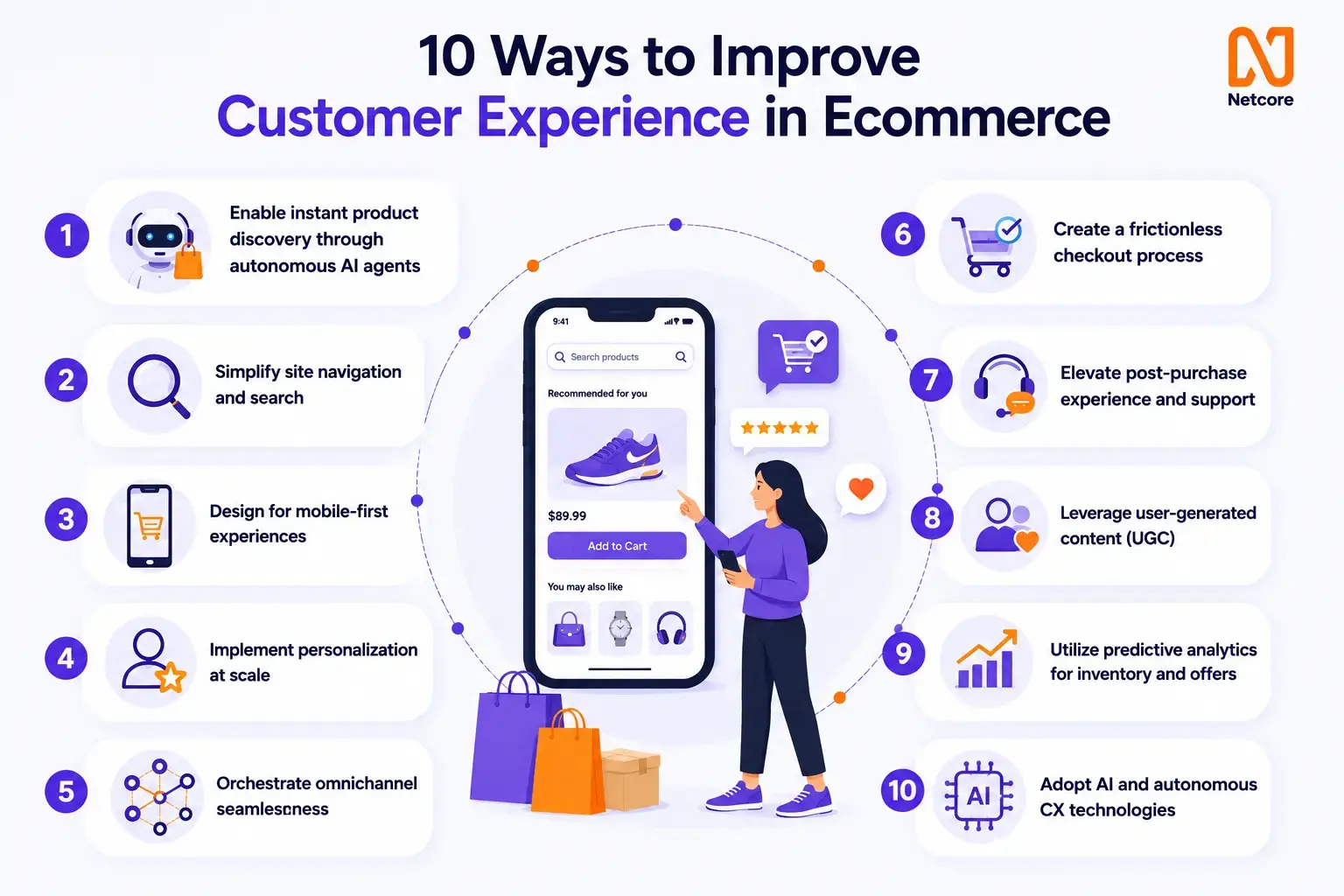
10 ways to Improve Customer experience in Ecommerce
In the hyper-competitive world of ecommerce, the difference between a soaring conversion rate and a high bounce rate often comes down to the “Experience Gap.” Customers today don’t just compare you to your direct competitors; they compare you to the best ecommerce shopping experience they’ve ever had. To stay ahead, brands must move beyond static storefronts and adopt a proactive, data-driven approach that anticipates needs rather than just responding to them. By integrating advanced technology with a human-centric design philosophy, you can transform a simple transaction into a seamless, high-value journey.
Here are 10 ways to improve ecommerce customer experience and drive sustainable growth:
1. Enable instant product discovery through autonomous AI agents
Speed in modern ecommerce is no longer just about how fast a page loads, but how quickly a shopper can find exactly what they want. The modern standard is “Instant Discovery” the ability for a user to complete their first meaningful action or transaction in under one minute. When product discovery is sluggish or irrelevant, users drop off before they even reach the checkout, leading to missed revenue opportunities.
To bridge this gap, brands are moving beyond static websites toward a Multi-Agent AI Framework. This involves deploying specialized autonomous agents such as Shopping Agents for search and product recommendations, and Segment Agents to identify affinity and propensity in real-time. By utilizing these AI-driven systems, brands can accelerate the journey from landing page to transaction, ensuring the experience is not just fast, but frictionless and hyper-relevant to a “Segment-of-ONE.” This shift is one of the most effective strategies for ecommerce success as it directly uplifts Average Order Value (AOV).
2. Simplify site navigation and search
If customers cannot find a product, they cannot buy it. Complex categorizations and hidden menus introduce cognitive load, causing frustrated shoppers to abandon the site in favor of competitors. Clear architecture prevents lost sales and is a fundamental part of the best ecommerce customer experience leaders provide.
Site architecture should follow intuitive, logical hierarchies. Implement persistent, sticky search bars equipped with autocomplete and typo-tolerance. Enterprise ecommerce platforms must deploy faceted search, allowing users to filter by size, color, price, and availability dynamically to reach their desired product with zero friction.
3. Design for mobile-first experiences that actually convert
Mobile traffic consistently outpaces desktop traffic in retail, yet mobile conversion rates often lag behind. This gap exists because many sites are merely “mobile-responsive” rather than designed “mobile-first.”If you are wondering how to improve customer experience in ecommerce for the modern shopper, look at your thumb-friendly tap targets and swipable images. A clunky mobile interface leads to misclicks, abandoned carts, and a damaged brand perception.
Shift the design paradigm to prioritize the smallest screens first. Ensure that all tap targets are thumb-friendly and spaced adequately to prevent accidental clicks. Streamline the mobile navigation to a clean “hamburger” menu and ensure that product images are easily swipeable. Minimizing pop-ups that obscure the screen on mobile devices is also essential to maintaining an uninterrupted browsing experience.
4. The secret to implementing personalization at scale
Generic storefronts are a remnant of the past. Today’s consumer expects an experience tailored to their preferences, browsing history, and real-time intent. However, most brands struggle because their data is siloed across different platforms, making true 1:1 personalization impossible. Closing this gap is the single most significant driver of conversion and customer loyalty.
The foundation of scaling personalization is a unified customer data layer, typically achieved through a robust Customer Data Platform (CDP). By centralizing data, brands can transition from broad segmentation to individualized journeys, creating the best ecommerce customer experience possible for every visitor.
5. Orchestrate omnichannel seamlessness
Customers do not think in terms of “channels”; they think in terms of their relationship with the brand. An omnichannel approach ensures that whether a customer is browsing on a website, interacting via WhatsApp, or reading an email, the experience is continuous. To improve ecommerce customer experience, unify marketing execution so that actions in one channel (like an abandoned cart) immediately inform the others (like a targeted SMS). Operating in silos creates disjointed communication, leading to customer frustration and lost revenue.
Unify marketing execution so that actions in one channel immediately inform the others. If a user abandons a cart on the mobile app, the subsequent follow-up should be a targeted SMS or WhatsApp message dynamically referencing the exact cart items. Orchestrating these channels requires centralized journey mapping tools that prevent message fatigue while maximizing relevance.
6. Steps to create a truly frictionless checkout process
Cart abandonment is the silent killer of ecommerce ROI. Forcing users through multi-page forms, demanding account creation, or surprising them with hidden shipping fees creates immense friction. The checkout must be the easiest part of the entire shopping experience.
To achieve this, enable Guest Checkout to capture payments without forced registration. Integrate digital wallets like Apple Pay and Google Pay to bypass manual credit card entry. Finally, provide transparent pricing by displaying shipping costs and taxes early in the journey to eliminate last-minute sticker shock.
7. Elevate post-purchase experience and support
The customer journey does not end when the credit card is charged; in many ways, the retention journey is just beginning. A poor post-purchase experience marked by opaque shipping timelines or difficult returns guarantees a customer will never return, plummeting long-term ROI.
Implement proactive, automated communication by sending real-time tracking updates via SMS or WhatsApp. Furthermore, turn the return process into a competitive advantage by offering portal-based, self-service returns. Excellent post-purchase support transforms one-time buyers into vocal brand advocates.
8. Leverage user-generated content (UGC) in the buyer journey
Consumers trust other consumers far more than they trust branded marketing copy. User-generated content provides authentic social proof, reducing the perceived risk of an online purchase. This is particularly critical in industries like fashion and beauty, where sizing and quality are primary concerns.
Integrate visual UGC directly onto product pages. Encourage buyers to upload photos of their purchases by incentivizing them with loyalty points. Displaying honest reviews complete with filtering options builds immediate trust and helps shoppers make confident decisions, which is vital when performing an ecommerce customer experience analysis of why return rates may be high.
9. Utilize predictive analytics to optimize inventory and offers
Reactive marketing relies on past behavior, but high-converting platforms anticipate future needs. By monitoring ecommerce customer experience metrics such as churn rate and purchase frequency, brands can use machine learning to forecast demand. Predictive analytics allow brands to move from guessing what customers want to knowing what they need before they actively search for it, minimizing stockouts and maximizing relevance.
Deploy machine learning models that analyze historical purchase data and seasonality to forecast demand. Use these insights to dynamically adjust the products featured on the homepage. For instance, if data indicates a high propensity for a user to replenish a consumable, the platform should automatically trigger a timely replenishment offer.
10. Future trends in AI and autonomous CX
The shift from rules-based automation to AI-native, agentic systems is reshaping ecommerce. Staying informed on ecommerce customer experience trends means looking toward generative AI for dynamic product descriptions and autonomous agents that optimize email send times without manual A/B testing.
Human marketers cannot manually orchestrate millions of 1:1 journeys in real-time. Autonomous AI systems make continuous, micro-optimizations that scale customer experience efforts far beyond human capacity.
Adopt generative AI to create dynamic product descriptions tailored to specific user segments. Explore autonomous agentic systems that can optimize email send times and channel preferences without manual A/B testing. By allowing intelligent systems to handle the execution layer, marketing teams can focus on higher-level strategy.
Final Take
While basic website optimization is now table stakes, the true driver of modern ecommerce customer experience is personalization at scale. By treating customer experience not as a series of isolated touchpoints but as a continuous, omnichannel journey powered by intelligent data, brands can significantly reduce friction, increase conversions, and build long-term loyalty.
The brands winning today are those that unify customer data, automate engagement intelligently, and deliver highly relevant experiences across every interaction. Platforms powered by AI and real-time orchestration are enabling ecommerce businesses to move beyond reactive marketing toward autonomous, revenue-driven customer journeys. Explore how Netcore’s Agentic Marketing Platform for Ecommerce helps brands unify data, personalize at scale, and drive measurable business growth.

