





Ever wondered why some retail drops feel like they’re reading your mind, while other brands are just aggressively filling your inbox with promotions you have zero interest in?
Here is the dirty little secret of the footwear and streetwear industry: consumer culture moves at the speed of light. But behind the scenes, a shocking number of marketing teams are still manually pulling lists, guessing at segments, and hoping for the best.
If you are relying on static workflows in today’s super-competitive market, you are bleeding revenue without even realizing it. In fact, Gartner reports that 65% of marketing leaders who use Generative AI strictly as a basic content-generation tool report absolutely zero significant gains in business outcomes.
The real paradigm shift lies in autonomy. IDC predicts that by 2027, agentic automation will enhance capabilities in over 40% of enterprise applications.
If you caught our recent breakdown of a certain global sports giant’s strategy, grab your popcorn. This one is just as juicy, but we are taking it to the underground streetwear scene. Let’s dive right in.
The Invisible Ceiling of No Precision
Let’s look closely at the premier sneaker and streetwear boutique. Established in 2016, this brand operates at the absolute bleeding edge of youth movements rooted in music, art, and fashion. They are the definition of hype.
For a while, their baseline digital marketing was doing its job, successfully driving standard customer engagement. But the leadership team realized they were hitting an invisible wall.
The problem? Manual static segmentation of customers with not a lot of focus on intent.
When you have thousands of users eyeing completely different products, from chunky dad shoes to sleek retro runners, treating them all the same is a fatal flaw.
The brand recognized that there was massive untapped potential hiding in their data, they needed a system that didn’t just follow static rules but actively reasoned and adapted to consumer behavior in real-time.
How They Flipped the Switch: Enter the AI Agent
To shatter that invisible ceiling, the brand completely ditched manual audience building and handed the keys over to Netcore’s Segment Agent.
Instead of a human marketer guessing who might want a new pair of high-tops, the autonomous agent went to work. Customers were instantly and dynamically categorized based on their exact preferences, live browsing behavior, and deep purchase history.
NOTE: > Wondering why hyper-segmentation matters? It isn’t just a buzzword. By letting the AI target campaigns for highly specific categories (like limited-edition drops, running shoes, and retro styles), brands can bypass the “spoilt-for-choice” syndrome and land right in the “must-have” mental bucket of the consumer.
The Agentic Playbook in Action: A Strategic Deep-Dive
An AI agent is only as good as the plays it executes. Here is the exact, three-part framework the brand used to turn its marketing stack into an autonomous revenue engine:
Part 1: Dynamic Clustering via the Segment Agent
Instead of a human marketer guessing who might want the next retro release, the platform’s Segment Agent took the wheel.
- Smart Categorization: The AI dynamically categorized customers based on their exact preferences, live browsing behavior, and comprehensive purchase history.
- Micro-Targeting: This allowed the brand to launch focused campaigns for specific micro-themes like limited edition drops, high-top sneakers, running shoes, streetwear collaborations, and retro styles.
- Ending the Spam: If a user historically only hunted for chunky, muted New Balances, the agent ensured they weren’t spammed with neon high-tops.
Part 2: The “Always-On” Behavior-Triggered Automations
The brand deployed automated, time-triggered journeys across both Email and WhatsApp.
- Lifecycle Tailoring: Campaigns were autonomously tailored to the user’s exact stage in the lifecycle, seamlessly moving between a dedicated welcome series, re-engagement campaigns, and specific purchase category flows.
- Browse Abandonment: The agent deployed highly specific product view abandonment emails for shoppers who browsed a drop but hesitated.
- Cart Abandonment: When users left high-heat items in their basket, the system automatically hit them with a cart abandonment journey, nudging them to “Make that Move” before the item sold out.
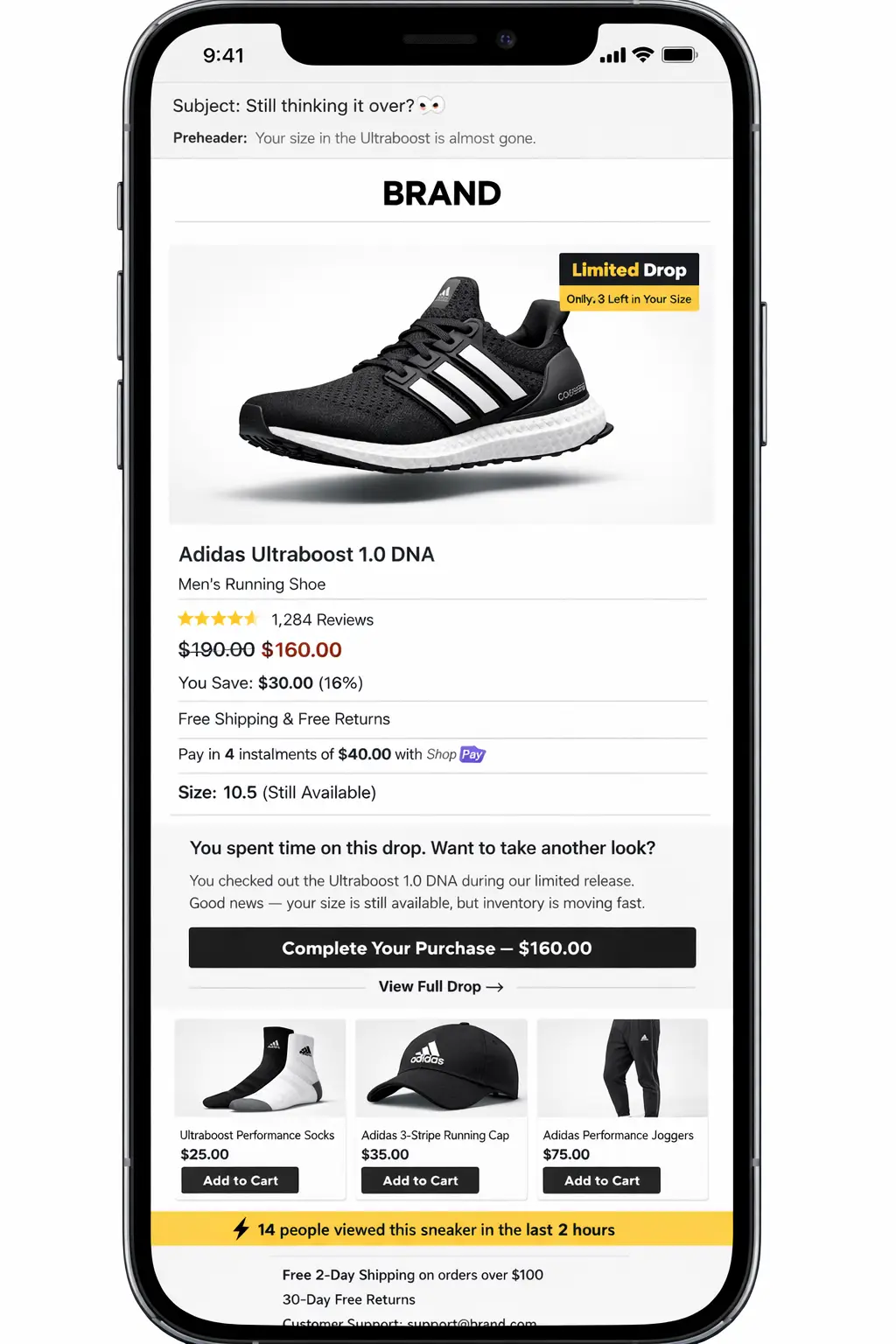
A typical “Make the move” Cart Abandonment Shoppable Email a la Netcore Cloud
Part 3: RFM Modeling (Separating the Hypebeasts from the Window Shoppers)
You can’t treat a one-time buyer the same way you treat a VIP camper. To solve this, the brand implemented advanced Recency, Frequency, and Monetary (RFM) modeling.
- Engagement Tracking: The agent actively segmented customers based on their real-time email engagement, tracking specific actions like opens and clicks.
- Dynamic Bucketing: This behavioral data autonomously bucketed users into high-value groups like “Star” and “Loyal” customers.
- The VIP Treatment: By identifying exactly who the heavy hitters were, the marketing team could lock in highly targeted, VIP-level communication that dramatically enhanced customer retention and overall sales.
The Drop: Outpacing Benchmarks
When you stop treating your customers like a monolith and start using Agentic AI to have one-on-one conversations at scale, the math changes completely.
By stepping out of the way and letting the Segment Agent orchestrate the campaigns, the streetwear brand saw explosive growth:
- 6X Revenue Pop: They achieved a 6X uplift in revenue strictly through intelligent retention marketing.
- Crushing Benchmarks: They hit a 3% CTR on emails, completely outperforming the standard benchmarks set by premium retail brands.
- Unprecedented Open Rates: Utilizing the agent resulted in a massive 75% higher open rate.
- Conversational Commerce Dominance: A staggering 67% of all revenue generated from their WhatsApp campaigns was contributed directly by the segment agent’s intelligence.
The Bottom Line
Manual marketing in a hype-driven retail environment is like wearing loafers to a marathon; you might finish, but it’s going to hurt.
By acknowledging the limits of manual workflows and embracing the autonomy of agentic AI, this retailer didn’t just keep up with sneaker culture, they engineered it, ultimately yielding a massive 16X ROI.
Want to learn more about AI agents in action?
Talk to us today!