 Worried About Your AI Marketing Strategy? Read the Agentic Marketing 2026 Predictions Report! →





In this blog, we’ll break down why paid media is quietly becoming a profit killer and how reacquisition is disguising itself as growth. You’ll also see how leading brands are shifting focus to owned channels and agentic marketing to regain control, reduce waste, and build sustainable customer lifetime value.
Paid media has never looked smarter on paper.
Every quarter, teams roll out sharper creatives, tighter targeting, and more sophisticated bidding strategies. Dashboards are busy. Traffic is flowing. ROAS is… fine. Not amazing, but defensible.
Then you walk into a board meeting.
Suddenly, the questions change. Why are margins shrinking? Why does growth feel fragile? Why does revenue dip the moment spend pauses? And why does it feel like we are running faster just to stay in the same place?
This is the paradox modern CMOs are stuck in. The better paid media “works,” the more expensive it becomes to keep the machine running. Not because teams are doing a bad job, but because the system itself is built this way.
Most brands believe they are investing in acquisition. In reality, a huge share of that spend goes toward reacquisition. Customers who already bought once drift away, then re-enter the funnel through paid ads weeks or months later. You pay again for the same relationship.
Industry estimates suggest close to 70% of digital marketing budgets are spent retargeting existing customers. Add rising CPMs, platform fees, fraud losses, marketplace commissions, and discount-driven retention tactics, and many brands quietly surrender 20 to 30% of revenue to what is effectively a hidden tax.
No dashboard calls it that. But finance teams feel it. And growth teams are running out of room to absorb it.
The Hidden Revenue Tax
Paid media extracts value in ways most reports never surface.
Consider the compounding costs:
- Roughly 22% of digital ad spend is lost to fraud
- Click fraud alone is projected to cost advertisers $172 billion by 2028
- CPMs rise even when performance does not
Add marketplace commissions, loyalty discounts, and price promotions, and brands routinely surrender 20 to 30% of revenue to what can only be described as revenue tax.
This tax is paid to:
- Adtech platforms
- Marketplaces
- Discounting to win back churned customers
- Retention programs that exist only to offset churn
And most brands treat it as inevitable.
Challenges with Growth, Driven by Paid Media
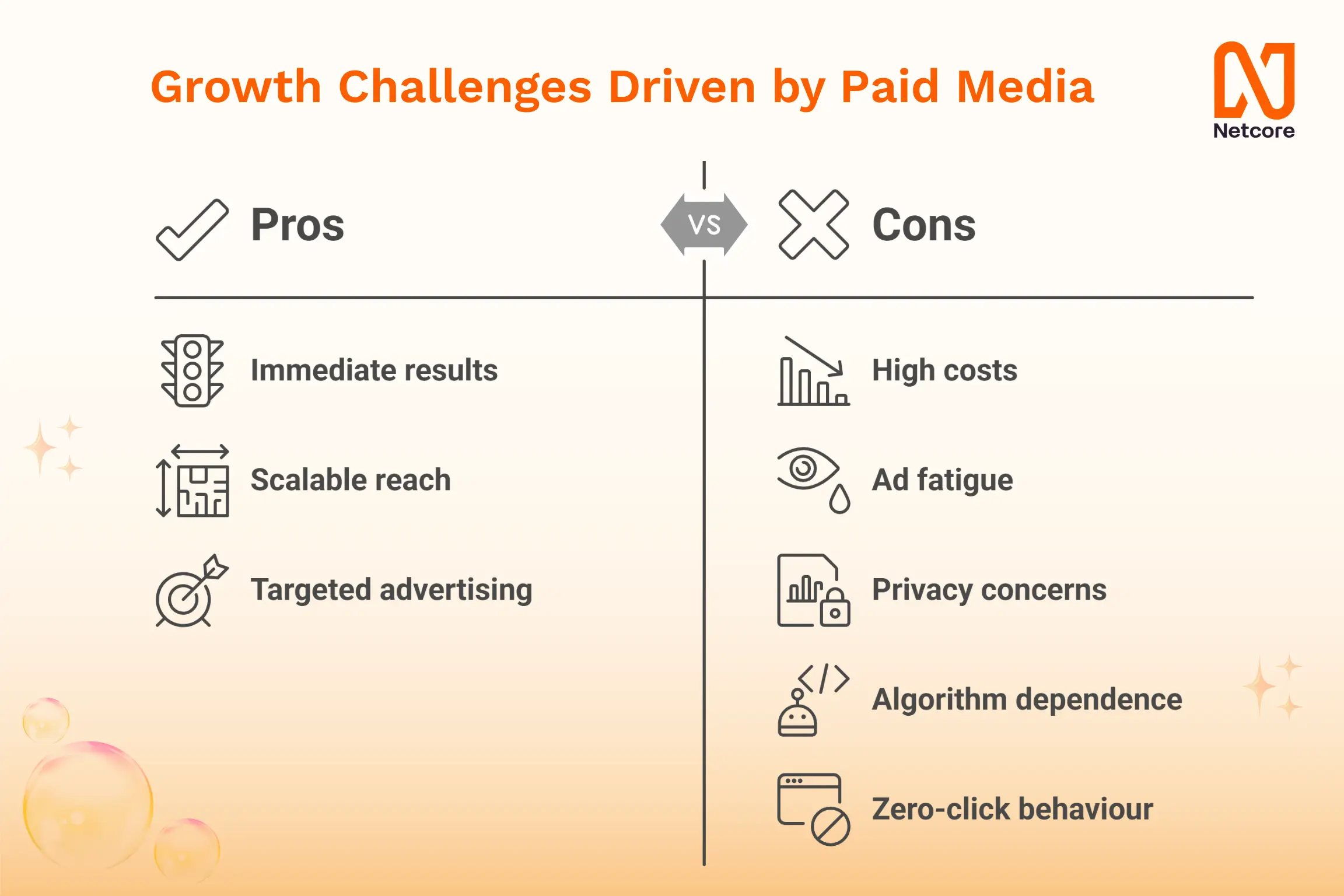
We all know that paid media has been one of the highly dependent channels of marketers to drive growth. But it is facing structural limits that no optimisation hack can fix. Some challenges are as follows:
1. Soaring costs in an overcrowded auction
Every meaningful audience is already being chased. Your brand is no longer competing only with direct rivals but with fintechs, D2C startups, marketplaces, and global brands all bidding for the same moments of attention. Incremental reach now comes at a disproportionate cost, and each new dollar delivers less than the last. The auction runs continuously, and history shows it only moves in one direction.
2. Ad fatigue and shrinking attention windows
Consumers scroll through hundreds of branded messages daily. Over time, even well-performing ads lose their impact. What converted last month blends into the background today. This is not a failure of creativity; it is the natural decay of attention in an oversaturated environment.
3. Privacy shifts removing precision
The cookieless future is not coming; it is already here. Third-party data is fading, targeting signals are weaker, and platforms increasingly operate as opaque systems. Brands provide budget, but visibility and control over outcomes continue to erode.
4. Algorithm dependence with no leverage
Paid platforms optimise for platform goals, not business outcomes. A single algorithm update can spike CAC, destabilise forecasts, or wipe out a reliable channel overnight. Brands rent reach, but they do not own the relationship.
5. The rise of zero-click behaviour
Users increasingly consume content without acting. Headlines are read, previews watched, ads seen, but clicks never happen. You pay for exposure that rarely turns into measurable action, while conversion quietly slips away.
What the Most Profitable Brands are Doing Differently?
The fastest-growing brands are not trying to outbid the market. They are redesigning how growth happens.
Instead of pouring more budget into rented attention, they are using agentic marketing systems to build always-on, owned engagement engines that learn, decide, and act in real time. Growth no longer depends on media spend. It depends on intelligence.
With agentic marketing, brands shift from campaign-led thinking to relationship-led orchestration. AI agents continuously detect intent, segment users dynamically, personalise messages, and trigger the right action across owned channels without waiting for manual intervention.
This is where platforms like Netcore come in, enabling brands to operationalise this shift at scale.
Owned channels become the backbone of this strategy:
- SMS
- App push
- In-app messaging
What makes these channels powerful is not just ownership. It’s autonomy.
There are no auctions to win, no algorithms to appease, and no bidding wars to survive. Agentic systems decide when, where, and how to engage each customer based on real-time signals, not assumptions.
The result is a fundamentally different growth model. One where engagement compounds, margins improve, and customer relationships are assets, not expenses.
Why Owned Channels Help Increase Revenue and Drive Growth
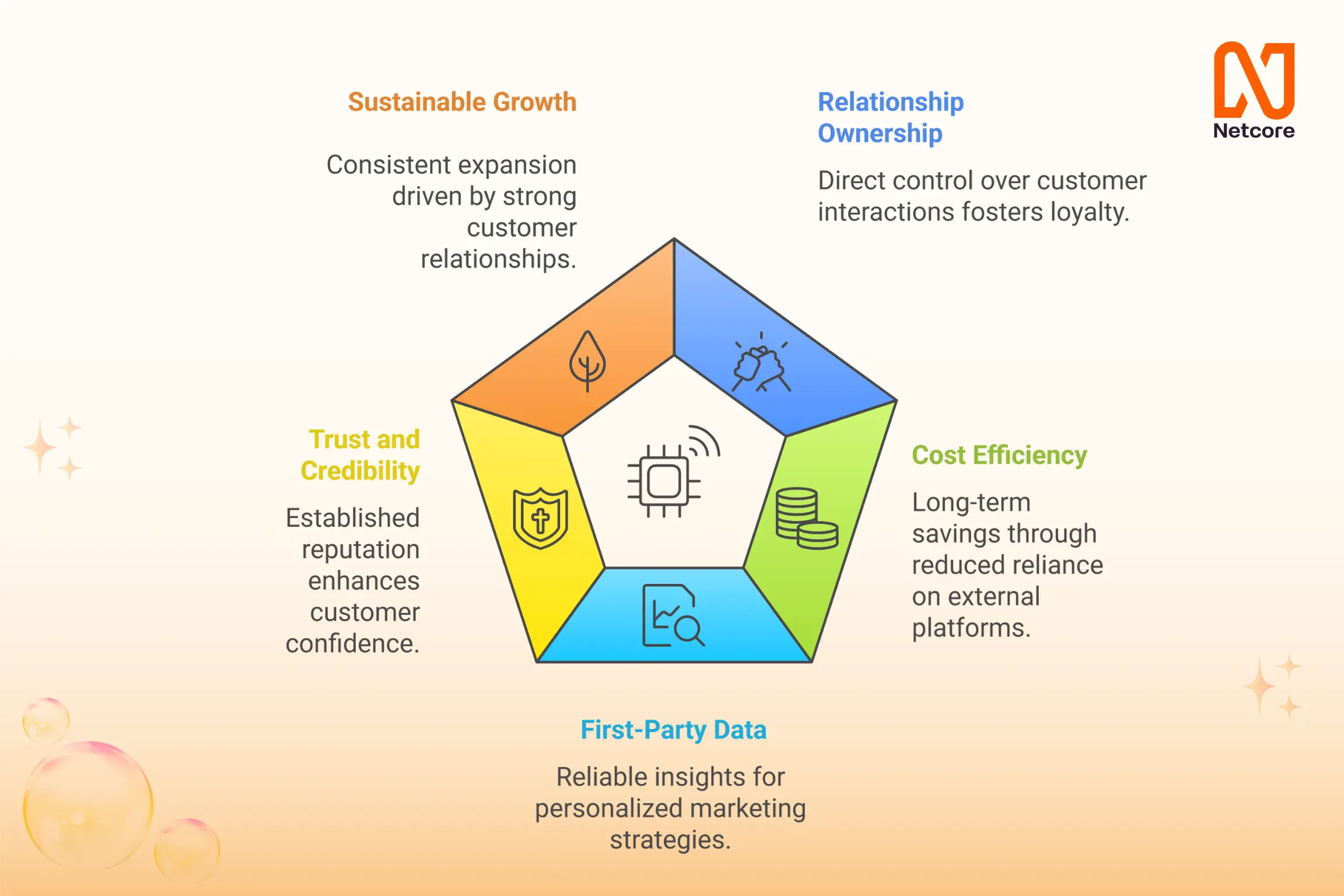
1. True ownership of the customer relationship
When you reach a customer through email, SMS, or WhatsApp, you are not entering an auction or fighting an algorithm. You are speaking to someone who has already given you permission. That permission removes intermediaries, volatility, and bidding wars. It creates a direct line of communication that no platform update can take away, and that kind of control is increasingly rare and valuable.
2. Compounding cost efficiency over time
Paid media becomes more expensive as you scale. More reach, more competition, higher costs. Owned channels work differently. Once the infrastructure is in place, the marginal cost of engaging another customer stays largely stable. As engagement and repeat purchases grow, the return compounds instead of eroding. Growth no longer feels like a tax.
3. First-party data that actually works for you
Every open, click, reply, and purchase deepens your understanding of the customer. You learn what they prefer, when they are most receptive, what signals intent, and where they sit in their lifecycle. Unlike third-party data, this insight belongs entirely to you and gets stronger with every interaction.
4. Built-in trust and credibility
Owned channels live in personal spaces, not public feeds. Messages feel relevant, timely, and intentional rather than disruptive. Customers engage because they choose to, not because an ad followed them around the internet. That trust consistently translates into higher engagement and stronger relationships.
5. The backbone of sustainable growth
Paid channels are still useful for discovery and reach. Owned channels are what turn that attention into lifetime value. The most resilient brands do not choose one over the other. They use paid media to start relationships and owned channels to deepen and monetize them over time.
The Conversion Friction No One Ever Budgets For
The most expensive cost in digital marketing rarely shows up in a spreadsheet. It’s the click-through penalty.
Every extra step between intent and action quietly kills conversions. A click to a landing page. A redirect. A delayed OTP. A slow load. Each one chips away at momentum. Studies consistently show that every additional click can reduce conversion probability by 80 to 90%.
Picture the moment.
A customer opens your email. The intent is there. They click the offer. A page loads. A notification pops up. Something else grabs their attention. They leave.
You paid to earn that attention. You just couldn’t hold it long enough to convert.
This is not a messaging problem. It’s an experience problem.
How Owned Channels Become True Revenue Engines
The smartest brands have stopped treating owned channels as traffic drivers. They use them as places where transactions actually happen.
This is where agentic marketing changes the rules. Instead of pushing users out to complete an action, AI-led experiences bring the conversion action directly into the message itself. The journey no longer leaks intent because it never leaves the environment where attention already exists.
This type of customer experience can be designed with Netcore’s AMP Email, AMP WhatsApp or AMP RCS messages. Customers can now:
- Browse products
- Select variants
- Fill forms
- Apply discounts
- Complete purchases securely
- Book appointments instantly
No redirects. No waiting. No decay.
When action happens at the exact moment and place attention is captured, conversion stops being a chase. It becomes a natural outcome.
Paid vs Owned Channel Growth Models
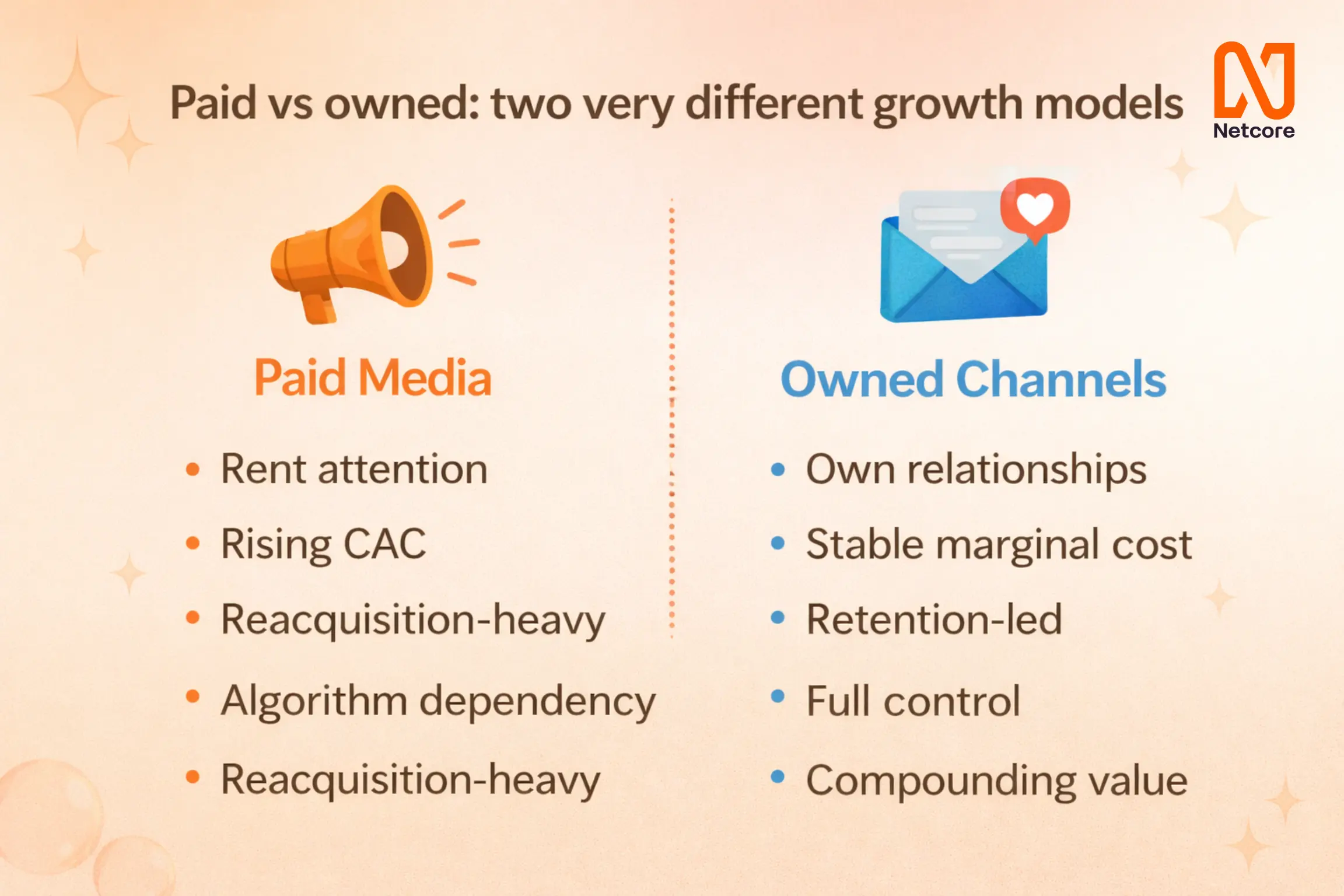
This contrast defines the next era of marketing.
The modern growth loop
The highest-performing brands follow a simple loop:
- Paid media drives discovery
- Owned channels capture the relationship
- Owned channels maximize CLV
- Result: Paid spend decreases over time

This is how marketing shifts from a cost centre to a profit engine.
What CMOs Should Do Next
This is not about abandoning paid media. It is about rebalancing.
Start by asking uncomfortable questions:
- How much of our paid spend is reacquisition?
- How much revenue comes from owned channels?
- Where are we losing intent due to friction?
- Are we measuring lifetime value or just campaign output?
Then act deliberately:
- Reduce dependency on paid reacquisition.
- Invest in owned-channel experiences that convert. Netcore takes complete ROI ownership with Value-Based Pricing. Know more about it.
- Design customer journeys that compound value over time.
Book a consultation call with Netcore and understand how to achieve exponential growth with Owned Channels.
Stop renting attention. Start compounding relationships.
The revenue tax crisis did not appear overnight, and it will not be solved with smarter bidding or prettier creatives. Paid media has become structurally expensive because it forces brands to keep paying to reach the same customers again and again.
Shifting away from paid channel dependence is not just an efficiency play. It’s a profitability move. Owned channels replace repeated bidding with direct relationships, reduce reacquisition spend, and turn every interaction into long-term value.
- Paid channels can still drive discovery.
- Owned channels are where sustainable CLV is built.
- The brands that win will not be louder. They’ll be the ones who own the conversation, personalizing every interaction with agentic marketing.

