





- Marketing’s Impossible Equation: Customers move faster than teams can react, making manual optimization unsustainable.
- What Agentic Marketing Really Means: Autonomous AI agents that plan, act, and optimize toward your goals in real time.
- How Agentic Makes It Work: AI interprets intent, generates content, chooses segments, times sends, and improves continuously.
- Agentic Marketing Principles: Goal-first decisioning, continuous learning, real-time relevance, and human + AI collaboration.
- The Anatomy of Agentic Marketing: A multi-agent system powered by unified data, intelligence, orchestration, and analytics.
- Agentic Marketing Framework: A closed-loop cycle of sensing, deciding, acting, and learning from every customer interaction.
- Choosing an Agentic Platform: Look for platforms with autonomous agents, predictive intelligence, omnichannel orchestration, and measurable ROI.
Marketing is broken. And if you’re honest with yourself, you already know it.
You’re spending more than ever on acquisition or on reacquisition of your lost customers. Your conversion rates are disappointing despite massive personalization investments. You are heavily dependent on the paid channels, and your owned channels are the least contributors to revenue. Your team is drowning in tactical execution while strategic opportunities slip away. And the hard truth? The hyper-personalization dream you’ve been sold doesn’t actually work at scale.
This isn’t a call for incremental improvement. This is about recognizing that the entire paradigm is fundamentally flawed—and there’s finally a way out.
The Real Problem: Marketing’s Impossible Equation
Today’s marketing leaders face the “impossible equation”: You need speed AND scale AND effectiveness simultaneously. Pick any two, and you might survive. But to thrive? You need all three.
Traditional marketing automation gave you speed, but sacrificed effectiveness with one-size-fits-all campaigns. Generative AI tools promised efficiency (speed with scale), but left you as the orchestrator of disconnected outputs.
Neither solved the core problem: how do you maintain genuine, personalized relationships with thousands or millions of customers without an army of marketers?
The answer isn’t more fragmented tools. It’s a different system entirely!
What Agentic Marketing Actually Means
Agentic Marketing is a system where specialized AI agents communicate with each other, orchestrate workflows, and collaborate autonomously with minimal human intervention—all operating safely within guardrails and aligned with the strategic goals you set.
This is not “AI marketing” or “marketing automation 2.0.” This is fundamentally different.
Think of it this way: Traditional automation follows the rules you program. Generative AI creates content when you ask. But Agentic Marketing? It sees your conversion rates declining and launches a recovery campaign before you even know there’s a problem. It doesn’t wait for prompts—it takes initiative within the boundaries you define. Know more about agentic marketing systems.
The difference is multi-agent orchestration, when individual agents don’t just execute tasks—they talk to each other to achieve outcomes. One agent identifies the right audience segment. Another crafts personalized content. A third determines optimal timing and channel. A fourth provides insights and recommendations for the next iteration. All working together, continuously learning, autonomously optimizing toward your business goals. That’s how agentic AI in marketing really works.
How Agentic Marketing makes it REAL
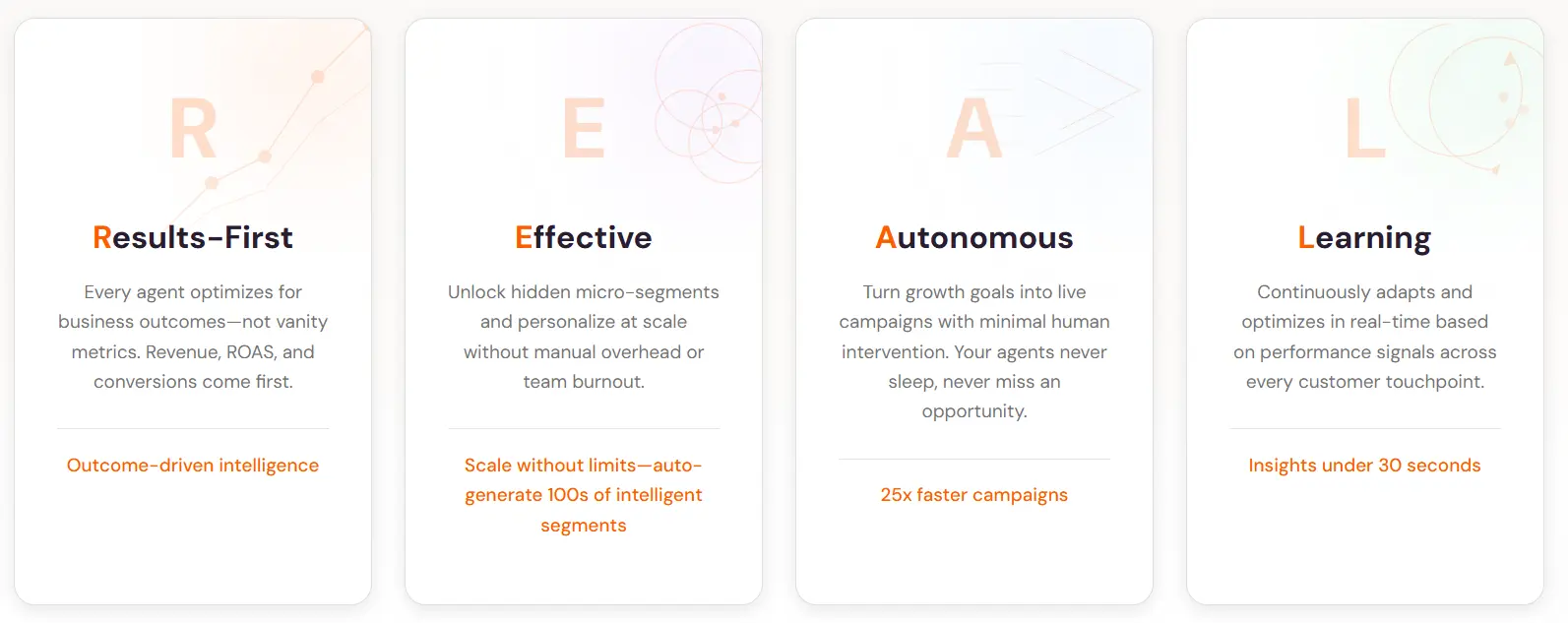
R – Result-focused: Stop measuring clicks and impressions. Start measuring revenue, margins, and lifetime value. Agentic Marketing shifts you from activity metrics to business outcomes. You set the goal—”increase repeat purchases by 15% this quarter”—and the system determines how to get there.
E – Effective, not just efficient: Doing things faster is pointless if you’re doing the wrong things. Effectiveness means doing what actually drives business results. Instead of launching campaigns based on last quarter’s playbook, agents analyze real-time data, identify opportunities, and execute strategies that move your actual business metrics.
A – Autonomous: Agents make decisions and take actions within the guardrails you establish. They don’t need you to write every rule or anticipate every scenario. They adapt to changing conditions, optimize based on performance, and coordinate complex workflows without constant human intervention. You focus on strategy and goals; they handle tactical execution.
L – Learning always: Every interaction feeds the system. Every campaign result trains the agents. Performance improves continuously without manual optimization cycles. The system gets smarter about your customers, your brand, and what drives results, compounding its effectiveness over time.
Agentic Marketing Principles
Agentic marketing is built on one core idea: marketing should act, not wait. Instead of static workflows and rule-based automation, agentic systems use autonomous AI agents that continuously observe customer behavior, interpret intent, and take the next-best action without needing human triggers.
The agentic marketing principles are simple:
- Goal-first, not task-first: Marketers define outcomes (increase purchases, reduce churn), and agents figure out the how.
- Continuous learning: Agents get smarter with every interaction, adapting journeys instantly.
- Real-time relevance: Every experience shifts as customer behavior shifts; no delay, no manual intervention.
- Human + AI collaboration: Humans set direction and strategy; agents execute with precision and speed.
The Anatomy of Agentic Marketing
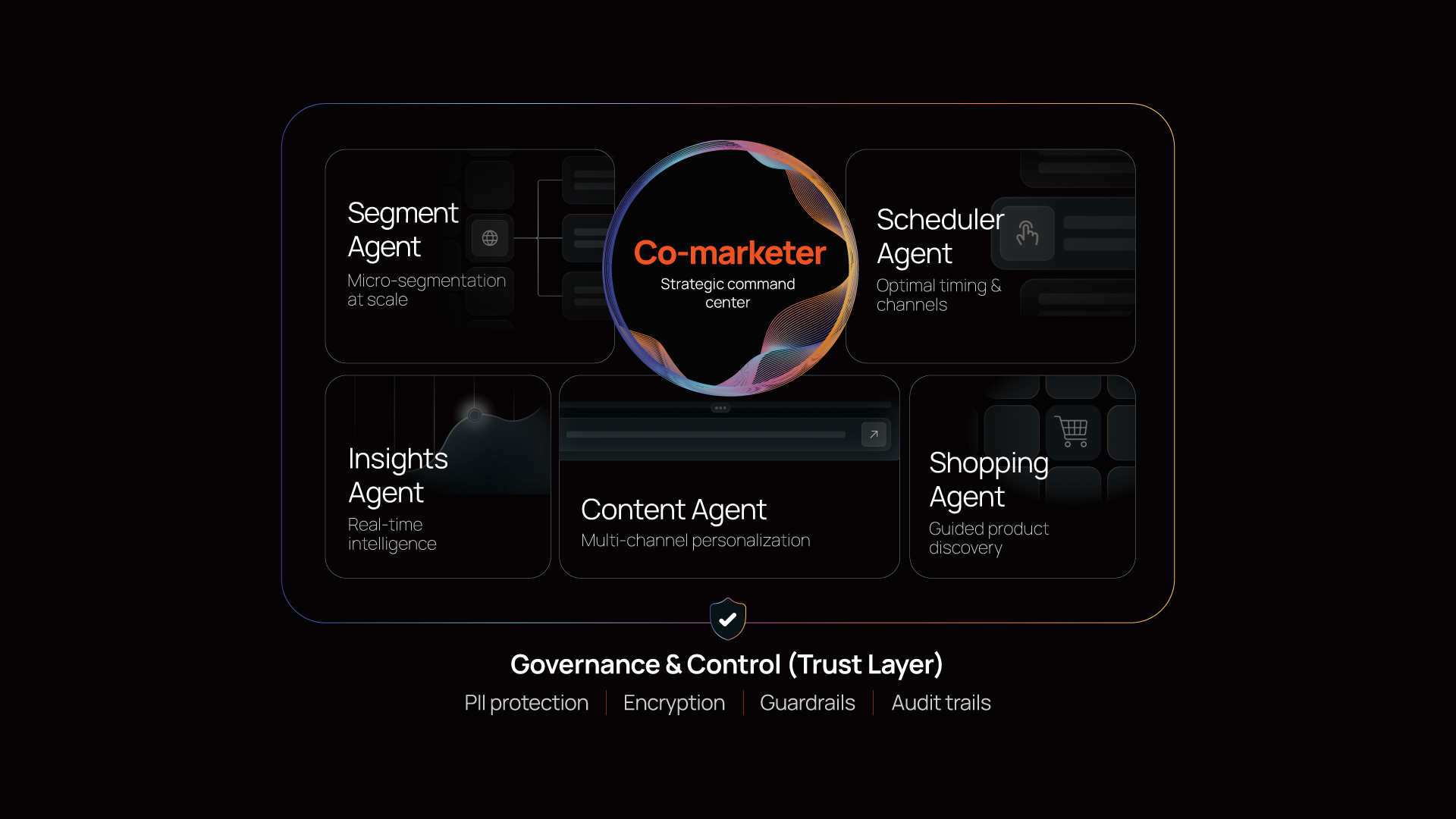
The Specialized Agents: Your AI Marketing Team
Segment Agent: Your audience strategist. Give it a goal like “identify high-value customers showing early churn signals,” and it analyzes behavioral data, purchase patterns, engagement metrics, and propensity models to create precise micro-segments. It doesn’t just use basic RFM analysis—it considers product affinity, price sensitivity, channel preferences, and hundreds of other signals to build segments that traditional tools would take weeks to create.
Content Agent: Your creative team. Once segments are defined, this agent generates campaign content that speaks to each audience’s specific context. Shopping for premium perfumes? The content emphasizes exclusivity and craftsmanship. Price-sensitive buyers? It highlights value and limited-time offers. The agent adapts tone, messaging, and calls-to-action across email, push notifications, and messaging platforms—maintaining brand voice while personalizing at the individual level.
Scheduler Agent: Your timing specialist. It determines not just when to send campaigns, but whether to send them at all. It analyzes individual engagement patterns, identifies optimal send times, prevents notification fatigue, and coordinates across channels. If someone just received a WhatsApp message, it might delay the email. If they typically engage on weekends, it adjusts accordingly.
Insights Agent: Your analyst. Instead of spending weekends pulling reports and building dashboards, you ask questions in plain language: “Why did WhatsApp conversions drop during the sale?” or “Which segment drove the most repeat purchases last month?” The agent analyzes the data, explains what happened, and recommends what to do next. Monday morning metrics that used to take two days now take 30 minutes.
Shopping Agent: Your virtual concierge, also called an AI Shopping Assistant. On your website or app, this agent guides discovery like an expert salesperson offering a complete Agentic Commerce experience. A customer searching for “running shoes for marathon training” doesn’t just see keyword matches—they get intelligent recommendations based on their running style, previous purchases, budget signals, and what similar customers bought. It turns product discovery from a frustrating search into a guided experience, increasing add-to-cart rates by up to 60%.
All the above AI agents can be integrated into your AI marketing team.
Co-Marketer: The Orchestration Layer
Individual agents are powerful, but the magic happens when they work together. This is where Co-Marketer comes in—the conductor of your AI marketing orchestra.
When you set an objective like “reactivate 25% of dormant customers with a 3X ROI target,” Co-Marketer doesn’t just pass instructions to agents. It strategizes. It determines which agents to deploy, in what sequence, with what parameters. It coordinates their outputs—ensuring the segments the Segment Agent creates align with the content the Content Agent generates and the timing the Scheduler Agent recommends.
Co-Marketer makes meta-level decisions: Should we prioritize reach or precision? Is this a relationship-building campaign or a conversion push? Should we test multiple approaches simultaneously? It manages workflows, resolves dependencies, and continuously monitors performance against your goal—adjusting the strategy in real-time as results come in.
This is the shift from “marketer as executor” to “marketer as strategist.” You set the destination; Co-Marketer charts the course and coordinates the journey.
Agentic Marketing Framework
The agentic framework replaces rigid automation with a closed-loop system where AI senses, decides, acts, and learns. It has four layers:
- Intelligence Layer: AI agents analyze affinities, propensities, intent, and context.
- Decision Layer: Determines the next-best action for each user.
- Execution Layer: Orchestrates messaging, journeys, channels, and offers autonomously.
- Feedback Layer: Measures outcomes and feeds learning back into the system.
This ensures every campaign self-optimizes toward business goals. Learn about the agentic marketing framework in detail here.
The Trust Layer: Control Without Micromanagement
Here’s what stops most enterprises from adopting autonomous systems: fear of losing control. What if the AI says something off-brand? What if it violates compliance rules? What if it makes decisions that conflict with business priorities?
The Trust Layer addresses these concerns directly. It’s a comprehensive governance framework that ensures agents operate within boundaries you define:
- Brand guidelines: Tone of voice, messaging frameworks, prohibited terms, and style requirements are encoded as guardrails. Content generation stays on-brand automatically.
- Compliance rules: Regulatory requirements, data privacy protocols, and approval workflows are built into the system. Agents can’t violate rules they don’t have permission to break.
- Risk management: Certain actions require human approval. High-value decisions can be flagged for review. You control the balance between autonomy and oversight.
- Transparency and auditability: Every agent action is logged and explainable. You can see why a decision was made, what data informed it, and what alternatives were considered.
This isn’t about hoping the AI behaves responsibly. It’s about architecting responsibility into the system from the ground up.
Making It Real: Your Path to Agentic Marketing
Understanding the concept is one thing. Actually adopting it is another. Here’s how to approach this transformation practically.
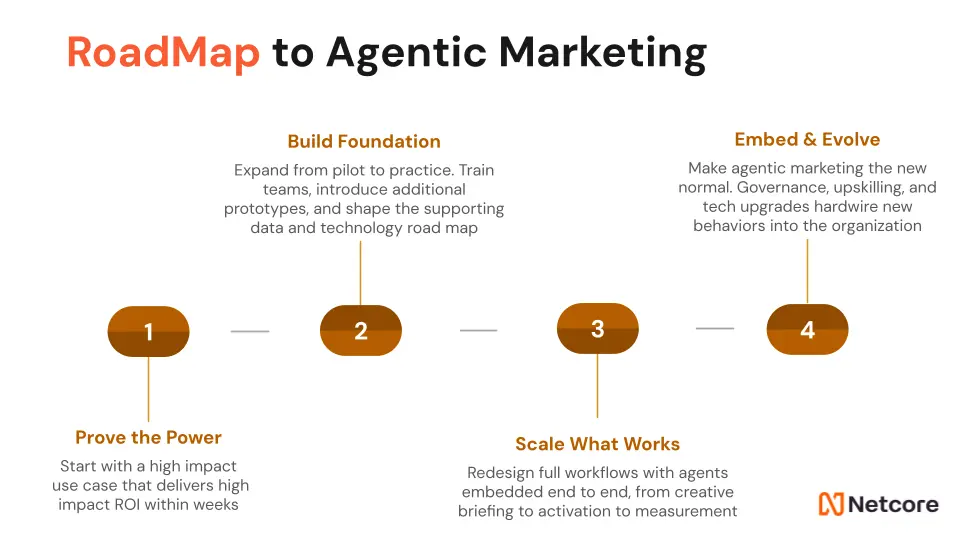
Start With One High-Impact Use Case
Don’t try to transform everything at once. Identify a specific, measurable challenge where autonomous agents can deliver clear value. Perhaps it’s: “Increase repeat purchase rates from first-time buyers” or “Reduce time from campaign strategy to deployment,” or “Improve email engagement from dormant segments.”
Run a focused pilot. Measure results rigorously. Learn what works in your context. Then expand systematically—adding use cases as you build confidence and capability.
Embrace the Mindset Shift
Agentic Marketing requires a different mental model:
- From executor to strategist: Your job isn’t running campaigns anymore. It’s setting goals, defining guardrails, and interpreting results. You’re coaching the team, not doing their work.
- From “I run campaigns” to “I set outcomes”: Stop thinking in terms of email campaigns, push notifications, and customer journeys. Start thinking in terms of business objectives: revenue growth, retention improvement, and margin optimization. Define what success looks like; let the agents determine how to achieve it.
- From controlling details to defining boundaries: You can’t and shouldn’t review every segment, every piece of content, every send time decision. Instead, establish the rules, guidelines, and approval thresholds. Trust the system within those boundaries.
- From reactive optimization to proactive learning: You’re no longer tweaking last week’s campaign. You’re setting strategic direction while the system continuously experiments, learns, and adapts in real-time.
This shift is uncomfortable. It requires letting go of control over tactics while gaining control over strategy. But it’s the only path to achieving the impossible equation: speed, scale, and effectiveness simultaneously.
Address the Fear Head-On
“Will I lose control?” No—you’ll gain strategic control while delegating tactical execution. You’re not surrendering authority; you’re elevating where you apply it. Instead of controlling every email sent, you control business outcomes and strategic direction.
“Will this replace my team?” Not even close. It replaces repetitive tactical work, freeing your team for creativity and strategic thinking. The brands seeing the best results aren’t cutting headcount—they’re redeploying talent to higher-value activities that humans excel at: brand strategy, customer empathy, creative innovation, and business judgment.
“Is this too complex to implement?” Start simple. Deploy one agent for one use case. See results in weeks, not months. Modern systems are designed for rapid implementation—most brands see value within 3-4 weeks of launch. Complexity scales with your ambition, but the entry point is surprisingly accessible.
“How do I trust AI agents with my brand?” That’s precisely what the Trust Layer ensures. You’re not hoping agents behave appropriately—you’re encoding appropriate behavior into the system architecture. Every output is filtered through brand guidelines, compliance rules, and approval workflows you define.
The Choice Before You
The marketing landscape has fundamentally changed. Customer attention spans are down to 8 seconds. Acquisition costs are up 60% in five years. Organic traffic is declining as AI search summaries replace click-throughs. The old playbook doesn’t work anymore.
You have two options: Fight harder with the same broken tools, or embrace a system designed for the reality you’re facing.
Agentic Marketing isn’t about replacing human marketers with robots. It’s about amplifying human creativity and strategic thinking with AI capabilities that handle what humans can’t: maintaining personalized relationships with millions of customers simultaneously, processing vast datasets in real-time, coordinating complex workflows across channels, and continuously learning and optimizing without fatigue.
The question isn’t whether marketing will work this way. The question is when you’ll make the shift—and whether you’ll lead the transformation or follow it.
The brands winning today aren’t just using better tools. They’re adopting agentic marketing platforms and integrating them intelligently into their marketing workflow. One where autonomous agents handle tactical execution while human strategists focus on what matters: understanding customers deeply, setting ambitious goals, and building businesses that grow sustainably.
Marketing isn’t broken forever. It’s broken now. And now, finally, there’s a fix.
The future of marketing is agentic. The platform exists. The results are proven. The only question left is: What impossible challenge will you solve first? Know which are the best agentic marketing platforms and choose wisely.

