 Worried About Your AI Marketing Strategy? Read the Agentic Marketing 2026 Predictions Report! →





Every technology revolution brings more than new tools; it rewrites the economics underneath them. The shift from Legacy Marketing to the Agentic Marketing Era is no different. We’ve seen this pattern before: when Apple’s App Store created a marketplace, it didn’t just add apps—it unlocked an ecosystem where developers, platforms, and users all shared in compounding value. When Amazon’s marketplace model scaled third-party sellers, it didn’t just expand inventory—it reshaped retail margins and who captured them.
Agentic systems now push marketing through a similar inflection point. These aren’t smarter dashboards to run campaigns faster; they are autonomous actors that learn, decide, and execute. That changes where value is created (personalized, real-time micro-decisions at scale) and how it’s captured (from paying for activity to paying for outcomes). In short: the tools are evolving, but the bigger story is economic. If agents do the work and prove the lift, business models must follow—toward pricing, partnerships, and platforms built for measurable, compounding impact.
The Shift That’s Reshaping Marketing Economics
For years, marketing economics have been locked into two models. In traditional SaaS, brands pay flat subscription fees whether or not the software delivers real impact. In performance marketing, platforms like Meta and Google skim 20–30% of revenue in what many now call “ad taxes.” Both models extract value without guaranteeing outcomes.
Agentic systems flip this equation. When autonomous agents take on retention, upsell, and loyalty, the marginal cost of engagement falls close to zero. One agent can orchestrate millions of personalized interactions simultaneously, with no proportional rise in cost—yet each interaction compounds into higher customer lifetime value.
Consider Spotify’s Discover Weekly. Behind the scenes, it works like an agentic system: autonomously curating hyper-personalized playlists for over 100 million users. The economics are elegant—it doesn’t cost Spotify more to personalize at massive scale, but the payoff is profound. Engagement rises, churn drops, and loyalty deepens.
This is the new math of marketing: costs flatten, while value creation compounds.
Why a New Business Model Matters
Agentic systems now push marketing through a similar inflection point. These aren’t smarter dashboards to run campaigns faster; they are autonomous actors that learn, decide, and execute. That changes where value is created (personalized, real-time micro-decisions at scale) and how it’s captured (from paying for activity to paying for outcomes). In short: the tools are evolving, but the bigger story is economic. If agents do the work and prove the lift, business models must follow—toward pricing, partnerships, and platforms built for measurable, compounding impact.
The Pricing Options Taking Shape
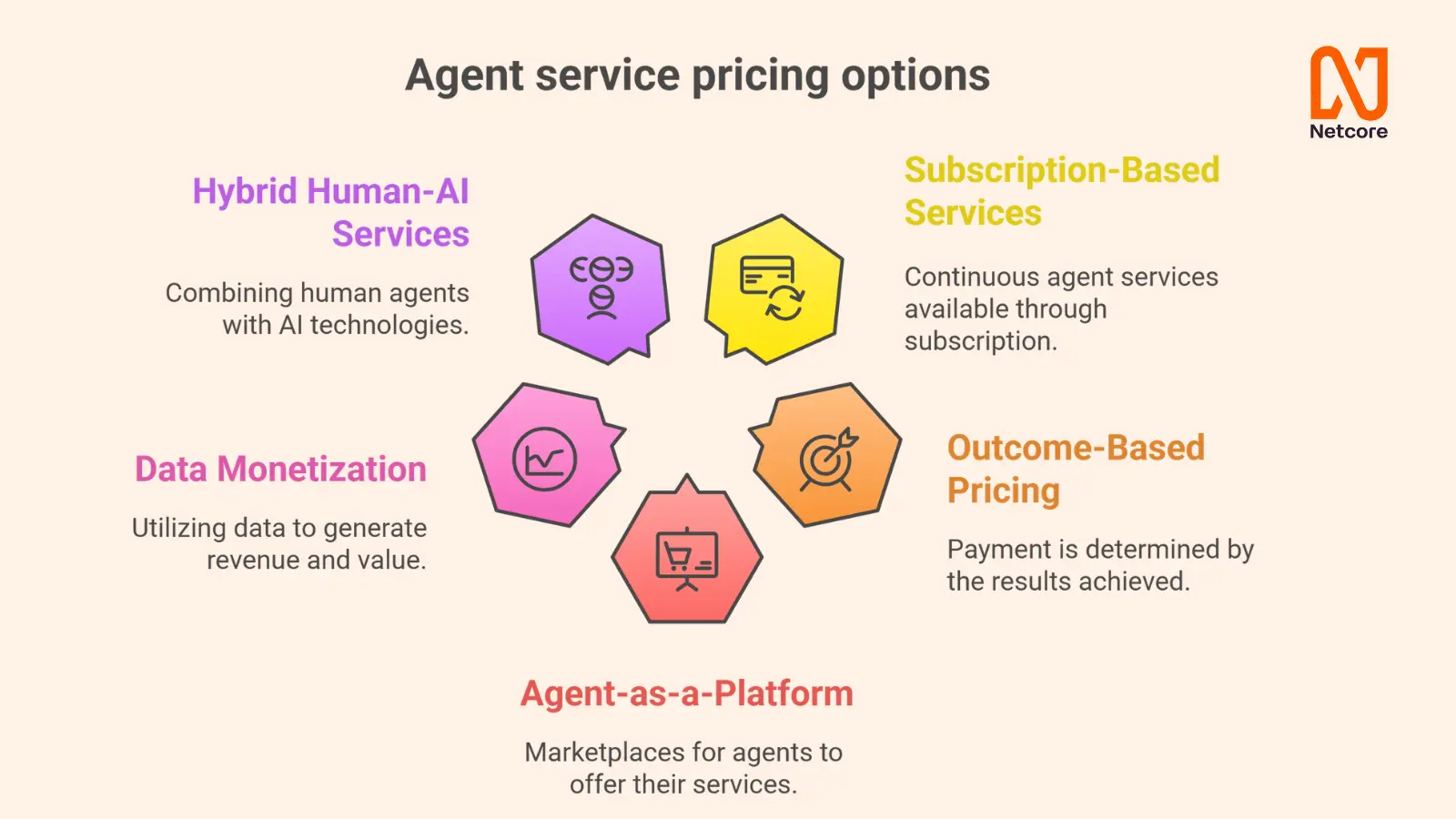
Subscription-Based Agent Services: Always-On by Design
Subscriptions aren’t going away; they’re evolving. Agentic systems are always on, learning and optimizing even while you sleep. A recurring model funds continual improvement while giving customers predictability. It’s the modern “software maintenance” fee—with a twist: the product gets smarter every day. That reduces churn and increases perceived value over time.
Outcome-Based Pricing: Pay for Results, Not Access
The breakthrough model for agentic systems is simple to say and hard to execute: get paid for the outcomes you produce. Compensation tied to qualified leads, incremental revenue, cost savings, or retention lift aligns incentives perfectly. Providers take more risk—but win with pricing power when they perform.
We see this in the wild:
- Intercom Fin prices per resolved issue—not per seat or message volume.
- Hitachi Rail sells trains-as-a-service, staking fees on punctuality and availability, not promiseware.
When attribution is clear and autonomy is high, outcome-based models shine.
Agent-as-a-Platform Marketplaces
One of the most exciting shifts in the agentic era is the rise of platform ecosystems—marketplaces where brands can mix, match, and deploy specialized AI agents like building blocks. Just as Apple’s App Store unlocked an explosion of mobile innovation, agent marketplaces let providers and developers innovate faster than any single company could alone.
This is where Netcore is carving out a category-defining position. Instead of forcing brands into rigid, one-size-fits-all tools, Netcore’s AI Agents Collective operates like a marketplace within a platform:
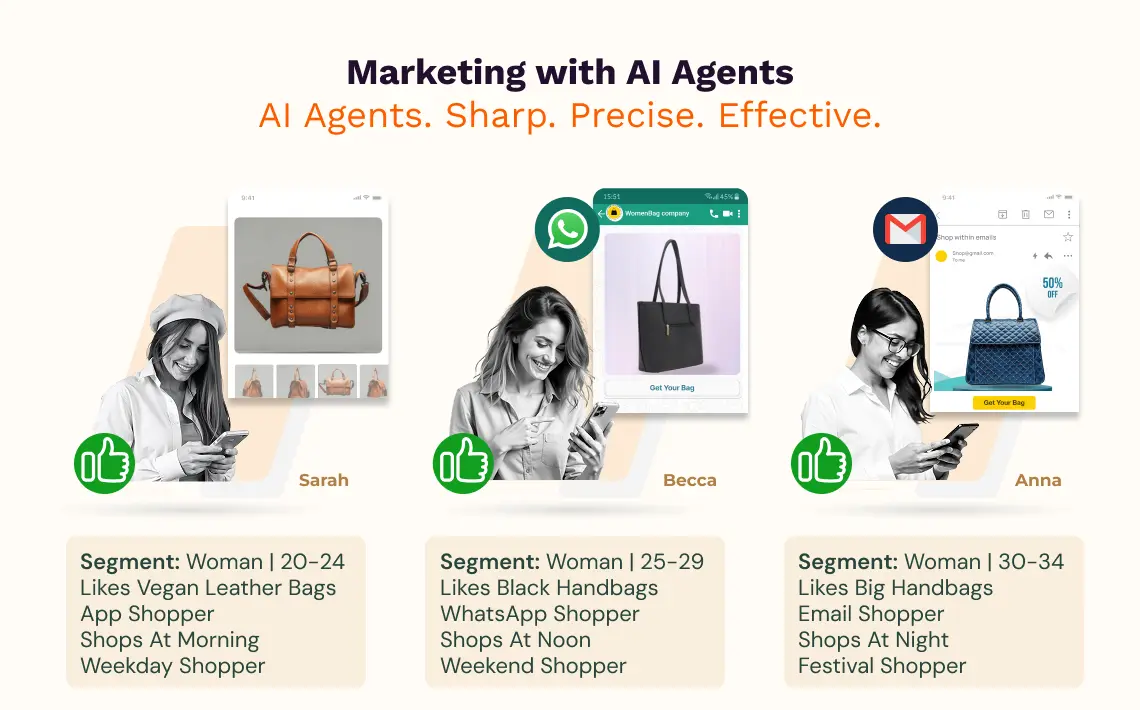
- Insights Agent surfaces patterns and opportunities hidden in customer data.
- Segment Agent builds predictive, affinity-based segments ready for activation.
- Content Agent generates and optimizes personalized creative on the fly.
- Shopping Agent powers commerce experiences from cart recovery to upsell.
Each agent functions independently, but the real magic is how they interoperate—brands can “assemble” their own stack based on needs, almost like picking apps from a store. This modularity means faster innovation, lower risk, and higher returns.
And because Netcore’s marketplace approach is tied to outcome-based economics, brands aren’t just buying access—they’re investing in performance. Every agent added strengthens the ecosystem, compounding value much like Shopify’s app store did for ecommerce.
Netcore isn’t just offering agents. It’s building the agent marketplace model for marketing—a future-ready ecosystem where innovation, flexibility, and profitability scale together.
Data Monetization: Fuel for the Flywheel
High-quality, proprietary data is the new compounding asset. In B2B especially, domain-specific datasets train better agents—and can be licensed to those who need that edge. The key is cleanliness, consent, and compliance. The payoff: a durable revenue stream that also improves your core product.
Hybrid Human–AI Services: The On-Ramp
Not every team is ready to go all-in on autonomy. Hybrid models—AI copilots plus human oversight—help build trust and justify premium pricing during transition. You charge for confidence and outcomes, not for hands on keyboards.
Bottom line: these options aren’t mutually exclusive. The most resilient providers use hybrids—a subscription base, plus outcome bonuses; a platform strategy, plus data licensing. The common thread is alignment with value.
The Levers That Unlock Value
Every era has its defining levers of value creation. For agentic marketing, they come down to four forces that—when combined—reshape what competitive advantage looks like.
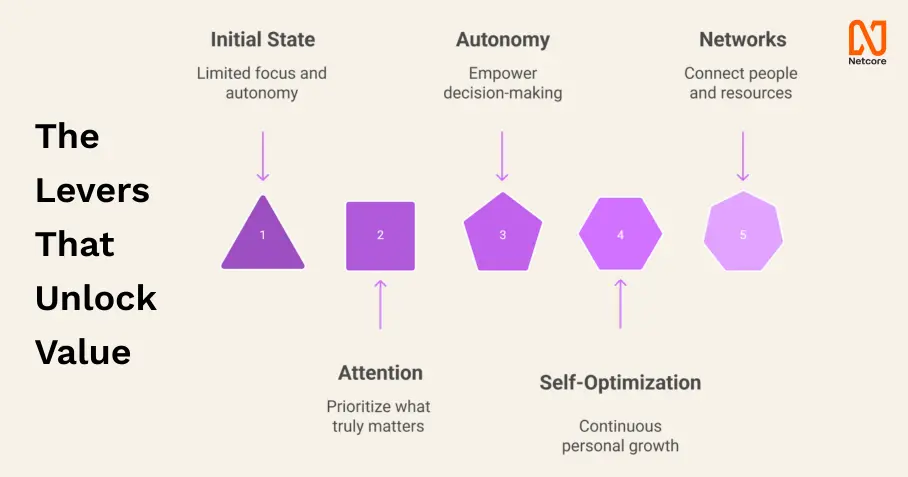
Attention becomes the moat. Not just fleeting clicks or impressions, but daily, habit-forming engagement that compounds over time. Think of Duolingo’s streaks: a deceptively simple mechanic that nudges millions to return day after day, building stickiness most brands can only dream of.
Autonomy redefines execution. Agents don’t wait for human instructions—they act in real time. Tesla’s Autopilot is a vivid example: the system isn’t passively waiting for commands, it’s continuously anticipating and responding, showing how autonomy scales beyond assistance into orchestration.
Self-optimization creates compounding advantage. Like Amazon’s recommendation engine, which has been refining itself for over 20 years and now drives 35% of the company’s revenue, agentic systems learn and improve endlessly. Each cycle makes them better, faster, and more profitable.
Networks magnify impact. When anonymized intelligence is shared across ecosystems, efficiency rises exponentially. Waze proved this by turning drivers into a collective intelligence system—each contribution making the network smarter for everyone.
Together, these levers don’t just make marketing more efficient; they create a flywheel effect where value compounds, moats deepen, and the economics of engagement tilt in favor of those who embrace them first.
Transitioning from Today’s Models
No brand flips a switch and becomes agentic overnight. The path forward is evolutionary, not revolutionary—and that’s a good thing. It means marketers can build trust in the technology while de-risking the shift in economics.
The first step is usually hybrids. A subscription base provides stability, while performance bonuses test the waters of outcome alignment. From there, many brands pilot outcome-based contracts in controlled use cases—cart recovery, churn reduction, or reactivation campaigns—where attribution is clean and results are easy to measure.
Over time, as confidence in agent-driven outcomes grows, these pilots expand. What begins as a narrow proof of concept scales across segments, channels, and eventually the entire engagement stack.
We’ve seen this playbook before. HubSpot, for example, started as a straightforward subscription platform. Over the years, it layered on a vibrant marketplace ecosystem and performance-based integrations that let customers tie spend to results. The model matured gradually, building trust at each stage.
The takeaway: transitioning to agentic models isn’t a leap of faith—it’s a series of steps. Each step compounds, creating confidence, proving ROI, and laying the groundwork for a future where outcomes, not inputs, define how marketing is valued and paid for.
Conclusion
Every marketing revolution has been defined not only by technology, but by the economics that followed it. Today, agentic systems mark the next leap—autonomous, self-optimizing, and infinitely scalable. They don’t just change how campaigns are executed; they change how value is created, measured, and shared.
The future will belong to brands and platforms that realign around this truth. Just as Netflix’s subscription pivot redefined media and AWS’s pay-as-you-go model redefined infrastructure, the ZeroBase philosophy and outcome-driven models will redefine marketing. Vendors stop billing for activity. Brands stop renting performance from platforms. Instead, both sides win only when measurable growth is achieved.
Netcore is already shaping this future, offering marketers a marketplace of AI agents that scale personalization, optimize outcomes, and tie success directly to business results. It’s not theory—it’s a playbook for making profit the default, not the exception.
The path forward is clear: embrace the levers of attention, autonomy, self-optimization, and networks. Transition step by step. And adopt business models that align incentives with impact. The brands that move first won’t just participate in the agentic era—they’ll define it.
The impossible has become inevitable. The inevitable is becoming invincible. The agentic era is here—and it’s rewriting marketing’s business model for good.

