





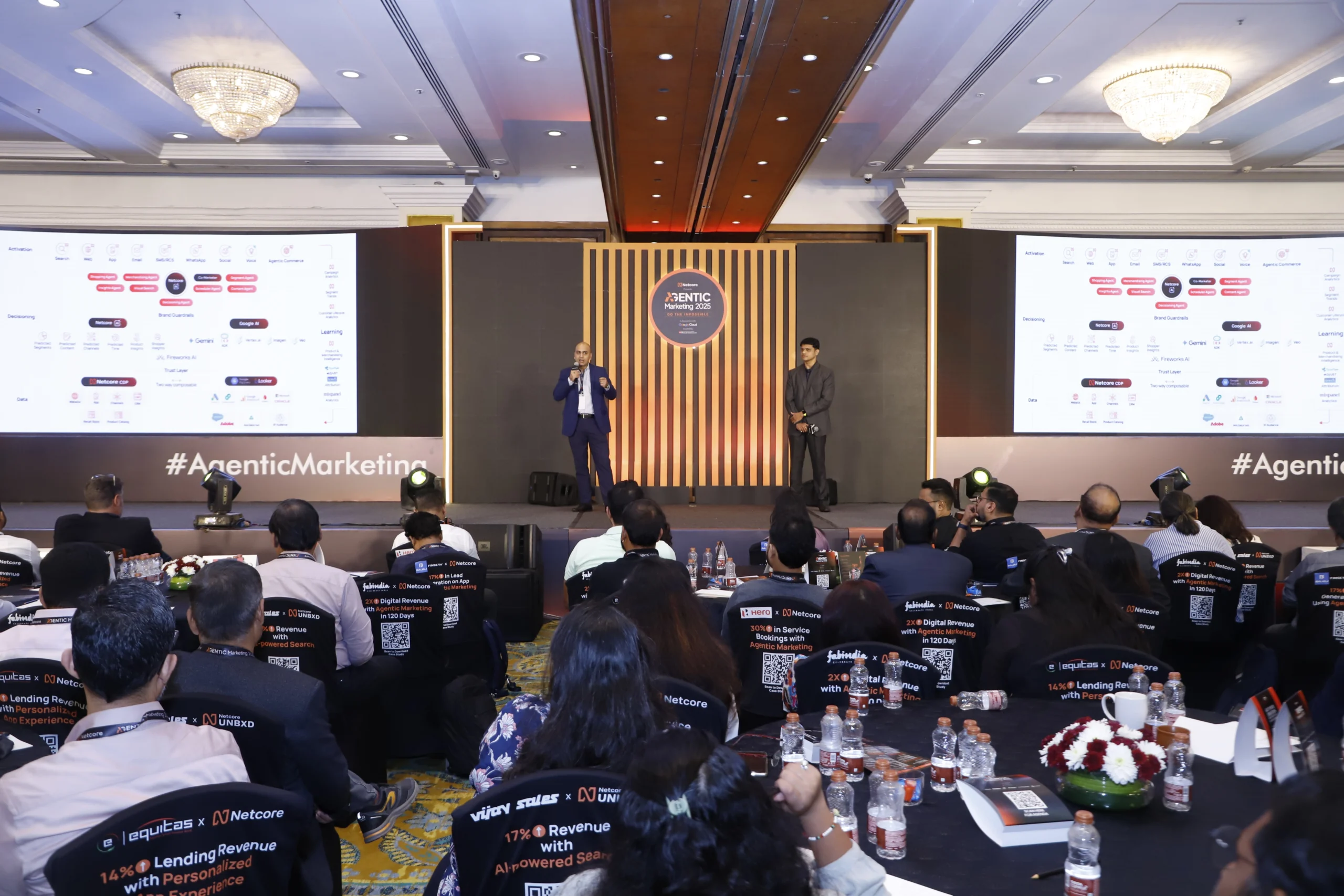
At Agentic Marketing 2025 in Mumbai on 30th October, over 600+ marketing and technology leaders witnessed something the industry hasn’t seen in over a decade: a genuine architectural rethinking of how marketing technology should work.
Why now? Because the current model is broken. Brands are losing 20-30% of revenue to constant reacquisition, campaigns take days to launch while markets move in minutes, and despite having more data than ever, true personalization remains impossible at scale. The stack reimagines marketing infrastructure to solve these fundamental problems; enabling brands to engage customers in real-time, maximize the value of existing relationships, and finally achieve personalization that goes beyond basic segmentation.
The centerpiece was the unveiling of the Agentic Marketing Stack; a collaborative system built by Netcore and Google Cloud that represents a fundamental shift from marketing automation to marketing autonomy to deliver scale and relevance.
Krishnan Chatterjee, Head of Marketing at Google Cloud, framed the collaboration: “The Agentic Marketing Stack stands at the intersection of intelligence and impact. It gives marketers the power to orchestrate, optimize, and outperform; all in real time.”
The Technology Behind the Stack
The Agentic Marketing Stack is built on Google Cloud’s comprehensive AI portfolio, and the technical foundation is what makes autonomous marketing possible at scale.
Traditional marketing automation executes predefined rules. Agentic systems reason through context, anticipate needs, and optimize continuously without constant human intervention.
Naren Kachroo, Head of GTM for AI at Google Cloud, walked through the infrastructure during the unveiling:
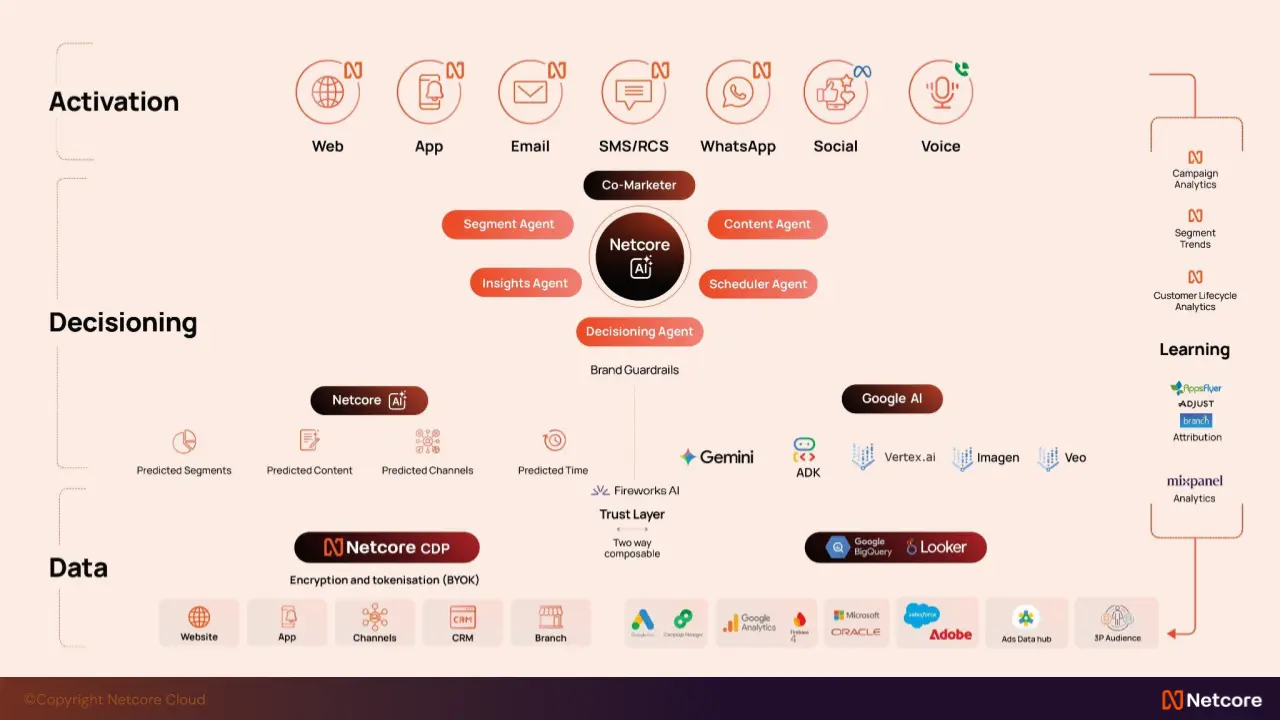
Google Cloud’s AI Models: The stack leverages Gemini for reasoning and decision-making, Imagen for creative generation, and Veo for video content; all accessible through Vertex AI. These aren’t just tools for generating content; they’re the intelligence layer that enables systems to understand context and make strategic choices.
Data Infrastructure: Built on BigQuery for analytics and Looker for visualization, the platform can process massive amounts of customer data in real-time, identifying patterns and opportunities that traditional systems would miss entirely.
Composable Architecture: Perhaps most critically, the stack is designed to integrate with existing martech investments rather than requiring a complete overhaul. It’s cloud-native, scalable, and built for interoperability.
Three Core Principles That Define the Stack
What became clear during the unveiling is that the Agentic Marketing Stack operates on fundamentally different principles than traditional martech:
1. Data: Scalability with Cloud-Native Composability
Most marketing stacks grow through acquisition and integration, creating technical debt and compatibility nightmares. The result is bloated systems that are expensive to maintain and impossible to innovate on quickly.
Built cloud-native on Google Cloud infrastructure, the Agentic Marketing Stack is designed for composability. New capabilities can be added, tested, and scaled without disrupting existing workflows. Innovation happens continuously rather than through painful migration projects.
Everything starts with unified, real-time customer data. The stack consolidates information from every touchpoint—web, mobile, email, commerce, support—into a single, comprehensive view. Using Google Cloud’s BigQuery and advanced data processing capabilities, the platform continuously ingests, processes, and enriches customer data in real-time.
2. Decisioning: Agility with Real-Time Orchestration
Traditional campaigns take days to launch and weeks to optimize. By that time, market conditions have shifted, customer intent has changed, and opportunities have passed.
The Agentic Marketing Stack orchestrates campaigns in real-time across every channel simultaneously. When customer behavior signals a shift in intent, the system adapts immediately; adjusting messaging, offers, timing, and channels without waiting for human analysis and approval.
This is where autonomy happens. Built on Google Cloud’s AI models—Gemini for reasoning, Vertex AI for model deployment—the decision layer analyzes customer data, understands context, and determines the optimal next action for each individual customer. NetcoreAI brings in a multi-agent system that is orchestrated by Co-marketer and includes individual agents such as segment, content, insights and more. The multi-agentic system works autonomously within guard rails to execute your campaigns end to end, focussing on business outcomes and solving for scale.
3. Delivery: Interoperability with Seamless Integration
No marketing leader wants to hear “rip and replace.” The reality is that most organizations have significant investments in existing tools, data warehouses, and customer engagement platforms.
The stack is built to work across marketing, adtech, and data systems. It connects disparate data sources, orchestrates actions across platforms, and ensures insights flow freely; ending the era of siloed tools creating more problems than they solve.
The delivery layer orchestrates personalized experiences across every channel in real-time—email, SMS, push notifications, web, mobile app, WhatsApp, and beyond.
The feedback loop is also closed by feeding the system with continuous learnings from data in real time helping achieve growth at scale without missing any gaps.
Beyond the Technology: A New Operating Model
What became clear throughout the unveiling is that adopting agentic marketing isn’t just a technology decision; it requires rethinking how marketing organizations operate and change their people, processes, and technology.
Autonomous systems don’t just execute faster; they change what marketers spend their time on. Instead of manually configuring campaigns and analyzing reports, marketers focus on strategy, creative direction, and defining the business outcomes they want systems to optimize toward.
This shift from execution to orchestration is significant. It means marketing teams need different skills, different workflows, and different success metrics. The brands getting the best results from early pilots aren’t just implementing new technology; they’re transforming how their marketing organizations work.
A part of this newer operating model is also our newly introduced variable pricing. The vision for this is to create trust and transparency when it comes to real business outcomes for our customers. We link a part of the payment to real outcomes like conversions, AOV, and more, and we get paid only when our customers achieve these outcomes. Essentially, we win when our customers win!
The Partnership That Makes It Possible
The collaboration between Netcore and Google Cloud brings together complementary strengths that make autonomous marketing practical at enterprise scale.
Google Cloud provides the AI infrastructure, models, and data platform that enable intelligent decision-making. Netcore brings deep expertise in customer engagement, omnichannel orchestration, and the practical challenges of implementing marketing technology in complex enterprise environments.
The result is a platform that’s both technically sophisticated and operationally pragmatic; advanced AI that actually works within the realities of how marketing organizations function.
What This Means for Marketing Leaders
If you’re a CMO or marketing leader evaluating where to invest in 2026, the Agentic Marketing Stack unveiling surfaced a few critical questions worth considering:
Can your current systems optimize in real-time? If campaigns take days to launch and weeks to optimize, you’re missing opportunities every single day. Speed is becoming more valuable than scale.
Are you paying for tools or outcomes? The shift toward autonomous systems also enables outcome-based pricing models. If your technology partners aren’t willing to tie fees to results, ask why.
How much of your budget goes to reacquiring customers you’ve already paid for? Agentic systems excel at maximizing the value of “resident customers”; people who already trust your brand but remain under-engaged.
Is your tech stack helping or hindering? If your team spends more time managing integrations than creating campaigns, the architecture needs rethinking.
The Industry Moment We’re In
As Rajesh Jain, Founder and MD of Netcore, said during his closing remarks: “This is not an evolution; it’s a revolution. We’re moving from automation to autonomy, from data to decisions, and from tools to intelligence.”
The Agentic Marketing Stack represents one answer to how that revolution takes shape practically. It’s not the only path forward, but it’s a significant one; backed by serious technology, real results, and a partnership between two companies committed to making autonomous marketing accessible to enterprises of all sizes to achieve scale and relevance.
The question for marketing leaders isn’t whether agentic AI will reshape the industry. It’s how quickly you can transform your organization to leverage it before your competitors do.

