





For decades, scaling marketing meant one thing: adding more. More budget, more headcount, more time. The equation was simple: if you wanted to reach twice as many customers, you doubled your resources. But there was always a hidden cost no one talked about: time lost in campaign optimizations.
Every new market, every product launch, every audience segment reset the clock. Your team would spend months testing messages, analyzing results, and iterating on what works, only to start over again when the next opportunity arrived. Traditional marketing doesn’t compound knowledge; it loses it.
That’s the real bottleneck to growth. And it’s exactly what agentic marketing was designed to solve.
Where is Major Time Lost in the Campaign Execution?
Marketing has always been about answering hard questions under uncertainty: Who is our ideal customer? What message resonates right now? Which channel converts most efficiently? What offer drives action?
The problem isn’t that these questions are difficult; it’s that the answers take too long to find. Generally, marketing teams spend most of their time learning from CTA rates, optimizing creatives, or messaging for marketing campaigns. Long A/B testing cycles. Manual post-mortems. Campaign related Insights, like users respond well to flash sales more than flat discount offer promotions, are locked inside specific campaigns that never transfer to the next campaigns.
This delay compounds as you scale. More customer segments mean slower insight velocity. More channels mean fragmented learning. More markets mean you are repeating the same mistakes in different geographies. Every new launch effectively starts from zero.
For CMOs and revenue leaders, this creates an impossible tradeoff: move fast and risk inefficiency, or move methodically and lose market opportunities. Neither option wins.
Why Is Agentic Marketing Underutilized?
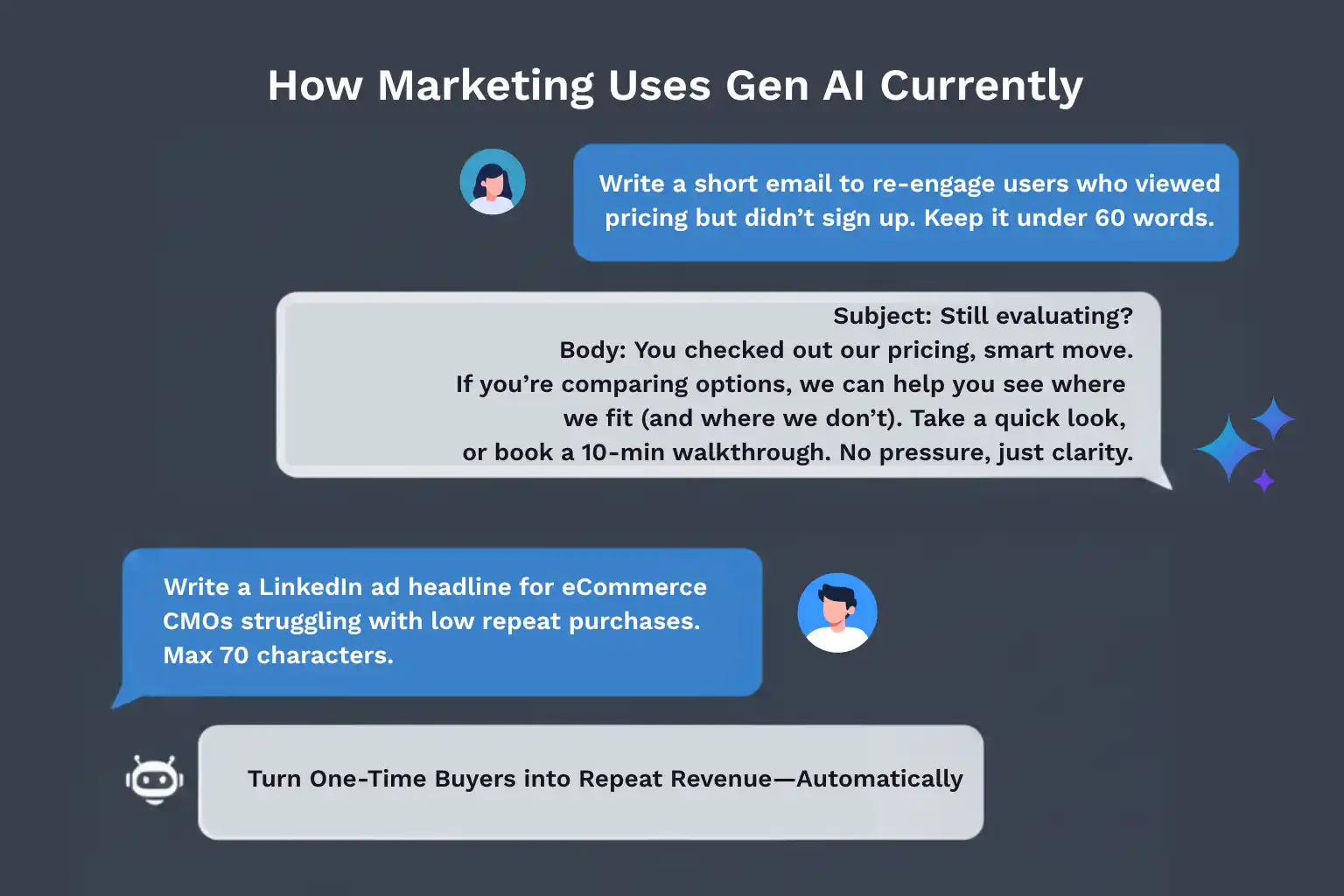
Most organizations have already adopted generative AI for marketing, writing subject lines, generating ad copy, and producing blog content. It’s made creative production faster and more efficient. But creativity is only half the equation.
Using GenAI as a creative assistant doesn’t solve the speed-at-scale problem because decision-making remains unchanged. Humans still choose which segments to target, which channels to activate, and how to interpret results. The learning loop is just as slow as it was before.
Think of it this way: using GenAI only for content creation is like using a smartphone just to make calls. Powerful, yes, but massively underutilized.
How is the World Changing for Agentic Marketing?
The Shift From Assistance —> Autonomy
Agentic marketing represents a fundamental shift in how marketing systems operate. Instead of assisting humans with tactical execution, agentic systems take on strategic decision-making, autonomously determining how to achieve marketing goals.
Here’s what makes it different: agentic marketing uses multi-agent architectures that observe customer behavior, decide on optimal actions, execute across channels, and continuously learn from outcomes. The goal remains fixed: revenue, conversions, retention, but the path is no longer predefined by humans.
These systems dynamically determine which segments to target, what content to deploy, which channels to activate, and when to engage. Marketing leaders move from being campaign designers to system architects, setting objectives and guardrails while autonomous agents optimize execution in real time.
This isn’t theoretical. Leading brands are already operating this way and seeing transformational results.
How to Achieve Speed at Scale with the Same Team
The promise of agentic marketing is not just better results. It provides faster results without expanding headcount. Marketing teams are already stretched thin. Adding more campaigns, more segments, and more channels without adding more people seems impossible. Agentic systems make it inevitable.
1. Automate Workflows to Eliminate Manual Bottlenecks
Traditional campaign creation is painfully slow. Segment creation alone can take weeks as teams pull data, analyze spreadsheets, and manually define cohorts. Agentic systems reduce this to hours by autonomously identifying high-value segments based on behavior, affinity, and predictive signals.
Send time optimization no longer requires slicing and dicing Excel reports from past campaigns to find when customers are most likely to engage. The system continuously learns optimal send times for each individual and adjusts automatically.
Channel selection becomes autonomous. Instead of marketers debating whether to use email, SMS, push, or WhatsApp, the system evaluates channel fatigue, historical engagement, and current context to select the highest-probability channel for each customer.
Perhaps most importantly, campaign flows can be changed in real time across multiple channels without rebuilding workflows. If customer behavior shifts mid-campaign, the system adapts instantly rather than waiting for the next planning cycle.
2. Implement Multi-Agent Systems That Work Like a Complete Marketing Team
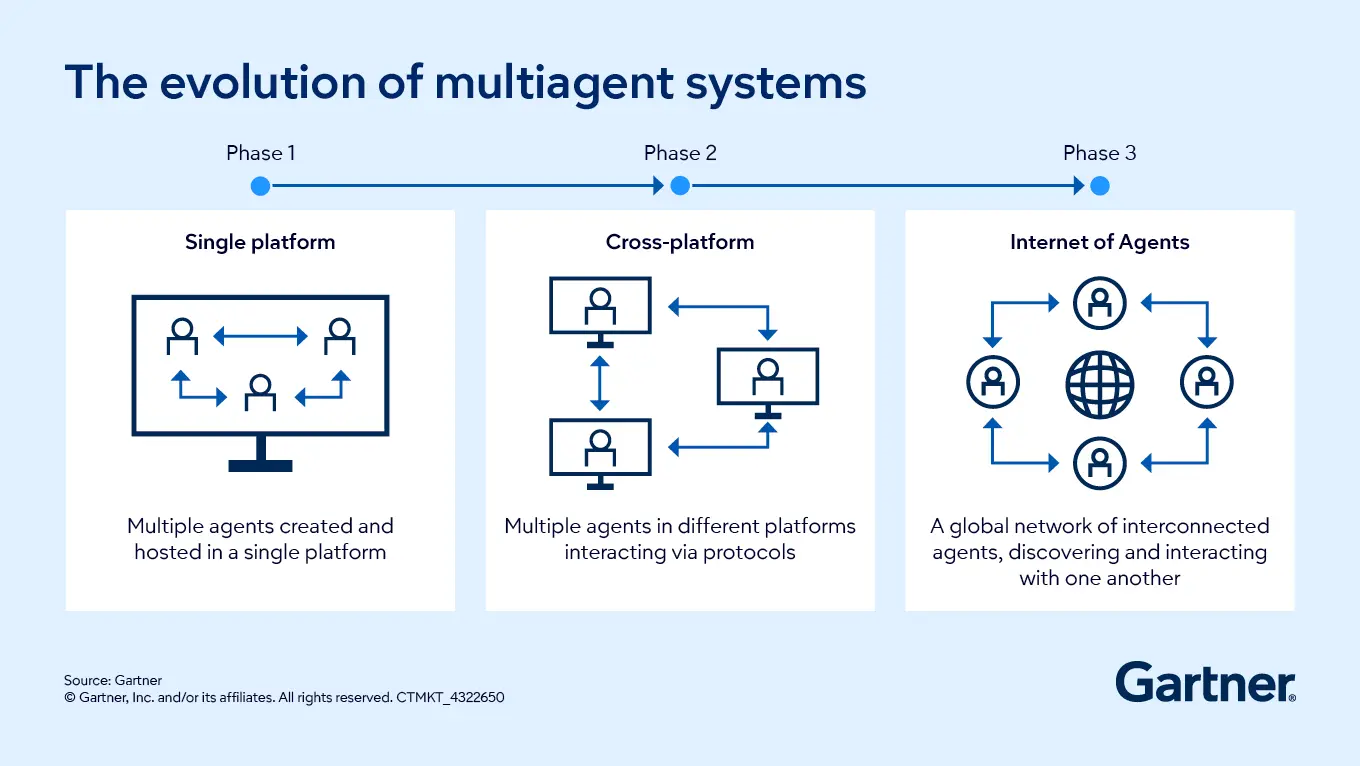
Agentic marketing does not rely on a single AI making all decisions. It uses multiple specialized agents working in collaboration, just like a high-performing marketing team.
One agent focuses on segmentation, identifying the right audiences. Another optimizes messaging and creative. A third manages channel orchestration. A fourth handles experimentation and learns from results. Together, they operate as a unified system that executes faster and more precisely than any manual process could.
This division of labor mirrors how marketing teams actually work, but without the coordination overhead, handoff delays, or communication gaps that slow human teams down.
3. Autonomy with Alignment: Strategy Stays Human, Execution Becomes Autonomous
Autonomy without alignment is chaos. This is why effective agentic systems maintain a clear separation: humans set strategy, goals, and guardrails. Agents execute within those boundaries.
Marketing leaders define OKRs, brand guidelines, compliance requirements, and strategic priorities. The agentic system optimizes execution to achieve those goals without requiring constant human intervention.
This is not about replacing marketers. It is about freeing them from repetitive tactical work so they can focus on what humans do best: strategy, creativity, and judgment.
4. Continuous Monitoring and Learning Across Campaigns
Traditional campaigns operate in isolation. Each new initiative starts with a blank slate. Marketers spend weeks testing messaging, analyzing results, and iterating to find what works. By the time they crack the formula, the campaign window has closed.
Agentic systems eliminate this learning curve by carrying insights forward. An AI agent that discovers high-performing messaging in one campaign immediately applies that knowledge to future campaigns. There is no time lost relearning what already worked.
Frequent monitoring ensures quality and speed remain aligned. The system does not just execute faster. It learns faster, adapts faster, and improves faster with every interaction.
5. Autonomous Experimentation at Scale
Always-on A/B and multivariate testing means winning patterns are identified and deployed instantly. No waiting for manual analysis. No delays while teams interpret results. The system tests, learns, and scales what works without human intervention.
6. Cross-Campaign Intelligence That Never Forgets
Insights do not disappear when a campaign ends. The system carries forward what worked and applies it to new contexts automatically. This is the compounding advantage traditional marketing can never achieve: institutional knowledge that grows stronger with every campaign.
7. Speed That Improves with Scale
Traditional marketing slows down as you add complexity. More segments, more channels, more markets mean more coordination overhead and slower execution. Agentic systems reverse this dynamic. They get faster because each new data point strengthens the learning model. Complexity becomes an advantage, not a constraint.
Which Brands are Scaling with Agentic Marketing?
The business impact is measurable. Consider these real-world examples:
Salomon deployed AI agents to rewrite product titles and descriptions using live search data. The result? A 43% increase in click-through rate and 83% growth in eCommerce revenue—all through autonomous optimization of product discovery.
Crocs India used Netcore’s multi-agent systems to identify high-value customer segments that traditional cohort analysis missed. Netcore Cloud’s Insight Agent suggested a critical high-value insight to one of our clients, Crocs, to target ‘Middle-aged consumer most likely to parent plus kid combo’ in their BOGO sale. They were able to achieve 5 million incremental revenue from this sale and 10X ROI with the help of multi-agents. Read the full case study.
Bajaj Markets implemented Netcore’s sagentic systems that identified engagement gaps, ran real-time A/B testing, and continuously refined messaging without human intervention. The outcome: a 17% month-over-month increase in app lead conversions.
Shriram Finance created a unified customer view across web, app, CRM, and call center, powered by Netcore’s funnel-aware autonomous journeys. In just six months, using agentic marketing, they achieved: 171X ROI, 130X revenue growth, and 22% decrease in cost of acquisition.
These aren’t incremental improvements; they are step-function changes in how marketing creates value.
Managing Risk in Autonomous Systems
Speed without control is dangerous. The legitimate concern with autonomous marketing is that it could compromise brand consistency, violate compliance requirements, or over-optimize for short-term metrics at the expense of long-term value.
This is why effective agentic systems include human-defined guardrails: brand guidelines that can’t be violated, compliance rules that are automatically enforced, and outcome-based optimization that balances multiple objectives. The autonomy is in execution, not in redefining what matters.
Continuous feedback loops ensure the system doesn’t drift. Marketing leaders retain strategic control; they are just freed from tactical bottlenecks.
The Compounding Advantage
Marketing has always been about learning under uncertainty. The question is whether your systems learn once or whether they learn continuously and remember everything.
Traditional marketing resets learning with every new initiative. Agentic marketing compounds it. And when learning compounds, speed compounds. When speed compounds, scale stops being a constraint and becomes an advantage.
The organizations that recognize this shift aren’t just moving faster; they& are fundamentally changing the economics of customer acquisition and retention. They are building marketing systems that get smarter, more efficient, and more effective with every interaction.
The question isn’t whether agentic marketing will become the standard. It’s whether you’ll adopt it while it’s still a competitive advantage, or after it becomes table stakes.
Ready to explore how agentic marketing can transform your growth trajectory? Request more information on agentic marketing solutions tailored to your business. Our team will show you how autonomous systems can eliminate learning latency, accelerate market expansion, and create compounding advantages that traditional marketing simply can’t match.
Contact us today to schedule a strategic consultation.

