





The marketing world has reached a turning point.
For years, we’ve relied on automation — rules, triggers, workflows — all designed to help humans move faster. But automation still waits for instructions. It still depends on us to decide what to send, when to send it, and to whom.
That’s changing fast.
In 2026, we’re entering the agentic marketing era, where AI-powered platforms act with intent — not instructions. These platforms don’t just execute workflows; they learn, adapt, and optimize campaigns in real time.
They’re not tools. They’re partners — autonomous marketing agents that predict customer intent, personalize engagement, and optimize ROI continuously. In this guide, we’ll explore what makes a platform truly agentic, highlight the key capabilities you should look for, and compare the top 5 agentic marketing platforms of 2026, including HubSpot Breeze, Agentforce, Salesforce Marketing Cloud Next, Yarnit, SuperAGI, and Netcore.
What Makes a Platform “Agentic”?
Agentic marketing platforms perceive, decide, and act autonomously to achieve your marketing goals.
Unlike traditional marketing automation, which runs on predefined rules, agentic systems operate on goals and context. You set an objective — like “increase repeat purchases by 20%” — and the system determines how to get there.
The Four Pillars of Agentic Behavior:
1. Autonomy – The platform can act without human prompts, adapting to real-time data.
2. Goal-Orientation – Campaigns optimize toward outcomes, not tasks.
3. Continuous Learning – Machine learning loops improve performance over time.
4. Cross-Channel Adaptability – Campaigns evolve dynamically across multiple touchpoints.
In short, traditional automation executes your plan; agentic systems build, adapt, and improve it for you.
Key Capabilities of an Agentic Marketing Platform
Not every “AI-powered” tool qualifies as agentic. The best platforms in 2026 go beyond automation and deliver adaptive, autonomous, and predictive marketing intelligence.
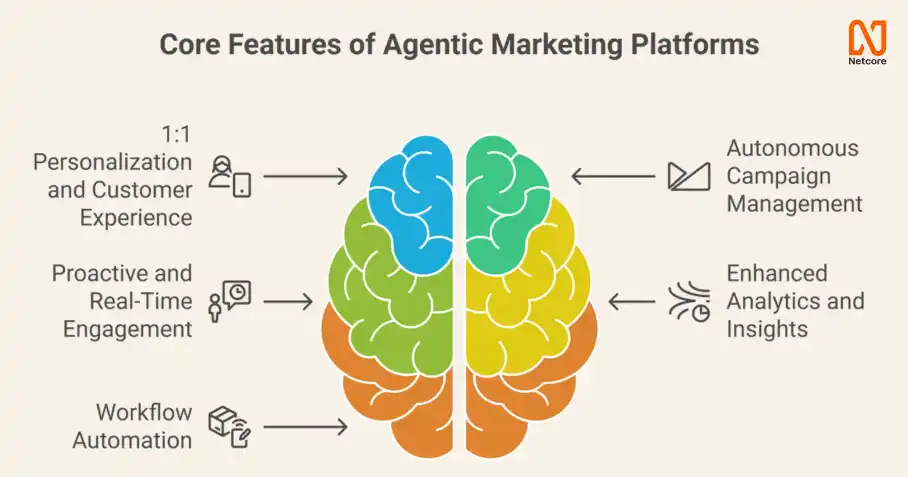
Here’s what to look for:
1. Personalization and Customer Experience
True agentic systems don’t personalize once — they personalize always.
These platforms continuously learn from user behavior, intent, and preferences to tailor messages, timing, and offers dynamically to the ‘segment of one’.
Example:
Netcore’s Segment Agent automatically builds predictive audience segments and delivers personalized product recommendations in real time — across email, WhatsApp, and app push.
2. Autonomous Campaign Management
Forget manual campaign scheduling. Agentic platforms manage campaigns like self-driving systems — learning, testing, and optimizing automatically.
They analyze customer journeys, detect drop-offs, and reallocate engagement efforts instantly.
Example: HubSpot Breeze uses AI to rebalance send frequency and optimize content delivery timing for higher conversions.
3. Proactive and Real-Time Engagement
Agentic marketing platforms don’t wait for the customer to act. They anticipate.
From detecting churn risk to identifying buying intent, these systems engage customers when the moment is right.
Example:
Netcore’s Shopping Agent predicts who’s likely to make a repeat purchase and triggers personalized offers on WhatsApp or email, reducing churn by up to 20%.
4. Enhanced Analytics and Insights
In the agentic era, reporting isn’t retrospective — it’s predictive.
The right platform delivers AI-generated insights and recommendations on what to improve next.
Example:
Salesforce’s Einstein GPT provides predictive insights into customer behavior, campaign fatigue, and next-best-action recommendations.
5. Workflow Automation
Agentic systems unify workflow automation with real-time decisioning.
Instead of static “if-then” rules, they allow agents to override workflows based on evolving patterns — ensuring that your campaigns remain relevant and adaptive.
Example:
Netcore blends workflow automation with dynamic triggers, enabling AI-driven customer journeys that evolve automatically as user behavior shifts.
How to Evaluate Agentic Marketing Platforms in 2026
Choosing an agentic marketing platform isn’t just about features — it’s about finding one that evolves with your business.
Here’s your 2026 evaluation checklist:
Platform Evaluation Checklist
| Evaluation Factor | What to Look For |
|---|---|
| AI Autonomy | Can the system operate without human input once goals are defined? |
| Integration Flexibility | Does it plug into your CRM, CDP, or ecommerce stack easily? |
| Personalization Depth | Does it deliver predictive, cross-channel personalization? |
| Ease of Use | Is it intuitive enough for non-technical marketers? |
| Scalability | Can it handle millions of interactions in real time? |
| ROI Transparency | Does it offer outcome-based metrics or pricing? |
Pro Tip:
Ask vendors to demonstrate learning speed — how their system improves campaign performance after initial deployment.
The Top 5 Agentic Marketing Platforms in 2026
Let’s break down the seven platforms shaping the agentic marketing landscape this year — each with unique strengths for different business needs.
1. HubSpot Breeze — AI-Powered Automation
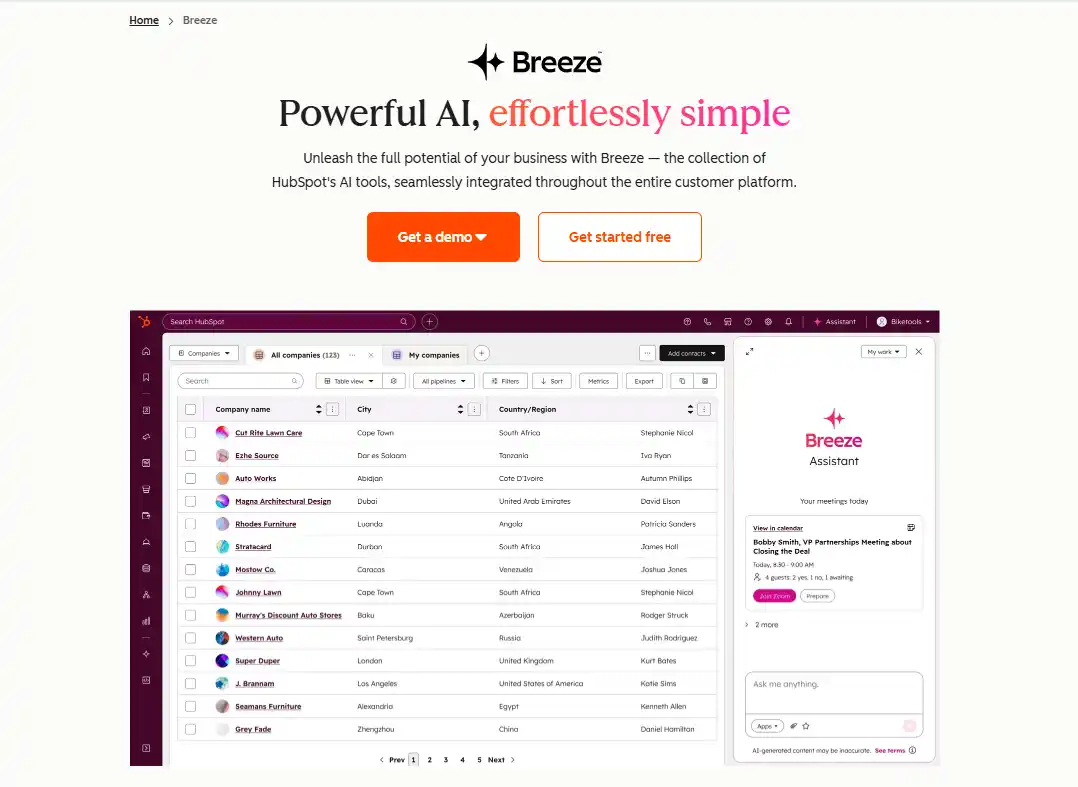
HubSpot Breeze introduces AI autonomy to HubSpot’s familiar ecosystem, making it ideal for SMBs and growing mid-market brands.
Key Highlights:
- AI-based lead scoring and follow-up automation.
- Dynamic nurture sequences that adapt to buyer intent.
- Deep integration with HubSpot CRM and Sales Hub.
Best For:
Marketing teams seeking simple, scalable AI-driven automation.
2. Netcore — Agentic Marketing for Predictive, Personalized, and Profitable Growth

Netcore is redefining marketing automation with an AI-native, agentic ecosystem built for enterprises and digital-first brands.
Key Highlights:
1. Autonomous AI Agents for Campaign Execution
Netcore’s AI agents autonomously manage everything from audience discovery to orchestration — learning continuously and surfacing real-time optimizations that boost campaign performance and ROI.
2. End-to-End Omnichannel Orchestration
AI agents seamlessly coordinate segmentation, content, and journeys across email, SMS, push, WhatsApp, and web — delivering real-time, consistent experiences that align with business goals.
3. AI-Led Content & Creative Generation at Scale
Generate on-brand copy and visuals instantly with generative AI. Launch personalized emails, pushes, and web creatives in minutes, accelerating campaign speed while keeping quality intact.
4. Product Recommendations + In-Channel Commerce
Turn engagement into revenue with 1:1 AI product recommendations and shoppable inboxes featuring carousels and instant checkout — enabling customers to buy directly within the message.
5. Measurable Uplift, Compliance & Fast Time-to-Value
Every agentic journey drives quantifiable results — higher engagement, reduced churn, and increased AOV — backed by enterprise-grade security, compliance, and scalability.
Brands like Pomelo Fashion have seen 30%+ conversion lifts after migrating to Netcore’s agentic stack.
Best For: Mid-to-large ecommerce, D2C brands, BFSI, travel, and media brands ready to embrace AI-native marketing — where every campaign is autonomous, every journey is adaptive, and every outcome is measurable.
3. Salesforce Marketing Cloud Next — Predictive Journeys at Scale
Powered by Einstein GPT, Salesforce’s new Marketing Cloud Next represents the enterprise evolution of agentic marketing. Agentforce is the brand name for the autonomous AI agents that are built inside Salesforce Marketing Cloud Next.
Key Highlights:
- Predictive journey orchestration across email, web, and ads.
- AI-driven insights into buyer intent and churn risk.
- Unified customer data with cross-cloud integration.
Enterprises seeking a global, data-driven agentic infrastructure.
4. Yarnit — Content-Driven Agentic Storytelling
Yarnit applies agentic intelligence to storytelling. It automates content creation, testing, and optimization for brand narratives.
Key Highlights:
- AI-generated storytelling optimized for engagement.
- Context-aware narrative testing across multiple formats.
- Adaptive brand voice consistency powered by fine-tuned models.
Best For: Content-led ecommerce and media brands.
5. SuperAGI — Open-Source Autonomy for AI Builders
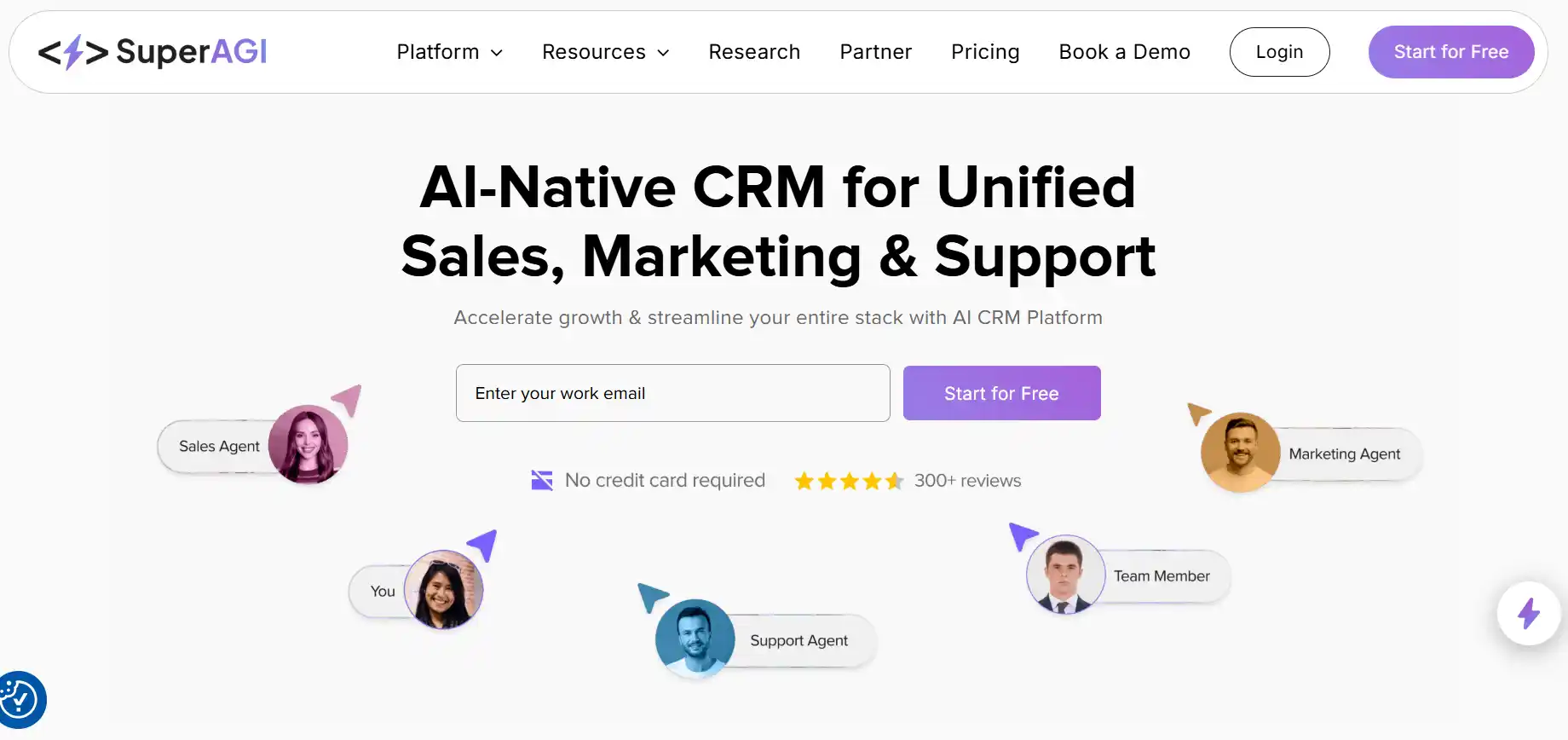
SuperAGI gives technical teams full control to build and deploy custom marketing agents.
Key Highlights:
- Open-source agentic framework.
- Plug-in ecosystem for ad testing, creative optimization, and analytics.
- Customizable workflows with autonomous decision agents.
Best For: AI-driven startups and engineering-led organizations.
Comparison: Top Agentic Marketing Platforms (2026)
The Top 5 Agentic Marketing Platforms in 2026
| Platform | Key Highlights | Best For |
|---|---|---|
| HubSpot Breeze AI-Powered Automation |
| SMBs and mid-market teams seeking simple, scalable AI-driven automation. |
| Netcore Predictive, Personalized, and Profitable Growth |
| Mid-to-large ecommerce, BFSI, travel, and media brands ready for measurable AI-native marketing. |
| Salesforce Marketing Cloud Next Predictive Journeys at Scale |
| Enterprises seeking a global, data-driven agentic infrastructure. |
| Yarnit Content-Driven Agentic Storytelling |
| Content-led ecommerce and media brands. |
| SuperAGI Open-Source Autonomy for AI Builders |
| AI-driven startups and engineering-led organizations. |
How to Choose the Right Agentic Marketing Platform
The right platform matches your marketing maturity, not just your budget. With that principle in mind, here are the tips I, as a marketer, use to shortlist an agentic marketing solution.
1. Early-Stage or SMBs
Start with HubSpot Breeze or Yarnit for fast, low-code automation and personalization.
2. Data-Rich Enterprises
Go with Salesforce Marketing Cloud Next or Netcore for scale, AI depth, and omnichannel engagement.
3. Tech-First Innovators
Explore SuperAGI or Agentforce if you want to build or customize your own AI stack.
4. ROI-Driven Marketers
Choose Netcore for its outcome-based pricing and full AI agent suite.
Tip: Start with one autonomous journey, such as churn prevention or cart recovery, and expand from there.
The Future of Agentic Marketing Platforms
By 2026, your campaigns won’t just be automated — they’ll manage themselves.
Key Trends:
- Collaborative AI Agents: Multiple agents working together across the funnel.
- Real-Time Decisioning: Systems adapting instantly to customer behavior.
- Outcome-Based Pricing: Pay for conversions, not clicks.
- Ethical AI Governance: Transparent, privacy-first data handling.
The agentic future is less about software and more about systems that think.
Final Take
Agentic marketing platforms are the natural evolution of automation — the bridge between human creativity and machine autonomy.
As we step into 2026, the question isn’t if marketers will adopt agentic systems — it’s how fast.
If you’re ready to scale personalized engagement, predict intent, and optimize performance without the heavy lift, Netcore delivers the perfect balance of AI autonomy, omnichannel orchestration, and ROI accountability.
Ultimately, your decision should hinge on finding a platform that offers clear ROI accountability for its intelligent actions. In this new era, marketing doesn’t wait for instructions — it acts, and you need a platform built for that shift.

