 Worried About Your AI Marketing Strategy? Read the Agentic Marketing 2026 Predictions Report! →





TL;DR
- This blog explains how agentic marketing works in the real world, moving beyond theory to practical, outcome-driven applications.
- It shows how agentic systems differ from manual automation by continuously learning from customer behavior, executing autonomously, and deciding next-best actions.
- You’ll explore real-world agentic marketing use cases across personalization, optimization, speed-to-market, operational efficiency, scalability, and governance.
- The blog outlines proven playbooks showing how brands apply agentic AI marketing across the full customer lifecycle.
- It also covers industry-specific agentic marketing applications in Ecommerce, BFSI, travel, subscriptions, and quick commerce.
- Key takeaway: Brands winning today apply agentic marketing where complexity is highest, and speed matters most.
Agentic marketing seems to be moving past the theoretical stage.
You might have noticed that CMOs are asking different questions now. Instead of “what is agentic marketing?”, they’re wondering: How might agentic marketing use cases actually work across different customers, channels, and situations?
That’s where a lot of AI conversations seem to lose steam. They tend to hover around features and concepts, while marketing leaders are often looking for something more concrete: real-world agentic marketing use cases and repeatable applications that could potentially drive results like revenue growth, efficiency, and customer lifetime value.
This blog explores agentic marketing applications in practice; how some brands are starting to apply these practical applications across the customer lifecycle, and why these agentic AI marketing practical applications might outperform what we’ve been doing with traditional automation.
Key to Understanding Real-World Agentic Marketing Use Cases
Think about manual workflow-based marketing systems for a moment. They’re designed for execution: running campaigns, triggering journeys, and reporting results.
Consider how these agentic marketing use cases work: continuously learning from customer behavior, determining the next best action based on business goals, and acting autonomously while learning from real-time user actions. These real-world agentic marketing use cases could fundamentally change how marketing scales and performs.
The difference becomes clearer when you look at practical applications rather than demos.
What Might Set Agentic Marketing Apart From Marketing Automation
Rule-based automation tends to assume:
- Customer behavior is predictable
- Journeys can be mapped upfront
- Humans can keep pace with optimization
But here’s what often happens instead: intent shifts constantly. Attention quietly decays. Journeys fragment across channels.
What if agentic marketing applications could work with:
- Continuous signal monitoring
- Autonomous decision-making
- Real-time execution
- Adaptive learning
These agentic AI marketing practical applications could enable marketing to respond at customer speed, something traditional automation struggles with.
Where Agentic Marketing Use Cases Could Show Up Across the Lifecycle
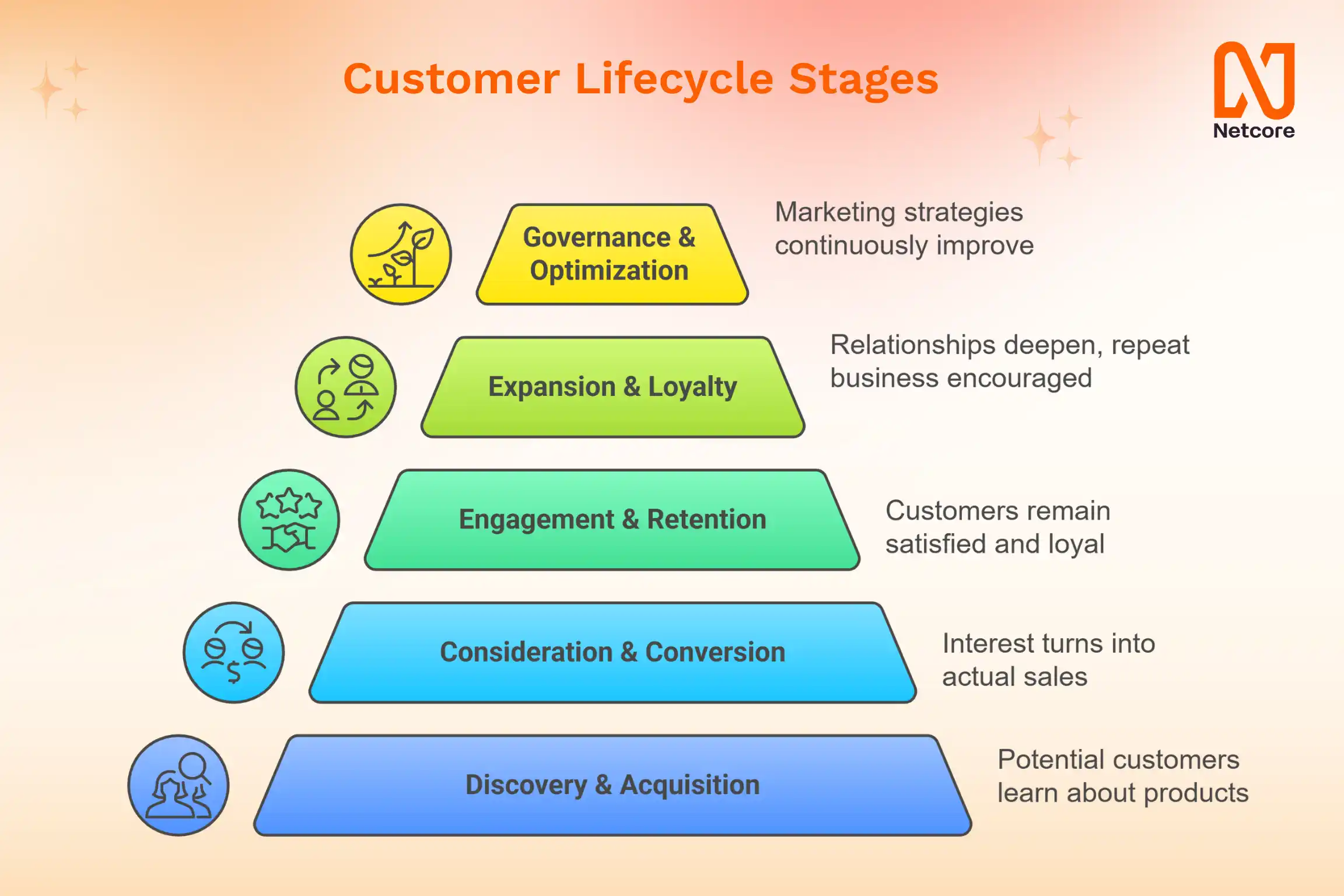
You might find agentic marketing applications appearing at five key moments:
- Discovery & acquisition
- Consideration & conversion
- Engagement & retention
- Expansion & loyalty
- Governance & optimization
Here’s how these real-world agentic marketing use cases could play out.
Use Case 1: Real-Time Personalization at Scale
Personalization often breaks down as volume grows. Teams end up using broad segments because individual relevance feels operationally impossible.
What if real-time personalization use cases could change this by personalizing decisions, not just messages? Imagine selecting content, offers, and journeys based on real-time intent rather than static attributes, one of the most compelling agentic marketing use cases today.
Potential impact: Higher conversion, lower fatigue, stronger CLTV; without multiplying your team’s workload.
Use Case 2: Continuous Autonomous Optimization
Most optimization happens weekly or monthly. Between those reviews, performance tends to drift.
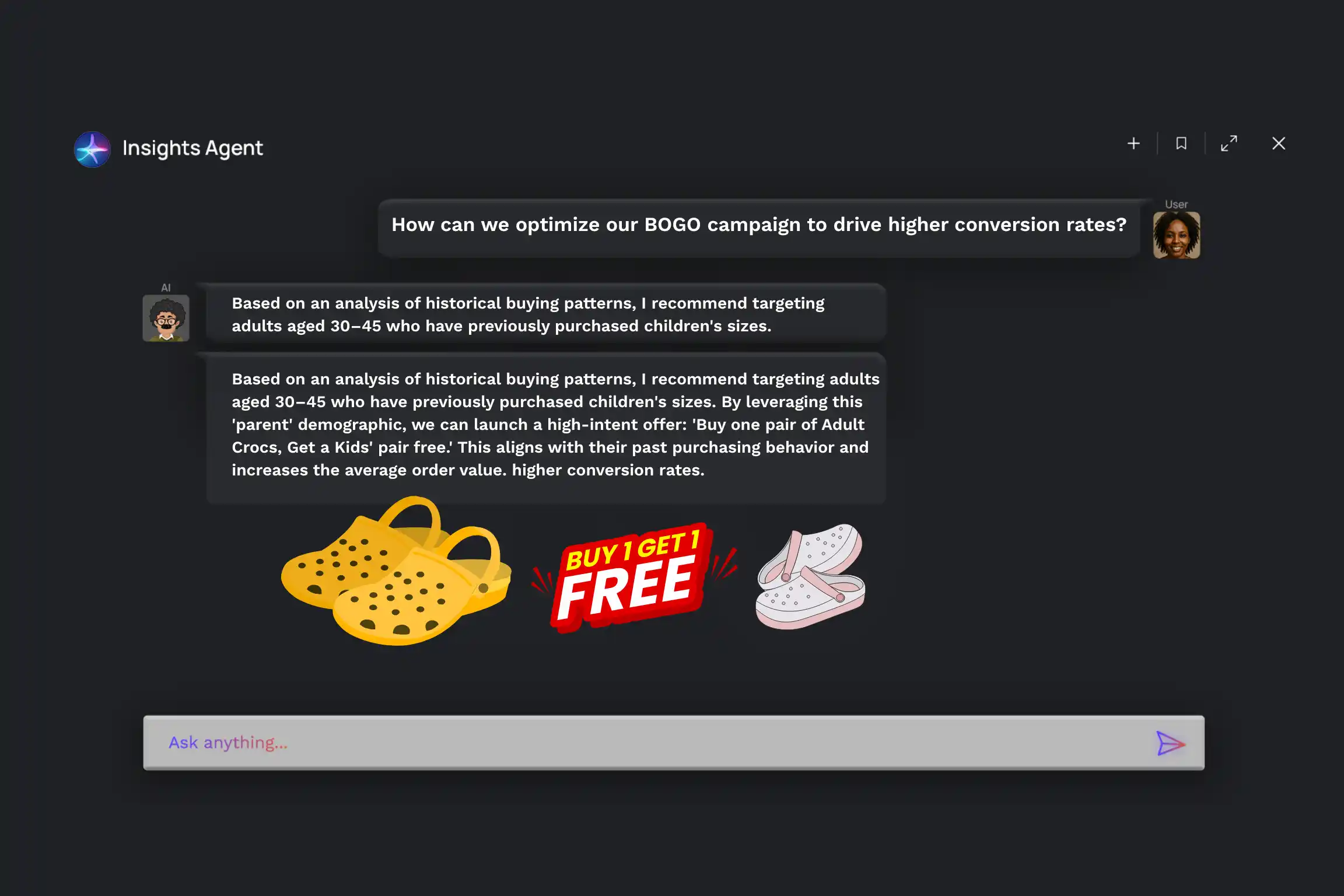
Picture this as one of the key agentic marketing applications: optimization that runs continuously; adjusting timing, channels, and engagement intensity automatically. When something underperforms, the system self-corrects without waiting for someone to notice and intervene. For example: Netcore Insights Agent surfaces critical data immediately. It identifies the next-best action, the next-best product, drop-off predictions, and churn windows. It detects content fatigue signals and presents actionable insights in under 30 seconds. Netcore Cloud’s Insight Agent suggested a critical high-value insight to one of our clients, Crocs, ‘Middle-aged consumer most likely to parent plus kid combo’ in their BOGO sale. They were able to achieve 5 Million incremental revenue from this sale and 10X ROI with the help of multi-agents. Read the full case study.
Potential impact: Performance gains that compound over time with less manual effort.
Use Case 3: Improve Marketing Efficiency
Marketing teams often lose time to dashboards, segment rebuilds, approvals, and constant firefighting.
Agentic systems could eliminate these bottlenecks by handling micro-decisions internally. Your team might stop reacting to alerts and start focusing on a bigger-picture strategy.
Potential impact: Faster execution, fewer errors, better consistency—without burning out your people.
Use Case 4: Faster Speed-to-Market With Safety
Speed usually means sacrificing control, right? These agentic marketing applications might resolve this trade-off.
By operating within defined guardrails and human-in-the-loop approvals, agents can move quickly while remaining compliant. Journeys could be launched, paused, or adapted in real time, without those risky last-minute scrambles.
Potential impact: Faster launches, safer experimentation, lower execution risk.
Use Case 5: Proactive Insights
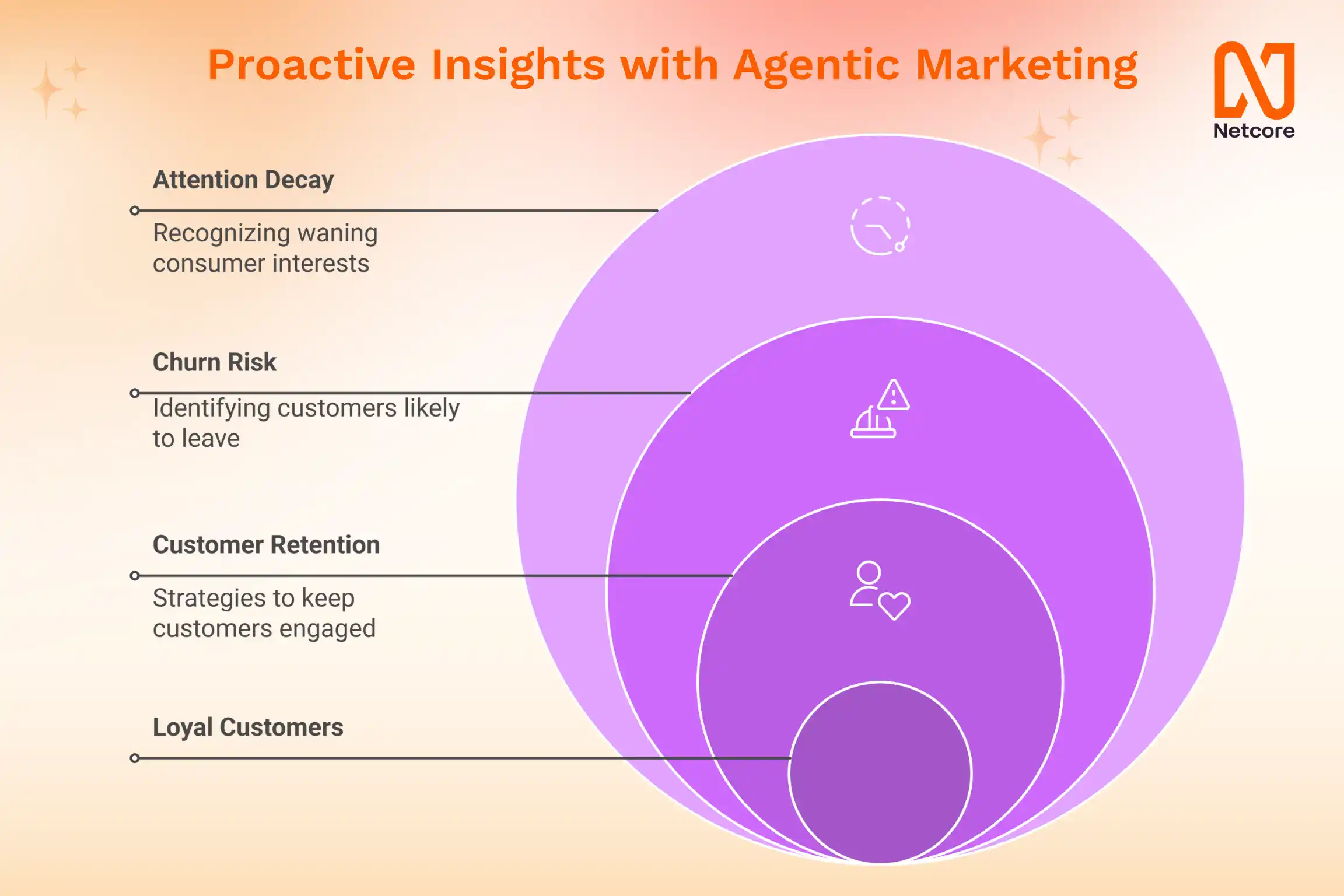
Traditional analytics explain what happened. Real-time personalization shows you what’s about to happen.
By detecting attention decay, hesitation, or churn risk early, these agentic marketing applications could enable proactive intervention before revenue walks out the door.
Potential impact: Fewer surprises, better forecasting, smarter allocation of effort.
Use Case 6: Adaptive Customer Journeys
Customers rarely follow linear paths. What if agentic marketing use cases could adapt dynamically, skipping steps, pausing engagement, or accelerating flows based on live behavior?
Potential impact: Smoother experiences, higher relevance, better satisfaction.
Use Case 7: Scalable Growth Through Agentic Marketing Applications
As customer bases grow, complexity explodes. Traditionally, that means more headcount.
These agentic AI marketing practical applications or AI agents might absorb that complexity by managing millions of micro-decisions autonomously.
Potential impact: Predictable scaling, consistent execution, lower operational drag.
Real-World Agentic Marketing Use Cases Across Different Industries
Ecommerce & D2C
Ecommerce teams often wrestle with static segments, rigid journeys, generic cart recovery, slow A/B testing, and churn models that confuse seasonality with actual disengagement. What if agentic marketing use cases could continuously sense intent and adjust discovery, offers, and journeys in real time?
For instance, among real-world agentic marketing use cases, Netcore’s Insights Agent might detect early attention decay, while the Segment Agent reclassifies users dynamically, and the Scheduler Agent adapts campaign flows automatically, guiding shoppers through personalized discovery instead of making them search blindly. Interestingly, these agentic marketing applications mirror how consumers increasingly ask AI assistants for shopping advice rather than browsing endless catalogs.
Banking & Financial Services
BFSI marketing often relies on crude demographic targeting, stale propensity models, irrelevant cross-sell attempts, rigid chatbots, and compliance bottlenecks that slow personalization. What if agentic AI marketing’s practical applications could enable trust-led journeys instead?
Netcore’s Insights Agent might detect life-stage and intent signals in real time while the campaigns are running and suggest optimizations to improve campaign ROI. The Segment Agent dynamically groups customers by financial behavior, not just age or income. These agentic marketing use cases could then deliver compliant, timely education and offers, potentially aligning marketing, sales, and service into a single, trusted experience.
Travel & Hospitality
Travel brands face long consideration cycles, mistimed engagement, disconnected pricing signals, generic upsells, and the challenge of distinguishing seasonal patterns from actual churn. Agentic marketing applications could help by continuously tracking intent across the inspiration, planning, and booking phases.
Among travel industry agentic marketing use cases, Netcore’s Insights Agent might identify price sensitivity and readiness, while the Scheduler Agent adjusts pacing, channels, and offers dynamically. Seasonal travelers wouldn’t be treated as churned; these real-world agentic marketing use cases allow engagement to pause and resume intelligently, preserving relevance and loyalty.
Subscription Businesses
Subscription churn is often caught too late, after usage has already collapsed. Recommendation engines can create echo chambers, and win-back offers sometimes feel desperate. What if agentic marketing use cases focused on the quality of engagement rather than just quantity?
These real-time personalization use cases might detect boredom and attention decay early. Netcore’s Insights Agent could spot disengagement patterns, the Segment Agent might differentiate healthy low usage from genuine disengagement, and the Content Agent could adapt content discovery and messaging tone, among the most effective agentic AI marketing practical applications for preventing churn before cancellation becomes inevitable.
Quick Commerce
Quick commerce apps often struggle with one-size-fits-all onboarding, noisy feature announcements, shallow health scores, and reactive support. What if agentic marketing applications could personalize onboarding pace using real-time behavior?
Among quick commerce agentic marketing use cases, feature education might be triggered contextually, and help could surface proactively. Netcore’s Insights Agent could identify friction moments, potentially reducing frustration and accelerating time-to-value through these practical applications.
Final Take
Agentic marketing use cases aren’t about futuristic promises or experimental AI hype. These agentic AI marketing applications are already live in the real world, powering systems that continuously decide, act, and learn so marketing operates at customer speed, not reporting speed.
The brands winning with real-world agentic marketing use cases aren’t stuck in endless experimentation cycles. Instead, they’re applying agentic marketing where complexity is highest and speed matters most: product discovery, conversion journeys, retention, and omnichannel orchestration.
If you’re exploring a partner to implement agentic marketing at scale, Netcore brings deep, hands-on expertise. We’ve helped brands like Crocs India, Fabindia, VegNonVeg, and Shriram Finance drive revenue growth and optimize campaigns using a proven Agentic Marketing Platform.

