





TL;DR
- The real churn problem starts with attention loss, not cancellations or inactivity.
- Attention retention shows up early in data through declining engagement depth, frequency, and continuity.
- Most growth teams measure outcomes downstream (conversions, revenue) instead of upstream attention decay.
- Attention Churn Rate is the leading indicator that signals growth risk long before revenue drops.
- Aggressive, interruption-led marketing accelerates attention decay instead of fixing it.
- Agentic Marketing solves attention retention by detecting decay early and intervening autonomously, in real time.
- Profitable growth is predicted by metrics like attention continuity, recovery time, and engagement depth—not just clicks and conversions.
We’ve all been in that Monday morning meeting. The dashboard shows a dip in revenue, and the room goes into a frenzy. We debate win-back strategies, we polish the loyalty program, and someone inevitably suggests, “Let’s just blast them with a 25% discount code.”
But here’s the uncomfortable truth our team realized: by the time we’re arguing over a discount, the customer is already gone. We’ve been trying to solve churn at the wrong point in time. For years, we treated churn like a sudden breakup.
In reality, it’s a slow, quiet fade. Customers don’t churn suddenly; their attention does.
Signs of Attention Retention in Data
Across almost every industry, nearly four out of five engaged customers disengage every quarter. The average click retention rate hovers around 20%. That means 80% of the people who were excited enough to click on your email or app last month haven’t come back this month.
Yet, most marketing teams aren’t tracking this. We celebrate the “Big Three”:
- Opens (They saw the envelope)
- Clicks (They stepped inside)
- Conversions (They bought something)
But these are isolated moments. They don’t answer the only question: Are the same people still leaning in, or are they slowly backing away?
The Challenges of Retaining Customer Attention
When attention is invisible, decision-making becomes reactive.
Most organizations cannot confidently answer questions like:
- Which Best customers are slipping into Rest this quarter?
- Why is the customer’s attention half-life? How long does engagement typically last before decaying?
- How much accumulated engagement usually precedes a purchase?
- Which journeys build attention, and which actively drain it?
Without these answers, marketers default to intuition—or worse, volume.
They increase frequency. They expand reach. They discount earlier. They acquire faster. These tactics may temporarily mask the problem, but they accelerate attention decay in the long run.
The Growth Problem We’ve Been Measuring Backwards
Think about a typical “Best Customer.” Let’s call her Sarah.
- Month 1: Sarah opens every newsletter, browses three categories, and buys a pair of boots.
- Month 2: She opens one email, looks at a scarf, but doesn’t buy.
- Month 3: She doesn’t open anything.
- Month 4: We realize she hasn’t bought in 90 days and send a “WE MISS YOU” coupon.
By Month 4, Sarah has already deleted the app. We tried to fix a transactional problem, but we missed the attention decay that started in Month 2.
Every transaction is just the “receipt” of accumulated attention. Before someone buys, they notice, they browse, and they return. When we only optimize for the checkout flow, we’re trying to harvest a crop we forgot to water conversions.
The Reality Check: If your traffic is stable but you’re softening, you don’t have a “close” problem. You have an attention decay problem.
Introducing Attention Churn: The Metric That Screams “Watch Out”
Customer churn is a lagging metric. It tells you who has already left the building. Attention churn rate is a leading indicator. It tells you who is standing by the exit.
It measures the percentage of previously engaged users who simply stop interacting. When we started calculating this for our partners, the numbers were sobering. Most brands are losing 80% of their “attention” every cycle.
This isn’t a creative problem. It’s not that the “subject line wasn’t punchy enough.” It’s a systems problem. Because we don’t measure attention churn, we don’t manage it. We wait for the “Revenue” fire to start before we grab the extinguisher.
The Questions We Usually Can’t Answer:
- Which of our “Power Users” are quietly slipping into the “Inactive” bucket this week?
- What is our attention half-life? How long does a customer stay “hooked” before they start to tune us out?
- Which specific marketing journeys build attention, and which ones act like a “drain”?
Why Aggressive Marketing is Killing Growth

When we don’t see attention slipping, we default to interruption. The team gets nervous about the numbers, so the campaigns get louder. The subject lines get more aggressive. The discounts get deeper.
It creates a toxic loop:
- Attention decays (Sarah stops opening).
- We panic and send 3x more emails.
- Sarah feels “spammed” and unsubscribes.
- Our margins compress because we only “win” her back with 40% off.
Attention cannot be coerced. It must be protected.
The Limits of Manual Personalization
Here is the “Aha!” moment our marketing team had: Even with the best people in the world, we cannot manually track attention at scale.
Attention decays in “micro-signals” that no human can catch in real-time:
- A session that is 15 seconds shorter than average.
- A user who usually visits on Sundays but has missed two weeks.
- Someone who used to scroll to the bottom of the page but now stops at the fold.
If you have 500,000 customers, you have 500,000 different “attention patterns.” A human team with a campaign calendar and a weekly sync is structurally too slow to catch these. By the time we pull the report, the attention has moved on to a competitor.
Agentic Marketing: Your Team’s “Sixth Sense”
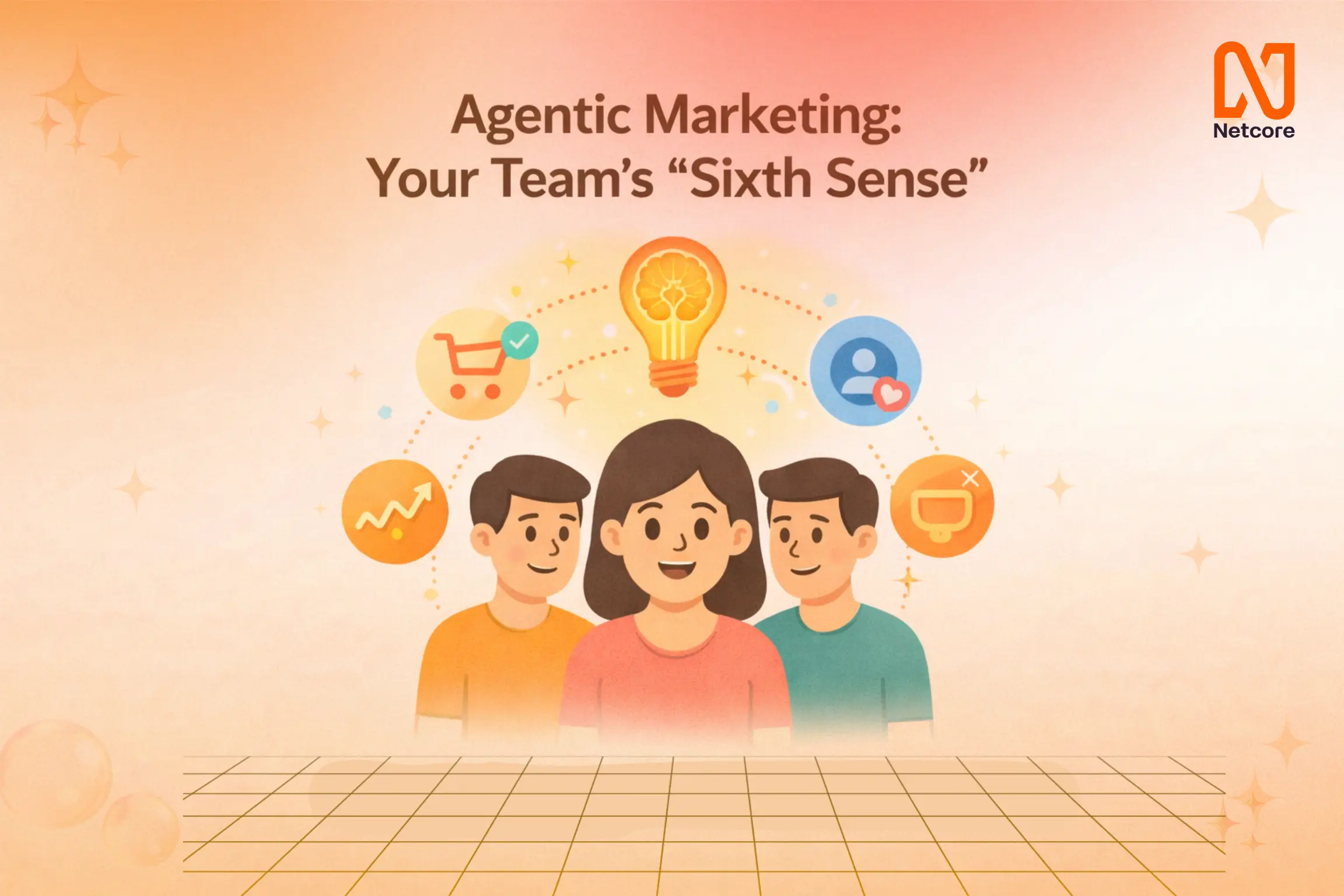
This is why we’ve moved toward Agentic Marketing. It’s not just “AI automation” (which just follows rules). It’s an autonomous layer that acts as a digital teammate.
An Agentic System doesn’t wait for you to build a segment. It:
- Observes: It watches those micro-signals of decay across millions of users.
- Detects: It flags that “Sarah is losing interest” before she stops buying.
- Acts: It intervenes in the moment—maybe by sending a helpful “How-to” guide instead of a loud sales pitch, or by simply giving her space so she doesn’t hit “Unsubscribe.”
How Agentic Marketing Solves Attention Retention
Agentic Marketing reframes growth from episodic campaigns to continuous attention management.
It enables brands to:
1. Detect Attention Churn Early
Instead of waiting for a cancellation or a period of inactivity, Netcore’s Segment Agent acts as an always-on analyst. It uses deep behavioral data analysis to identify the subtle shifts in how users interact with your brand.
- Real-Time Cohorting: Automatically group customers into cohorts based on their current engagement “velocity” rather than just their last purchase.
- Predictive Detection: Identify the exact moment a “Power User” begins to slip into the “At-Risk” category.
- Behavioral Insights: Understand the why behind the fade—whether it’s a drop in session frequency, a change in browsing depth, or a missed habitual action.
2. Understand Why Attention Is Dropping
Is it overload? Irrelevance? Confusion? Or simple friction?
Agentic systems don’t just guess; they correlate behavioral patterns with real-time context to unearth the root causes of disengagement. With Netcore’s Insight Agent, you move from staring at data to receiving specific, actionable intelligence.
By analyzing customer behavior as it happens, the Insight Agent suggests the “Next Best Action,” allowing you to optimize campaigns mid-flight. You no longer have to wait for a “post-mortem” meeting to realize you missed an opportunity; you pivot while the window of attention is still open.
To see this in action, look at a recent success story from Crocs.
While the marketing team was focused on standard discounts, the Insight Agent identified a specific behavioral trend among middle-aged users. It suggested a unique BOGO (Buy One, Get One) bundle: “Buy for you, Get Kids’ Crocs Free.” By pivoting the campaign to target this “sandwich generation” of shoppers, who are often buying for personal use and their children, the brand generated ₹50+ Lakh in incremental revenue from that campaign alone. This wasn’t a pre-planned seasonal strategy; it was a real-time tactical adjustment fueled by agentic insights.
3. Intervene in the Moment
Marketing usually moves at the speed of the campaign calendar, which is often a week too slow. Agentic systems don’t wait for the next scheduled broadcast; they act the second a signal is sent. Whether a customer is showing signs of confusion or a sudden drop in interest, the intervention happens immediately.
This isn’t just about pushing a sale; it’s about providing what the user needs in that exact micro-moment—be it a helpful guide, a reassuring testimonial, or a personalized recommendation. By closing the gap between “intent” and “action,” you rescue attention before it has a chance to wander.
4. Adapt Intensity Dynamically
In the race for growth, we often assume that more is better. But “batch and blast” is the fastest way to accelerate attention decay. Modern engagement requires dynamic restraint.
Agentic systems understand that sometimes the best way to preserve attention is to say less, not more. By sensing “message fatigue,” the system can automatically dial back the frequency for a tired user while ramping it up for one who is in a high-intent browsing fever. It’s about finding the “Goldilocks Zone” of communication—not too much, not too little, but exactly what keeps the relationship healthy.
5. Measure Attention Recovery
Most teams celebrate a “win-back” if a customer clicks on an email. But a single click isn’t a recovery, it’s just a pulse. True success is measured by Attention Recovery: seeing those “at-risk” users return to their baseline habits and engage consistently over time.
Instead of just tracking one-off conversions, we focus on the long-game metrics: Is the same cohort still with us 30, 60, or 90 days after an intervention? When you prioritize recovery over a quick click, you stop the “leaky bucket” problem and start building a compounding base of loyal, attentive customers.
From Funnels to Attention Loops
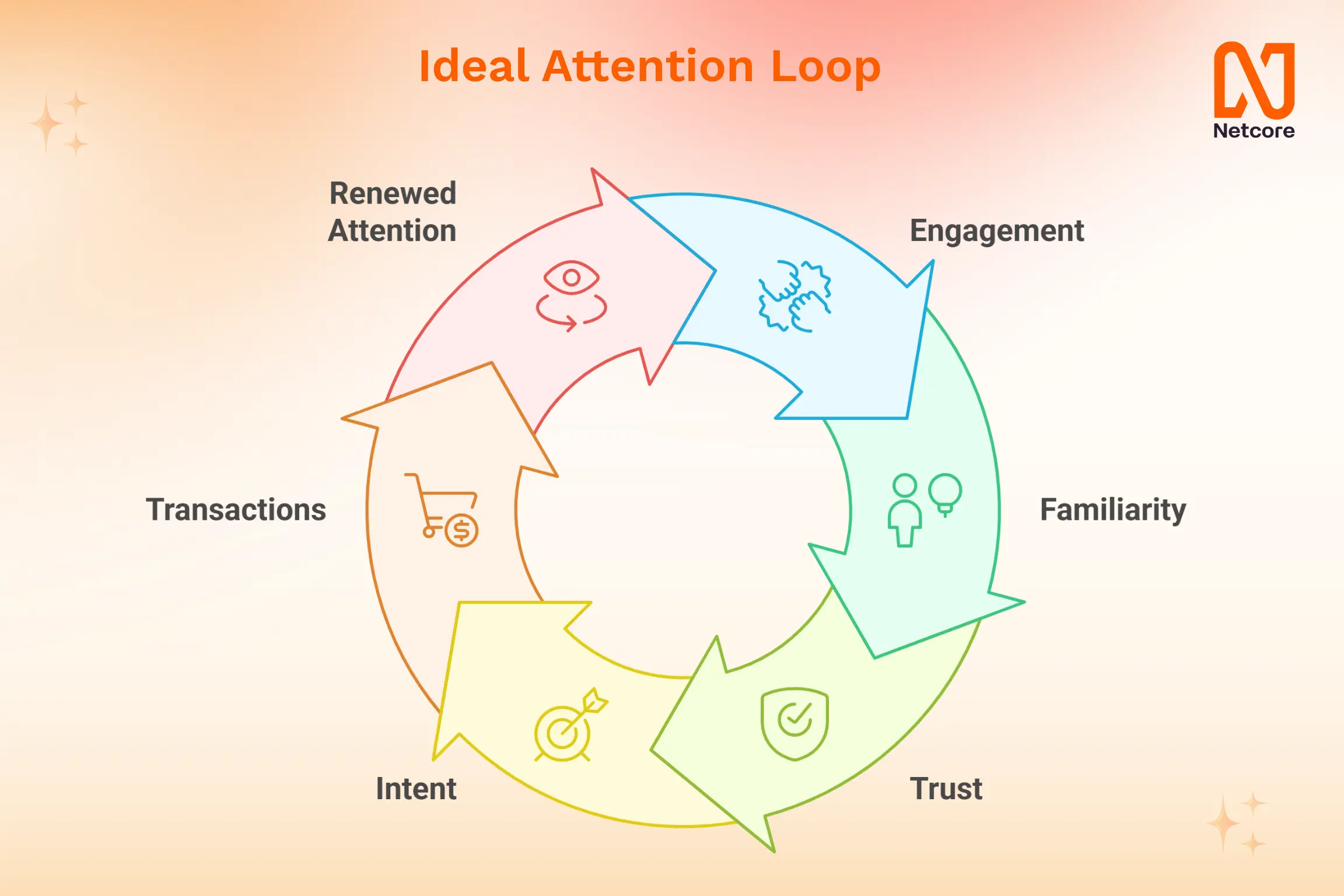
Traditional funnels assume linear progression: awareness → consideration → conversion.
But attention doesn’t move linearly. It loops. It fades. It resurfaces. It compounds—or collapses.
Agentic Marketing platform enables attention loops:
- Engagement builds familiarity
- Familiarity reinforces trust
- Trust deepens intent
- Intent leads to transactions
- Transactions renew attention
When attention is protected, growth compounds naturally. CAC declines. LTV rises. Discount dependency falls.
Measuring What Actually Predicts Profitable Growth
In 2025, attention is the new currency, and brands that fail to adapt will be left behind. In an agentic framework, the most important metrics are upstream:
- Attention Churn Rate
- Click Retention Rate over time
- Attention half-life
- Time-to-attention-recovery
- Engagement depth before conversion
These metrics explain revenue movement before revenue moves.
They allow brands to act early, not explain late.
Final Take
The brands that win the next decade won’t be the ones with the biggest ad budgets or the flashiest creative. They’ll be the most attentive.
They’ll understand that customers don’t leave when they cancel a subscription, they leave much earlier, when they stop caring about notifications, messages, and experiences that once felt relevant. By the time revenue drops, attention has already moved on.
This is why reacting to outcomes is no longer enough. Dashboards that explain what happened offer comfort, not control. The real advantage comes from recognizing what’s about to happen, and acting before it does.
It’s time to stop measuring what happened and start measuring what’s about to happen. Agentic Marketing isn’t the future of growth. It’s the minimum requirement for protecting attention today. Book a demo

