Worried About Your AI Marketing Strategy? Read the Agentic Marketing 2026 Predictions Report! →





Every ecommerce brand knows the math: acquiring a new customer costs 5 to 25 times more than retaining an existing one. Yet most brands still pour 60 to 70% of their marketing budgets into acquisition, treating retention as an afterthought. The result? A perpetual cycle of reacquisition that silently drains profitability.
The uncomfortable truth is that existing customers already drive 20 to 40% of revenue for most ecommerce brands, and 50 to 80% for mature, high-performing companies. The opportunity isn’t in finding more customers. It’s in keeping the ones you already have.But here’s the real problem: repeat purchases are not a loyalty problem. They’re an attention decay problem at scale. And traditional retention marketing simply cannot solve it.
The Hidden Cost of Losing Customers
Here’s how the cycle works. Brands spend $50 to $100 to acquire a customer. They engage them actively for 60 to 90 days. Then, roughly 80% of those customers quietly disengage. No dramatic exit. No complaints. They simply fade.
Six months later, those same brands run acquisition campaigns targeting similar audiences, unknowingly spending another $50 to $100 to reacquire customers they already had. This is the reacquisition trap, and it’s costing the industry billions.
In India alone, approximately $10 billion is spent annually on reacquiring lost customers. Globally, that figure exceeds $500 billion. The vast majority of this spend could be avoided if brands retained attention before it disappeared.
Traditional win-back campaigns try to solve this, but they trigger too late. By the time a customer is categorised as “at risk” or “churned,” the most valuable asset (attention) is already gone. Generic messaging and delayed engagement cannot recover what was never preserved.
Why Traditional Retention Marketing Breaks at Scale
Most retention strategies rely on static customer segments: active, at risk, churned. The problem? Customer behaviour changes faster than these segments refresh. By the time a customer is flagged as “at risk,” they may have already moved into a different behavioral state entirely.
Manual campaign design creates another bottleneck. Marketing teams build one-size-fits-many journeys, launch them, wait for results, analyze performance, and iterate. This process takes weeks or months. Meanwhile, customer intent shifts daily.
Then there’s the discount trap. Many brands default to blanket promotions to drive repeat purchases. The unintended consequence? Margin erosion. Price-sensitive customers learn to wait for offers, while high-affinity buyers who would have purchased at full price are unnecessarily subsidized.
The structural failure is clear: traditional retention marketing is too slow, too generic, and too reliant on reactive tactics. It cannot operate at the speed or precision required to retain attention at scale.
Reframing the Problem: Earn Attention First, Then Use It Well
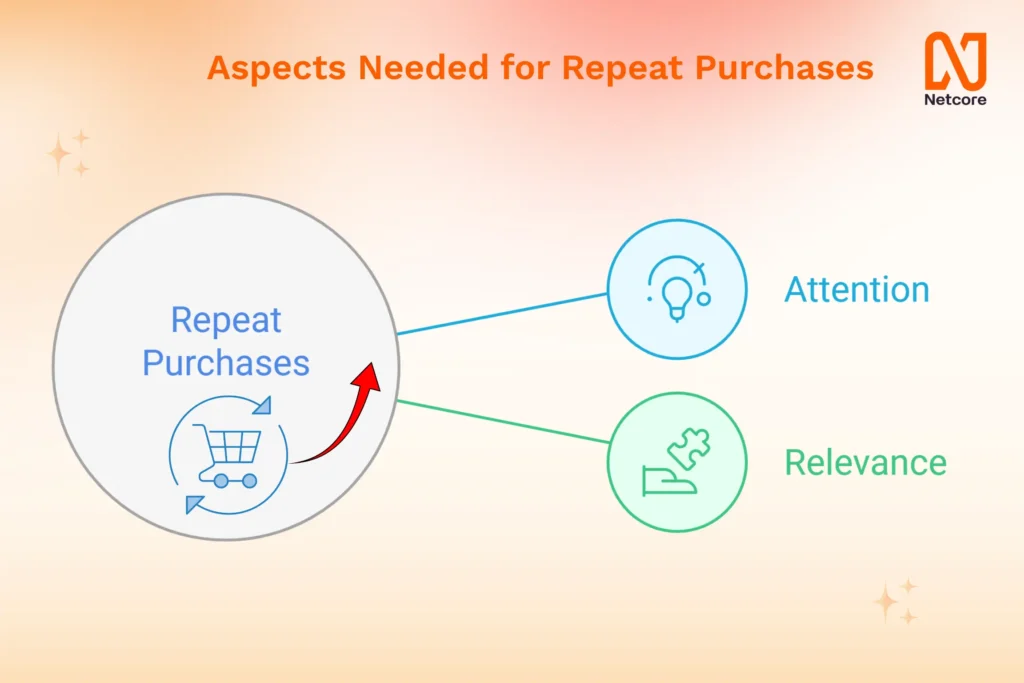
Repeat purchases require two things: attention and relevance. You cannot convert a customer who is not paying attention. And you cannot hold attention without being relevant.
The mistake most brands make is treating these as sequential problems. They try to drive conversions without first ensuring they have the customer’s attention. This is why traditional retention campaigns generate diminishing returns over time.
The solution is to prioritize earning attention before deploying conversion tactics. For the 80% of customers who disengage after initial purchase (the “rest and test” segment), this means using high-deliverability, low-cost owned channels to restore engagement before attempting to drive repeat purchases.
Once attention is reestablished, relevance becomes the differentiator. This is where agentic marketing transforms retention strategy entirely.
What Agentic Marketing Changes in Retention Strategy
Agentic marketing represents a fundamental shift from rule-based automation to autonomous decision-making. Instead of following predefined workflows, agentic systems continuously evaluate customer behavior and autonomously decide the next-best action for each individual.
The difference is profound:
Traditional automation uses rule-based triggers (if a customer does X, send message Y). Decision-making is static. Personalization happens at the segment level. Optimization is periodic, as when the marketing sets up the review call to evaluate all the campaigns and take action post discussion with decision makers.
Agentic marketing uses autonomous agents that observe behavior, evaluate context, and decide actions dynamically. Personalization is 1-to-1. Optimization is continuous. Every interaction refines future decisions.
This is exactly what repeat purchases require: timing precision, context awareness, and continuous learning. Agentic systems deliver all three at scale.
1. Hyper-Personalization at Scale
Personalization is no longer manual or slow. Agentic workflows for driving CLTV operate through real-time decisioning that adapts to each customer’s unique behavioral signals.
AI-powered product recommendations in real time. Instead of static “customers who bought this also bought that” logic, agentic systems synthesize browsing behavior, purchase history, and affinity signals to surface the right product at the right moment.
Lifecycle-aware messaging. A first-time repeat buyer needs a different engagement than a habitual buyer or a lapsing user. Agentic systems recognize these states automatically and adjust messaging accordingly.
Continuous learning from every interaction. Each click, ignore, or conversion becomes a data point that refines future actions. The system doesn’t just execute. It learns, adapts, and improves over time.
2. Building Profitable Loyalty Programs Without Eroding Margins
Blanket discounts are a false solution widely used today by multiple ecommerce brands to increase revenue. They train customers to wait for promotions, erode margins, and fail to differentiate between price-sensitive buyers and premium customers who would have purchased at full price.
Agentic marketing for repeat purchases solves this by delivering the right benefit to the right customer at the right time. Price-sensitive users receive targeted offers that nudge conversion without overspending. Premium, high-affinity buyers receive exclusive access, pre-launch drops, or member-only benefits that reinforce brand loyalty without discounting.
This level of precision requires real-time decisioning that evaluates affinity scores, lifetime value, and engagement momentum for every customer. Agentic systems make these decisions autonomously, at scale, without human intervention.
3. Re-Engaging Lost Customers Before They’re Truly Lost
Customer churn is not a sudden event. It’s a gradual decline in engagement that traditional systems detect too late. By the time a customer is labeled “churned,” recovery is exponentially harder and more expensive.
Agentic marketing changes this by identifying silent drop-offs early. Declining engagement signals (fewer opens, reduced browsing activity, channel fatigue) trigger autonomous re-engagement journeys before the customer fully disengages.
These journeys are not static playbooks. Content, timing, and channel are decided dynamically based on what is most likely to restore attention. The system experiments, learns, and adapts continuously.
The strategic benefit is substantial: owned channels become the first recovery lever, reducing dependence on expensive paid reacquisition. Paid media is used only when attention has been restored, and the probability of conversion is higher.
Real-World Proof: Agentic Marketing Driving Repeat Purchases
Consider Pomelo, a leading fashion ecommerce brand. By implementing agentic personalization through Netcore’s agentic marketing platform, Pomelo achieved a 31% uplift in conversion rates alongside a significant increase in repeat purchases. Conversion rates on APNs through wishlist low-in-stock reminder communications in 3 months.
“Netcore Cloud has proven to be a great choice for us. Their commitment to our success and their skill in simplifying a complex migration is genuinely impressive. They carefully planned and executed every step of the setup, leaving nothing overlooked. Throughout the entire process, their team offered consistent guidance, making sure we stayed on course. Their steadfast support and expertise have facilitated a smooth transition, minimizing any potential disruptions.”
Seeraj Ahmad
Global VP for Technology, Pomelo.
This proves a critical point: repeat purchases are an execution problem, not a demand problem. Customers want to buy again. The question is whether your systems can identify the right moment, the right product, and the right message to convert intent into action. Agentic systems consistently outperform static retention playbooks because they operate at customer speed, not campaign speed.
Repeat Purchases Are Won at Customer Speed
Customers don’t churn suddenly. They disengage gradually. Traditional marketing reacts too late because it operates at campaign speed, not customer speed.
Agentic marketing solves the repeat purchases problem by earning attention early, personalizing continuously, and converting relevance into loyalty. The brands winning repeat purchases today are not reacquiring customers. They are retaining attention before it disappears.
The question is not whether repeat purchase automation with AI agents will become the standard. The question is whether you will adopt it while it is still a competitive advantage, or after it becomes table stakes.
Ready to transform your retention strategy with agentic marketing?
Request more information on agentic marketing, repeat purchases solutions tailored to your ecommerce business. Our team will show you how autonomous AI systems can reduce reacquisition costs, increase customer lifetime value, and turn retention into your most predictable growth lever.
Contact us today to schedule a consultation.