 Worried About Your AI Marketing Strategy? Read the Agentic Marketing 2026 Predictions Report! →





TL;DR
- Agentic marketing features go beyond automation by enabling systems to observe, decide, and act autonomously in real time.
- The core features of agentic marketing include continuous signal monitoring, autonomous decision-making, real-time intervention, and adaptive learning.
- Unlike traditional automation or predictive tools, agentic AI capabilities for marketers focus on outcomes—revenue, retention, and LTV—not just activity metrics.
- Automated marketing agent features allow individual agents to operate independently, adjust engagement intensity, self-correct, and coordinate across channels.
- True agentic marketing platform capabilities require a unified system—combining customer data, identity resolution, real-time decisioning, and cross-channel orchestration at scale.
- The result is marketing that shifts from executing campaigns to continuously making and acting on better decisions.
Every platform claims to have “agents.” Every demo promises autonomy. Every roadmap talks about AI-driven growth. And yet, for many marketing leaders, the lived reality hasn’t changed much. Teams still spend their weeks launching campaigns, reviewing dashboards, and reacting to drops in performance after the fact.
That disconnect isn’t accidental.
Most “agentic marketing” today is still optimized for activity, not outcomes. It automates execution, accelerates workflows, and surfaces insights—but it stops short of owning results.
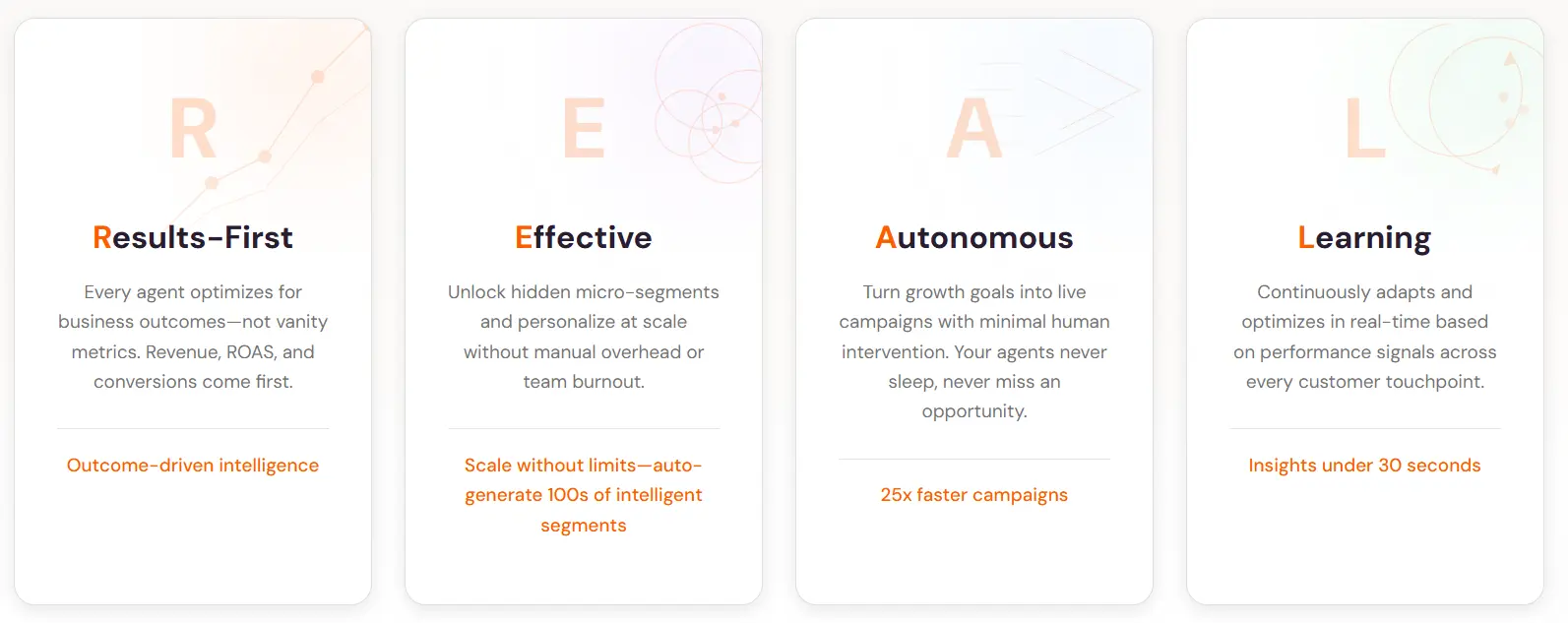
That’s why Agentic Marketing only becomes practical when it is REAL.
R – Result-focused
E – Effective, not just efficient
A – Autonomous
L – Learning always
This blog unpacks why REAL is the litmus test for evaluating agentic marketing features, and how it fundamentally changes how marketing operates.
What Makes Agentic Marketing Different From Traditional Marketing Automation?
To understand why Agentic Marketing matters, it’s important to understand what it is reacting against.
For over a decade, marketing automation has helped teams execute faster. Rules trigger emails. Journeys move customers from one step to another. Dashboards report performance. But these systems were designed for a simpler world—one where customer behavior was predictable, and change happened slowly.
That world no longer exists.
Why Rule-Based Automation Is No Longer Sufficient?
Rule-based automation assumes two things:
- You can anticipate most customer scenarios in advance
- Human teams can keep up with monitoring and optimization
Both assumptions break at scale.
Customer intent now shifts daily, sometimes hourly. Attention decays quietly, without explicit signals. By the time a rule fires or a report is reviewed, relevance has already slipped.
Rule-based systems execute instructions. They don’t evaluate whether those instructions are still the right ones.
The Defining Shift: From Execution Tools to Decision Systems
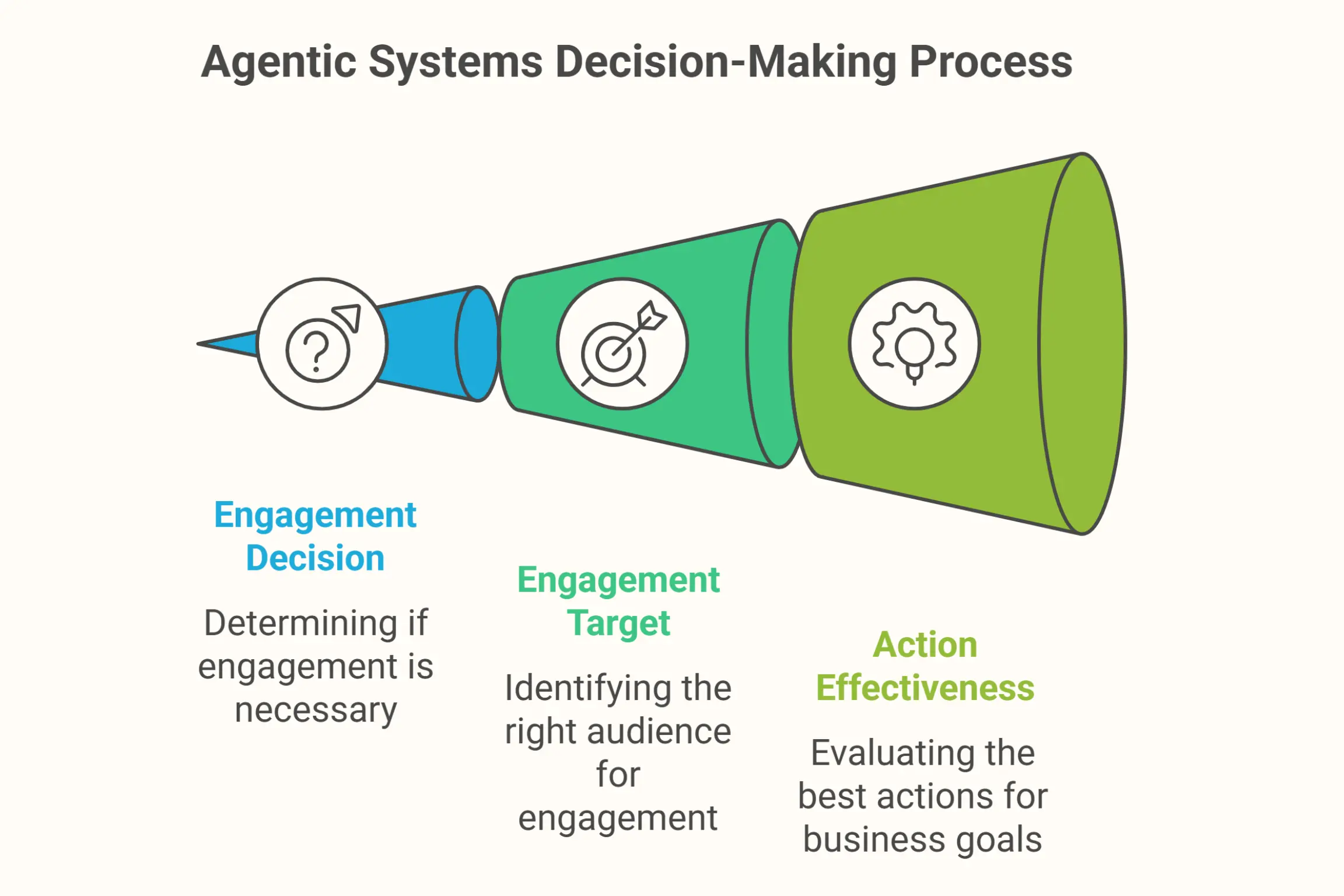
This is the fundamental shift Agentic Marketing introduces.
- Traditional automation focuses on how to execute
- Agentic Marketing focuses on what decision should be made right now
Agentic systems don’t just run workflows. They continuously decide:
- Who should be engaged
- Whether engagement should happen at all
- Which action best supports the business goal
Execution becomes a consequence of decisions, not the starting point.
How Agentic Marketing Differs From Existing Approaches
Agentic Marketing is often confused with other AI-powered tools. The differences are subtle, but critical.
- Marketing automation executes predefined paths
- Predictive analytics forecasts what might happen
- Personalization engines customize experiences within fixed rules
Agentic Marketing goes further. It decides and acts autonomously, closing the gap between insight and execution.
This distinction sets the foundation for understanding the core features that make agentic marketing real.
What Agentic Marketing Really Is
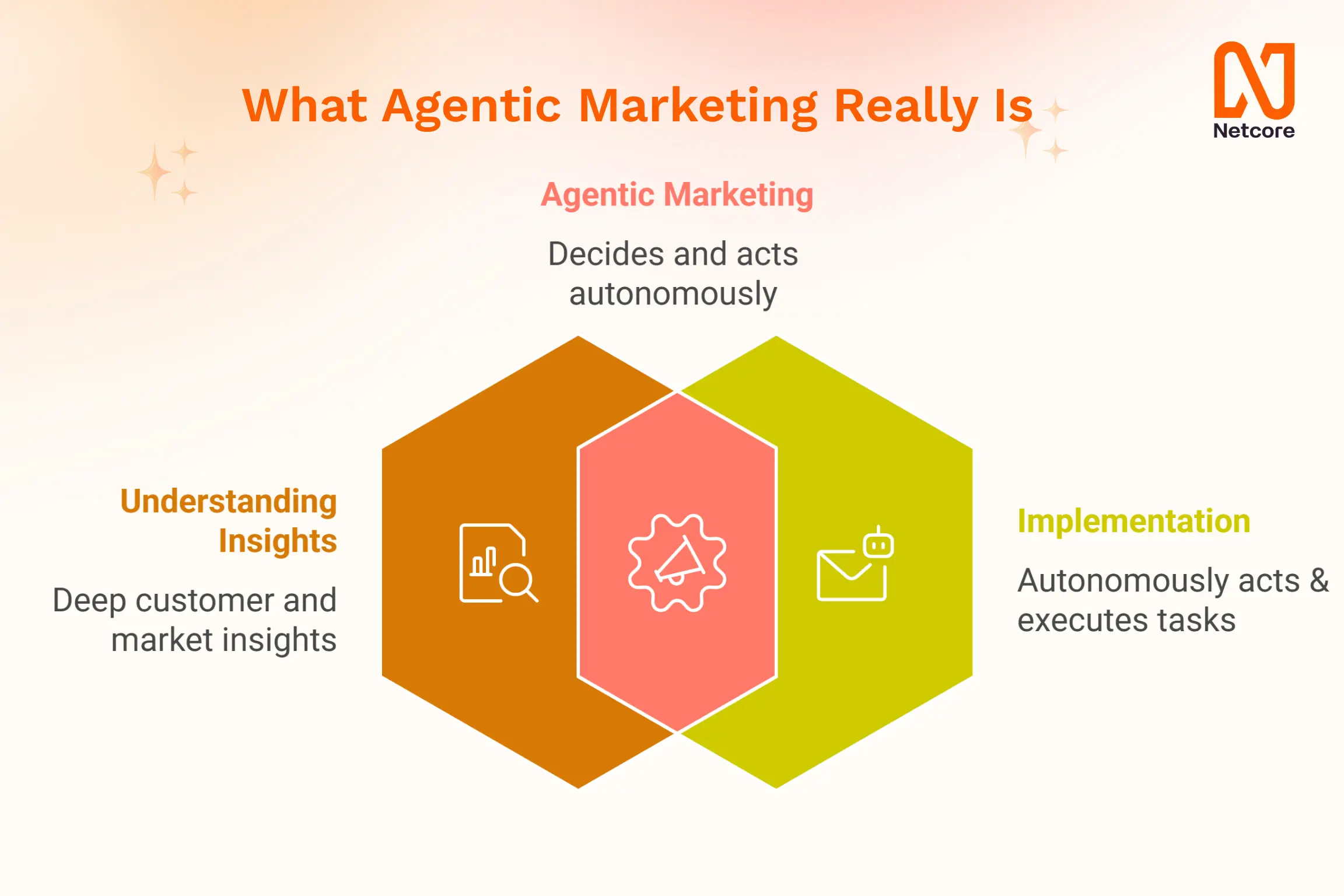
At its core, Agentic Marketing is about autonomous decision-making in service of business goals.
Not just:
- AI-powered insights
- Faster execution
- Smarter recommendations
But systems that can:
- Observe customer behavior continuously
- Decide what matters right now
- Take action without waiting for human intervention
- Learn from outcomes automatically
Many platforms stop at intelligence.
REAL Agentic Marketing goes further; it takes responsibility for outcomes.
That’s where the REAL framework comes in.
You will notice the difference when your marketing team creates entire campaigns within minutes rather than days.
R = Result-Focused: From Activity Metrics to Business Outcomes
Most marketing systems still reward motion.
Clicks. Opens. Impressions. Campaign volume.
These metrics are easy to track, easy to optimize, and easy to mistake for progress. But they rarely answer the only question leadership truly cares about:
Is marketing driving profitable growth?
REAL Agentic Marketing flips the starting point.
Instead of asking:
- “Which campaign should we run next?”
- “How do we improve open rates?”
The question becomes:
- “What business outcome are we trying to achieve?”
For example:
- Increase repeat purchases by 15% this quarter
- Reduce churn among high-value customers
- Improve lifetime value without increasing discounts
Once the goal is defined, the system works backwards:
- Which customers influence this outcome?
- Which behaviors predict success or failure?
- Which actions move the needle, not just activity metrics?
This shift is foundational. Agentic Marketing becomes real when the system optimizes for results, not motion.
E = Effective, Not Just Efficient: Doing the Right Things
Speed is meaningless if it’s pointed in the wrong direction.
Many marketing teams have become incredibly efficient at executing playbooks that no longer reflect reality. Campaigns are launched on schedule. Journeys run flawlessly. Automation fires exactly as designed.
And yet, results stall.
Why? Because efficiency amplifies whatever strategy you’re running. If the strategy is outdated, you simply fail faster.
REAL Agentic Marketing prioritizes effectiveness over efficiency.
Instead of relying on last quarter’s winners, agentic systems:
- Analyze real-time customer behavior
- Detect emerging intent or hesitation
- Identify which actions are likely to drive outcomes now
This means:
- Pausing campaigns that are technically “working” but no longer relevant
- Shifting focus from volume to impact
- Allocating effort where marginal gains actually exist
Effectiveness is about doing fewer things that matter more. Agentic Marketing becomes real when systems can make that judgment autonomously.
A = Autonomous: Letting Systems Decide and Act
Autonomy is the most misunderstood and most critical pillar of Agentic Marketing.
Many platforms still require humans to:
- Review alerts
- Approve actions
- Adjust rules by defining logic
- Trigger execution
That may feel safe, but it introduces delay. And delay is expensive.
REAL Agentic Marketing systems operate within guardrails, not scripts.
Marketers define:
- Goals
- Constraints
- Brand principles
- Risk thresholds
Agents handle:
- Micro-decisions
- Timing
- Channel selection
- Message intensity
- Journey adjustments
This autonomy matters because modern marketing is a game of thousands of small decisions, not a few big ones. Humans cannot monitor and respond to each one in time.
Autonomy doesn’t remove control; it removes bottlenecks.
Agentic Marketing becomes real when marketers focus on strategy and direction, while agents manage tactical execution at scale.
L = Learning Always: Systems That Compound Over Time
Traditional marketing systems reset too often.
Each campaign is treated as a new experiment. Learnings are reviewed manually. Optimizations happen periodically. And much of the intelligence is lost between cycles.
REAL Agentic Marketing systems don’t reset. They compound.
Every interaction feeds the system.
Every success or failure refines future decisions.
Every customer response improves prediction accuracy.
Over time, the system learns:
- Which signals truly predict conversion or churn?
- How do different segments respond to different interventions?
- When to engage, and when to stay silent?
This continuous learning creates an advantage that’s hard to replicate. While competitors rely on periodic optimization, agentic systems improve quietly, every day.
Agentic Marketing becomes real when performance improves without additional manual effort.
Agentic AI Capabilities for Marketers
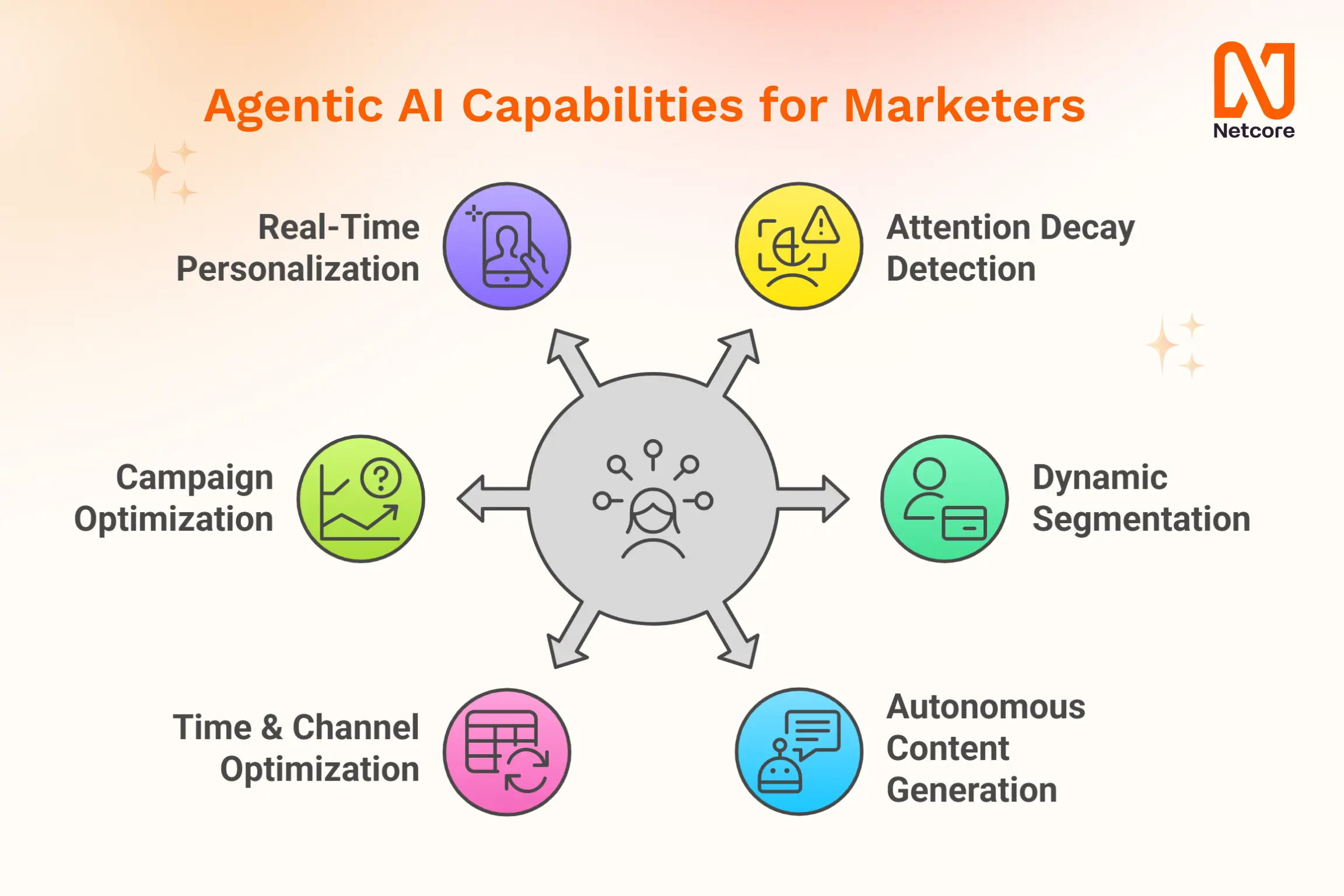
Marketers don’t need more AI complexity. They need AI that reduces cognitive and operational load. Agentic AI capabilities should translate directly into clear outcomes for teams.
Instead of asking, “What models does this platform use?”, marketers should ask:
- What decisions does this system make for me?
- What effort does it remove?
- What risk does it reduce?
The most valuable agentic AI capabilities include:
- Early Detection of Attention Decay and Churn Risk
Churn doesn’t start with cancellation. It starts with disengagement.
Agentic AI detects early signals—reduced engagement, longer gaps, shallow interactions—allowing teams to intervene before customers go dormant.
- Dynamic Segmentation Based on Real-Time Intent
Segments shouldn’t be rebuilt monthly.
Agentic systems continuously reclassify customers based on live behavior, ensuring messaging reflects current intent—not outdated assumptions.
- Context-Aware Content and Message Selection
Instead of blasting predefined messages, agentic AI selects content based on:
- Customer context
- Journey stage
- Recent behavior
- Attention sensitivity
This improves relevance without increasing message volume.
- Channel and Timing Optimization per Individual
Agentic AI in marketing determines:
- Which channel works best for each customer?
- When are the customers most receptive? Time.
- How frequently should they engage?
This protects attention while improving engagement efficiency.
- Journey Adaptation Without Manual Reconfiguration
Customers don’t follow linear paths. Agentic systems adapt journeys in real time—skipping steps, changing intensity, or redirecting flows without manual rebuilds.
Where Most “Agentic” Platforms Fall Short
Many platforms claim to be agentic but fail the REAL test.
Common gaps include:
- Insights without execution (R missing)
- Automation without decision-making (A missing)
- AI features without outcome accountability (E missing)
- Models that don’t improve without manual tuning (L missing)
These systems may look sophisticated, but they still depend heavily on human intervention. They assist marketing, they don’t transform it.
Why REAL Agentic Marketing Changes the Marketing Role Itself
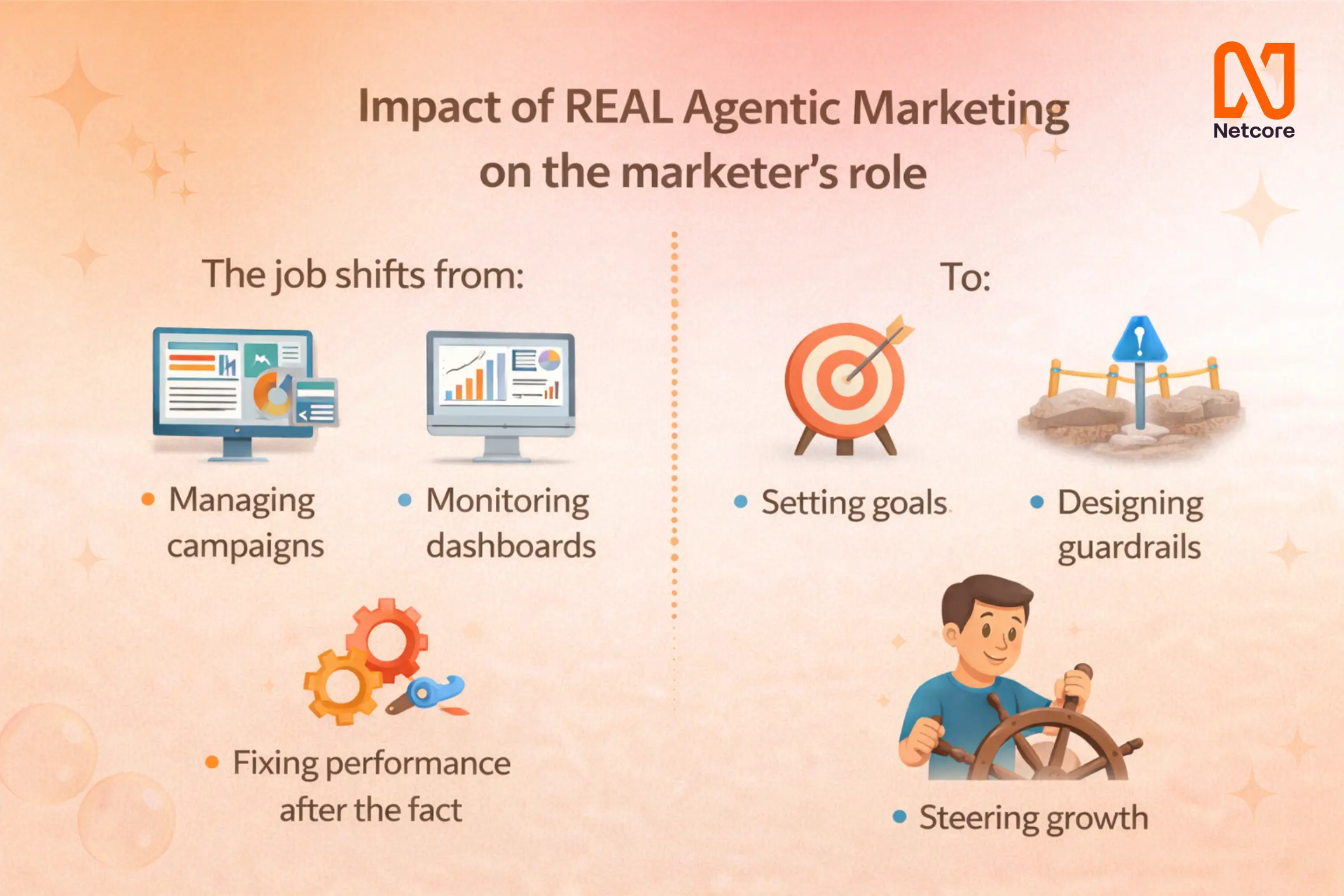
One of the most powerful effects of REAL Agentic Marketing is how it reshapes the marketer’s role.
As agents take over continuous decision-making, marketers regain:
- Time to think strategically
- Space to design better experiences
- Freedom to experiment without operational drag
The job shifts from:
- Managing campaigns
- Monitoring dashboards
- Fixing performance after the fact
To:
- Setting goals
- Designing guardrails
- Steering growth
Agentic Marketing doesn’t replace marketers. It finally lets them do the work only humans should be doing.
Final Take
The point of agentic marketing isn’t to run campaigns faster—it’s to make better decisions, sooner, and tie every action back to business results. If a platform only surfaces insights or automates predefined journeys, it’s still operating in an automation mindset.
Real agentic marketing requires non-negotiables: continuous signal monitoring, autonomous decision-making, real-time intervention, and learning that improves performance over time. When those capabilities work together as a coordinated platform—unifying data, identity, and cross-channel orchestration—marketing shifts from reacting to outcomes to shaping them.
Evaluate agentic marketing features through one lens: do they help you measure and move revenue, margins, and LTV—not just clicks and impressions? That’s the difference between AI that looks impressive and AI that actually works.

