




Fashion has always operated at the speed of change. Trends rise and vanish in weeks. Consumer intent shifts in moments. Demand is influenced as much by cultural signals and social virality as by merchandising strategy. Few industries expose the limits of traditional marketing systems faster.
And that is exactly why fashion is becoming one of the most important proving grounds for agentic marketing.
For years, fashion brands have relied on increasingly sophisticated MarTech stacks to personalize engagement, recover abandoned carts, drive repeat purchases, and optimize omnichannel journeys. But beneath the sophistication sat the same constraint: human-built logic trying to keep pace with customer behavior that moved faster than rules ever could.
That model is beginning to break.
Agentic marketing offers something different: autonomous systems that do not simply automate journeys, but pursue outcomes. Systems that can perceive signals, reason within context, take action, and optimize continuously.
In fashion, where timing, relevance, and customer lifetime value determine margin, that shift is becoming transformational.
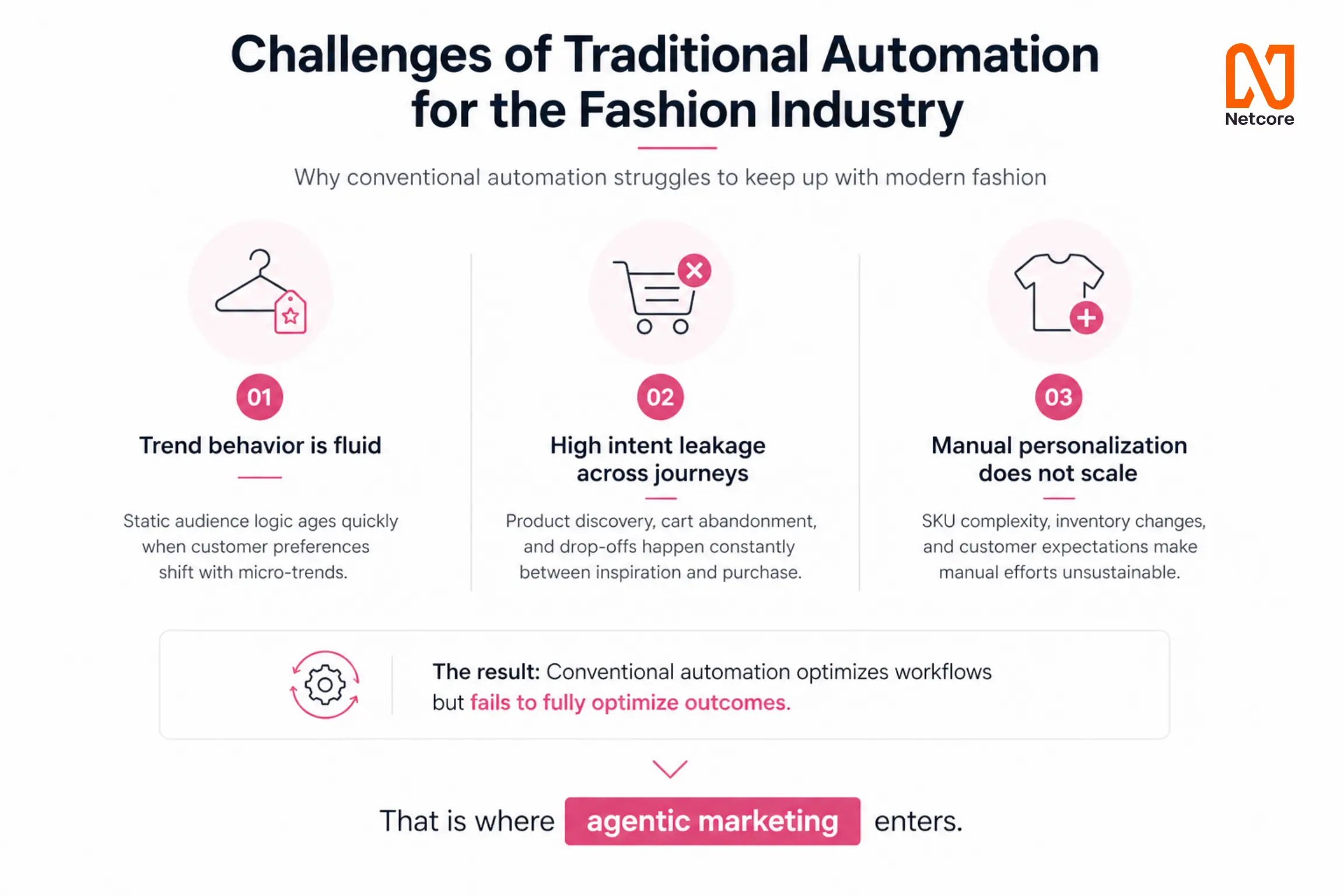
Challenges of Traditional Automation for the Fashion Industry
Fashion has always had a personalization challenge disguised as a merchandising challenge.
A customer browsing premium sneakers this week may be responding to price sensitivity, trend affinity, seasonality, or social influence. Traditional segmentation struggles to interpret those signals dynamically. Rules-based journeys struggle even more.
Three structural pressures have made that gap harder to manage.
First, trend behavior is fluid. Static audience logic ages quickly when customer preferences shift with micro-trends.
Second, fashion journeys have unusually high intent leakage. Product discovery, cart abandonment, and drop-offs happen constantly between inspiration and purchase.
Third, manual personalization does not scale against the SKU complexity of modern retail.
The result is a category where conventional automation often optimizes workflows without fully optimizing outcomes.That is where agentic marketing enters.You can also read agentic marketing vs automation to know more about teh differentiation.
What Agentic Marketing Looks Like in Fashion
In fashion, agentic marketing is not simply personalization powered by AI.
It is coordinated autonomous decisioning across the entire customer lifecycle.
- An Insights Agent surfaces hidden buying patterns and detects intent signals in real time.
- An Audience Agent continuously refreshes micro-segments around style affinities, engagement behavior, and purchase propensity.
- A Content Agent dynamically generates creative variants tailored to those audiences.
- A Decisioning Agent determines the next-best action for each customer.
- A Scheduler Agent optimizes when and where that action should happen.
- And a Shopping Agent embeds commerce directly inside the engagement itself.
Individually, these improve tasks. Together, they create an autonomous growth system.
Deep Dive into Agentic Marketing Fashion Case Study
Facing retention challenges and the need to drive higher-value repeat engagement, Crocs deployed agentic retention strategies that moved beyond static segmentation and campaign-led optimization.
The system identified a high-value “parent-plus-kid” audience pattern conventional targeting had overlooked, a signal surfaced through autonomous insight discovery rather than manual analysis.
From there, agentic orchestration took over. Learn how in the success story.
Dynamic audience formation continuously refines targeting. Personalized interventions were deployed autonomously.
Offers, messaging, and product recommendations are adapted based on behavior signals.
The result was not a marginal performance lift.
It was a reported 7X return on ad spend, alongside $5 million in incremental revenue generated from a segment traditional approaches had missed.
The significance was not just the performance.
It was how the performance was achieved.
An autonomous system outperformed the manually optimized workflow it replaced.
Five Agentic Marketing Use Cases Fashion Brands Can Replicate
We have covered generic agentic marketing use cases earlier but here are some use cases especially for fashion ecommerce brands to take inspiration from:
1. Dynamic Trend-Based Micro-Segmentation
Fashion customers do not fit neatly into fixed personas.
Agentic segmentation allows brands to build micro-audiences based on emerging style signals, category affinities, and behavior shifts, reportedly up to 50 times deeper than traditional rules-based approaches.
That precision changes relevance. And relevance changes conversion.
2. Autonomous Cart Recovery
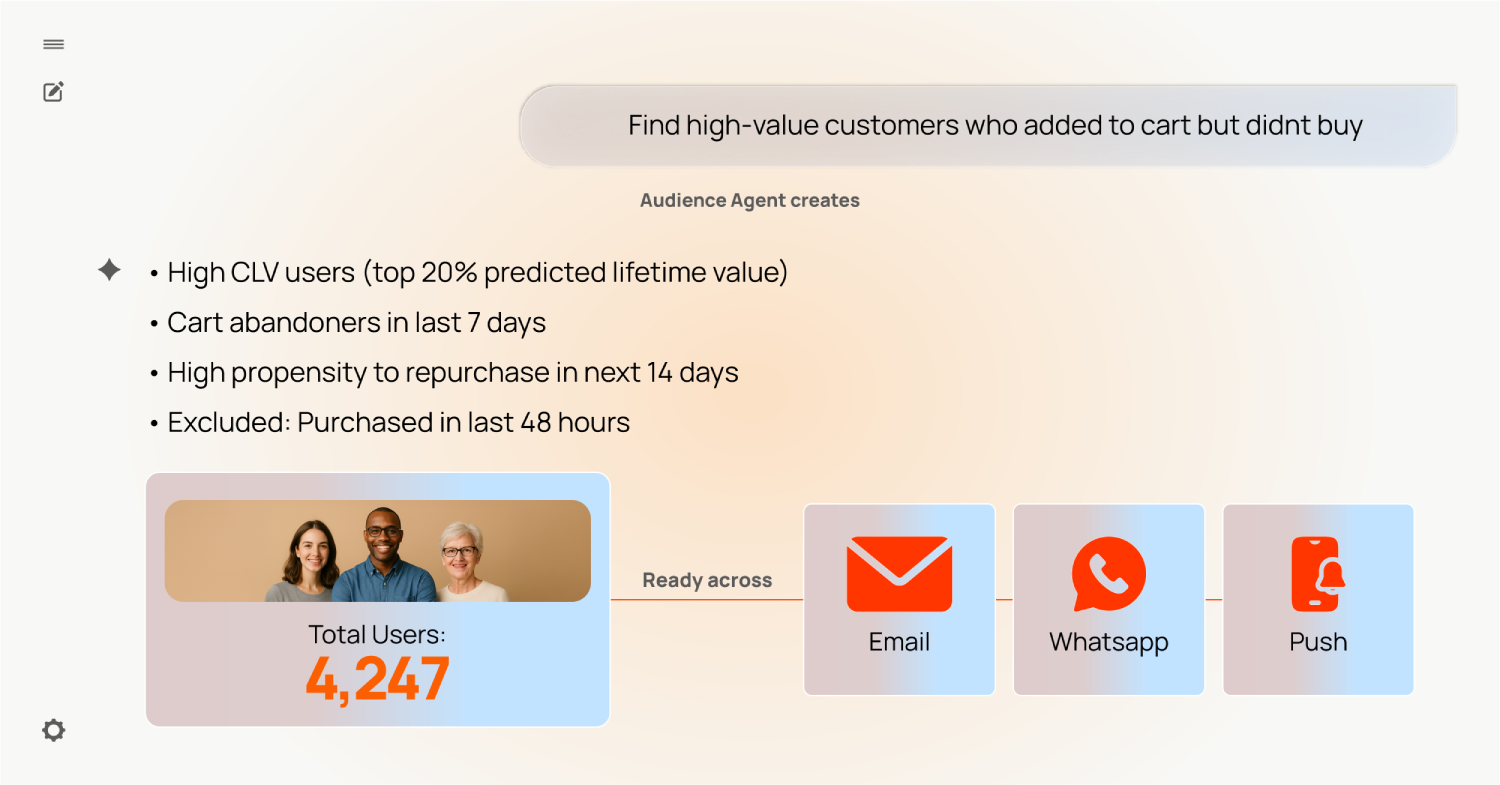
Traditional abandonment journeys operate on static timing.
Agentic systems reason about why abandonment happened, determine the most effective intervention, and deploy recovery strategies in real time.
Not every abandoned cart needs a discount.
Some need urgency. Some need reassurance. Agents can decide.
3. Personalized Product Discovery at Scale
Fashion discovery is often where revenue is won or lost.
By combining product intelligence with behavioral signals, agents can guide discovery dynamically, surfacing what a customer is likely to want before they explicitly ask.
That moves personalization from reactive to anticipatory.
4. Conversational Commerce
This may be one of the biggest shifts ahead.
Shopping Agents bring commerce into the conversation itself, enabling browsing, recommendation, and purchase without leaving the engagement channel.
The friction between intent and transaction collapses. And so do drop-offs.
5. Predictive Retention and Loyalty Activation
Retention in fashion is often treated as campaign work.
Agentic systems turn it into continuous decision-making.
They identify churn risk, choose interventions autonomously, and optimize toward lifetime value rather than isolated purchases. That changes retention economics.
What It Changes for Fashion Customer Experience
For customers, this shows up as a fundamentally different brand relationship.
From relevant experiences to anticipatory ones. From siloed channels to genuine omnichannel orchestration.
From transactional shopping to conversational shopping. From delayed brand responses to real-time adaptation.
A brand no longer merely reacts well. It appears to understand.
And in fashion, that perception often determines loyalty.
The Future of Fashion Marketing Is Agentic
The long-term implications reach far beyond campaign optimization.
Agentic systems could reshape merchandising intelligence, lifecycle engagement, loyalty economics, and even how brands think about customer relationships.
The role of marketers shifts, too. Less manual orchestration.
More strategic supervision. Less campaign management.
More autonomous outcome management. That is not simply the next layer of retail AI.
It is a new operating model for growth.
Final Take
In fast-moving categories like fashion ecommerce, relevance has a half-life. If your brand does not surface at the exact moment intent forms, someone else will, with a better offer, a free goodie, or simply a lower price.
That is why fashion may be the clearest natural fit for agentic marketing.
Because in a market shaped by fleeting attention, trend volatility, and instant switching behavior, manually managed campaigns are too slow. Agentic systems can anticipate signals, act in real time, and keep a brand present in the consumer’s consideration set before competitors capture the moment.
And that may be the deeper value of agentic marketing in fashion, not just improving conversions, but helping brands infiltrate the minds of consumers first, when preference is still being formed.
That is not better automation. It is competitive defense at machine speed. And increasingly, it is what winning in fashion looks like. Want the same for your business? Request demo.