




TL;DR
- BFSI brands lose high-intent leads because traditional nurture journeys rely on static reminders and delayed follow-ups.
- Agentic marketing uses AI and real-time behavioral intelligence to detect drop-off risks, personalize engagement, and recover leads proactively across channels.
- Instead of generic workflows, agentic systems continuously optimize messaging, timing, and channel selection based on customer intent.
- The future of BFSI growth will depend on autonomous, AI-driven customer engagement that reduces lead leakage and improves conversion efficiency at scale.
Most BFSI brands today are generating more leads than ever before across loans, credit cards, insurance, investments, and banking products. The real challenge begins after acquisition.
Customers start applications but never complete them. They compare competitors mid-journey. They ignore generic follow-ups. They abandon onboarding flows due to friction, delays, or irrelevant communication.
The result? Massive lead drop-offs across the funnel.
Traditional marketing automation systems were never designed to solve this problem intelligently. Most BFSI engagement journeys still rely on:
- Static drip campaigns
- Generic reminders
- Fixed retargeting schedules
- Manual segmentation
- Channel-specific communication silos
But financial decisions are highly intent-driven and time-sensitive. A customer exploring a personal loan behaves very differently from someone comparing Demat accounts or insurance plans. Treating every lead the same creates disengagement instead of conversions.
This is where agentic marketing changes the operating model.
Why Traditional BFSI Journeys Fail to Prevent Drop-Offs
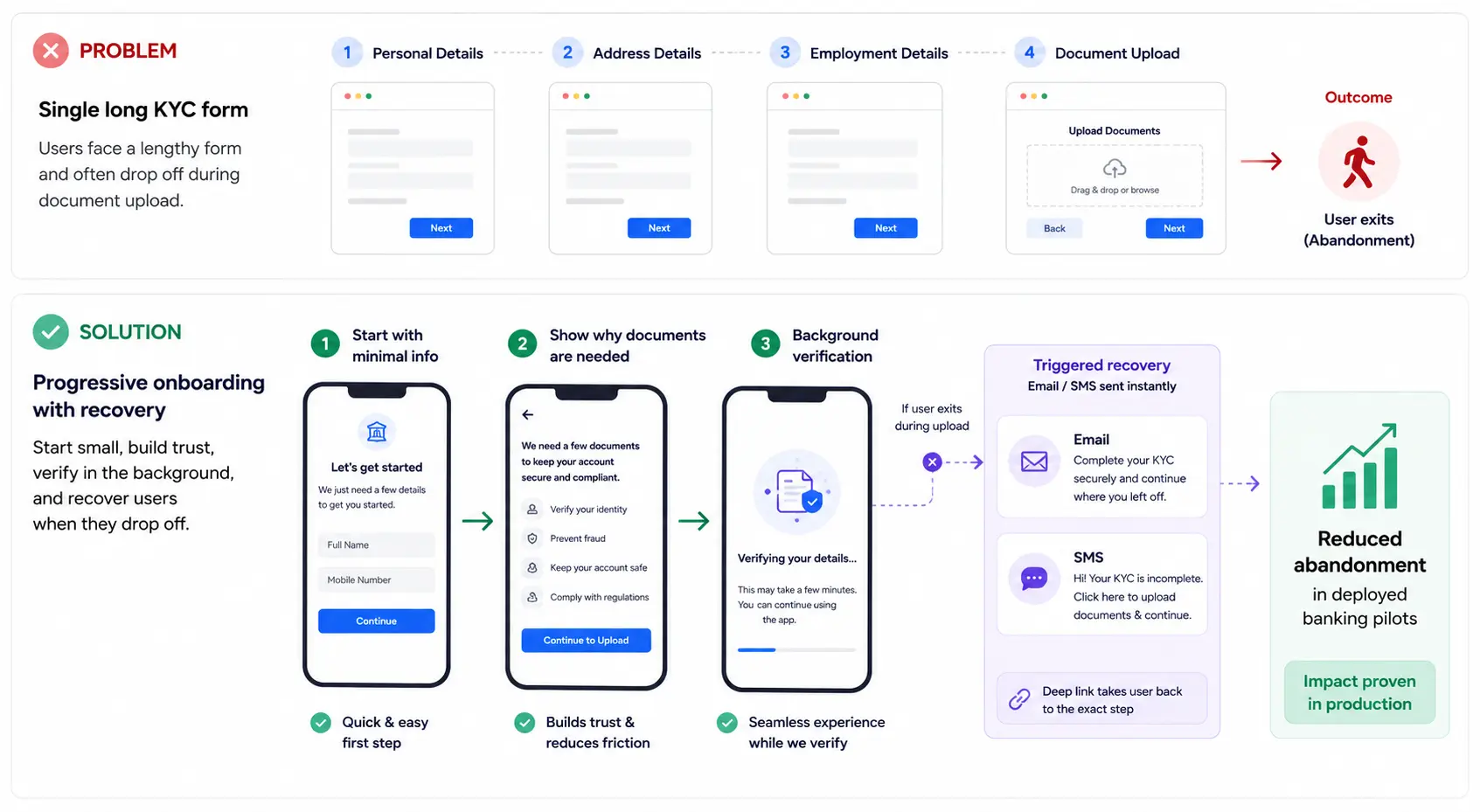
Most BFSI marketing systems react too slowly.
By the time a lead drops off:
- Intent has already weakened
- Competitor research has started
- Decision fatigue has increased
- Trust has reduced
Traditional workflows cannot dynamically detect:
- High-intent signals
- Friction points
- Drop-off probability
- Channel preference
- Engagement fatigue
- Real-time behavioral changes
Instead, they continue sending the same reminders to every customer.
This creates operational efficiency, but not conversion intelligence.
Why Agentic Marketing Is Becoming Critical for BFSI
BFSI customers now interact across:
- Apps
- Websites
- SMS
- Search
- Call centers
- Financial marketplaces
Every interaction creates intent signals.
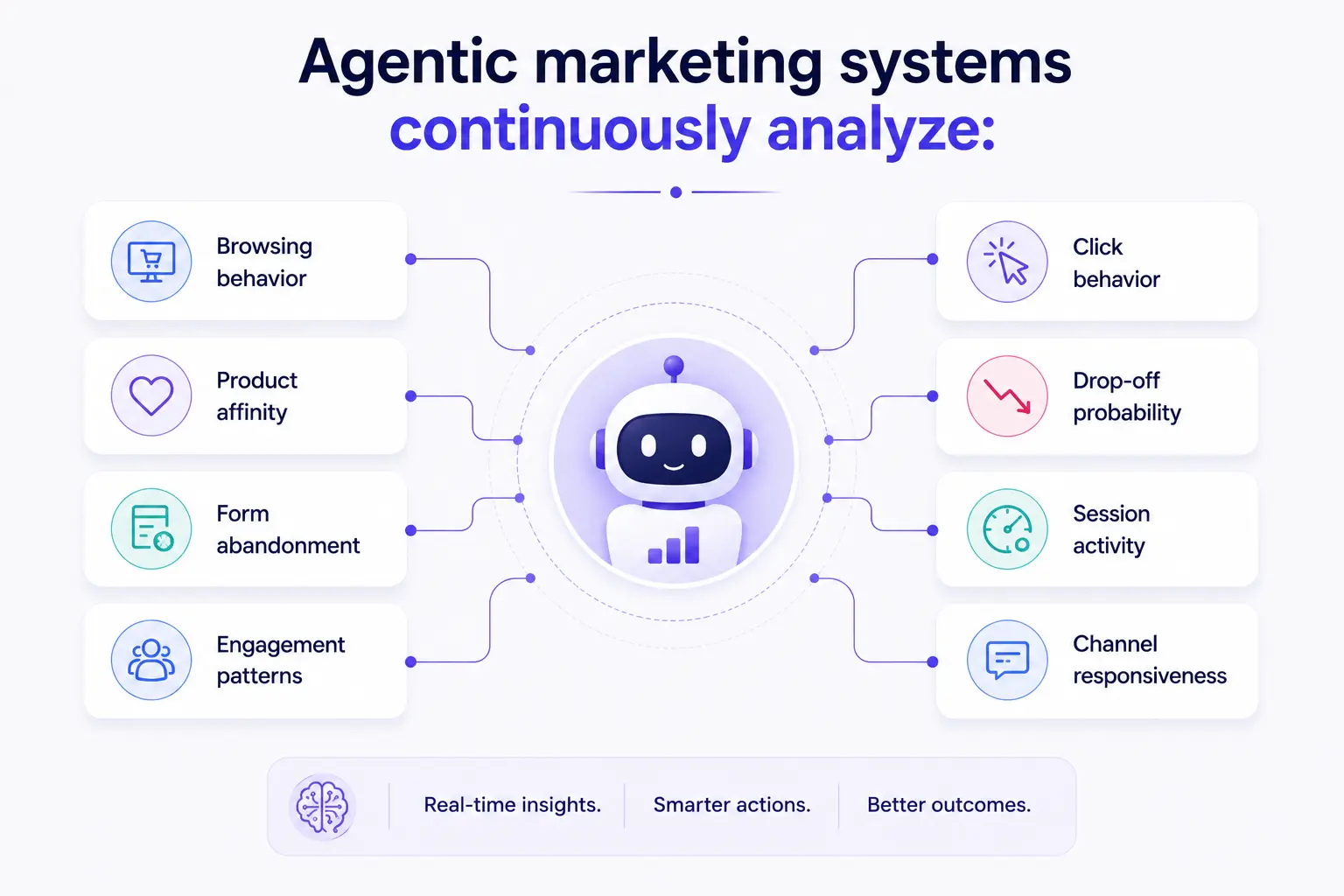
Agentic marketing platform continuously analyze:
- Browsing behavior
- Product affinity
- Form abandonment
- Engagement patterns
- Click behavior
- Drop-off probability
- Session activity
- Channel responsiveness
Instead of waiting for leads to disappear, AI agents proactively optimize the customer journey in real time.
For example:
- A customer abandoning a personal loan journey may instantly receive contextual reassurance content.
- A high-intent Demat user may get personalized onboarding nudges through WhatsApp.
- A disengaged insurance lead may receive optimized app push communication at the ideal engagement time automatically.
The system continuously learns which journeys, channels, and messaging combinations drive the highest conversion probability.
This is the shift from campaign-led engagement to autonomous conversion optimization.
How Bajaj General Insurance Reduced Lead Drop-Offs With Intelligent Renewal Journeys
Bajaj Markets partnered with Netcore to improve customer engagement and conversion performance across financial product categories using AI-powered personalization and agentic marketing capabilities.
The challenge was clear:
- Generic communication was limiting engagement
- CTRs across campaigns remained low
- Campaign performance needed improvement without increasing budgets
To solve this, Bajaj Markets implemented:
- AI-generated personalized push notifications
- Real-time A/B testing and optimization
- Personalized messaging based on user behavior and product category affinity
- Continuous campaign optimization powered by AI
The results demonstrated the impact of intelligent engagement:
- 17% month-on-month growth in app lead conversions
- ~10% increase in CTR across campaigns
- 80% increase in lead generation
- 16% improvement in app stickiness
- 81X ROI from renewal-driven engagement initiatives
The biggest takeaway was not simply better campaign performance.
It was the ability to continuously personalize engagement dynamically instead of relying on static communication workflows
Why Agentic Marketing Is Becoming a Necessity in BFSI
BFSI brands can no longer rely on static nurture journeys to drive conversions.
As acquisition costs continue rising, reducing lead drop-offs has become one of the most important revenue levers for banks, fintechs, insurers, and financial marketplaces.
The future belongs to BFSI brands that can:
- Detect intent in real time
- Predict lead drop-offs before they happen
- Personalize engagement dynamically
- Coordinate journeys across channels
- Optimize conversion journeys autonomously
This is why agentic marketing is no longer an experimental AI initiative.
It is rapidly becoming a conversion necessity for modern BFSI growth teams.
Final Take
Lead drop-offs in BFSI are no longer just a funnel problem; they are a personalization and timing problem. Agentic marketing helps brands detect intent in real time, recover high-intent users proactively, and optimize customer journeys autonomously across channels.
If you want to build agentic journeys with proven ROI across renewals, onboarding, and lead conversion, talk to Netcore and see how leading BFSI brands are reducing drop-offs and driving measurable growth at scale.