





If you’re using ChatGPT to rewrite social posts or Sora to generate campaign videos, and think your marketing team has adopted AI, you’re already behind.
That’s not AI-native marketing. That’s AI-assisted content production.
The real transformation isn’t about creating faster. It’s about marketing systems that think, act, and optimize without waiting for you.
Welcome to the era of agentic marketing, where campaigns run on autonomous intelligence, not pre-scheduled automation.
The AI Illusion: Why Most Brands Aren’t Truly AI-Driven
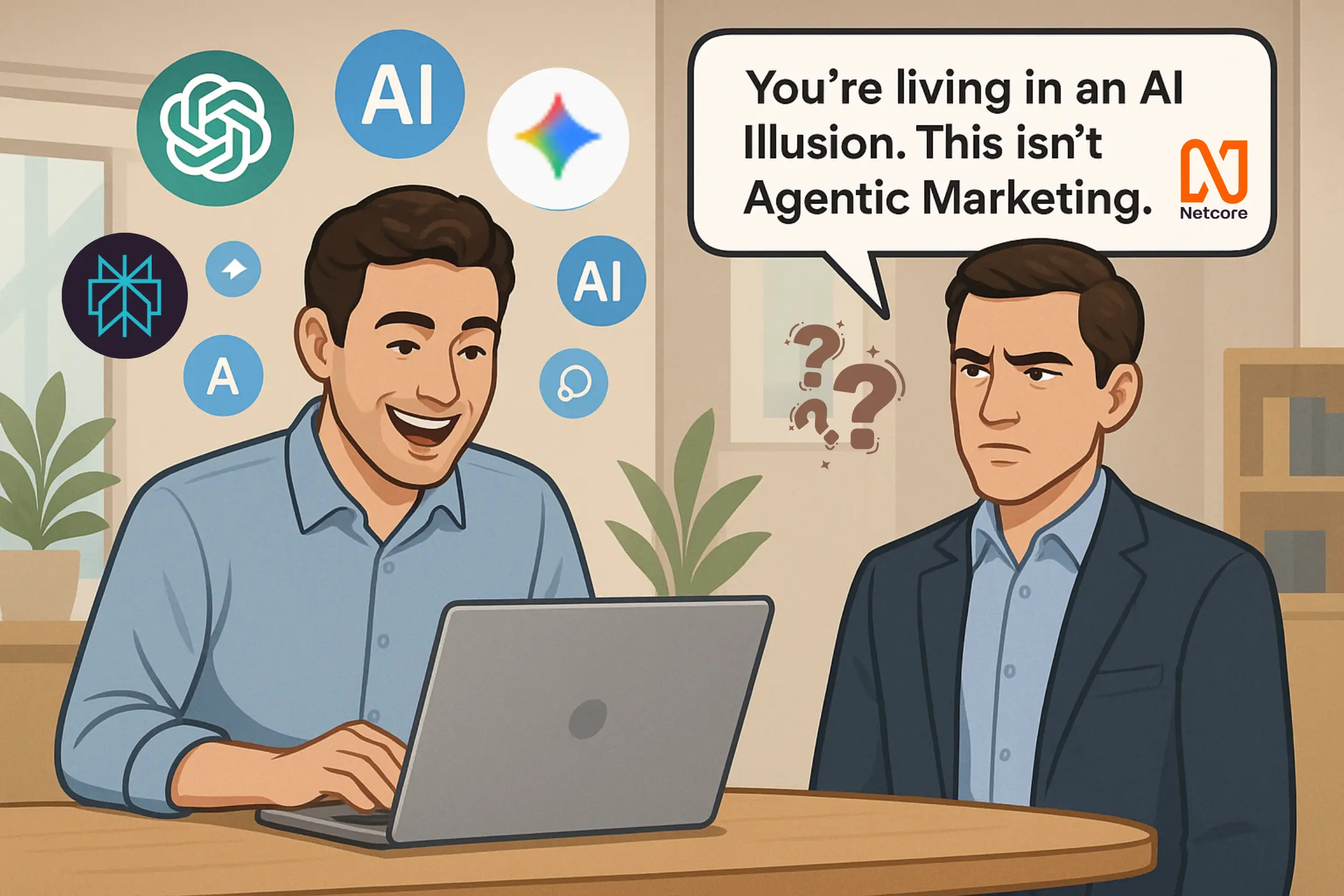
Today’s marketing stack looks deceptively advanced. You have automation, analytics, maybe even predictive models. But behind the dashboards lies an inconvenient truth: most “AI marketing” still depends on human operators.
Campaigns wait for instructions. Journeys are pre-scripted. Personalization is static.
Meanwhile, AI-native competitors are operating differently.
Their systems don’t wait for marketers to act; they decide, adapt, and execute autonomously.
Think of Tesla’s Autopilot, but for marketing: always learning, always acting. When a customer’s behavior shifts, the system doesn’t send a ticket to a marketer, it adjusts the journey instantly.
That’s the foundation of agentic marketing architecture, a structure where intelligence, autonomy, and orchestration are built into the system itself.
What Is Agentic Marketing Architecture, and Why It Matters
At its core, agentic marketing architecture is a blueprint for autonomous, goal-based marketing systems.
Instead of relying on marketers to manually design every flow, these systems self-learn and self-optimize across channels, based on business outcomes.
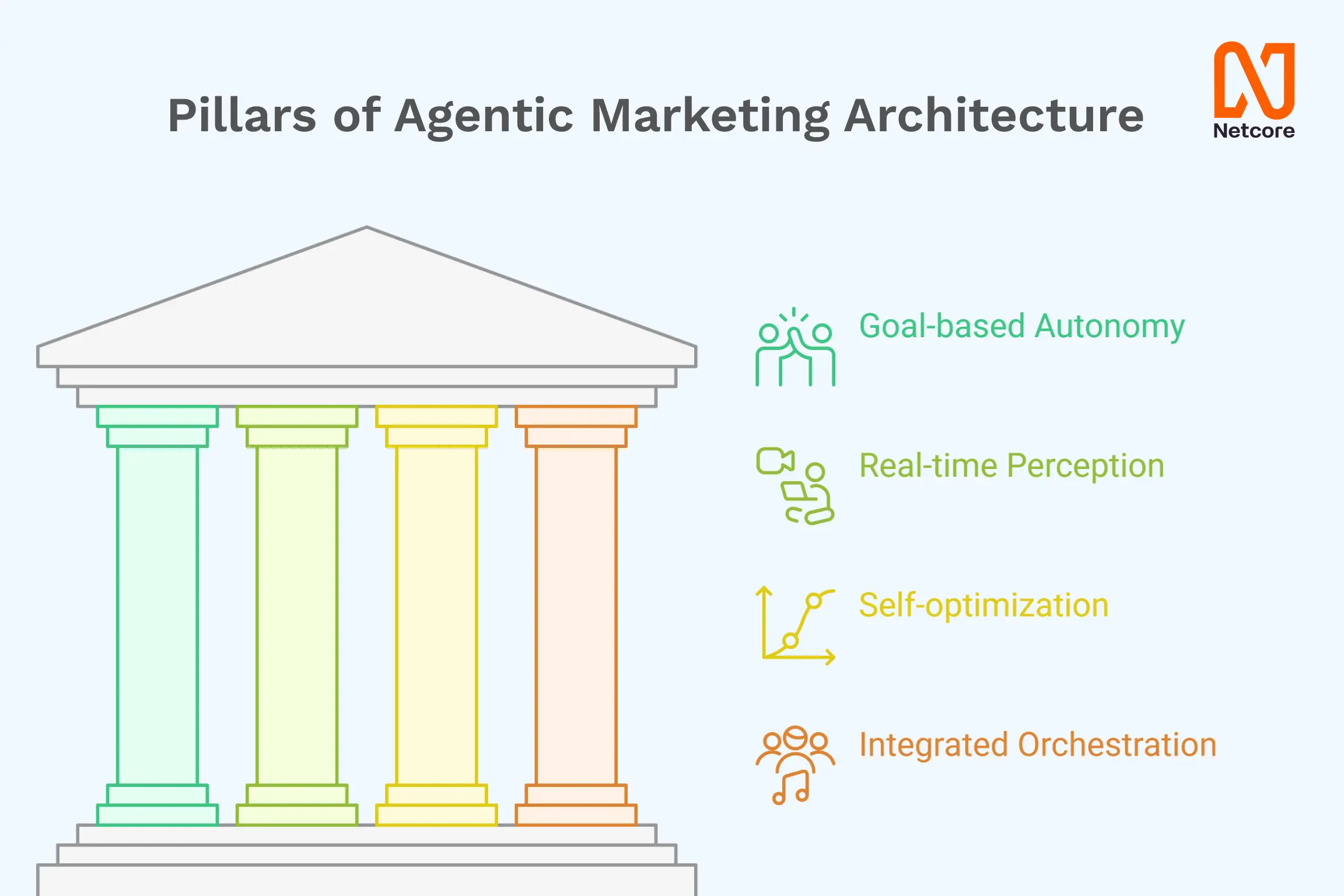
The architecture is built on four pillars:
- 1. Goal-based autonomy: Define objectives, like retention, conversion, or upsell, and let agents work toward them.
- 2. Real-time perception: Agents observe every customer interaction and adapt instantly.
- 3. Self-optimization: With every campaign, the system learns what works, and improves automatically.
- 4. Integrated orchestration: Every channel, campaign, and message operates in harmony.
Why this matters now:
- Customers expect personalization in milliseconds, not days.
- Marketers are buried under tool fragmentation and data silos.
- AI-native startups are already executing 100x faster than legacy marketing teams.
Agentic architecture bridges the gap, turning automation into intelligence and execution into evolution.
The Building Blocks of an Agentic Marketing Architecture
Think of agentic marketing like building an ecosystem, one where every component feeds and learns from another.
1. Unified Data Layer
Integrate behavioral, transactional, and psychographic data into one real-time source of truth.
Without unified data, autonomy collapses because AI agents can’t act on incomplete context.
2. Intelligence Layer
This is where decisioning happens.
Agents process inputs (customer behavior, inventory, context) and act toward predefined goals.
3. Execution Layer
Omnichannel systems bring intelligence to life across email, SMS, push, WhatsApp, and web, ensuring one consistent experience per user.
4. Feedback Layer
Every result loops back to train the system, closing the intelligence gap between planning and performance.
The Rise of Agentic Use Cases: From Theory to Daily Marketing
Let’s make this real. Across the world, leading brands, from ecommerce giants to fintech disruptors, are already using autonomous AI agents to perform complex, goal-oriented tasks.
These agents don’t replace marketers; they amplify them, automating the thinking, not just the doing. Here are some AI agents utilized by leading adaptive organizations.
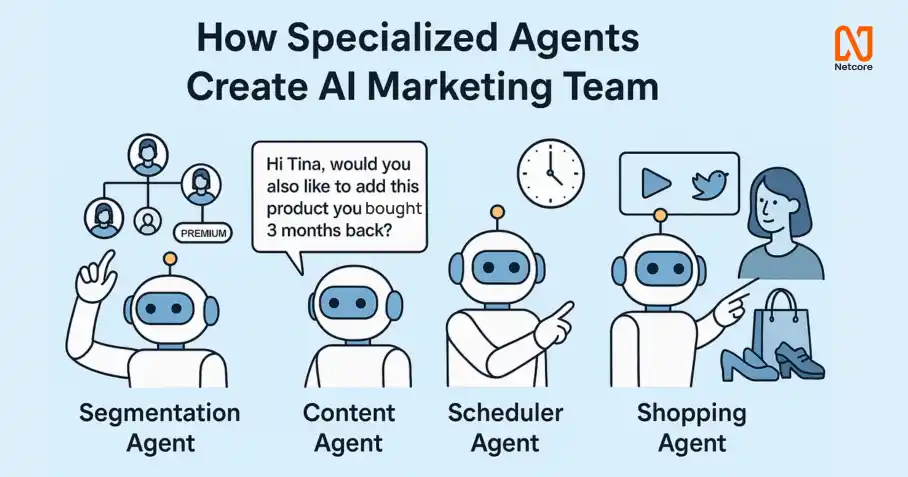
1. Content Agent: Hyper-Personalized, Real-Time Campaigns
What it does: Delivers hyper-personalized messaging across email, SMS, app push, and RCS, dynamically adjusting sequences based on engagement, behavior, and preferences.
Example use case: A fashion retailer’s Content Agent tailors message frequency and creative style to each customer.
Engaged shoppers get new arrivals. Lapsed ones get price drops. VIPs get early access.
Impact: Marketers no longer have to guess what works, the agent tests, learns, and optimizes campaigns in real time.
2. Segment Agent: AI-Driven Audience Precision
What it does: Creates granular, predictive segments based on affinity, behavior, and propensity.
Plan: Use the Segment Agent to auto-build micro-segments (500+ data points) for each campaign goal, e.g., high-value repeat buyers or cart-abandoners with discount affinity.
Execute: Auto-generate target lists and deploy personalized creatives instantly, enabling teams to run 100x more campaigns without manual segmentation.
Result: Smarter targeting. Less human effort. Consistent uplift in conversion and retention.
3. Scheduler Agent: Smarter Timing, Less Fatigue
What it does: Predicts the best time and channel per user using Send Time Optimization (STO) and Channel Preference Intelligence.
Plan: Let the Scheduler Agent recommend when and how to reach each user. Execute: Automatically apply smart delays to avoid over-notification, while maximizing engagement across channels.
Result: Campaign speed improves up to 25x, while fatigue and unsubscribe rates drop.
4. Shopping Agent: Real-Time Commerce Inside Messaging
What it does: Acts like a virtual in-store expert, instantly suggesting products based on context.
Plan: Use the Shopping Agent to define recommendation logic (cross-sell, upsell, or bundles) and prototype shoppable inbox experiences.
Execute: Deploy the agent across web, app, or inbox to provide context-aware product suggestions, all within the message itself.
Result: Customers discover products in under a minute, reducing clicks to purchase and boosting AOV.
5. Insights Agent: Real-Time Intelligence in 30 Seconds
What it does: Surfaces actionable insights, conversion blockers, channel performance breakdowns, and optimization recommendations, right inside the marketer’s workspace.
Plan: Use during campaign planning to identify issues or new opportunities.
Execute: Get instant, prescriptive suggestions under 30 seconds, from “change your subject line” to “redefine your audience.”
Result: Analytics becomes proactive. Marketers go from reporting on data to acting on it instantly.
How to Design Your Agentic Marketing Architecture
Building an agentic architecture isn’t a rip-and-replace project — it’s a mindset shift.
You’re evolving from “automate tasks” to “automate decisions.”

Here’s your practical roadmap:
1. Define the Mission: Start With Outcomes, Not Actions
Forget campaign counts and open rates — start with business objectives.
Do you want to reduce churn by 10%? Increase average order value by 20%?
Agentic systems work best when you define clear, outcome-driven goals.
Each agent should operate with a purpose:
- The Segment Agent finds who to target.
- The Content Agent determines what to say.
- The Scheduler Agent decides when to say it.
- The Insights Agent ensures you learn and adapt.
The more specific the goal, the smarter the autonomy.
2. Unify Your Data Layer: The Foundation of Autonomy
No agentic system can think clearly with fragmented data.
Your architecture needs a single source of truth connecting CRM, CDP, ecommerce, and behavioral data streams.
This enables:
- Real-time profile updates across systems
- Seamless identity resolution for cross-channel personalization
- Predictive modeling that updates as behavior changes
Because if your data lags, your AI acts on yesterday’s customer.
3. Map Agents to Marketing Functions Human + Agent Workflow
| Function | Agent Type | What the Agent Does | What the Human Does |
|---|---|---|---|
| Audience Intelligence | Segment Agent | Builds and updates dynamic micro-segments using 500+ signals (behavior, affinity, propensity) in real time. | Sets campaign goals (e.g., increase repeat purchases), reviews cohorts, and aligns targeting with business strategy. |
| Content Personalization | Content Agent | Generates, tests, and refines on-brand copy/creatives and adaptive sequences across email, SMS, push, and web. | Defines brand voice and guardrails, approves top performers, and locks winning themes for scale. |
| Campaign Orchestration | Scheduler Agent | Selects best channel and send time per user (STO + Channel Preference), applies smart delays to reduce fatigue. | Sets cadence priorities, monitors fatigue and deliverability, and adjusts engagement policy as needed. |
| Product Discovery & Commerce | Shopping Agent | Recommends products contextually (upsell, cross-sell, bundles) and powers shoppable inbox/conversational flows. | Defines merchandising logic and promos, validates outcomes, and refines inventory and pricing strategy. |
| Optimization & Insights | Insights Agent | Surfaces blockers, predicts lift, and recommends next-best actions in under 30 seconds; triggers micro-tests. | Interprets insights, validates hypotheses, green-lights experiments, and feeds learnings back into strategy. |
4. Establish Feedback Loops
True autonomy isn’t linear — it’s cyclical.
Your system should continuously learn from outcomes and feed them back into decision-making.
For example:
- The Insights Agent surfaces which creatives or audiences perform best.
- That data trains the Segment Agent to refine targeting.
- The Content Agent adjusts tone, offers, or imagery automatically.
That’s how your marketing system evolves — not quarterly, but daily.
5. Layer Accountability and Transparency
AI autonomy doesn’t mean AI opacity.
Every agent’s decision must tie to a measurable KPI — whether it’s conversion uplift, engagement rate, or retention gain.
This ensures marketers remain in control of strategy, while agents execute the operations.And when things go wrong (because they sometimes do), you can trace why an agent acted the way it did — the new gold standard for AI accountability in marketing.
From Manual Control to Machine Collaboration
Agentic marketing isn’t about replacing humans — it’s about removing human bottlenecks.

Before agentic systems:
Marketers spent 80% of their time building campaigns and 20% analyzing them.
After agentic systems:
Marketers spend 80% of their time on strategy and creativity, while AI agents handle execution and optimization.
Real-World Impact: How Agentic Architecture Transforms Marketing Workflows
Here’s what day-to-day marketing looks like in an agentic organization:
Traditional vs Agentic Marketing
| Stage | Traditional Marketing | Agentic Marketing |
|---|---|---|
| Segmentation | Manual filters, static lists created in multiple excel sheet with formulas sometimes with chances of manual errors. | Real-time micro-segments updated automatically |
| Campaign Planning | Takes 3–4 weeks | Built and executed within hours |
| Optimization | Based on past reports | Continuous real-time improvement |
| Execution | Human-triggered | Goal-triggered and AI-managed |
| Measurement | Post-campaign reports | Predictive + prescriptive insights within seconds |
The Framework in Action: Agentic AI in Campaign Planning
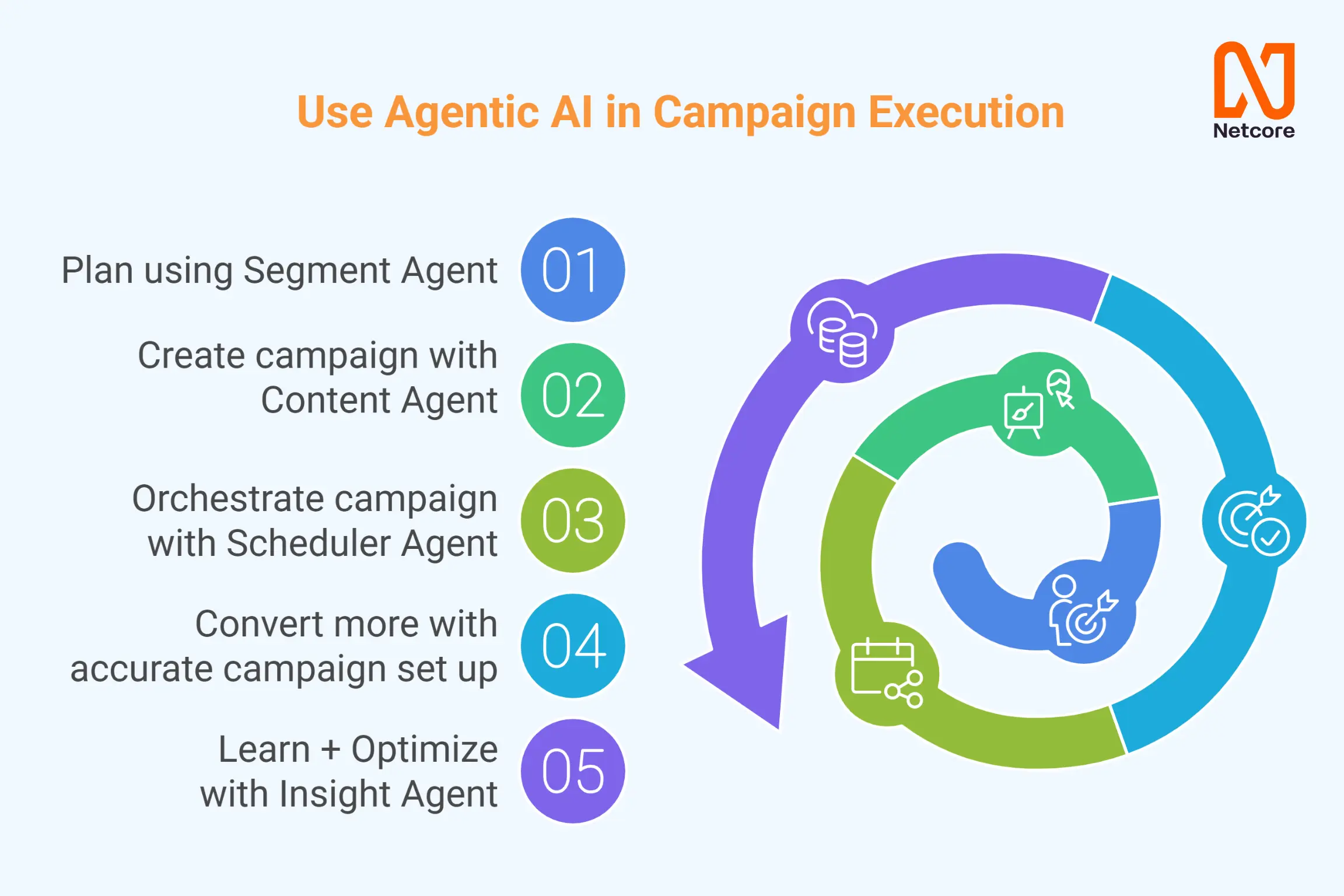
Let’s visualize how a marketing team might use an Agentic Marketing Platform in their daily workflow:
Step 1: Plan
The Segment Agent identifies your top 5 customer cohorts — say, “High-value repeat buyers,” “Cart abandoners,” and “Price-sensitive first-timers.
”The Insights Agent flags that push notifications underperform with the ‘price-sensitive’ group.
Step 2: Create
The Content Agent automatically drafts three personalized offers and subject lines per cohort.
Copy is tested in real time, while imagery is adjusted for engagement response.
Step 3: Orchestrate
The Scheduler Agent launches campaigns at each user’s preferred channel and time — email at 9 AM for one, WhatsApp at 7 PM for another.
Step 4: Convert
The Shopping Agent recommends a cross-sell in the message itself — users can purchase directly without leaving the conversation.
Step 5: Learn
Within seconds, the Insights Agent identifies the most successful creative variant and auto-updates campaign parameters for the next send.
What once took an entire team three weeks now happens in a few clicks or none at all.
The Future: Architectures That Evolve Themselves
Marketing is entering its autonomous era — one where systems don’t just execute campaigns, but learn, decide, and optimize on their own.
Today’s marketers are battling a silent drain on budgets: ad waste.
Insights from Rajesh Jain, Founder of Netcore
As Rajesh Jain, Founder of Netcore, put it in his interview with Social Samosa:
“Success, to me, is simple. It’s about eliminating ad waste. Today, nearly 70% of marketing budgets are spent on inefficiencies — reacquiring the same customers multiple times instead of retaining them. That’s pure waste.”
That’s exactly where agentic marketing steps in. It’s not just about automation anymore — it’s about autonomy.
“Agentic marketing is about bringing autonomy into operations,” Jain explains. “Automation has existed for a long time, automating journeys, processes, and repetitive tasks. But autonomous marketing, where agents come in, goes a step further. It’s about decision-making. These agents won’t just execute; they’ll make decisions.”
Imagine AI agents that dynamically reallocate ad spend in real time — cutting waste, prioritizing retention, and amplifying ROI without a single manual tweak.
This future isn’t speculative. It’s already unfolding in marketing teams across the globe.
Brands leveraging agentic architectures are discovering what happens when campaigns start thinking — not just running.
Those who adapt now won’t just save costs; they’ll redefine performance itself.
Those who wait? They’ll find themselves spending more just to keep up with machines that never waste a cent.
Final Take: Build the Marketing Engine That Thinks for You
The biggest leak in modern marketing isn’t bad creative — it’s ad waste. Billions are lost reacquiring the same customers instead of retaining and growing them. Agentic marketing changes that equation entirely.
By building an agentic marketing architecture, you give your system the power to act — not just react. It learns continuously, optimizes in real time, and drives decisions that maximize every dollar spent.
This isn’t about automating tasks — it’s about automating profitability. With Netcore, marketers eliminate inefficiencies, cut ad spend waste, and orchestrate campaigns that deliver measurable ROI — all through AI agents that work 24/7 toward your business outcomes.
The brands that act today will define tomorrow’s marketing playbook. Don’t wait to adapt — lead the change. Talk to Netcore and start architecting your agentic future today.

