





Agentic commerce transforms ecommerce customer experience, from browsing to guided decision-making. As shoppers face choice overload and rising friction, AI shopping assistants now understand intent, advise intelligently, and act on behalf of users to drive faster decisions, higher conversions, and better customer experience.
What Is Agentic Commerce?
- What it is: Agentic commerce is the next wave of ecommerce, where AI agents act on behalf of shoppers to guide discovery, compare options, and complete actions instead of forcing users to browse endlessly.
- Why it matters now: Shopper behavior has shifted. People have more choice, less patience, and higher decision fatigue, especially in high-consideration categories like electronics, skincare, and appliances.
- What’s broken in traditional ecommerce: Filters, grids, and search assume shoppers already know what they want. Most don’t. The real friction today is decision-making, not browsing.
- How agentic commerce works: AI shopping agents understand intent, advise intelligently, learn continuously from interactions, and reduce friction from discovery to purchase.
- Why Netcore’s Shopping Agent: Platforms like Netcore’s Shopping Agent enable guided, conversational discovery at enterprise scale, improving conversions and customer satisfaction.
- This shift is already happening: While still early, agentic commerce is live in the market. Leaders like Alphabet, Perplexity, OpenAI, and Salesforce have launched agentic solutions ahead of peak shopping moments like Thanksgiving and Cyber Monday.
Picture this: It is Black Friday week. Your analytics dashboard is flashing green. Traffic is at an all-time high. Your ad spend is astronomical, but it’s bringing people in.
On the surface, it looks like a win. But look closer.
Your customers are drowning. They have fifteen tabs open. They are cross-referencing specs, reading contradictory reviews, and trying to decipher if “tropical wool” is actually breathable. They are overwhelmed by choice and paralyzed by the fear of buying the wrong thing.
Eventually, the cognitive load becomes too heavy. They close the tabs. They leave.
This is the ecommerce paradox of our time: We have given shoppers more tools, more filters, and more data than ever before, yet we have made the decision-making process harder.
The friction isn’t your checkout page button color. The friction is thinking.
This specific frustration has triggered the most significant shift in digital retail since the invention of the smartphone: Agentic Commerce.
What Is Agentic Commerce?
At its simplest, Agentic Commerce is a retail environment powered by autonomous AI agents that actively guide, advise, and transact for the shopper.
Think of the evolution of retail like this:
- Traditional Ecommerce: A massive library where you have to find the book yourself using a card catalog.
- Personalized Ecommerce: A library that highlights books other people liked.
- Agentic Commerce: A knowledgeable librarian who walks up to you, asks what you’re interested in, and places the perfect book in your hands.
In an agentic system, the AI doesn’t just wait for a click. It acts. It understands natural language, navigates complex trade-offs, and completes tasks across different platforms.
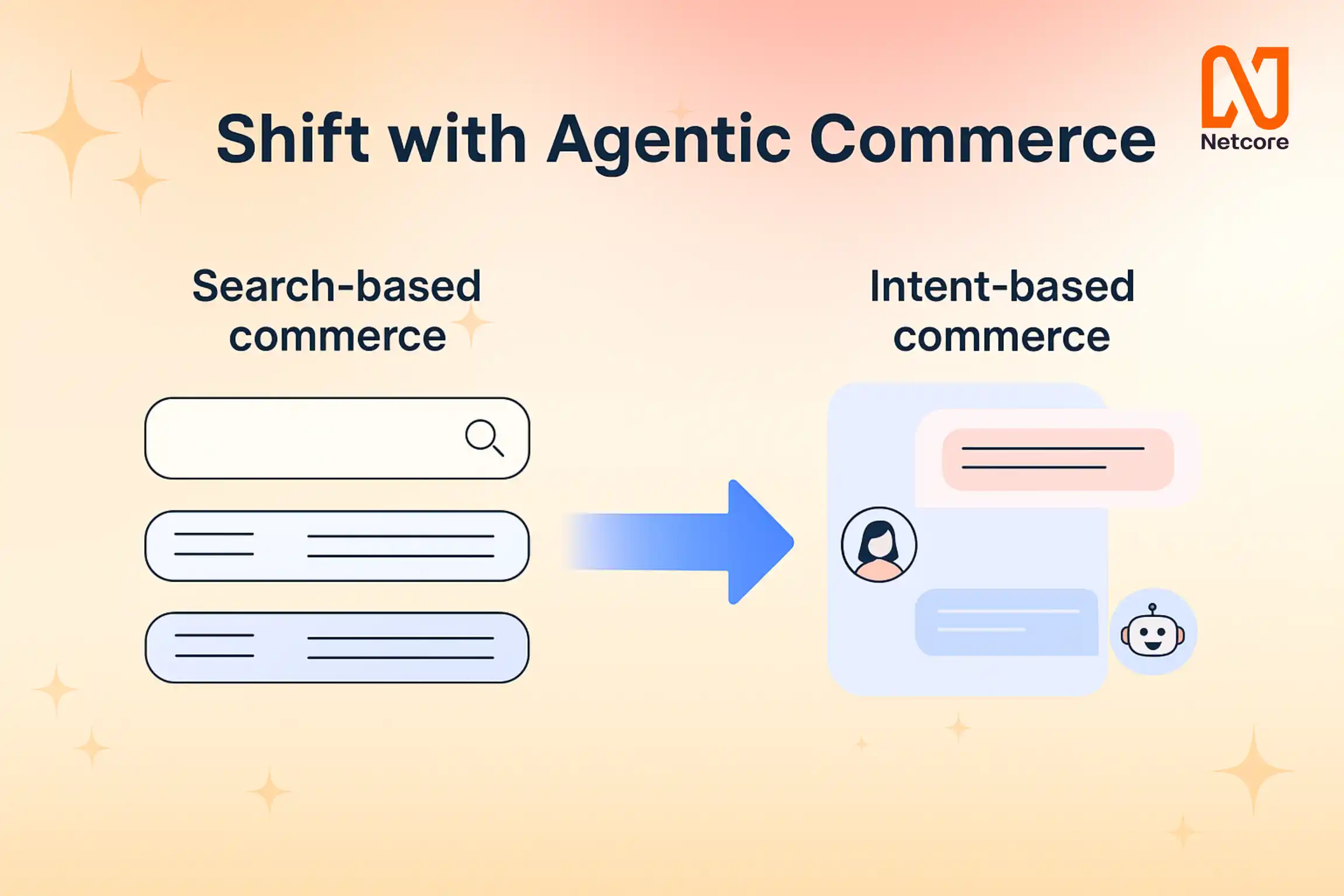
The Core Shift: We are moving from Search-based commerce (where the user does the work) to Intent-based commerce (where the agent does the work).
Transformation of Modern Retail & Ecommerce
Agentic Commerce isn’t a “nice-to-have” trend. It is a survival mechanism born out of necessity in the agentic marketing era. Traditional ecommerce has hit four distinct walls that simple optimization can no longer climb.
1. The Decision-Fatigue Wall
Shoppers are exhausted. One AI executive recently noted, “Buying a t-shirt now feels as complex as applying for a mortgage.” When the brain faces too many variables, it defaults to “no action.” Agents remove the variables and present the solution.
2. The Discovery Wall
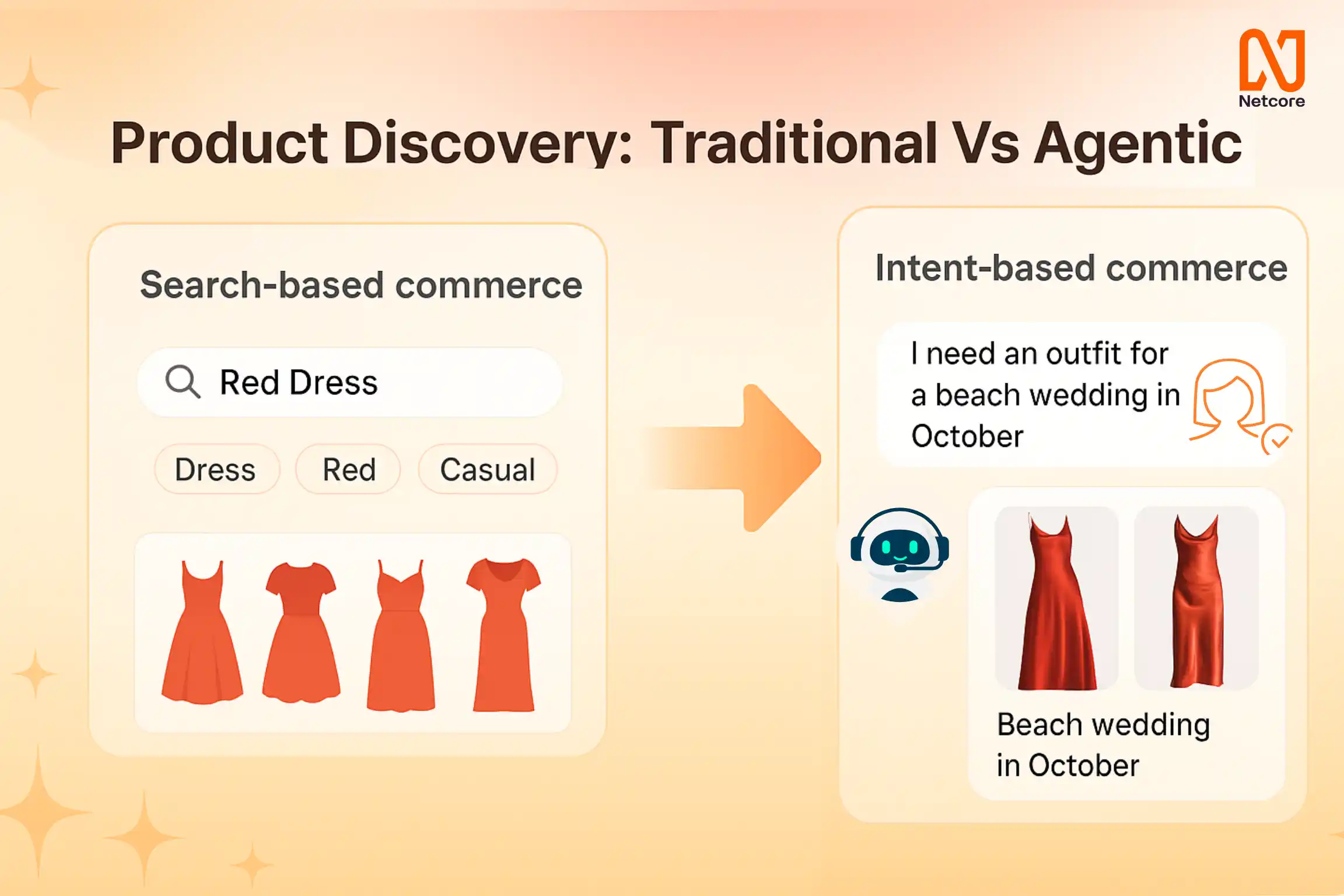
Keywords are failing us. A search bar can handle “Red Dress.” It cannot handle: “I need an outfit for a beach wedding in October where it might rain, and I hate synthetic fabrics.” Traditional search gives you zero results. Agentic search gives you a curated lookbook.
3. The Ad Waste Wall
Rajesh Jain, Founder of Netcore, put it bluntly:
“Nearly 70 percent of marketing budgets are wasted on reacquisition. That’s not marketing — that’s leakage.”
Brands are burning cash to bring the same hesitant customer back to the site five times. Agents engage the customer meaningfully on the first visit, drastically reducing the need for retargeting.
4. The Bandwidth Wall
Marketing teams are capped. You cannot write unique copy for 50,000 SKUs or manually guide every visitor. Agents operate at infinite scale, providing white-glove service to millions simultaneously, without sleeping.
Agentic Marketing for Ecommerce: How Agentic Commerce Accelerates Growth
Agentic marketing for ecommerce shifts product discovery from static catalogs and rule-based recommendations to dynamic, goal-driven guidance that adapts in real time. Instead of forcing shoppers to search, filter, and compare on their own, agentic commerce systems observe intent signals—queries, clicks, hesitation, and past behavior—and actively guide users toward the most relevant products through personalized prompts, smart filters, and conversational assistance. This is already visible in how brands like Amazon use intent-aware recommendations and guided discovery to reduce choice overload, how Zalando personalizes fashion discovery by style and context, and how Sephora blends AI-driven quizzes and recommendations to turn exploration into confident purchase decisions. The result of agentic AI use cases in ecommerce is faster time-to-product, higher conversion, and less friction—without relying on deeper discounts. By automating millions of micro-decisions across discovery, conversion, and retention, agentic marketing enables ecommerce brands to grow at scale with unprecedented speed, turning browsing into buying and personalization into a sustainable growth engine.
How Agentic Commerce Works
How does a piece of software feel human? By moving through a cognitive loop that mimics a high-performing salesperson.
- Sense (The Eyes and Ears): The ecommerce ai agent observes more than just clicks. It reads scroll depth, hesitation time, search phrasing, and historical affinity. It “reads the room.”
- Interpret (The Brain): It decodes intent. It understands that a user looking for “rugged laptops” isn’t just looking for a hard case; they likely work outdoors or travel frequently.
- Guide (The Voice): The ai agent for ecommerce initiates a dialogue. “I see you’re looking at gaming monitors. Are you prioritizing refresh rate for competitive gaming, or color accuracy for design work?”
- Execute (The Hands): It doesn’t just show links; it compares specs, applies coupons, and can even process the checkout within a chat interface.
- Learn (The Memory): Every interaction feeds the “Behavioral Intelligence” model. If a user rejects a recommendation, the agent learns why and never makes that mistake again.
Answer Engine Optimization (AEO) for Ecommerce
As we move toward Agentic Commerce, the rules of visibility change. We are leaving the era of SEO (Search Engine Optimization) and entering the era of AEO (Answer Engine Optimization).
Shoppers are no longer typing keywords; they are asking questions.
- Old Query: “Best running shoes for women.”
- New Query: “What are the best running shoes for marathon training if I have flat feet and a $150 budget?”
To win in this new world, your product data must be structured so that AI agents (both yours and external ones like ChatGPT or Perplexity) can “read” and recommend your products.
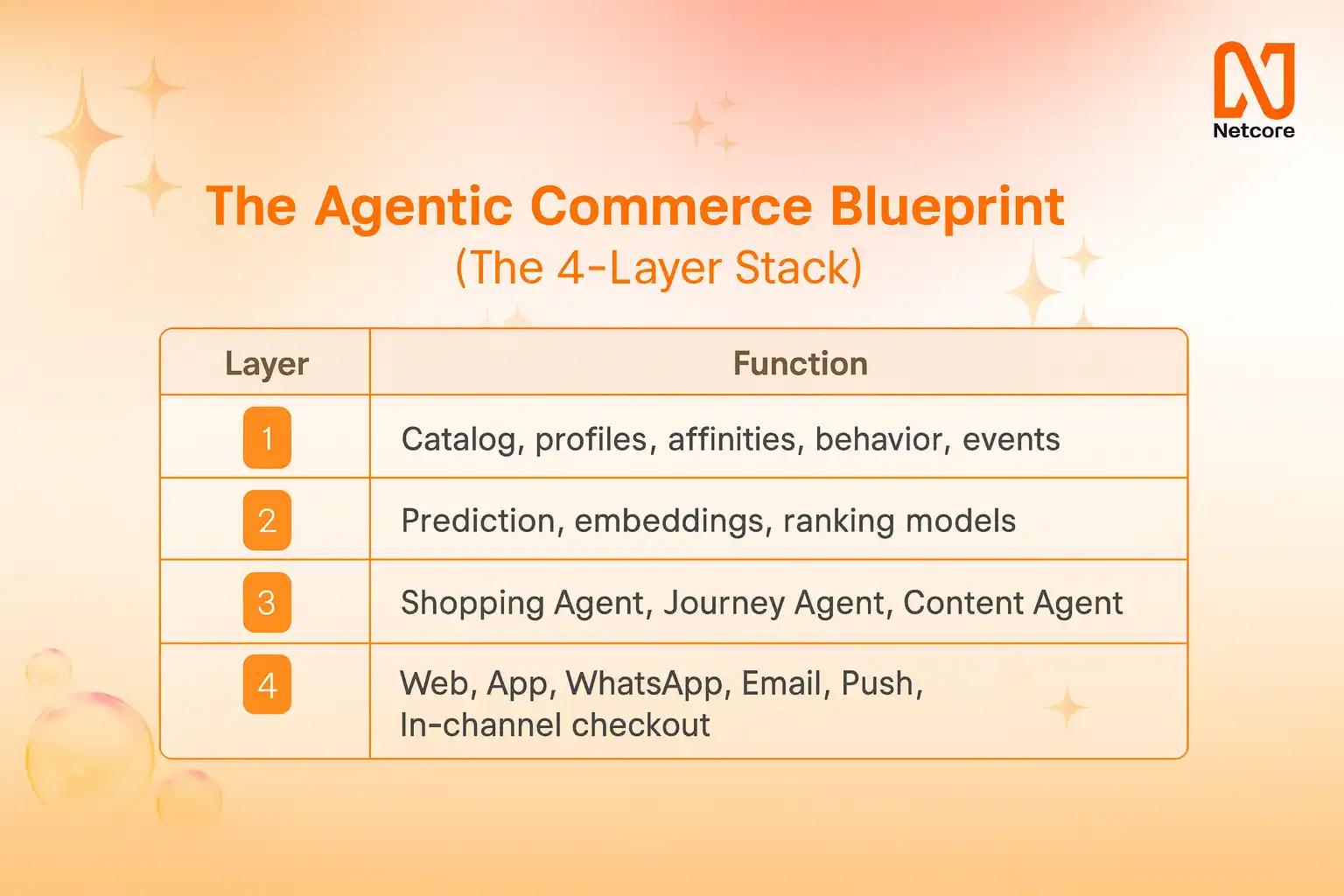
The 4-Layer Agentic Stack
What Agentic Commerce Experience Feels Like for the Customer
Let’s look at how Agentic Commerce changes the narrative in practice and how ecommerce brands use agentic AI.
Use Case 1: The “I Don’t Know What I Need” Shopper
- Traditional Experience: The shopper types “Camera” and gets 4,000 results sorted by price. They get overwhelmed and leave.
- Agentic Experience: The shopper asks, “I need a camera for a safari trip.” The Agent instantly filters for high zoom and image stabilization, compares three top models, explains why the lighter one is better for travel, and offers a memory card bundle. Exploration time drops from 2 hours to 2 minutes.
Use Case 2: Saving the Sale (Cart Abandonment)
- Traditional Experience: The shopper abandons a jacket. 4 hours later, they get a generic email: ” You forgot this.”
- Agentic Experience: The Agent analyzes why they left. (Perhaps they checked the size chart three times). The Agent sends a WhatsApp message: “Hi! I noticed you were looking at the Parka. It runs small, so I’d recommend sizing up. Should I add the Medium to your cart with free shipping?”
Use Case 3: Commerce Everywhere
- Traditional Experience: You must drag the user back to your website to buy.
- Agentic Experience: The entire transaction happens where the user is—inside an email, a WhatsApp chat, or a social DM. The agent brings the checkout to the human, not the other way around.
Why Choose Netcore For Agentic Commerce
While the market buzzes with generic “AI features,” Netcore has engineered a purpose-built agentic marketing platform for this exact shift.
The Netcore’s Shopping Agent isn’t just a chatbot; it is a holistic commerce engine. It combines:
- Hybrid Intelligence: Blending probabilistic AI (creativity) with deterministic logic (business rules), so the AI never hallucinates a price or promises out-of-stock inventory.
- In-Session Adaptation: Most platforms personalize after you leave. Netcore’s agents personalize while you are thinking, adjusting recommendations in milliseconds based on your current behavior.
- Deep Catalog Understanding: It ensures your products are “AEO-ready,” mapped correctly so agents can understand nuance, context, and use cases.
Ecommerce is no longer about converting browsers with discounts. It’s about reducing friction in decision-making accelerating conversion rates.
Agentic commerce represents a fundamental shift in how ecommerce works. As shoppers face choice overload and shrinking attention, the brands that win will be those that reduce cognitive friction, guide decisions, and act at the speed of intent.
AI shopping agents move commerce from static discovery to intelligent guidance — understanding context, advising with precision, and completing actions without forcing users through endless clicks.
Platforms like Netcore’s Shopping Agent make this shift practical at enterprise scale, helping brands turn uncertainty into clarity, hesitation into confidence, and attention into revenue. Brands who adopt Agentic Commerce will enjoy lower acquisition costs, higher loyalty, and a distinct competitive advantage. Those who stick to the old “search and scroll” model will find themselves competing against agents that learn faster, convert better, and never sleep.
The question is no longer “Should we use AI?” The question is: “Is your store smart enough to sell for you?”
If you are interested in futurproofing your business, then talk to us to know how to integrate agentic into your business.

