




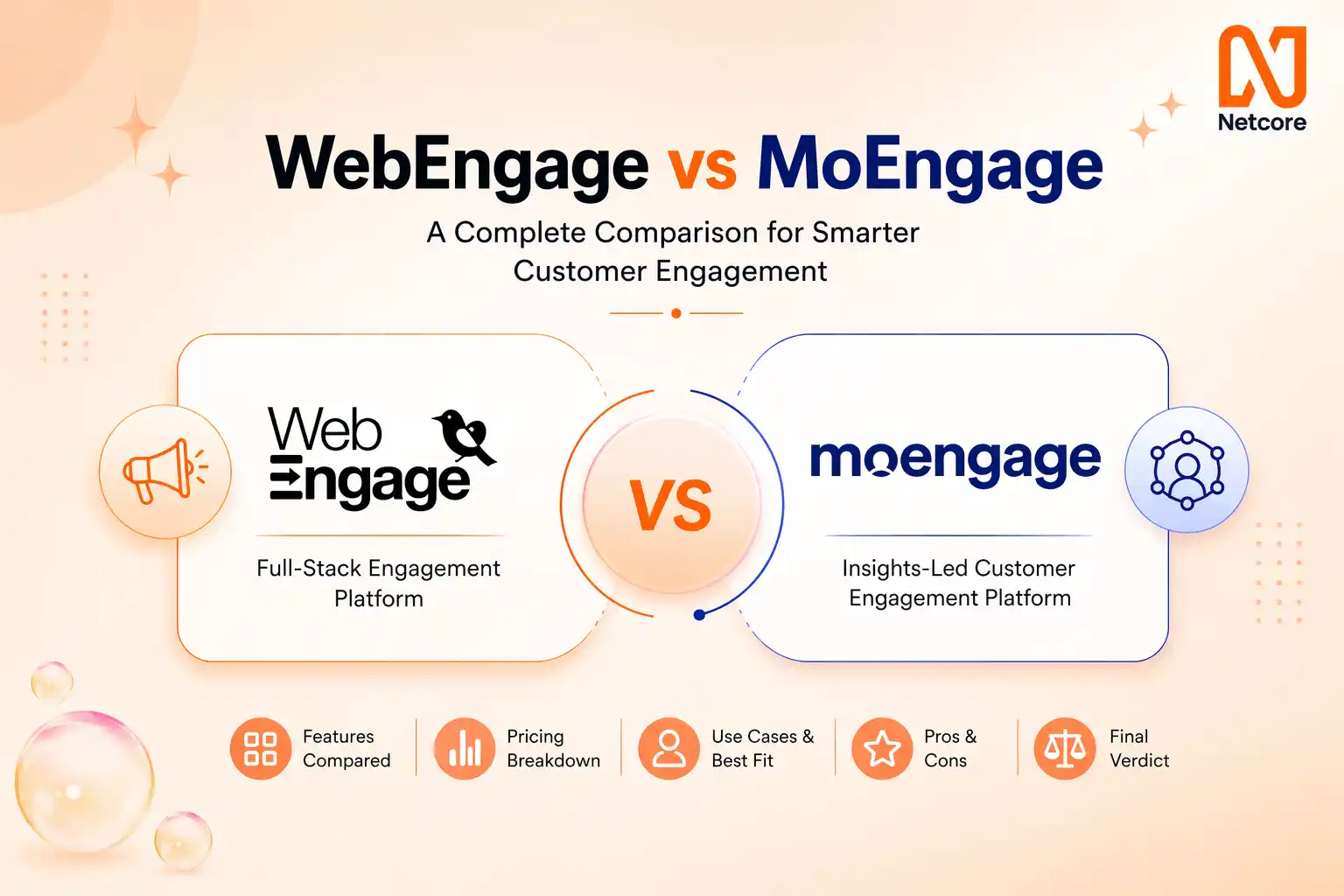
In this buyer’s guide, we’ll break down WebEngage vs MoEngage to help you understand how they compare across capabilities, usability, scalability, and ROI. Whether you’re looking to optimize retention, personalize journeys, or future-proof your martech stack, this guide will help you make a more informed, strategic choice.
Why This Comparison Matters
WebEngage and MoEngage are two of the most shortlisted customer engagement platforms in emerging markets, and they look deceptively similar from the outside. Making the wrong call costs you more than money; it costs you 12–18 months of migration pain.
Both platforms promise omnichannel engagement, personalization, AI-driven automation, and a cleaner view of your customer. Both have strong reputations. Both will give you an impressive demo. And both have real, meaningful differences that only become obvious once you’re actually using them at scale.
I’ve looked at verified user reviews across G2, Gartner Peer Insights, and PeerSpot, and here’s the honest read: this is not a “one is clearly better” comparison. It’s a “which one is built for what you’re actually trying to do” comparison.
That’s what this guide is for.
A Quick Comparison Table
| Dimension | WebEngage | MoEngage |
|---|---|---|
| Primary Strength | Journey orchestration + CDP | AI-driven analytics + omnichannel |
| Best For | Retention-first, mid-market to enterprise | Growth + retention, mid to large enterprise |
| Ease of Use | High, intuitive for non-technical teams | Moderate, powerful but steeper learning curve |
| AI Capabilities | WebEngage AI (analytics, personalization) | Merlin AI + Sherpa AI (predictive, send-time, content) |
| Pricing Model | Module-based, custom quote | MAU-based; from ~$999/month |
| Customer Support | Highly rated, especially onboarding | Strong, but varies by plan tier |
| Data Foundation | Built-in CDP as the core layer | Insights-first architecture |
| Mobile-First Strength | Balanced web + mobile | Strong mobile-native roots |
| G2 Rating | 4.5 / 5 | 4.5 / 5 |
| Gartner Peer Insights | 4.2 stars out of 5 | 4.7 stars out of 5 |
Both platforms score 4.5 on G2. That’s not a tie; it means both have earned genuine user trust. The differentiation is in the details below.
WebEngage Strengths
WebEngage is built around one core belief: that retention starts with a great data foundation. Its CDP-first architecture and journey builder are where it genuinely pulls ahead.
Here’s what WebEngage does well:
- Intuitive interface and low technical overhead. G2 reviewers consistently highlight that WebEngage’s dashboard with basic capabilities is easy to navigate, even for non-technical marketers. Teams can build and launch campaigns without heavy developer involvement.
- Journey Builder is a genuine differentiator. The visual journey creation feature is one of the most praised capabilities across review platforms. It simplifies building automated, multi-channel campaigns and saves meaningful time for teams that run high-frequency, complex lifecycle programs.
- CDP as a core layer, not an add-on. WebEngage’s Customer Data Platform sits at the centre of the platform, unifying web, app, offline, and third-party data into a single customer profile. This makes segmentation and personalization more accurate because they’re built on cleaner data.
- Onboarding and support quality. Multiple reviewers specifically call out the quality of WebEngage’s support team during implementation. For teams without large in-house technical resources, this matters more than most vendor pitches acknowledge.
- Strong personalization for web and app. WebEngage’s web and app personalization engines adapt content and in-app experiences using behaviour-based rules and ML, without requiring custom development for each variation.
- RFM analysis built in. Recency, Frequency, and Monetary analysis is available natively, giving e-commerce and subscription teams a clean way to segment by actual revenue behaviour.
WebEngage Limitations
WebEngage’s strengths in usability and journeys come at the cost of some depth, particularly in predictive AI, advanced reporting customization, and notification delivery at extreme scale.
Being honest about where WebEngage falls short:
- Interface can get complex at scale. While praised for ease of use in basic workflows, reviewers note that navigating WebEngage becomes harder as campaigns and segments multiply. The UI doesn’t always scale gracefully with operational complexity.
- Advanced AI capabilities are still maturing. WebEngage has added AI features, but reviewers note that MoEngage’s Merlin AI and Sherpa AI are more sophisticated in areas like predictive send-time optimization, content recommendations, and AI-based segmentation suggestions.
- Analytics customization is limited. Some users find that while WebEngage provides solid out-of-the-box analytics, the ability to build custom reports and deeply configure dashboards is more restricted than competing platforms.
- Notification delivery issues at scale. A recurring theme in user reviews, at high volume, some teams have experienced inconsistent push notification delivery rates. For businesses sending tens of millions of messages, this is worth probing in a proof of concept.
- Pricing opacity. WebEngage doesn’t publish pricing. You build your module stack (CDP, Omnichannel, Web Personalization, App Personalization, WebEngage AI) and request a quote. This makes budgeting harder in the early evaluation stages.
MoEngage Strengths
MoEngage is built for teams that want to lead with data and let insights drive campaign decisions. Its AI layer is more mature, and its analytics depth gives product and growth teams more to work with.
Here’s where MoEngage genuinely excels:
- Insights-first architecture. MoEngage was designed around the idea that better analytics leads to better engagement. Its event tracking, funnel visualization, and cohort analysis are consistently praised as reliable and easy to validate, especially useful during QA cycles and product decisions.
- Merlin AI and Sherpa AI. MoEngage’s AI capabilities cover send-time optimization, best-channel prediction, content testing, and multivariate experiments. These are more deeply integrated and more practically usable than many comparable AI layers in the market.
- Real-time segment updates. Unlike static segmentation approaches, MoEngage’s segments update based on actual user behaviour in real time. This means campaigns are always targeting the right people based on what they’re doing now, not what they did last week.
- Strong cross-channel depth. MoEngage supports email, SMS, WhatsApp, push, in-app, and web push, and its WhatsApp integration is bundled into the MAU-based pricing, which removes the per-conversation cost unpredictability some platforms create.
- Scalable for enterprise. MoEngage is particularly well-suited to medium-to-large enterprises in e-commerce, fintech, travel, and media. Its architecture handles high-volume customer bases and the segmentation complexity that comes with them.
MoEngage Limitations
MoEngage’s power comes with a learning curve, a higher price floor, and occasional gaps in delivery consistency that teams need to go in with eyes open about.
Where MoEngage has room to improve:
- Cost adds up quickly. The Standard plan starts at $999/month, and that’s for up to 10k MAUs with core features only. As you add channels, scale your user base, or unlock advanced AI features, costs escalate faster than some teams anticipate. Add-ons and extra features draw criticism for the unpredictable total cost of ownership.
- Complex use cases expose gaps. Some users report that MoEngage handles standard use cases well but shows friction when customer engagement workflows become highly complex or non-standard. For businesses with intricate, multi-condition journey logic, this is worth testing before committing.
- Segment creation speed. At least one commonly cited review notes that building segments can be slow and that delivery rates have been inconsistent. For time-sensitive campaigns, lag in segment processing is a real operational cost.
- Limited UI customization. Reviewers mention a lack of interface customization options, a drawback for teams that prefer to configure their workspace to match internal workflows or reporting structures.
- Steep learning curve for advanced features. Multiple G2 reviewers specifically flag that navigating MoEngage’s more sophisticated capabilities requires time and training. Non-technical teams may find the ramp-up frustrating without structured onboarding support.
WebEngage vs MoEngage Features: A Head-to-Head Comparison
Both platforms cover the core feature set. The differences are in depth, architecture, and how each feature is built into the platform versus bolted on.
| Feature | WebEngage | MoEngage |
| Core Focus | Full-stack retention suite with CDP, omnichannel campaigns, personalization, and AI. | Insights-led cross-channel engagement powered by analytics, flows, and AI (Merlin & Sherpa). |
| Channel Ownership | Limited channel flexibility; relies on multiple ESPs and partners for email and SMS. | Native support for SMS, WhatsApp, and RCS, while email requires ESP integrations. |
| Customer Data Platform | Strong CDP for unified profiles and data ingestion; weaker in advanced predictive modelling in some reviews. | Insights-led data unification via APIs/SDKs with real-time profiles; not a full CDP and limited schema setup complexity for some users. |
| Journey Builder | Easy-to-use journey builder for lifecycle campaigns, yet limited flexibility for complex workflows. | Advanced journey builder with real-time triggers and deep orchestration, but difficult to manage at scale |
| AI / ML capabilities | Basic AI (RFM, predictive insights), but largely rule-based and not deeply embedded into workflows. | Strong AI (predictive, recommendations, send-time optimization) embedded into execution. Limited transparency and customization. |
| Segmentation | Strong rule-based segmentation via CDP, but less real-time and more static. | Real-time, event-based segmentation with dynamic updates. May face latency at scale. |
| Analytics & reporting | Solid analytics (funnels, cohorts, revenue) with strong support; limited depth and occasional performance issues. | Advanced analytics with dashboards, funnels, revenue tracking, and AI insights; powerful but has a steep learning curve. |
| Personalisation | Rule-based personalization across channels; less dynamic and reliant on predefined conditions as compared to MoEngage | Real-time, AI-driven personalization with deep behavioural targeting; effectiveness depends heavily on data quality and setup. |
| Onboarding support | Relatively quick onboarding, especially for SMBs | Strong onboarding support for enterprise clients with structured implementation and dedicated account management |
Use Case Scenarios: Which Platform for Which Business?
The right choice isn’t about which platform is better; it’s about which one fits the stage, structure, and goals of your business right now.
Choose WebEngage if:
- You are an SMB or mid-market brand prioritizing retention over acquisition. WebEngage’s CDP-first approach and journey builder are built for businesses that need to squeeze more value from their existing customer base.
- Your team is non-technical or lightly resourced. WebEngage’s intuitive interface and strong onboarding support mean your marketers can move quickly without waiting for developer bandwidth at every step.
- You run complex, multi-channel lifecycle journeys. If your primary use case is sophisticated lifecycle marketing, onboarding, win-back, upsell, and loyalty sequences, WebEngage’s Journey Builder is the most practical tool in this comparison.
- You want a unified data foundation before layering on engagement. WebEngage’s native CDP makes it a good fit for teams that want to consolidate customer data before they scale campaigns.
- You are in e-commerce, edtech, or BFSI and want a platform that balances web and mobile equally. WebEngage doesn’t skew heavily mobile-first, making it more balanced for businesses with significant web traffic alongside an app.
- Budget predictability matters. While pricing isn’t published, WebEngage is generally perceived as more cost-accessible at the entry level, with a startup programme (REV) for early-stage companies.
Choose MoEngage if:
- You are a growth-stage or enterprise business that wants data to drive every decision. MoEngage’s insights-first architecture and deeper analytics layer give product and growth teams more to work with in optimizing engagement strategy.
- AI-driven automation is a strategic priority. If predictive send-time optimization, AI-based segment suggestions, and ML-powered content recommendations are capabilities you’ll actually use, MoEngage’s Merlin AI and Sherpa AI are more mature options.
- You are in e-commerce, fintech, or travel with large, complex customer bases. MoEngage is particularly strong for businesses managing high-volume, high-frequency customer interactions across these verticals.
- You need real-time segmentation at scale. MoEngage’s real-time segment updates mean campaigns can respond to what users are doing right now, critical for time-sensitive offers, cart abandonment, or behaviour-triggered retention plays.
- Cross-channel depth is non-negotiable. If WhatsApp, push, in-app, email, and SMS all need to work together seamlessly, with AI optimizing across all of them, MoEngage’s architecture handles this better.
- You have the team and budget to extract full value. MoEngage rewards investment in setup and learning. If you have a capable marketing operations team and are willing to invest the ramp-up time, the depth pays off.
Here’s how the comparison of MoEngage and WebEngage head-to-head across pricing, user satisfaction, and features, using data from actual users on G2, looks:
| Category | MoEngage | WebEngage |
|---|---|---|
| Meets Requirements | 8.8 | 8.5 |
| Ease of Use | 9.0 | 8.8 |
| Ease of Setup | 8.8 | 8.3 |
| Ease of Admin | 8.8 | 8.7 |
| Quality of Support | 9.0 | 8.6 |
| Business Partnership | 9.2 | 8.8 |
| Product Direction (% Positive) | 9.6 | 9.6 |
| Pros | Ease of Use, Features | Ease of Use, Helpful |
| Cons | Missing Features, Learning Curve | Learning Curve, Slow Performance |
Why Choose Netcore
If WebEngage and MoEngage are both on your shortlist but neither feels like a complete fit, Netcore is the AI-powered customer engagement platform that closes the gap, without the trade-offs.
Here’s where the honest conversation goes: both WebEngage and MoEngage are strong platforms with genuine track records. But neither was built to be the platform for what marketing is becoming in 2026: agentic, AI-first, and centred on individual-level personalization at scale.
On Gartner Peer Insights, Netcore holds a 4.7-star rating across 769 reviews, compared to WebEngage‘s 4.4 stars across 186 reviews, a larger and more consistent signal of user satisfaction. On the email marketing market specifically, Netcore Cloud holds a 4.6-star rating with 212 reviews, compared to MoEngage’s 4.1 stars with 42 reviews.
Here’s what specifically sets Netcore apart from both:
- Full-stack AI-powered engagement from day one. Unlike WebEngage’s maturing AI and MoEngage’s more separated AI layer, Netcore embeds AI across segmentation, personalization, orchestration, and channel delivery. Its agentic AI ecosystem includes Insights Agent, Audience Agent, Scheduler Agent, Content Agent, Decisioning Agent, Shopping Agent, plus Co-Marketer for coordinated autonomous execution.
- AI-powered product discovery and nudges. Intelligent recommendations and AI-powered Nudges drive contextual discovery, reduce friction, and lift conversions through behavior-led engagement.
- Hyper-personalization to the segment of one. Unified data + behavioral intelligence + AI decisioning enable true 1:1 engagement and real-time personalization at scale.
- All-in-one platform architecture. A unified ecosystem combining channel infrastructure, analytics, CDP, and agentic marketing capabilities in one stack.
- KPI-focused onboarding and proactive support. Customer success is structured around helping brands achieve business outcomes, not just platform adoption.
- Full channel ownership. Netcore owns its own AMP + email infrastructure, RCS BSP, and is a WhatsApp Alpha Partner, reducing third-party dependency and improving deliverability.
- Inbox Commerce. Interactive shopping and transactional experiences (product carousels, add-to-cart, booking flows) directly inside email and messaging inboxes; a native differentiator versus WebEngage and MoEngage.
The bottom line on Netcore: if you’ve already been through a WebEngage or MoEngage implementation and found yourself running into ceilings on AI depth, personalization precision, or channel ownership, Netcore is the platform that removes those ceilings without asking you to stitch together a separate stack to do it.
Final Take
WebEngage and MoEngage are both credible, capable platforms. If your team needs an intuitive journey builder on top of a clean CDP, WebEngage is a solid choice. If you want analytics-led engagement with a more mature AI layer, MoEngage earns serious consideration.
But here’s the thing, neither vendor will tell you in a demo: both platforms were largely shaped by what marketing required three to five years ago. Strong channel coverage, solid segmentation, and campaign automation were the differentiators then.
In 2026, the differentiator is whether the platform can move from executing campaigns to orchestrating relationships, autonomously, in real time, at the individual level.
That’s the gap Netcore is built to close.
The right question isn’t just “which of these two is better?” It’s “which platform will still be the right call in three years?” For the teams I’ve seen get this right, that answer increasingly points in one direction. Get a personalized consultation today, talk to us.